The difference between a successful legacy and a costly oversight often rests on a single tax calculation. For many affluent families, the financial friction of abds for landed property acts as a significant barrier to entry, turning a dream of asset progression into a complex financial puzzle. You likely recognize that high transaction costs and the intricate web of residency-based tax tiers can stall even the most well-planned property upgrades. It’s natural to feel a sense of caution when managing these regulations, especially with the rigorous nature of IRAS audits regarding ownership structures. Precision is paramount.
This 2026 guide provides the seasoned authority you need to master these complexities. You’ll gain a clear understanding of your specific tax liabilities and discover the legal remission frameworks that can preserve your family wealth. We’ll move through a structured analysis of current rates, from the 0% base for first-time citizens to the 65% rate for trusts. This methodical approach offers the clarity required to optimize your acquisition and secure your place in Singapore’s most exclusive landed estates.
Key Takeaways
- Identify your precise tax liability based on the updated 2026 residency tiers, which range from 0% for first-time Singapore Citizens to 65% for entities and trusts.
- Master the nuances of abds for landed property by understanding how partial shares and beneficial interests are calculated in your total property count.
- Evaluate the strategic trade-off between high upfront friction costs and the superior capital preservation offered by scarce assets like Good Class Bungalows.
- Discover legal pathways for tax optimization, including the specific conditions required to qualify for the married couple remission when upgrading your family home.
- Learn how professional strategic planning mitigates the risk of IRAS audits by ensuring all ownership structures remain transparent and compliant.
Navigating the 2026 ABSD Framework for Singapore Landed Property
Additional Buyer’s Stamp Duty, or ABSD, functions as a progressive tax layered on top of standard Stamp duty obligations, designed specifically to manage demand and sustain long-term stability within Singapore’s residential property market. In the context of landed acquisitions, its impact is categorically different from what a condominium buyer encounters. The quantum of a typical landed transaction amplifies every percentage point of ABSD into a material capital outlay, which is precisely why strategic clarity before commitment is non-negotiable.
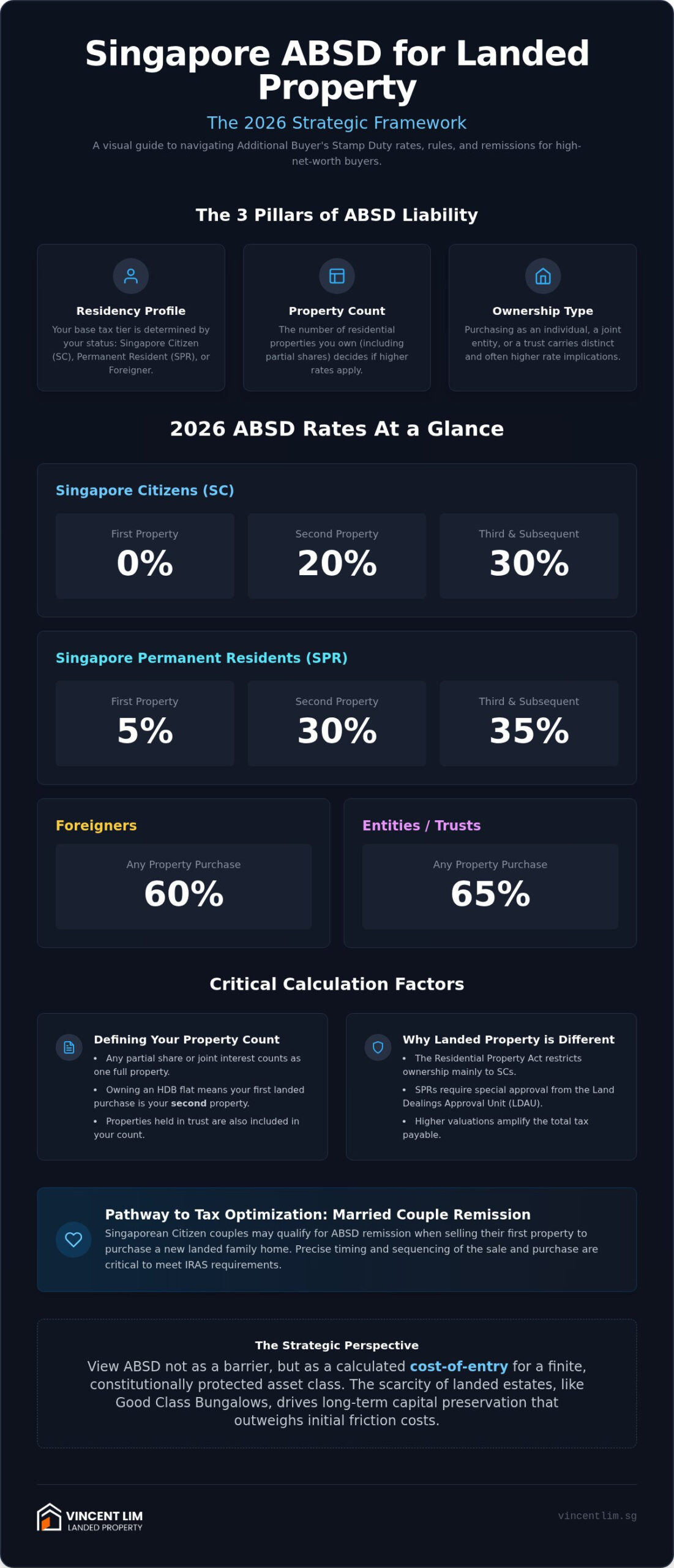
Three foundational pillars determine your precise ABSD liability for any landed acquisition in 2026:
- Profile: Your residency status, whether Singapore Citizen, Singapore Permanent Resident, or foreign national, establishes your base rate tier.
- Property Count: The number of residential properties you currently hold, including partial shares and beneficial interests, determines whether a higher subsequent-purchase rate applies.
- Ownership Type: Whether the acquisition is structured as an individual purchase, a joint purchase, or held through an entity or trust carries distinct and often significantly elevated rate implications.
The seasoned perspective here is this: ABSD is not an obstacle to be feared but a cost-of-entry to be precisely calculated. Landed estates, particularly Good Class Bungalows, represent a finite and constitutionally protected asset class. Disciplined buyers who account for this friction upfront secure assets whose scarcity creates long-term capital preservation that few other instruments can match.
Why Landed Property ABSD Differs from Condo Acquisitions
The Residential Property Act restricts landed ownership primarily to Singapore Citizens, placing a structural ceiling on eligible buyer demand. This legal constraint shapes the entire ABSD calculus. Singapore Permanent Residents who wish to acquire a landed property must first obtain approval from the Land Dealings Approval Unit, a process that introduces an additional layer of regulatory scrutiny. The landed designation also affects how the valuation base is determined for stamp duty computation; the duty is assessed on the higher of the purchase price or the market value, a distinction that carries meaningful financial weight at the price points typical of detached houses and GCBs. Understanding these nuances when calculating absd for landed property is where professional representation delivers its most tangible value.
The 2026 Tax Landscape for High-Net-Worth Buyers
The current fiscal environment reflects a government posture that prioritises market stability over transactional velocity. For the typical landed property upgrader, the entry state is often that of a Singapore Citizen disposing of an existing private residential property and simultaneously acquiring a larger landed asset. This profile sits at a critical juncture: the timing of the sale relative to the purchase directly determines whether a remission applies or whether the full second-property rate becomes payable. Precision in sequencing is everything.
Calculating ABSD Liability: Property Count and Residency Status
Precision in calculating your property count is the cornerstone of a successful acquisition. Under the Official ABSD Rates for 2026, Singapore Citizens (SC) enjoy a 0% rate on their first residential property. However, the liability escalates to 20% for a second property and 30% for a third. Singapore Permanent Residents (SPR) start at 5% for their first home, rising sharply to 30% and 35% for subsequent purchases. These tiers define the financial landscape for abds for landed property and require careful navigation.
It’s a common oversight to assume that owning an HDB flat won’t impact your first landed purchase. In the eyes of the law, an HDB flat is a residential property. If you retain your flat while purchasing a terrace house or a detached home, you’re acquiring your second property. This triggers the 20% or 30% rate immediately. Foreigners face a 60% rate and must overcome the Land Dealings Approval Unit (LDAU) hurdle, which is rarely granted for landed assets unless specific economic criteria are met.
Determining Your Residential Property Count
The definition of ownership extends beyond holding a title deed. Any partial share or joint-tenancy interest in a residential property within Singapore counts as one full unit for ABSD purposes. If you hold a beneficial interest through a trust, that property is included in your count. Inherited properties also contribute to your liability if the transfer of interest is completed before your new acquisition. These nuances often lead to unexpected tax liabilities when buyers fail to audit their existing portfolios thoroughly. Understanding the count for abds for landed property is critical before signing any legal documents. You might consider a bespoke portfolio review to ensure your counting logic aligns with current IRAS standards.
Residency Tiers and FTA Remissions
Certain foreign nationals may qualify for SC-equivalent status through Free Trade Agreements. Citizens of countries like the United States, Iceland, or Norway often receive the same tax treatment as Singapore Citizens for their first residential purchase. Qualifying for this remission requires meticulous documentation at the point of Acceptance of Option. You must provide valid proof of citizenship to ensure the correct rate is applied at the outset. Relying on outdated advice can result in a 60% upfront payment, which then requires a complex and time-consuming refund process. Accuracy here is essential for preserving liquidity during high-quantum transactions.
Landed vs. Luxury Condos: ABSD Implications for High-Net-Worth Portfolios
High-Net-Worth Individuals (HNWIs) in Singapore face a sophisticated choice between the immediate rental liquidity of luxury condominiums and the generational wealth preservation of landed estates. While a luxury condo might offer a more attractive entry point, the abds for landed property represents a strategic “tax on scarcity” that many veteran investors are willing to absorb. The decision hinges on whether you prioritize short-term yield or long-term capital resilience.
Luxury condominiums often provide gross rental yields between 2% and 3%, which appeals to those prioritizing consistent cash flow. In contrast, detached houses and Good Class Bungalows typically yield lower percentages but command a much higher degree of capital stability. Transitioning from a high-end condo to a terrace house in 2026 involves more than just a lifestyle upgrade; it’s a move toward an asset class that is geographically finite and constitutionally protected. The “ABSD friction” is a one-time cost that buys entry into this exclusive tier.
Capital Appreciation vs. Upfront Tax Costs
The financial friction of a 20% or 30% ABSD can seem daunting at the point of purchase. However, the capital appreciation of landed assets has historically outpaced these entry costs over a medium-term horizon. Research projections for 2026 indicate that private home prices are expected to increase by 3% to 4%, a trend that disproportionately benefits the landed segment due to its extremely limited supply. For a buyer paying a 20% rate, the break-even point is often reached within five to seven years of steady market growth. This timeline reinforces why landed property is viewed as a marathon asset rather than a short-term trade.
The Scarcity Factor of Good Class Bungalows
Good Class Bungalows (GCBs) occupy the absolute pinnacle of the Singapore residential hierarchy. With only approximately 2,800 units in existence, the supply is essentially fixed. This extreme scarcity creates a natural price floor that effectively offsets the friction of abds for landed property. HNWIs accept these high tax brackets because they understand they are acquiring a legacy asset that cannot be replicated. This is why the demand for GCBs remains robust even amidst cooling measures. For a deeper analysis of this elite tier, you may wish to explore What is a Good Class Bungalow? to understand why it remains the definitive choice for Singapore’s most successful families.
Legal Remissions and Strategic Ownership Structures
Strategic ownership is the hallmark of the elite strategist. It transforms a tax liability from a static obstacle into a manageable variable. Understanding the nuances of abds for landed property requires a deep dive into the specific legal remissions sanctioned by IRAS. These frameworks allow affluent families to transition into larger estates without permanently eroding their liquidity. Precision in these structures doesn’t just save capital; it ensures your legacy remains resilient against regulatory shifts.
The Married Couple Remission remains one of the most effective tools for upgraders. If you’re a Singaporean couple purchasing a landed home as your replacement residence, you’re eligible for a refund of the ABSD paid on that second property. This remission is contingent on selling your first residential property within six months of the purchase date or the Temporary Occupation Permit (TOP) date. It’s a structured path that rewards those who plan their entry and exit with meticulous care.
However, strategies like decoupling or “99-1” ownership shares face intense scrutiny in 2026. IRAS audits now focus heavily on the substance of the transaction rather than just the legal form. If an arrangement is deemed an artificial construct solely to circumvent tax, the consequences can be severe. Working with a partner who prioritizes transparency ensures your acquisition stands up to the highest standards of compliance.
ABSD (Trust) and Legacy Wealth Planning
Since the regulatory adjustments in 2022 and 2023, residential property transferred into a living trust attracts an upfront ABSD rate of 65%. This is a significant liquidity hurdle designed to ensure transparency in beneficial ownership. You can apply for a remission if the trust has an identifiable individual beneficiary at the time of the transfer. The remitted amount is the difference between the 65% rate and the beneficiary’s own applicable ABSD rate. This mechanism is a vital component for those pursuing Asset Progression to Landed Property while securing assets for the next generation.
The 6-Month Selling Rule for Upgraders
Timing is the most frequent point of failure in remission claims. The six-month window for disposing of your prior residence is rigid and strictly enforced. Missing this deadline by even a single day often results in a forfeited refund. Coordinating the sale of a luxury condo while finalizing the acquisition of a detached house requires a steady, intentional rhythm. You’ll find a methodical framework for managing this transition in our Guide to Selling Your Landed Property.
For families interested in redevelopment, developers can seek remissions on the 65% entity rate. A specific rule for small-scale projects of four units or less allows for more flexible development timelines. This is particularly relevant when subdividing a large plot into multiple semi-detached or terrace houses. To ensure your ownership structure is both efficient and compliant, book a strategic consultation with Vincent Lim today.
Expert Brokerage: Optimizing Your Landed Property Acquisition Strategy
High-stakes transactions involving Good Class Bungalows and detached houses demand a level of sophistication that transcends conventional real estate services. When the acquisition quantum reaches tens of millions, the margin for error in calculating abds for landed property narrows significantly. A standard agent might facilitate a viewing, but an elite strategist coordinates the entire financial and regulatory landscape to ensure your capital is deployed with maximum efficiency. Precision in these high-quantum deals is the difference between a seamless transition and a costly regulatory entanglement.
Vincent Lim operates as a veteran partner in this space, bringing over two decades of experience in the Singapore luxury market. His role involves a meticulous audit of total acquisition costs, where ABSD is just one variable among several. Managing the lifecycle of a landed deal requires precise coordination of several critical workstreams:
- Independent valuations that align with both market reality and financial institution requirements.
- Land Dealings Approval Unit (LDAU) applications for eligible permanent residents, ensuring all criteria are met before commitment.
- Strategic timing for stamp duty payments to maintain portfolio liquidity during the transition period.
- Integration of bespoke legal advice regarding trust structures or joint-tenancy arrangements.
Professional Representation in the Luxury Market
A successful acquisition is rarely the result of a single individual’s effort. It requires a coordinated approach involving legal experts and tax professionals to ensure every layer of the transaction is robust. Integrity in high-stakes negotiations is paramount; transparency about the long-term implications of tax liabilities builds the trust necessary for a seamless transfer of legacy assets. For those currently holding property and looking to transition, a bespoke approach to Selling Your Landed Property is essential to maximize the value of your existing portfolio before committing to a new high-quantum purchase.
Secure Your Singapore Landed Legacy
Acquiring a landed home in Singapore is more than a purchase; it’s a deliberate act of wealth planning. By adopting a methodical approach to abds for landed property, you transform a regulatory requirement into a strategic advantage. Refined planning ensures that your family’s asset progression remains on a steady, intentional trajectory toward capital preservation. Taking a disciplined view of the 2026 landscape allows you to secure assets that are as resilient as they are prestigious.
The complexities of the 2026 market require a guide who understands the gravitas of these transactions. To refine your acquisition strategy and ensure your legacy is protected by the highest standards of professional discipline, Contact Vincent Lim for a Strategic Consultation. This is the final step in moving from uncertainty to a position of calculated competence.
Securing Your Generational Asset in a Regulated Market
Success in Singapore’s 2026 property landscape requires a transition from reactive buying to strategic acquisition. You’ve seen how precise property counting and a clear understanding of residency tiers form the bedrock of tax efficiency. While the upfront friction of abds for landed property is significant, it serves as the entry price for assets defined by extreme scarcity and enduring capital resilience. By leveraging legal remissions and transparent ownership structures, you ensure your legacy remains both compliant and financially optimized.
Managing high-quantum transactions like Good Class Bungalows requires the steady hand of a veteran professional who prioritizes your peace of mind. As an Executive Associate Director at OrangeTee & Tie with over 20 years of Singapore real estate expertise, Vincent Lim specializes in navigating these complex regulatory waters for affluent families. His methodical approach ensures that every detail, from valuation to stamp duty sequencing, is handled with calculated competence. It’s time to move forward with the clarity your portfolio deserves. Refine your landed property strategy with Vincent Lim and take the next step toward securing your family’s future with confidence.
Frequently Asked Questions
What is the current ABSD rate for a Singapore Citizen buying their second landed property?
As of August 2026, a Singapore Citizen acquiring their second residential property is liable for a 20% ABSD rate. This applies whether the asset is a terrace house, semi-detached home, or a Good Class Bungalow. It’s essential to ensure your property count is verified before the transaction. Even a partial share in another residential unit will trigger this second property tier. Precision in this calculation is vital for maintaining your portfolio’s liquidity.
Can a Permanent Resident (SPR) buy a landed property and how much ABSD is involved?
Singapore Permanent Residents must first obtain approval from the Land Dealings Approval Unit (LDAU) before acquiring landed property. Once approved, the ABSD rate is 5% for the first residential property, 30% for the second, and 35% for the third and subsequent units. This regulatory hurdle ensures that landed assets remain primarily within the domestic community. Managing the timeline for LDAU approval is a critical step in your acquisition strategy.
Is ABSD refundable if I sell my existing terrace house after buying a new semi-detached house?
You may qualify for a remission of abds for landed property under the Married Couple Remission framework. To be eligible, the couple must be Singaporean, and the first property must be sold within six months of the purchase date or the TOP date of the new semi-detached house. This refund process requires meticulous documentation and strict adherence to the six month window to ensure the capital is successfully returned to your family office.
How is ABSD calculated for a mixed-status couple buying a landed home?
In a joint purchase involving a Singapore Citizen and a Permanent Resident, the highest applicable ABSD rate is applied to the entire purchase price. For example, if it’s the first property for both, the SPR’s 5% rate will apply to the whole transaction instead of the SC’s 0% rate. This rule necessitates strategic planning regarding ownership shares and beneficial interests to optimize the total tax liability for the household. Accuracy at the point of purchase prevents unforeseen costs.
Do I have to pay ABSD if I buy a landed property under a trust for my child?
Acquisitions made under a living trust for a child attract an upfront ABSD rate of 65%. While this is a significant initial outlay, you can apply for a remission if the trust has an identifiable individual beneficiary at the time of the instrument’s execution. The remitted amount is the difference between the 65% and the beneficiary’s applicable rate. This structure is often used for legacy planning but requires careful legal coordination to ensure eligibility.
Are there any countries whose citizens are exempt from Foreigner ABSD rates for landed property?
Citizens and Permanent Residents of specific countries with Free Trade Agreements enjoy the same ABSD treatment as Singapore Citizens. This includes nationals of the United States, Iceland, Liechtenstein, Norway, and Switzerland. For their first residential purchase, these individuals are eligible for a 0% rate. However, they must still navigate the LDAU approval process if they intend to purchase landed property. The FTA only affects the tax rate, not the legal eligibility to own land.
What happens if I fail to pay the ABSD within the stipulated 14-day period?
Failure to pay the required stamp duty within 14 days of the execution of the sale document results in significant financial penalties. IRAS may impose a penalty of up to four times the amount of the unpaid duty. Such delays not only erode your capital but also invite unwanted regulatory scrutiny into your transaction history. Maintaining a methodical timeline for all payments is a cornerstone of professional property management and strategic wealth preservation.
Can CPF be used to pay for the Additional Buyer’s Stamp Duty?
You can utilize your CPF Ordinary Account funds to pay for Additional Buyer’s Stamp Duty on residential properties. This includes abds for landed property purchases, provided the property is for residential use. However, the funds are typically used as a reimbursement after the initial payment is made in cash, or they’re drawn directly by your legal representative during the completion process. Balancing CPF usage with cash liquidity is a key part of refining your acquisition strategy.