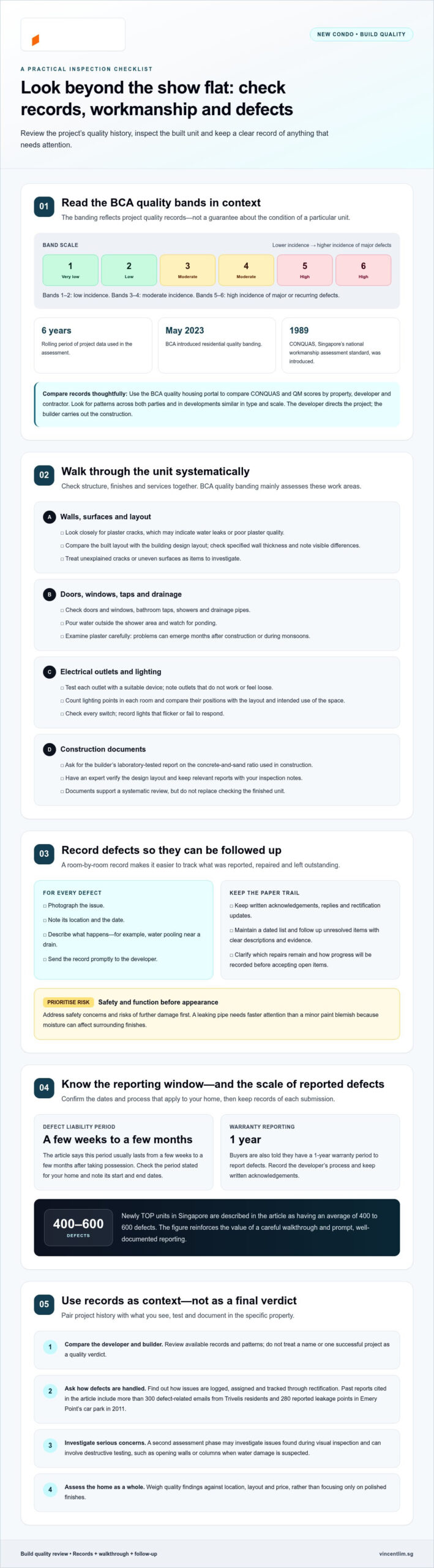
A polished show flat is not enough to judge a home’s construction. Assessing build quality in a new condo means reviewing its BCA quality band and construction records, then inspecting the workmanship and defects in the unit. Bands 1 and 2 indicate a low incidence of major defects, Bands 3 and 4 a moderate level, and Bands 5 and 6 a high incidence of major or recurring defects.
It’s sensible to look beyond appearances when buying a condo. A practical review can help distinguish cosmetic flaws from issues that may affect safety, function or future maintenance, while keeping location, layout and price in perspective.
This guide explains how to compare BCA quality records, inspect finishes and key systems, and document defects during a walkthrough. You’ll also learn how to weigh your findings against the features that matter most, so you can assess the home as a whole rather than focusing only on its finish.
Key Takeaways
- Compare the developer’s and builder’s quality records, then consider what the project-level results reveal about workmanship.
- During your walkthrough, test fittings and drainage, and record defects clearly so you can prioritise issues that affect function or risk further damage.
- Inspect finishes alongside structural and mechanical features, including wall condition, electrical outlets and air-conditioning operation.
- Weigh any quality concerns against the home’s location, layout and price to decide whether the overall fit makes sense for you.
Checking both developer and builder quality records
Use the BCA quality housing portal to compare developments’ CONQUAS and QM scores by property, developer and contractor. Consider the scores alongside what you observe during a site inspection.
- Compare like with like. Singapore’s BCA introduced residential quality banding in May 2023. The assessment uses a rolling six-year period of project data, drawing on CONQUAS scores, customer feedback and quality audits. Band 1 indicates a very low incidence of major defects; Band 2 indicates a low incidence. Bands 3 and 4 indicate moderate defects, while Bands 5 and 6 signal a high incidence of major or recurring defects. Compare both the developer and builder, and look for patterns across their records.
- Understand who did what. The developer is responsible for the project’s overall direction, while the builder carries out the construction work. CONQUAS is Singapore’s national standard for assessing workmanship in new building projects; according to the Building and Construction Authority, it was introduced in 1989. A strong score is useful context, but it doesn’t replace checking the actual unit, finishes and shared areas.
- Match experience to the project. Review each party’s record in developments similar in type and scale. A developer’s experience across different market segments can inform how relevant its past projects are to your condo. Don’t treat a name or one successful project as a quality verdict; compare available records and inspect the specific property.
- Test the response to defects. Singapore developments have seen substantial reported concerns: Trivelis residents sent more than 300 emails about defects, and Emery Point’s car park had 280 reported leakage points in 2011. Ask the developer how defects are logged, assigned and tracked through rectification. Keep your own dated list, photographs and written updates, then follow up on unresolved items with clear descriptions and evidence.
How serious is the home defect problem?
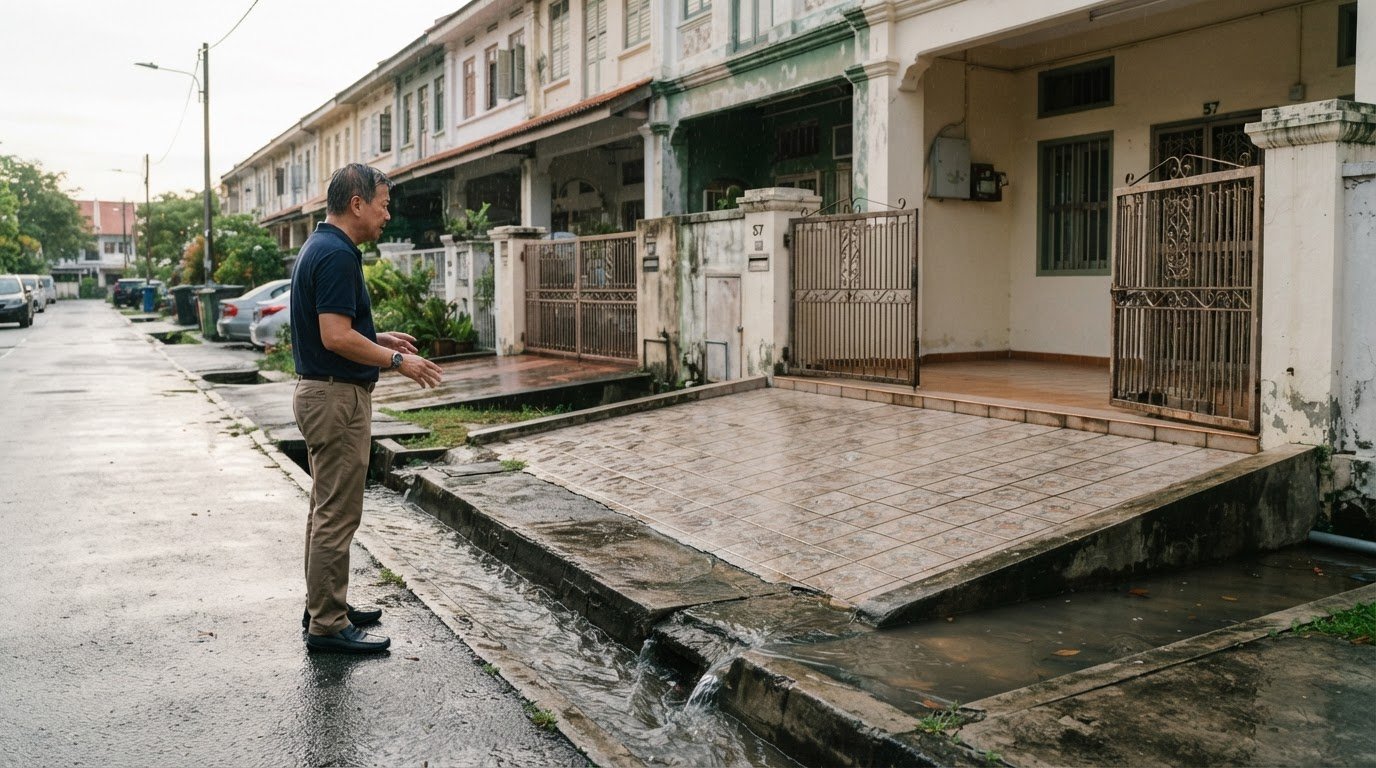
Unresolved defects can affect safety, daily function and repair needs, particularly if water intrusion continues. In Singapore, document each issue and address safety concerns or risks of further damage first.
Identify Common Home Defects
Look for cracks in plaster, which may indicate water leaks or poor plaster quality. Check doors and windows, bathroom taps, showers and drainage pipes. Pour water outside the shower area and watch for ponding. Plaster problems can emerge months after construction or during monsoons, so examine surfaces carefully rather than relying on a quick glance.
Understand the Defects Liability Period
Clarify the defect liability period stated for your new home and note its start and end dates. In Singapore, this period usually lasts from a few weeks to a few months after taking possession. Buyers are also told they have a 1-year warranty period to report defects. Record the developer’s reporting process and keep written acknowledgements of each submission.
Inspect and Document Defects
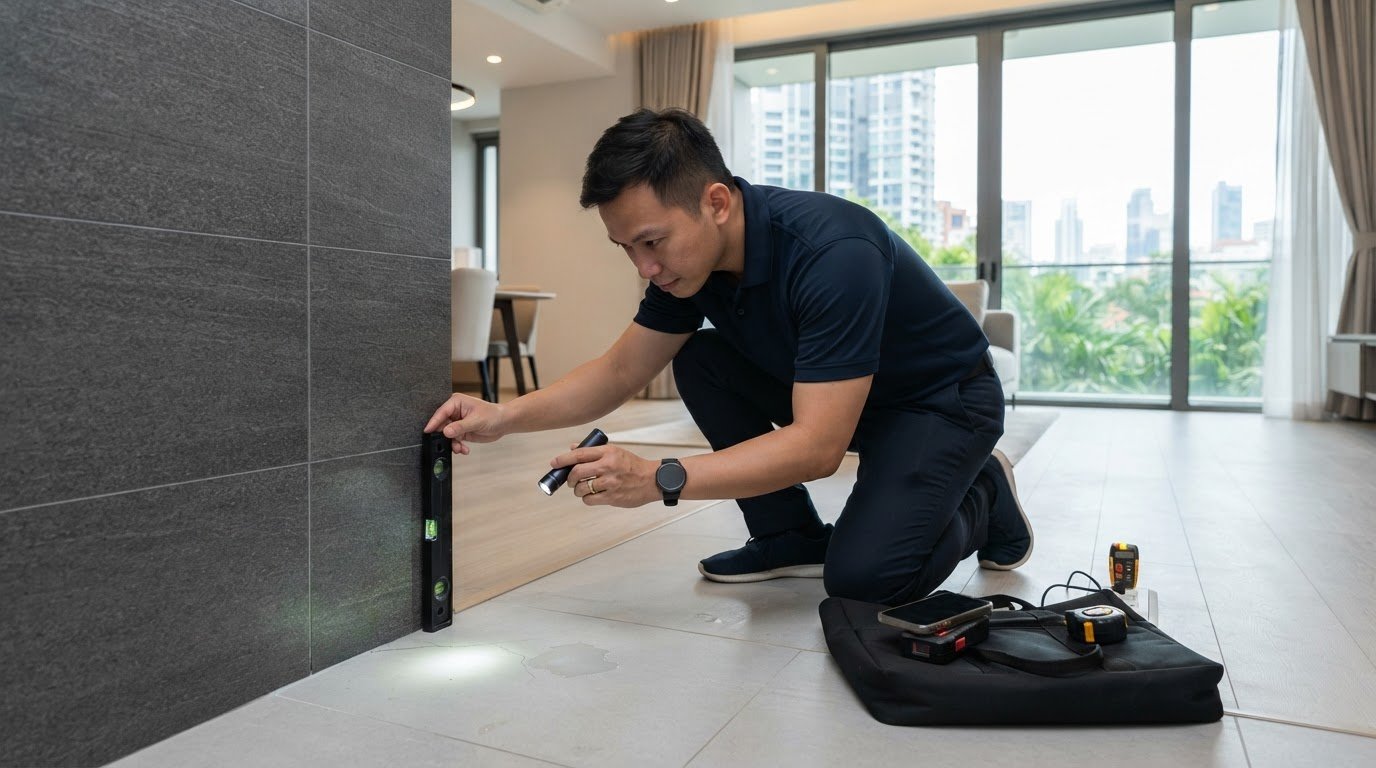
Walk through each room systematically, testing fittings and checking walls, windows and bathroom drainage. Photograph every defect, note its location and date, and describe what happens, such as water pooling near a drain. Send your record promptly to the developer and keep replies and rectification updates. Clear documentation helps distinguish completed work from outstanding items.
Assess Risks of Unresolved Defects
Prioritise defects that affect safety or function, or could cause further damage. A leaking pipe, for example, deserves faster attention than a minor paint blemish because moisture can affect surrounding finishes. Before accepting a new condo with open items, clarify which repairs remain and how progress will be recorded. If defects change your property decision, explore luxury condominium sales as part of your wider real estate considerations.
Newly TOP units in Singapore are described as having an average of 400 to 600 defects. Owners are advised to document defects, report them promptly to the developer, and check plaster cracks for indications of water leaks or poor plaster quality.
A second assessment phase investigates issues found during visual inspection and may involve destructive testing, such as opening walls or columns when water damage is suspected. Past defect disputes can be a reminder to consider how a developer handles after-sales service.
Structural, architectural and mechanical and electrical works
Review the unit’s structure, finishes and services as connected parts of construction quality. BCA quality banding mainly assesses structural works, architectural finishes, and mechanical and electrical works.
- Compare the layout with the built unit. Ask for the building design layout and have an expert verify it. Check that wall thickness matches the layout specification, and note visible differences for follow-up. Construction quality also depends on how the structure distributes its weight, so treat unexplained cracks or uneven surfaces as items to investigate.
- Review construction records. Request the builder’s laboratory-tested report on the concrete-and-sand ratio used in construction. Compare the report with the project information available to you, and keep it with your inspection notes. A document review helps buyers assess the work more systematically, but it doesn’t replace examining the finished unit.
Verify Electrical Outlets and Lighting Points
Test each electrical outlet with a suitable device, noting any that don’t work or feel loose. Count the lighting points in each room, then compare their positions with the layout and how you plan to use the space. Check every switch and note lights that flicker or fail to respond. This simple sequence can reveal functional issues before furnishing or renovation changes the room.
Check Electrical Fittings and Appliances
Operate the supplied electrical fittings and appliances, including air-conditioning units, during your walkthrough. Switch on the air-conditioning in each room at the beginning of the inspection to give the system time to reveal possible leaks. Check that the controls respond, and look for visible water around the units. Record the room and symptom for each issue separately.
Finish by comparing your notes with the condo’s layout and available construction records. Working outlets, an accurate count of lighting points and consistent wall specifications each offer a practical check on a different aspect of the completed home.
Balancing build quality against location, layout and price
Assessing build quality in a new condo should inform your buying decision, not dictate it. Compare each development against your priorities for location, usable layout, condition and asking price.
- Set priorities before comparing. List the features that matter most, such as a manageable commute, room for a home office, or access to daily amenities. Use the same list for each property. This prevents an impressive lobby or polished show unit from outweighing practical needs you’ll notice every day.
- Assess location through your routine. Map the journeys you regularly make, then consider how the condo’s position affects them. A home closer to work may suit one buyer, while access to family or familiar amenities may matter more to another. Compare actual travel patterns, not just a development’s neighbourhood label.
- Test the layout against daily use. Consider how furniture, storage and movement will work in the actual unit. For example, a smaller room may be less useful if it cannot accommodate both a bed and essential storage. Compare the floor plan with your intended use, rather than judging space from staged furniture alone.
- Separate repair concerns from cosmetic preferences. A paint blemish and a recurring leak don’t carry the same implications. Use inspection notes and rectification records to understand which items affect function or could lead to further damage. Keep assessing build quality in a new condo in perspective by weighing these findings alongside location and layout.
- Compare price with the complete value. Review the asking price in relation to the unit’s location, layout, observed condition and outstanding defects. Avoid assuming that a lower price compensates for a problem you cannot comfortably manage. If you’re weighing condo choices alongside broader property priorities, discuss your property priorities as part of a considered decision.
- Make the trade-off explicit. Write down the strongest advantage and the most consequential compromise for each condo. A convenient location may justify a less preferred layout, while a well-planned unit may offset a longer commute. Choose the property whose compromises fit your needs, not simply the one with the best finish.
Vincent Lim (OrangeTee & Tie): Terrace House Sales
Vincent Lim (OrangeTee & Tie) can help if your condo assessment leads you to compare a new development with landed-property options. If location, layout or maintenance considerations shift your priorities, exploring terrace house sales may help clarify which type of home better suits your plans.
His property sales offerings also include semi-detached houses, detached houses and Good Class Bungalows. These options offer a different housing format to weigh against a condo’s construction records, unit condition and overall fit. Define the trade-offs that matter most, then consider which property type aligns with them.
Contact Vincent Lim (OrangeTee & Tie) or visit vincentlim.sg to discuss your property priorities.
Use Your Findings to Choose With Confidence
Turn your observations into a decision rule. Decide which trade-offs you can accept, which concerns would change your plans, and what evidence you need before proceeding. Treat assessing build quality in a new condo as a way to sharpen your judgment, not as a search for a flawless home.
A clear personal threshold can stop attractive staging from dominating your decision. Write down the features you won’t compromise on, the concerns you’re prepared to manage, and any questions that remain unresolved. Then compare each property against the same criteria. This gives you a considered basis for proceeding, revisiting your shortlist or broadening your search to include other property types.
If your review has prompted you to reconsider what kind of home best fits your plans, contact Vincent Lim (OrangeTee & Tie) to discuss your next step. Keep your priorities in view and move forward at a pace that suits your decision.
Frequently Asked Questions
How Can I Assess A New Home’s Construction Quality?
Assess construction quality by combining project records with a methodical review of the completed home. Compare the development’s quality information with the condition of your unit and shared areas, such as corridors and facilities. For example, if a project record looks strong but several doors don’t close properly, record the mismatch and seek clarification. This balanced approach gives you a more practical view than relying on a score alone.
What is the 1-year defects liability period for new condos in Singapore
Buyers are told they have a 1-year warranty period to report defects in a new home. The defect liability period stated for the home usually lasts from a few weeks to a few months after possession, so note its start and end dates and the developer’s reporting process.