
Your borrowing capacity is shaped by more than a property’s value: the share of your income already committed to debt matters too. Knowing how to calculate the total debt servicing ratio (TDSR) means adding your monthly debt obligations, including the property loan you’re applying for, dividing by gross monthly income, and multiplying by 100%. For a Singapore property loan, if your TDSR exceeds 55%, the loan amount has to be reduced.
The calculation is straightforward once you know which income and repayments count. Gross monthly income is income before tax and excludes employer CPF contributions, while debt obligations can include housing loans and other debts. This guide explains how lenders assess income and debt, how to apply the formula, and which thresholds apply, helping you understand how your finances may affect a property purchase.
Key Takeaways
- List the debts lenders assess, including the proposed property loan and relevant revolving credit, before estimating your monthly commitments.
- Use income before tax and exclude employer CPF contributions; variable and rental income are assessed differently from fixed income.
- Apply the calculation consistently by comparing counted monthly debt obligations with assessable gross monthly income.
- Distinguish the TDSR limit from the separate mortgage servicing ratio rules that apply to certain HDB flat and executive condominium loans.
What factors need to be considered in TDSR calculation?
A TDSR assessment includes existing debt, the proposed property loan and the income used to support repayments. The interest-rate assumptions used to calculate the monthly instalment also affect the result.
Included Monthly Debt Obligations
Monthly debt obligations are recurring repayments lenders count when assessing a borrower’s total debt. Include the proposed property loan, other loans, credit-card payments and investment loans, such as margin financing or personal loans used to buy investment products. A repaid property loan may be excluded. For revolving credit, lenders use the latest available statement and apply the relevant calculation method.
Interest Rate and Loan Tenure Assumptions
The interest-rate assumption is the rate used to estimate a property loan’s monthly instalment for TDSR. For residential purchase loans and mortgage equity withdrawal loans, financial institutions use the higher of a 4% floor or the thereafter interest rate. That rate is the highest offered by the institution at any point during the property loan tenure. The chosen tenure also affects the instalment: spreading repayment over a longer tenure lowers the assessed monthly amount.
For joint borrowers and co-borrowers, lenders assess the application based on their combined financial position. To determine the maximum loan tenure, lenders use the borrowers’ income-weighted average age. Each borrower’s income therefore affects the age calculation, rather than both ages being treated equally.
A guarantor’s property-loan obligations can also affect an assessment. For applicable HDB flat and executive condominium loans, the mortgage servicing ratio applies if the minimum occupation period has not expired. When calculating that ratio, financial institutions must include at least 20% of the monthly debt obligation for a property loan where the borrower is a guarantor.
To lower your TDSR before applying, pay off debts to free up monthly income for home-loan repayments, or consider a longer loan tenure to reduce monthly instalments. Borrowers may also pledge or show funds and net worth to increase assessable income under the TDSR framework.
Gross monthly income
Gross monthly income is a borrower’s income before tax, excluding employer CPF contributions. Singapore financial institutions use this figure to assess repayment capacity for a property purchase. It differs from take-home pay: tax deductions and employer CPF contributions are not part of the calculation. Keep the income period consistent when preparing figures for a mortgage assessment.
Variable income includes earnings that can change from month to month, such as commissions or bonuses. Financial institutions calculate it using the average monthly variable income earned in the preceding 12 months. They then apply a minimum 30% haircut to variable income, reducing the amount counted for TDSR. This adjustment means the full amount received doesn’t necessarily become assessable income.
Rental income is also subject to a minimum 30% haircut. A rental agreement used to verify rental income must have a remaining rental period of at least six months. For example, a tenancy with less than six months remaining doesn’t meet that stated period for verification. Include the eligible rental amount only after accounting for the haircut.
Eligible financial assets can be converted into income streams for TDSR by amortising them over 48 months. This spreads the assessable value across a defined period instead of treating the entire asset balance as monthly income. Liquid assets that are unpledged or pledged for less than four years have a minimum haircut of 70%. Other financial assets pledged for at least four years have a minimum haircut of 30%; other financial assets that are unpledged or pledged for less than four years have a minimum haircut of 70%.
For a practical income worksheet, separate regular income, variable income, rental income and eligible financial assets. Apply the relevant averaging period, haircut or amortisation method to each category before adding the resulting monthly figures. This keeps the income side of your TDSR estimate clear and shows which components contribute less than their gross amount.
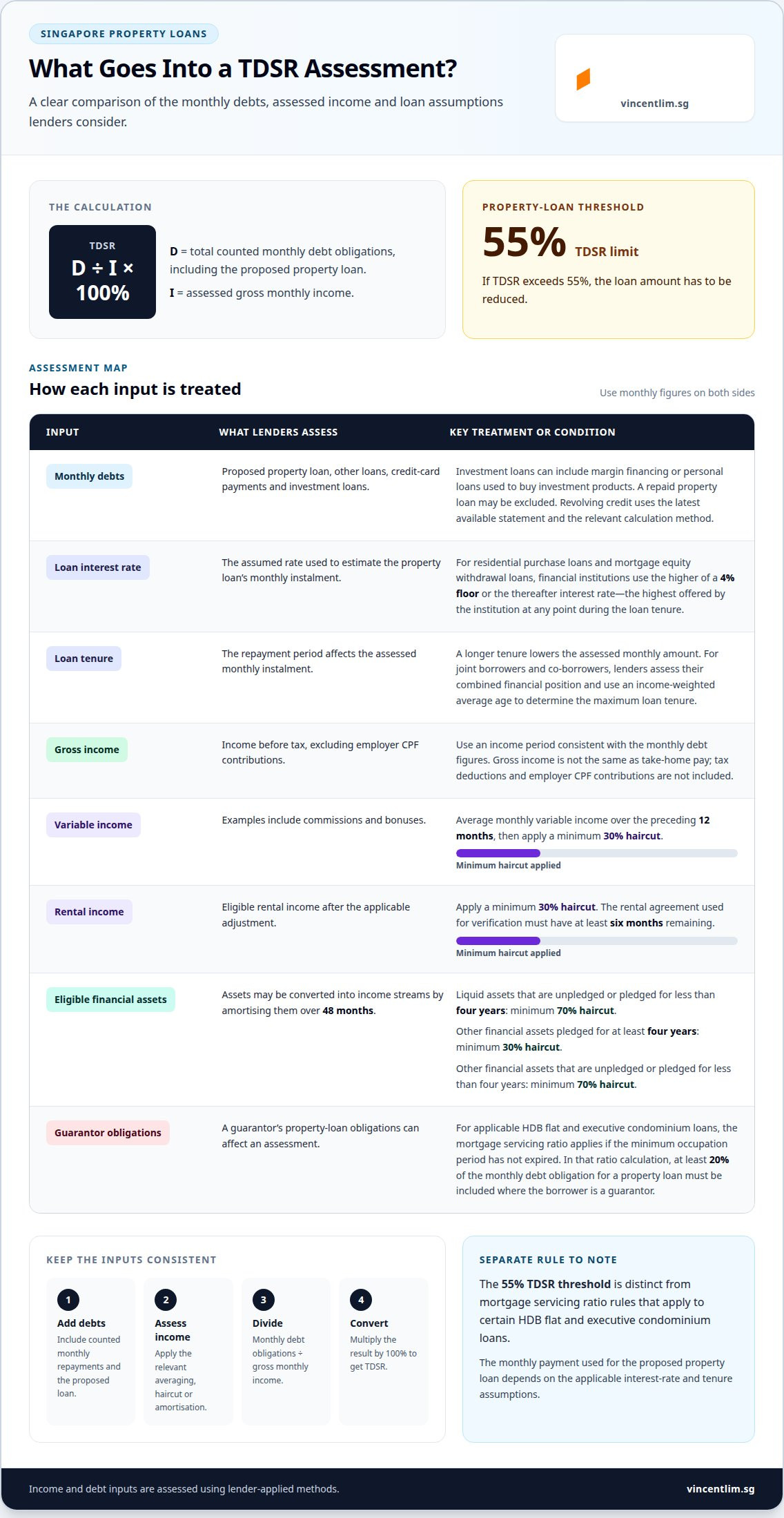
TDSR formula and calculation
The TDSR formula divides a borrower’s total monthly debt obligations by gross monthly income, then multiplies by 100%. It expresses the portion of income committed to debt as a percentage.
Use monthly figures for both sides of the calculation. Don’t compare annual debt totals with monthly income or average figures from unrelated periods. Start with the monthly commitments and assessable income identified for the property-loan application.
- Add debt obligations: total the monthly repayments counted by financial institutions, including the proposed property loan.
- Identify gross monthly income: use income before tax, excluding employer CPF contributions, after applying the relevant income assessment.
- Divide: divide total monthly obligations by gross monthly income.
- Convert to a percentage: multiply the result by 100% to obtain the borrower’s TDSR.
For a simple calculation, label monthly debt obligations D and gross monthly income I. The formula is D ÷ I × 100%. For example, place the lender-assessed monthly payment for the new property loan in D alongside other counted debts. Use the assessed income figure in I, not an unadjusted total that includes excluded or reduced income.
Check the result against Singapore’s 55% threshold for a property loan. If a borrower’s TDSR exceeds 55%, the loan amount has to be reduced. The percentage indicates how much gross monthly income is allocated to debt, but it doesn’t establish the loan amount by itself. The monthly payment used for the proposed loan depends on the applicable interest-rate and tenure assumptions.
Before relying on a result, confirm that every input uses the same monthly basis and includes the proposed borrowing. Recalculate if a debt is repaid, the requested loan changes or assessable income changes. This step-by-step method makes the calculation clearer and helps identify which input is driving the borrower’s TDSR.
TDSR thresholds stated on the page
A TDSR threshold is a percentage limit used to assess monthly debt repayments against gross monthly income. In Singapore, a property-loan assessment uses a 55% threshold that affects the permitted loan amount.
If a borrower’s TDSR exceeds 55%, the loan amount has to be reduced. The calculation includes monthly debt obligations and the assessed repayment for the proposed property loan. A higher interest rate used in the instalment assessment can increase that repayment and push the ratio upward, even if the borrower’s current debts remain unchanged.
The stated TDSR loan limit is capped at 60% of gross monthly income. The 55% figure is the point at which the loan amount must be reduced; the 60% figure is the stated cap. These figures serve distinct purposes in the assessment and shouldn’t be treated as interchangeable.
Singapore’s TDSR limit was 60% before December 2021. That earlier period matters when reading older explanations or comparing past borrowing assessments with current calculations. Use the applicable current threshold when estimating a new property loan, rather than carrying forward the earlier 60% figure as the reduction trigger.
The mortgage servicing ratio, or MSR, is a separate limit on the share of gross monthly income used for mortgage repayments. It limits applicable HDB flat and executive condominium loans to 30% when the minimum occupation period has not expired. Where both TDSR and MSR apply, the borrower must account for each test rather than relying on the higher limit alone.
To interpret a result, first calculate TDSR using the lender-assessed monthly repayment and income. Then compare it with the 55% reduction threshold and identify whether the 30% MSR applies to the property. A change in repayment, income or debt obligations can move the result across a threshold, so review the inputs for the relevant application period.
Vincent Lim (OrangeTee & Tie): Terrace House Sales
Vincent Lim (OrangeTee & Tie) can support your next step when you’re considering buying or selling landed property in Singapore. Understanding TDSR helps you assess borrowing commitments, while a property decision also calls for careful consideration of the home and transaction.
For buyers and owners considering a terrace house, Vincent Lim provides Terrace House Sales. His services also include sales of semi-detached houses, detached houses and Good Class Bungalows (GCBs). Turn to him when you’re ready to consider a transaction and want professional guidance on these residential property types.
To discuss your property plans, contact Vincent Lim (OrangeTee & Tie) or visit vincentlim.sg.
Bring Your Property Plans Into Focus
Understanding how to calculate the total debt servicing ratio (TDSR) can help you approach a property decision with a clearer view of your borrowing commitments. The next step is to connect that financial picture with the type of home you plan to buy or sell and the options that fit your plans.
Vincent Lim (OrangeTee & Tie) handles terrace house, semi-detached house and detached house sales. If landed property is part of your plans, his guidance can help you consider the transaction alongside your broader property objectives. A focused discussion can clarify your priorities as you decide how to proceed.
For support with your property plans, contact Vincent Lim (OrangeTee & Tie). Take your next step with clarity and confidence.
Frequently Asked Questions
What is TDSR?
TDSR, or total debt servicing ratio, measures the share of a borrower’s gross monthly income committed to debt repayments. In Singapore, financial institutions use it to assess a proposed property loan alongside existing obligations. Treat it as an indicator of repayment capacity, not as a property budget or a guarantee of loan approval.
How is it calculated?
To understand how to calculate the total debt servicing ratio (TDSR), divide counted monthly debt obligations by assessable gross monthly income, then multiply by 100%. Include the proposed mortgage payment in the debt total. For a useful estimate, keep every figure on a monthly basis and distinguish income that is assessed in full from income reduced by a haircut.
What amount of home loan can I afford?
First estimate monthly repayment capacity: apply the relevant TDSR threshold to assess total debt commitments, then subtract existing obligations to see what remains for a new loan. The loan amount depends on the repayment that remaining capacity supports, based on the interest-rate and tenure assumptions. Loan-to-value limits also affect how much of a property’s value can be financed.
What is the difference between TDSR and MSR (Mortgage Servicing Ratio)?
TDSR considers a borrower’s total monthly debt obligations, while MSR focuses on mortgage repayments for applicable HDB flat and executive condominium loans. MSR limits that mortgage share to 30% of gross monthly income when the minimum occupation period has not expired. If both measures apply, assess each separately because meeting one threshold doesn’t establish that the other is met.
What is the home loan eligibility criteria in Singapore?
Singapore home-loan eligibility assessment considers income, existing debt, the proposed repayment, and applicable TDSR or MSR limits. Loan-to-value rules also matter: a first-property buyer may borrow up to 75% of the property’s value or purchase price under the stated loan-tenure conditions. The limit is 55% if the loan tenure exceeds 30 years or extends past age 65.
What is the total debt servicing ratio (TDSR) in Singapore?
Singapore’s stated TDSR loan limit is capped at 60% of gross monthly income, while a borrower whose TDSR exceeds 55% must have the loan amount reduced. These figures describe different thresholds in the stated framework. The limit was 60% before December 2021, so older explanations may reflect that earlier period rather than the current reduction trigger.