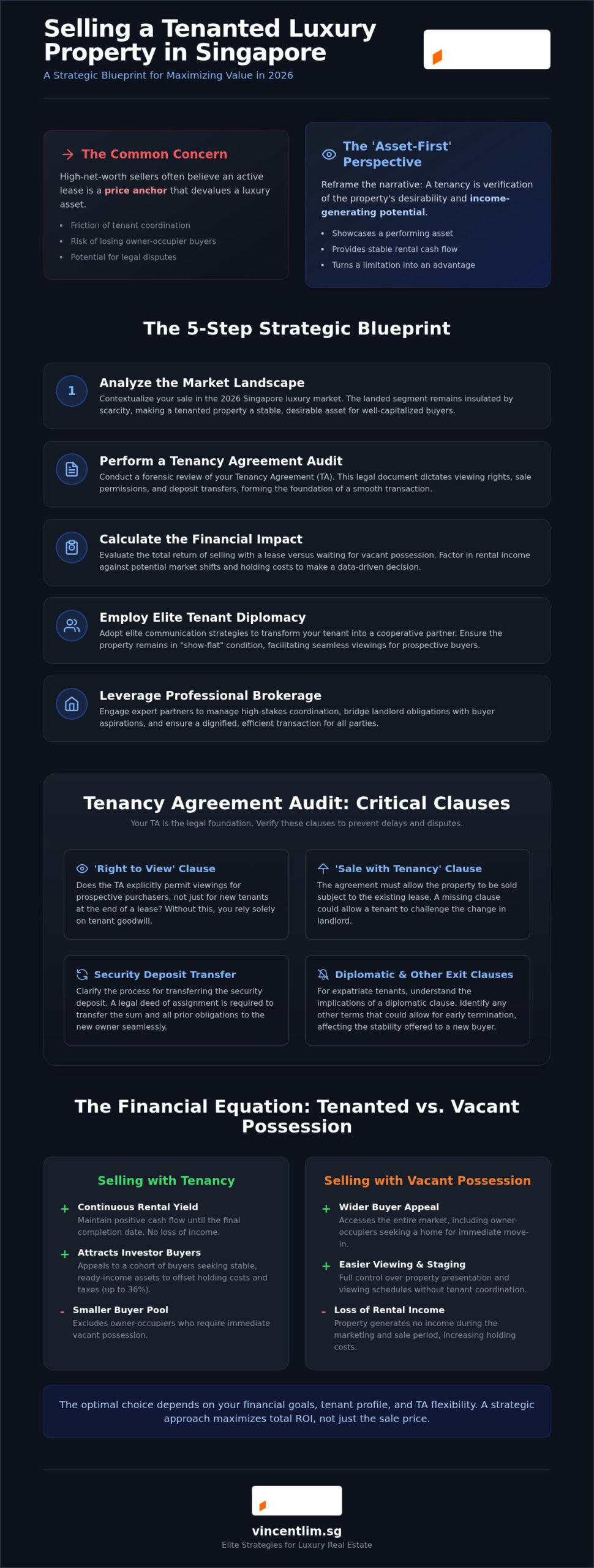
Most high-net-worth sellers believe that an active lease is a price anchor that inevitably devalues a luxury asset. It’s a common concern; the friction of managing tenant coordination and the risk of losing owner-occupier buyers can make the process feel like a compromise. You likely want to avoid the stress of uncooperative viewings or legal disputes over the Tenancy Agreement that could derail a record-breaking deal. I understand that maintaining a positive rental cash flow until the final completion is just as vital as the final sale price itself.
This strategic guide provides a sophisticated blueprint for selling a tenanted property in Singapore in 2026 without sacrificing your premium or your peace of mind. You’ll learn how to navigate complex legal frameworks and employ elite diplomacy to ensure a seamless transition of ownership. We will examine the exact methods used to protect your yield while positioning your landed home or luxury condominium to achieve a record price, regardless of the current occupancy status. By following this methodical approach, you can turn a perceived limitation into a distinct market advantage.
Key Takeaways
- Analyze the 2026 luxury market landscape to determine if your landed property’s current tenancy is a strategic asset or a potential hurdle.
- Perform a comprehensive audit of your Tenancy Agreement to clarify legal obligations and viewing protocols when selling a tenanted property in singapore.
- Calculate the precise financial impact of selling with an existing lease versus waiting for vacant possession to maximize your total return on investment.
- Adopt elite communication strategies that transform your tenant into a cooperative partner, ensuring the property remains in show-flat condition for prospective buyers.
- Leverage professional brokerage expertise to manage high-stakes coordination and maintain a seamless transition of ownership for your GCB or luxury condominium.
Contextualizing the Tenanted Sale in Singapore’s 2026 Market
The 2026 property landscape in Singapore is currently defined by a selective growth phase. While new launch prices remain firm, with median prices approaching S$2,800 per square foot, the resale market offers distinct value opportunities for savvy buyers. Owners of luxury landed homes often face a unique dilemma when their assets are occupied by high-profile tenants. Unlike mass-market condominiums, where volume drives liquidity, selling a tenanted property in Singapore within the luxury segment requires a bespoke strategy that balances immediate rental yield against long-term capital growth.
While the broader market, including Public housing in Singapore, is showing signs of stabilization due to an increased supply of flats reaching their Minimum Occupation Period, the luxury landed segment remains insulated by its inherent scarcity. For these high-value assets, the tenancy shouldn’t be viewed as a hurdle; it’s a verification of the property’s desirability and income-generating potential. This perspective is central to the Strategic Guide to Selling Your Landed Property, which emphasizes maximizing value through meticulous timing and elite positioning.
The Shift in Buyer Demographics
The year 2026 has seen a resurgence of well-capitalized buyers who prioritize stability. Many are moving up from the “million-dollar HDB” segment or exiting private apartments to secure permanent landed legacies. Since interest rates have bottomed out, mortgage costs are now more predictable for those seeking ready-income assets. While some owner-occupiers still prefer immediate possession, a significant cohort of buyers is now willing to wait for a high-quality home. They recognize that an existing tenancy provides a stable yield that offsets holding costs, which is particularly relevant given that non-owner-occupier property tax rates can reach up to 36%. When selling a tenanted property in Singapore, understanding these shifting motivations allows us to target the right audience with surgical precision.
The ‘Asset-First’ Perspective
Success in this elite market depends on refining the property’s narrative from the outset. We move away from viewing the tenant as an obstacle to viewings and instead present the home as a “performing asset.” This approach requires identifying the ideal buyer profile based on your specific tenancy term. A buyer looking for a Good Class Bungalow or a terrace house might be a legacy investor seeking a safe haven for capital or a family planning a relocation in twelve months. My role involves active management to bridge the gap between your current landlord obligations and the buyer’s future aspirations, ensuring the transaction remains dignified and efficient for all parties involved.
Legal and Contractual Obligations: The Tenancy Agreement Audit
The success of selling a tenanted property in Singapore hinges on a forensic review of the existing Tenancy Agreement (TA). This document is the legal foundation that dictates how you interact with your tenant and what rights you can transfer to a prospective buyer. A common mistake is assuming a standard TA covers the nuances of a high-stakes landed sale. In reality, every clause must be audited to ensure it aligns with your exit strategy and protects you from potential litigation or deal delays.
One of the most critical elements to identify is the ‘Right to View’ clause. While most agreements permit viewings during the final months of a lease, selling mid-tenancy requires specific language to allow access for prospective purchasers. If this is not explicitly stated, you rely entirely on tenant goodwill. Beyond access, we must manage the transition of the security deposit. This sum must be precisely accounted for and transferred to the new owner at completion via a legal deed of assignment, ensuring the new landlord assumes all prior obligations without friction.
Critical Clauses Every Owner Must Verify
- Sale with Tenancy Clause: You must verify if the TA explicitly allows for the property to be sold subject to the existing lease. If this is missing, a tenant might challenge the change in landlord, potentially complicating the completion process.
- Diplomatic Clauses: For luxury properties often leased to expatriates, the diplomatic clause is a standard inclusion. You need to understand the exact notice period, typically 60 days after a minimum stay, as this directly impacts the “guaranteed” income narrative you present to investors.
- Option to Renew: An active option to renew can be a double-edged sword. It provides income security for investors but acts as a significant deterrent for owner-occupiers who require vacant possession by a specific date.
Managing Legal Friction
Legal disputes often arise not from the contract itself, but from its execution. If a tenant becomes uncooperative regarding viewings, professional mediation is far more effective than legal threats. I often act as the buffer, explaining the process to tenants and ensuring their privacy is respected while maintaining your right to market the asset. It’s also vital to ensure the Inventory List is pristine. In a Good Class Bungalow or luxury detached home, high-value fittings and appliances must be documented to avoid disputes during the handover to the new owner. Working closely with experienced solicitors to coordinate these details ensures a seamless transfer of rights. If you are unsure how your current lease affects your sale price, consulting a specialist can provide the clarity needed to safeguard your transaction.
Evaluating the Financial Impact: Tenanted vs. Vacant Possession
Deciding whether to wait for a lease to expire or proceed with an immediate sale requires a precise mathematical assessment. When selling a tenanted property in Singapore, you’re essentially choosing between two distinct buyer pools: the yield-focused investor and the utility-focused owner-occupier. For luxury condominiums, a consistent rental income can be a powerful selling point that supports an ‘Investor Price’ based on prevailing cap rates. However, for landed assets, the ‘Owner-Occupier Premium’ often outweighs the value of the remaining rental income. This financial trade-off is a critical component of a successful Asset Progression to Landed Property strategy, where timing the exit is just as vital as the entry.
The Investor vs. Owner-Occupier Pricing Gap
In the 2026 market, we see a pricing variance of approximately 5% to 8% for landed homes sold with vacant possession versus those with long-term tenancies. Good Class Bungalows (GCBs) are particularly sensitive to this; most GCB buyers intend to perform extensive renovations or rebuild entirely. A tenant with eighteen months remaining on a lease represents a significant delay to these plans, which often translates into a lower offer price. We must perform a scenario analysis to determine if the cost of breaking a lease, including potential compensation to the tenant, is lower than the premium gained from an owner-occupier buyer. In many high-stakes transactions, the ability to offer immediate possession is the catalyst for a record-breaking price.
Tax and Duty Considerations
Tax liability is another pivot point for your net proceeds. Since the holding period for Seller’s Stamp Duty (SSD) was increased to four years for properties purchased on or after July 4, 2025, sellers must be meticulous with their exit timelines. Selling in the third year incurs an 8% duty, while waiting until the fourth year drops the rate to 4%. We also consider the buyer’s perspective. An investor purchasing your tenanted unit faces significant Additional Buyer’s Stamp Duty (ABSD), which naturally tightens their negotiation ceiling. By aligning your sale with the end of a lease, you can pivot your marketing toward owner-occupiers who aren’t restricted by investor-level taxes. Strategic timing ensures you don’t just achieve a high headline price, but a high net return after all duties are settled.
Strategic Tenant Management and Viewing Protocol
Managing the human element is often the most complex variable when selling a tenanted property in Singapore. A tenant who feels blindsided or inconvenienced can unintentionally sabotage a high-value transaction through subtle cues or poor property presentation. To prevent this, we establish a ‘White-Glove’ communication channel that prioritizes transparency and professional courtesy. By treating the tenant as a respected partner in the transition, we secure the cooperation necessary to present your home in its best light.
Incentivizing this cooperation is a tactical necessity. This doesn’t always involve financial rebates; often, it means providing value-added services such as professional weekly cleaning or garden maintenance at the owner’s expense. These gestures ensure the property remains in show-flat condition while reducing the tenant’s domestic burden. It’s about creating a win-win scenario where the tenant’s privacy is protected and your asset’s marketability is maximized.
The Diplomacy of High-Stakes Viewings
Framing the sale is the first step in successful diplomacy. We present the transition as a structured process with clear timelines, which helps alleviate the tenant’s anxiety regarding their living situation. Part of this protocol involves establishing strict ‘Viewing Windows’. Instead of ad-hoc requests that disrupt the tenant’s life, we consolidate viewings into specific, high-impact blocks. This creates a sense of exclusivity and competition among buyers while respecting the occupant’s boundaries. Professional staging techniques are also adapted for occupied homes, focusing on decluttering and neutralizing spaces without demanding a full relocation of the tenant’s belongings.
Preserving Property Condition
The aesthetic standard of a tenanted home must mirror the precision of a Luxury Condominium Sale. Prospective buyers in the 2026 market have high expectations; any sign of neglect or deferred maintenance can lead to aggressive price haggling. I conduct pre-viewing inspections to identify and rectify minor repairs, from leaky faucets to scuffed walls, before the first buyer enters. This attention to detail builds immediate trust. When a buyer sees a well-maintained, tenanted home, they feel confident that the asset has been respected. If you require assistance in managing these delicate interactions, my team provides strategic tenant coordination to ensure your sale proceeds without friction.
Maintaining this standard requires constant vigilance and a proactive approach. We don’t just wait for the tenant to report issues. We actively manage the property’s condition to ensure it remains a “performing asset” in every sense of the word. This psychological impact on buyer trust cannot be overstated; it often represents the difference between a standard offer and a record-breaking price for a landed home or GCB.
Securing Elite Results with a Strategic Real Estate Partner
The complexities of selling a tenanted property in Singapore demand a level of sophistication that goes beyond traditional brokerage. In the luxury landed segment, every variable from tenant diplomacy to tax timing must be perfectly synchronized to achieve a record price. A standard listing agent might focus on volume; a strategic partner focuses on the preservation of your asset’s value and the seamless execution of your exit. My methodology is rooted in over 20 years of experience navigating high-stakes transactions where precision is the gold standard.
Leveraging the extensive OrangeTee & Tie network allows me to bypass general market noise and connect directly with qualified investor leads. These are individuals who recognize the inherent value of a performing asset and are prepared to pay the premium your property deserves. This isn’t just about closing a deal. It’s about ensuring your transition from one successful sale to your next legacy asset is handled with absolute discipline and calculated competence.
Expertise in the Landed Segment
Navigating the unique requirements of Good Class Bungalow (GCB) Sales requires a deep understanding of the regulatory and psychological landscape specific to Singapore’s most prestigious asset class. Whether you are selling a tenanted detached home or a terrace house, I design customized marketing plans that highlight the property’s potential while managing the existing lease constraints. My intuition, refined since 2004, allows me to anticipate buyer objections before they are voiced and address them proactively.
- Strategic positioning of tenanted assets to attract high-net-worth investors and legacy buyers.
- In-depth analysis of market cycles to identify the optimal exit window for your specific property type.
- Direct access to a curated database of qualified buyers seeking ready-income luxury assets.
A Bespoke Approach to Brokerage
True “white-glove” service means taking the burden of coordination entirely off your shoulders. I handle the heavy lifting of tenant communication, viewing logistics, and legal synchronization so you don’t have to manage the daily friction. This level of personal accountability ensures transparency and peace of mind at every stage of the transaction. Success in selling a tenanted property in Singapore is built on trust and the ability to execute a complex plan without compromise. If you are ready to explore the true market potential of your asset, I invite you to Consult with Vincent Lim for a Strategic Valuation of Your Tenanted Property.
Maximizing Your Asset’s Potential in 2026
Navigating the intricacies of selling a tenanted property in Singapore requires more than just a listing; it demands a calculated, multi-disciplinary approach. Success depends on a forensic audit of your Tenancy Agreement and a precise understanding of the financial trade-offs between investor yields and owner-occupier premiums. By prioritizing high-level tenant diplomacy and professional property presentation, you can maintain positive cash flow while positioning your home for a record-breaking exit.
As an Executive Associate Director at OrangeTee & Tie with over 20 years of specialized experience in the GCB and landed market since 2004, I understand that the right strategy doesn’t just protect your yield. It ensures your legacy asset is presented with the dignity it deserves. My methodology manages every detail of the coordination process, so you can focus on your next objective with absolute confidence. Take the first step toward a seamless transition today.
Secure a Strategic Consultation with Vincent Lim to define your property’s next chapter with precision and peace of mind.
Expert Insights: Frequently Asked Questions
Can a tenant refuse viewings if I decide to sell my property?
A tenant’s right to refuse viewings depends entirely on the specific clauses within your Tenancy Agreement. Most standard agreements allow for viewings during the final two or three months of the lease. If you’re selling mid-lease, you rely on the tenant’s goodwill or a pre-existing “right to view” clause for prospective purchasers. Professional mediation often helps resolve these access issues without damaging the relationship.
Do I have to pay the tenant compensation if I sell the property before the lease ends?
You aren’t legally required to compensate a tenant simply for selling the asset, provided the sale is “subject to tenancy.” In this scenario, the buyer inherits the lease under the same terms. However, if the buyer requires vacant possession and you need the tenant to vacate early, you’ll likely need to negotiate a compensation package. This usually involves covering relocation costs or a rent rebate to secure an early termination.
What happens to the security deposit when a tenanted property is sold?
The security deposit is transferred from the current owner to the new buyer upon the completion of the sale. This is typically handled through a “Deed of Assignment” or a formal adjustment in the settlement statement. It’s vital that the new landlord acknowledges receipt of this sum, as they become legally responsible for refunding it to the tenant once the lease expires, provided no damages occur.
Is it better to wait for the lease to expire before selling a landed house?
The decision depends on your target buyer profile and current market conditions. Owner-occupiers, who dominate the landed segment, often pay a premium for immediate possession. Conversely, selling with a high-yield lease attracts investors seeking stable returns. When selling a tenanted property in singapore, we calculate the “Owner-Occupier Premium” against the remaining rental income to determine if waiting for lease expiry maximizes your final net proceeds.
Can the new owner increase the rent immediately after the sale is completed?
No, the new owner can’t unilaterally increase the rent or change lease terms until the current Tenancy Agreement expires. The buyer of a tenanted property is legally bound by the existing contract signed between the previous owner and the tenant. Any adjustments to the rental rate or security deposit can only be negotiated during a lease renewal or if the tenant agrees to a new contract.
How do I handle a tenant who is uncooperative with the new buyer’s inspection?
Uncooperative tenants are best managed through professional diplomacy rather than legal confrontation. We often establish a “white-glove” communication channel to address their concerns, such as privacy or scheduling disruptions. If the tenant still refuses access despite a “Right to View” clause, you’ll need to involve solicitors to issue a formal reminder of their contractual obligations. Maintaining a respectful relationship is key to ensuring a smooth inspection process.
What is the ‘Sale with Tenancy’ clause in a standard Singapore TA?
A ‘Sale with Tenancy’ clause is a provision that allows the landlord to sell the property while the existing lease remains in force. It ensures the buyer takes over the role of the landlord and respects the tenant’s right to occupy the premises until the lease ends. This clause protects the tenant from sudden eviction and provides the seller with the legal framework to market the asset as an income-generating investment.
How does a tenanted status affect my property valuation in 2026?
In 2026, tenanted status can lead to varied valuations based on the asset class. For luxury condominiums, a high rental yield can bolster the “Investor Price.” However, for Good Class Bungalows or detached houses, a long-term tenancy might lead to a slight discount of 5% to 8% if it deters owner-occupiers who want to rebuild. selling a tenanted property in singapore requires a strategic valuation that accounts for these specific buyer motivations.