Owning a semi-detached house in Singapore is less about purchasing a residence and more about managing a high-stakes land asset where the sticker price is merely the opening bid. You’ve likely identified landed property as the ultimate vehicle for privacy and capital growth, yet the move away from the managed convenience of a luxury condominium brings a complex set of financial variables. Understanding the hidden costs of buying a semi-detached house is essential to ensure that your transition into the landed market is both seamless and strategically sound.
It’s easy to focus on the 6% Buyer’s Stamp Duty or the 20% ABSD for a second property, but the real challenges often lie in the structural stewardship and regulatory compliance unique to landed titles. This guide provides a definitive 2026 roadmap to navigate these obligations with the precision of a seasoned investor. We will examine the first five years of ownership, covering everything from URA setback requirements to the substantial maintenance costs of older structures. You will gain the clarity needed to evaluate a property’s true health and the confidence to secure your investment with total transparency.
Key Takeaways
- Quantify the true acquisition cost by analyzing the 2026 progressive Buyer’s Stamp Duty and other overheads unique to high-value landed transactions.
- Uncover the hidden costs of buying a semi-detached house by assessing the long-term financial impact of assuming full responsibility for structural maintenance and roofing.
- Master URA setback regulations and BCA compliance standards to accurately forecast the costs of future Additions & Alterations.
- Evaluate the shift in operational expenses, including higher property tax assessments and the necessity of comprehensive home protection policies.
- Learn how a pre-purchase technical audit serves as a vital strategic tool for identifying defects before they compromise your investment.
Acquisition Overheads: The True Entry Cost of a Semi-Detached Asset
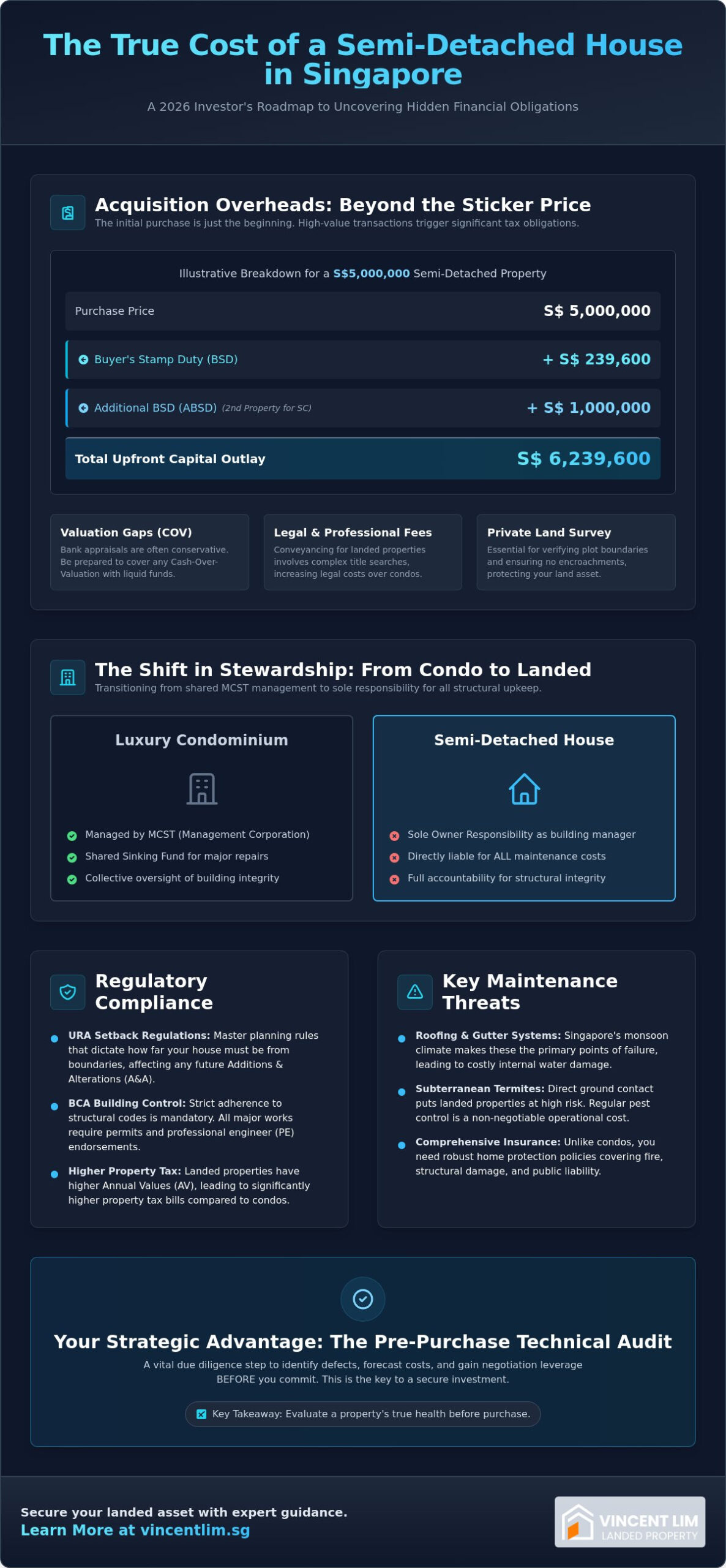
Acquiring a semi-detached property in Singapore is a sophisticated capital maneuver that extends far beyond the advertised listing price. By definition, Semi-detached houses are pairs of dwellings separated by a shared party wall, requiring a minimum land area of 200 square meters. In the 2026 market, the entry price for these assets frequently exceeds the $4 million mark, triggering the highest tiers of the progressive Buyer’s Stamp Duty (BSD). For any portion of the purchase price exceeding $3 million, you must account for a 6% tax rate. When coupled with a 20% Additional Buyer’s Stamp Duty (ABSD) for Singapore Citizens acquiring a second residential property, the initial tax obligation alone represents a massive capital reserve. These upfront taxes are often the first of many hidden costs of buying a semi-detached house that investors must anticipate before signing the Option to Purchase.
Strategic asset progression requires a clear understanding of how these overheads impact your liquidity. For instance, a $5 million semi-detached acquisition involves a BSD of approximately $244,600. If this is a second property purchase, the 20% ABSD adds another $1 million to your immediate cash or CPF requirement. This level of taxation necessitates a disciplined approach to capital allocation, ensuring that your remaining funds are sufficient for the operational and structural demands of landed ownership.
Valuation Discrepancies and Cash Outlay
Landed property valuations are notoriously conservative compared to the high-velocity condominium market. Banks typically apply different risk weightings to freehold and leasehold semi-detached homes, often resulting in a “valuation gap.” If the bank’s appraisal falls short of the agreed purchase price, you’re required to cover the difference in cash. This Cash-Over-Valuation (COV) is a critical liquidity consideration in a competitive 2026 market. We recommend a granular land-rate analysis; assessing the price per square foot of land rather than just the built-up area; to justify the premium and ensure the asset’s long-term viability. Relying on a standard agent’s estimate is rarely sufficient for such a high-stakes transaction.
Legal and Professional Fees for Landed Transactions
Conveyancing for landed assets involves a higher degree of due diligence than standard strata-titled units. Your legal counsel must navigate complex title searches and verify that the property isn’t subject to restrictive covenants or historical encumbrances that could limit future redevelopment. A private land survey is equally vital. Engaging a registered surveyor to verify plot boundaries ensures you aren’t inheriting encroachments from neighboring lots or public land. While these professional fees, combined with caveat lodgments and administrative title searches, are higher than those for a condo, they form a necessary layer of protection for your investment. These costs ensure that the land you’re paying for is exactly the land you legally own.
Structural Stewardship: Hidden Maintenance and Rectification Costs
Transitioning from a luxury condominium to a semi-detached house involves a fundamental shift in how you manage your asset. You no longer benefit from the collective oversight of a Management Corporation Strata Title (MCST). Instead, you assume the role of an active building manager. This transition often reveals the true hidden costs of buying a semi-detached house, as the responsibility for the structural integrity of the entire building envelope rests solely on your shoulders. You must coordinate everything from facade cleaning to the technical upkeep of mechanical systems without the buffer of a shared sinking fund.
Singapore’s tropical climate is particularly demanding on landed structures. Roofing and gutter systems are the primary points of failure, where intense monsoon rains expose minor cracks or clogged drainage paths. These issues can lead to internal water damage that is both expensive and disruptive to rectify. Any structural rectification or extension must adhere strictly to BCA’s Building Control regulations, which require professional engineer endorsements and formal permits. Neglecting these requirements can lead to enforcement actions that compromise your property’s valuation.
Subterranean termites pose another significant threat. Unlike high-rise units, your property is in direct contact with the ground, making it vulnerable to infestations that can compromise timber flooring and structural beams. Maintaining a comprehensive subterranean termite protection system is a non-negotiable operational overhead for any landed owner. We recommend that every semi-detached owner maintains a dedicated annual maintenance reserve fund equivalent to 1% of the property’s purchase price to ensure long-term structural health without financial strain.
The Party Wall and Shared Structural Responsibility
Sharing a structural boundary with a neighbor introduces unique legal and financial complexities. The party wall is a shared asset, and any repairs required for leaks or cracks usually involve a cost-sharing protocol. Disputes often arise regarding the source of a leak or the necessity of a specific repair. Resolving these issues requires a diplomatic approach and, occasionally, professional mediation. If you’re unsure how to navigate these neighborly negotiations, consulting a specialist in semi-detached house sales can provide the necessary context on local norms and legal precedents.
Landscaping and Outdoor Drainage Systems
Landed living requires meticulous outdoor management to avoid regulatory pitfalls. The Urban Redevelopment Authority (URA) often mandates specific greenery requirements, meaning tree pruning and garden upkeep are recurring costs. Neglecting perimeter drains can lead to stagnant water, inviting National Environment Agency (NEA) inspections and potential fines for mosquito breeding. Private water features or pools add another layer of complexity, requiring weekly chemical balancing and pump maintenance to prevent equipment failure and ensure safety.
Regulatory Compliance: URA and BCA Requirements
Navigating the regulatory landscape of Singapore’s landed market requires more than just an architect; it demands a strategic understanding of how urban planning laws dictate your financial outlay. The Urban Redevelopment Authority (URA) imposes strict 2.1-meter side setback requirements for semi-detached houses. These setbacks ensure a mandatory fire break and privacy gap between neighbors, but they also significantly reduce the buildable footprint of your lot. When planning a renovation, these spatial constraints often lead to higher design and engineering costs as you attempt to maximize utility within a restricted area. These regulatory hurdles represent significant hidden costs of buying a semi-detached house that many first-time landed buyers fail to quantify until the design phase begins.
Beyond URA’s spatial rules, the Building and Construction Authority (BCA) mandates rigorous structural oversight. Any significant modification requires formal BCA submission fees and professional endorsements. If you’re considering a full redevelopment, you’ll need to budget for topographical surveys to determine precise land levels and soil tests to assess foundation requirements. These “soft costs” are essential for ensuring structural safety, yet they’re frequently omitted from initial investment appraisals. By 2026, compliance with updated environmental building codes, such as solar readiness and sustainable drainage, has also become a mandatory expense for new builds and major reconstructions.
Additions & Alterations (A&A) vs. Reconstruction
The financial distinction between Additions & Alterations (A&A) and a full reconstruction hinges on the 50% Gross Floor Area (GFA) rule. If your proposed changes exceed 50% of the existing GFA or involve significant structural replacements, the project is classified as a reconstruction. This classification triggers more stringent building codes and higher professional fees for Qualified Persons (QP) and Registered Inspectors (RI). Failing to account for these compliance layers adds to the hidden costs of buying a semi-detached house, potentially inflating your budget by six figures. You’ll also need to account for modern infrastructure requirements, such as upgrading the property’s electrical load to support high-speed EV charging and comprehensive smart home ecosystems, which can involve substantial utility connection fees.
The “Envelope Control” Guidelines and Lost Opportunity
The “Envelope Control” guidelines define the maximum permissible building volume. While these rules offer more design flexibility than older micro-zoning plans, they strictly limit height based on the designated storey height of your estate. Failing to understand these limits can result in a “lost opportunity” cost, where you’re unable to build the attic or basement space you envisioned. This limitation directly impacts the asset’s future resale potential. To put these spatial constraints into perspective, it’s helpful to review the average price of semi detached house in singapore to see how build-up efficiency correlates with market valuation. Understanding the maximum potential of your land is the only way to ensure you aren’t overpaying for a lot with restricted growth potential.
Lifestyle and Operational Overheads: Landed vs. Condo
The transition from a high-end condominium to a semi-detached house often brings a realization that the convenience once managed by an MCST must now be personally funded and coordinated. While the lack of monthly maintenance fees is appealing, the operational overheads of a landed property are frequently more substantial and less predictable. These lifestyle expenses represent the recurring hidden costs of buying a semi-detached house, requiring a disciplined approach to monthly cash flow management. Property tax, for instance, is typically higher because the Inland Revenue Authority of Singapore (IRAS) assesses the Annual Value (AV) based on prevailing market rentals for similar landed homes, which inherently command a premium over strata-titled units.
Insurance requirements also shift significantly. In a condominium, the MCST maintains a master fire insurance policy for the building’s structure. As a landed owner, you must secure comprehensive home protection that covers not just the structure, but also your renovation investments, contents, and public liability. Utility consumption is another area where the efficiency gap becomes apparent. Cooling a multi-storey landed footprint with high ceilings and larger glass surfaces demands significantly more energy than a compact, insulated condo unit. You also need to account for private waste disposal fees and the “invisible” costs of managing your own security presence, which were previously bundled into your condo’s service charges.
Security and Privacy Infrastructure
Condominium living provides a baseline of security through shared guards and gated access. In a semi-detached environment, the burden of establishing a secure perimeter falls on you. This involves initial capital outlays for high-definition CCTV systems, perimeter sensors, and alarm monitoring services, followed by recurring maintenance fees. Automated gate systems and intercoms require regular servicing to ensure reliability and prevent mechanical failure. While these systems offer superior privacy, they lack the “free” 24/7 physical presence of a condo’s security team, making proactive infrastructure management a necessity.
The Efficiency Gap: Staffing and Cleaning
The sheer scale of a semi-detached home often necessitates full-time domestic help to manage daily upkeep, gardening, and general cleaning. Unlike a condo where common areas are maintained by a professional crew, every square inch of your land requires active attention. External window cleaning for multi-storey facades and the dusting of high-void ceilings often require specialized professional services that carry a premium. These operational demands are frequently overlooked hidden costs of buying a semi-detached house that can impact your monthly liquidity. For those planning this transition, reviewing a comprehensive guide on asset progression to landed property singapore is essential for mapping out the long-term financial implications. If you’re ready to refine your strategy, you should consult a landed property strategist to evaluate your specific transition plan.
Strategic Financial Planning with a Landed Specialist
A standard property transaction often prioritizes aesthetics and location, but acquiring a semi-detached asset is a technical land-play that requires a different caliber of expertise. A generalist agent might navigate the paperwork, yet they often lack the specialized knowledge to identify the true hidden costs of buying a semi-detached house, such as the efficiency of land-use versus built-up area. Engaging a specialist ensures that you aren’t just buying a home, but securing a high-performing asset. We perform a “Pre-Purchase Technical Audit” to uncover underlying issues like structural settlement, historical seepage, or party wall encumbrances before you commit. This data-driven approach transforms these findings into powerful negotiation levers, allowing you to adjust the purchase price based on quantifiable rectification costs.
Strategic positioning is vital for long-term legacy planning. A semi-detached house shouldn’t just serve your current lifestyle; it must be prepared for future resale or redevelopment. By analyzing the plot’s “opportunity cost”—the difference between its current state and its maximum allowable built-up potential—we help you identify properties with the highest growth ceiling. This level of foresight ensures that the capital you deploy today is protected against market volatility and regulatory shifts, turning potential liabilities into strategic advantages.
The Vincent Lim Advantage: Elite Market Intelligence
With over 20 years of experience in the Singapore landed market, I’ve developed a disciplined methodology for identifying “red flag” properties before an offer is ever made. My clients gain access to a curated network of trusted land surveyors, BCA-approved architects, and specialized contractors who provide immediate, professional clarity on complex structural questions. While a semi-detached home offers a unique balance of privacy and value, some investors find that a detached house for sale singapore provides a more robust alternative for long-term legacy planning. My role is to provide the elite market intelligence required to choose the path that best aligns with your wealth preservation goals.
Mitigating Risk through Meticulous Planning
Successful landed ownership depends on a 10-year capital expenditure (CAPEX) plan. This roadmap anticipates major structural milestones, such as roof replacements or facade refreshes, ensuring that these hidden costs of buying a semi-detached house don’t become financial surprises. We focus on properties that offer significant redevelopment potential, as these assets provide a natural hedge against the depreciation of older structures. By meticulously planning every phase of your ownership, from the initial technical audit to the final resale strategy, we ensure your investment remains a source of pride and prosperity. If you’re ready to secure your future in the landed market, consult with Vincent Lim for a bespoke landed property financial audit today.
Securing Your Multi-Generational Legacy in the Landed Market
Acquiring a semi-detached home is a landmark achievement that requires a transition from passive ownership to active asset management. By mastering the hidden costs of buying a semi-detached house, you transform potential liabilities into a controlled, high-value investment. Success in this segment depends on a meticulous understanding of structural stewardship and the foresight to navigate complex URA and BCA regulations. This strategic approach ensures that your property remains a resilient vehicle for capital growth and a prestigious sanctuary for your family.
As an Executive Associate Director at OrangeTee & Tie, I’ve specialized in GCB and luxury landed sales since 2004. My focus is on providing the elite market intelligence necessary for high-value asset progression and long-term wealth preservation. You shouldn’t leave the health of your multi-million dollar investment to chance. Secure your landed investment with a professional consultation from Vincent Lim to ensure every variable of your acquisition is refined for long-term success. Your journey toward a secure and sophisticated landed lifestyle starts with a partner who values precision as much as results.
Frequently Asked Questions
Is a semi-detached house more expensive to maintain than a bungalow?
A semi-detached house is generally less expensive to maintain than a bungalow because it features one shared party wall and a smaller external facade. Detached bungalows require upkeep for four external walls and typically sit on larger land plots with more extensive landscaping requirements. However, semi-detached owners face the unique challenge of coordinating shared structural repairs with a neighbor, which can occasionally lead to complex legal or negotiation costs.
How much should I budget for annual maintenance of a semi-detached house in Singapore?
You should allocate approximately 1% of the property’s purchase price annually to a dedicated maintenance reserve. For a typical semi-detached home in 2026, this budget covers essential services such as landscaping ($3,000 to $12,000), pest control ($600 to $1,500), and general repairs ($5,000 to $20,000). Older properties or those with private pools will require additional provisions for structural stewardship and mechanical system upkeep.
Can I share the cost of party wall repairs with my neighbor legally?
Yes, the cost of repairing or maintaining a party wall is legally a shared responsibility between the two adjoining owners. Most boundary disputes are resolved through an equal cost-sharing protocol for waterproofing, crack injections, or structural reinforcements. It’s vital to engage a professional surveyor to document the wall’s condition and enter into a formal agreement with your neighbor before commencing any rectification works.
What is the difference between A&A and reconstruction in terms of cost?
Reconstruction is significantly more expensive than Additions & Alterations (A&A) because it involves replacing more than 50% of the existing structure. A full reconstruction triggers compliance with the latest 2026 building codes, environmental sustainability standards, and higher BCA submission fees. While A&A allows you to retain parts of the original structure to save on foundation costs, reconstruction essentially provides a brand-new building with a higher valuation ceiling.
Do semi-detached houses have higher property taxes than condos?
Semi-detached houses usually face higher property tax bills because their Annual Value (AV) is assessed based on the prevailing market rentals of landed homes. Since landed properties are a scarce asset class in Singapore, their rental potential is significantly higher than that of most condominiums. These recurring taxes are part of the hidden costs of buying a semi-detached house that investors must evaluate when calculating their total cost of ownership over a five-year horizon.
What are the most common hidden defects in older semi-detached homes?
The most frequent issues discovered during technical audits include subterranean termite damage, roof seepage, and structural cracks caused by ground settlement. Many older homes also possess outdated electrical wiring that can’t support modern EV chargers or high-capacity air conditioning systems. Identifying these defects before the Option to Purchase is exercised allows you to negotiate a fair price that accounts for the necessary rectification works.
Is it worth buying a 99-year leasehold semi-detached house in 2026?
A 99-year leasehold semi-detached house can be a strategic choice if the entry price is significantly lower than freehold alternatives and fits your lifestyle timeline. These properties often offer better rental yields but face capital depreciation as the remaining lease shortens. For investors focused on legacy planning and multi-generational wealth preservation, freehold titles remain the preferred choice despite the higher initial capital outlay.
How much does a professional land survey cost in Singapore?
A professional land survey typically costs between $1,500 and $3,500 depending on the plot’s complexity and the level of topographical detail required. This survey is a critical step in the due diligence process to verify boundary markers and ensure no encroachments exist from neighboring lots. It’s a small but necessary investment that protects you from future legal disputes regarding land ownership and setback compliance during renovations.