Selling a landed estate in 2026 is a high-stakes financial manoeuvre where a single miscalculation in timing can erode your equity by as much as 16% of the transaction value. While the market remains resilient, the updated four-year Seller’s Stamp Duty window and the compounding nature of CPF accrued interest have made the cost of selling landed property singapore a primary concern for strategic owners. You likely recognise that a successful divestment requires more than just a premium offer; it demands a precise understanding of the net proceeds that will actually remain in your portfolio.
This guide provides the professional clarity you need to master these financial complexities by breaking down transactional fees, tax liabilities, and the strategic costs of preparing a large estate for market. We will examine the current 2026 legal fee averages, commission structures, and the impact of the latest property tax rebates. You will gain a comprehensive financial checklist designed to maximise your proceeds and ensure a seamless transition to your next luxury investment.
Key Takeaways
- Navigate the updated 2026 Seller’s Stamp Duty (SSD) framework and legal conveyancing requirements to ensure your equity is meticulously protected throughout the transaction.
- Accurately forecast the true cost of selling landed property singapore by identifying the cumulative impact of CPF accrued interest and mortgage redemption penalties.
- Implement “white-glove” preparation strategies, such as professional staging and targeted maintenance, to command a premium in a market defined by asset scarcity.
- Secure your net proceeds through disciplined planning of the three-month mortgage notice period and a thorough review of potential lock-in clauses.
- Leverage a strategic pre-sale financial audit to streamline your divestment and facilitate a smooth, well-timed transition to your next high-value investment.
The Financial Architecture of Selling Landed Property in 2026
Selling a landed property in Singapore is fundamentally different from divesting a high-rise unit. It requires a sophisticated financial framework because you aren’t just selling a home; you’re selling a finite piece of Singapore’s sovereign land. For the elite strategist, this sale isn’t merely a transaction but a critical pillar of a broader wealth portfolio. To preserve your equity, you must distinguish between compulsory transactional fees and strategic preparation costs. Understanding the cost of selling landed property singapore begins with a shift in perspective, moving from a standard “seller” mindset to that of a disciplined asset manager.
The Landed Advantage: Why the Stakes are Higher
Ownership of land introduces specific legal and valuation complexities that don’t exist in the strata-titled market. The buyer pool for landed property is significantly restricted by the Residential Property Act, which requires the Land Dealings Approval Unit (LDAU) to vet any potential foreign purchasers. This layer of regulation can influence your sale timeline and negotiation leverage, as the pool of eligible buyers is smaller and more discerning. Landed sellers must account for a wider margin of error in financial planning due to the sheer scale of the capital involved and the complexity of land-related legalities.
Overview of the 2026 Market Context
The 2026 market has shown remarkable resilience. According to data from the Urban Redevelopment Authority (URA), landed property prices increased by 2.5% in the second quarter of 2026, following a minor dip earlier in the year. With 1,043 landed homes sold in the first half of 2026, transaction volumes remain healthy. This resilience is supported by an easing interest rate environment, with two-year fixed rates starting from approximately 1.40%. These conditions create a window of opportunity for sellers to maximise their returns, provided they have a clear roadmap. For a deeper look at market positioning, refer to this Strategic Guide to Selling Your Landed Property in Singapore: Maximizing Value in 2026.
A successful divestment requires balancing the books before the first viewing occurs. Official tax liabilities and regulatory costs are governed by the Inland Revenue Authority of Singapore (IRAS), ensuring that every dollar of your divestment is accounted for under national regulations. By identifying these non-negotiable costs early, you can focus your resources on strategic investments like “white-glove” preparation, which often yields a higher final sale price. This methodical approach ensures that the total cost of selling landed property singapore is a managed variable rather than a financial surprise.
Primary Transactional Costs: Commissions, Legal Fees, and SSD
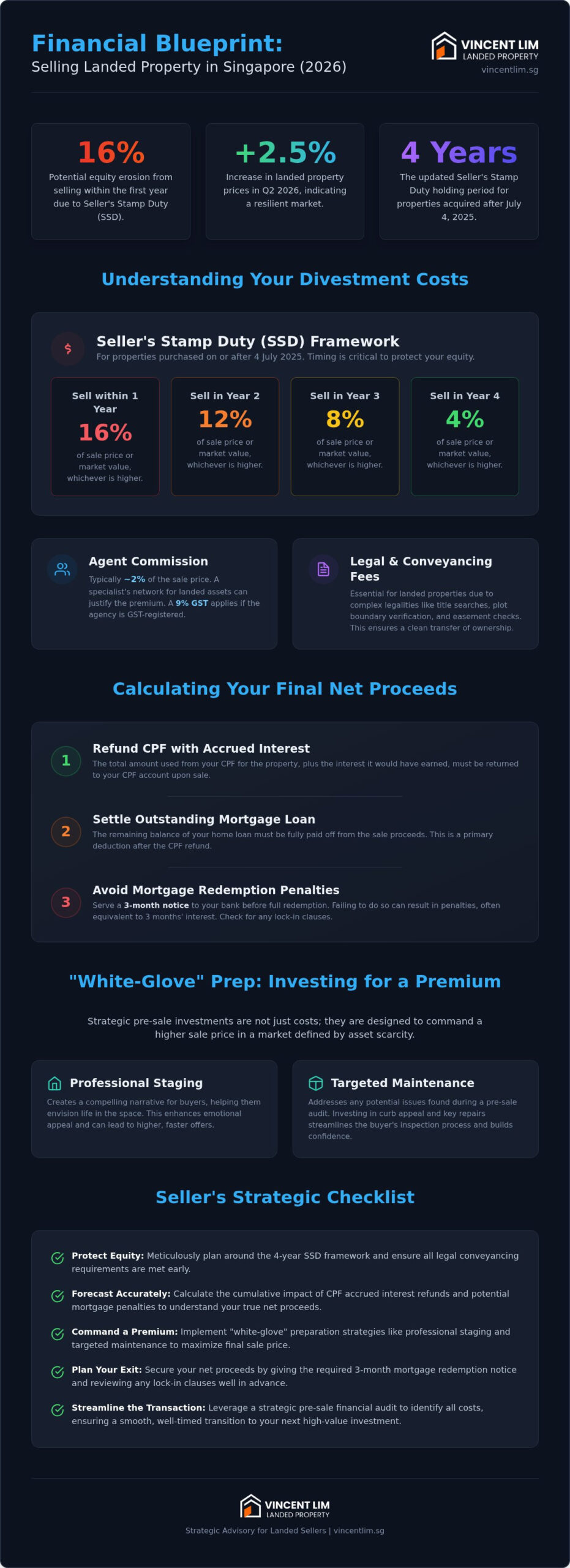
The primary transactional costs represent the non-negotiable financial commitments of your divestment. While commissions are the most visible component, the nuanced application of taxes and legal fees determines your final liquidity. For private resale properties, sellers typically pay a commission of approximately 2% of the sale price. However, a generalist may lack the specific network required for high-value landed assets. Engaging a specialist ensures that you aren’t just paying for a listing, but for a bespoke marketing strategy that justifies the premium. Note that a 9% Goods and Services Tax (GST) applies if your chosen agency is GST-registered, which is a standard factor in the total cost of selling landed property singapore.
Decoding the 2026 SSD Framework
The Seller’s Stamp Duty (SSD) landscape shifted significantly for properties purchased on or after 4 July 2025. For these assets, the holding period is now four years, with a top rate of 16% for homes sold within the first year. This contrasts with the older three-year window, where the maximum rate was 12%. The current tiers for post-July 2025 purchases are 16% for up to one year, 12% for one to two years, 8% for two to three years, and 4% for three to four years. To determine your exact SSD liability, you must calculate the duration from the date you exercised your Option to Purchase (OTP) to the date the current buyer exercises theirs.
Legal and Professional Representation
Landed transactions are legally intensive. Unlike high-rise units, these sales require exhaustive title searches to verify plot boundaries, easements, and potential encumbrances. Standard conveyancing fees for a straightforward landed sale typically range from S$2,500 to S$3,500, though complex estates with unique title issues may incur higher professional fees. A formal appraisal is also essential for high-value assets to establish a credible asking price. This is particularly vital for those managing a Good Class Bungalow, where land value and heritage factors play a significant role in the final valuation.
Property tax pro-rations also form part of the final settlement. The seller is responsible for the tax up to the day before the completion date, after which the buyer takes over. For 2026, owner-occupied private residential properties benefit from a one-off 10% property tax rebate, capped at S$500, which should be accounted for during the final pro-ration calculations. Navigating these details requires a methodical approach to ensure no equity is left on the table. If you’re planning a complex divestment, a strategic consultation can help identify potential bottlenecks before they impact your timeline.
White-Glove Preparation: Investing in Strategic Curb Appeal
In the luxury landed market, the “as-is” condition is rarely sufficient to trigger a record-breaking offer. Discerning buyers in 2026 expect a level of move-in readiness that mirrors the experience of a five-star hotel. Consequently, strategic preparation is not an optional expense but a calculated investment within the total cost of selling landed property singapore. When you’re divesting an asset worth tens of millions, the goal is to eliminate any friction that might give a buyer leverage to negotiate downwards. This requires a shift from basic maintenance to a “white-glove” presentation strategy.
The ROI of Presentation
Professional home staging is the cornerstone of this approach. While a generalist might suggest a simple cleaning, market observations within the luxury segment suggest that professional staging can influence the final sale price by a margin of 5% to 10%. By renting high-end furniture that complements the architectural style of the home, you allow buyers to visualise the lifestyle your estate offers. However, aesthetics must be supported by structural integrity. It’s vital to prioritise repairs logically; addressing a roof leak or a damp patch is a non-negotiable requirement that prevents deal-breaking red flags during the valuation or inspection phase. For large estates and Good Class Bungalows, the “first impression” budget must also cover intensive garden and pool maintenance to ensure the exterior is as pristine as the interior.
Marketing the Legacy
Selling a high-value detached house requires more than a standard listing; it requires bespoke storytelling. Generic photographs fail to capture the scale and prestige of these properties. High-production videography and drone photography are essential tools to communicate the property’s layout and its relationship with the surrounding land. These media costs are a necessary part of the cost of selling landed property singapore when targeting ultra-high-net-worth individuals who often begin their search digitally. A well-produced narrative highlights the unique heritage or architectural significance of the home, transforming it from a mere structure into a legacy asset. For owners planning a transition, understanding these nuances is key to a successful detached house for sale in Singapore. By investing in high-tier marketing, you ensure your property stands out in an environment where asset scarcity is the primary driver of value.
Calculating Net Proceeds: CPF Refunds and Mortgage Redemption
The final stage of your divestment involves translating the gross sale price into actual liquidity. While the headline figure is often the focus, your net proceeds are determined by the efficiency of your financial exit strategy. For landed owners, the scale of the debt and the duration of ownership mean that these “exit costs” are significantly higher than for other residential classes. Meticulous planning is required to ensure that the cost of selling landed property singapore doesn’t compromise your next investment. A clean financial handover involves accounting for outstanding property taxes, service charges, and the precise timing of your mortgage redemption.
The CPF Accrued Interest Trap
For many landed owners, the most significant “invisible cost” is the Central Provident Fund (CPF) accrued interest. When you sell your property, you must refund the principal amount used from your Ordinary Account (OA) plus the interest you would have earned had that money remained in the fund. With the CPF OA interest rate at 2.5% per annum as of late 2026, this compounded figure can be substantial for those who have held their estates for a decade or more. In multi-generational homes where multiple family members have contributed CPF, the refund requirements can drastically reduce the final cash-in-hand. Landed owners should check their CPF portal six months before listing to obtain an accurate statement of their required refund amount.
Mortgage and Financial Exit Strategies
Redeeming a high-value mortgage requires more than a simple bank notification. Most financial institutions in Singapore require a three-month notice period for full redemption. If you fail to provide this notice, you may be liable for “interest in lieu,” which can amount to thousands of dollars on a landed property loan. Additionally, if you are still within a lock-in period, you could face penalties typically ranging from 1% to 1.5% of the outstanding loan amount. Managing the transition between selling your current asset and bridging to your next purchase is a hallmark of the elite strategist. For a comprehensive look at how to navigate these transitions, consult the Asset Progression to Landed Property Guide.
To calculate your net proceeds accurately, apply this formula: (Sale Price) minus (Agent Commission + GST), (Legal Fees), (SSD if applicable), (Outstanding Loan + Penalties), and (CPF Principal + Accrued Interest). This calculation should be performed early in the process to identify potential bottlenecks. If you require a detailed pre-sale financial audit to protect your equity, you can book a strategic consultation to review your specific portfolio requirements. By addressing these financial nuances proactively, you ensure that the cost of selling landed property singapore remains a controlled component of your wealth progression.
The Vincent Lim Advantage: Strategic Advisory for Landed Sellers
Managing the cost of selling landed property singapore requires more than a simple calculation of fees; it demands a comprehensive divestment strategy. While a standard agent focuses on the mechanics of a listing, Vincent Lim bridges the gap by acting as an elite strategist who prioritises your long-term wealth mobility. With over 20 years of industry experience, he understands that a successful sale is measured by the net proceeds that remain in your portfolio after all liabilities are settled. By conducting a meticulous pre-sale financial audit, he identifies potential SSD or CPF bottlenecks before they impact your liquidity, ensuring your asset progression remains on a steady trajectory.
Bespoke Brokerage for the Discerning Owner
In the high-stakes landed segment, a “white-glove” service level is essential to maintain the integrity of your asset’s value. Vincent Lim develops customised marketing plans that justify a premium sale price, often offsetting the inherent selling costs through superior positioning. These plans are not generic; they are precise narratives designed to appeal to ultra-high-net-worth individuals. Past case studies have demonstrated that strategic negotiation and professional presentation can significantly maximise net proceeds, even in a moderating market. Vincent Lim employs a rigorous vetting process to identify the most qualified high-net-worth buyers, effectively reducing time-on-market costs and preventing the deal fatigue that often plagues large estate transactions.
For owners of Good Class Bungalows and luxury detached homes, the sale is frequently a component of a larger legacy or wealth planning exercise. Vincent coordinates seamlessly with your legal and financial advisors to ensure the transaction aligns with your broader estate objectives. This multidisciplinary approach provides the peace of mind that every aspect of the cost of selling landed property singapore is managed with professional discipline. Whether you are navigating the complexities of land titles or the nuances of tax pro-rations, having a trusted guide ensures that your interests are protected at every turn.
Next Steps for Your Asset Journey
The first step toward a successful divestment is a clear understanding of your financial position. Requesting a personalised net proceeds calculation allows you to move forward with confidence, knowing exactly what your post-sale liquidity will look like. This audit accounts for your specific mortgage redemption figures, CPF accrued interest, and any applicable tax liabilities under the 2026 regulations. If you are ready to explore a strategic divestment for your Good Class Bungalow or luxury landed home, scheduling a private consultation is the most effective way to begin. You may Consult with Vincent Lim for a Strategic Landed Property Review to ensure your next asset journey is built on a foundation of professional transparency and excellence.
Securing Your Financial Future Through Strategic Divestment
Navigating the 2026 market requires a disciplined approach to the financial variables that define your net proceeds. You’ve seen how the updated four-year SSD window and the compounding nature of CPF accrued interest can impact your liquidity if left unmanaged. By prioritising “white-glove” preparation and bespoke marketing, you transform the cost of selling landed property singapore from a series of expenses into a controlled investment that protects your equity. Meticulous stewardship of these details is what separates a standard transaction from a strategic success.
Partnering with a specialist ensures that every title search, tax pro-ration, and buyer negotiation is handled with the highest standard of professional accountability. As an Executive Associate Director at OrangeTee & Tie with over two decades of experience in the GCB and luxury landed segment, Vincent Lim provides the seasoned authority required for these high-stakes transactions. Partner with Vincent Lim to Maximise Your Landed Property Sale Proceeds and ensure your asset journey continues with absolute clarity and confidence. Your legacy deserves nothing less than a masterfully executed transition.
Frequently Asked Questions
What is the standard agent commission for selling a landed property in Singapore?
The standard commission for private resale properties is typically 2% of the final sale price. This rate is not fixed by regulation and remains negotiable between the owner and the real estate agency. If your chosen agency is GST-registered, a 9% Goods and Services Tax applies to this fee. For high-value assets like Good Class Bungalows, owners often prioritise bespoke marketing services that justify this investment to secure a premium result.
How much should I budget for legal fees when selling a terrace or detached house?
For a straightforward sale of a terrace or detached house, legal conveyancing fees generally range between S$2,500 and S$3,500. Landed transactions involve more intensive legal work than condominiums, including exhaustive title searches and boundary verification. If the estate involves complex trust structures or unique title encumbrances, professional fees may increase. Engaging a specialist conveyancing lawyer ensures that the legal transfer of land is executed with precision and administrative transparency.
Does the new 4-year Seller’s Stamp Duty (SSD) apply to all landed properties?
The updated four-year Seller’s Stamp Duty framework applies to all residential landed properties purchased on or after 4 July 2025. If you acquired your property before this date, the previous three-year holding period rules still apply. For newer acquisitions, the rates are tiered at 16% for sales within the first year, 12% for the second, 8% for the third, and 4% for the fourth, making timing a critical factor in your divestment strategy.
Will I need to pay back CPF interest when I sell my landed home?
Yes, you must refund any CPF savings used for the property purchase back into your Ordinary Account upon completion. This refund includes the principal amount plus the accrued interest you would have earned, currently calculated at 2.5% per annum. This “invisible” cost is a significant component of the total cost of selling landed property singapore. It directly reduces your cash proceeds, particularly for multi-generational homes held over several decades.
How much does it cost to stage a Good Class Bungalow for sale?
Staging a Good Class Bungalow involves high-end furniture rental and curation to match the estate’s architectural prestige. While costs vary based on the scale of the property and the duration of the listing, this investment is designed to trigger a premium offer. Professional staging often influences the final sale price by 5% to 10% in the luxury segment. It is a strategic preparation cost that ensures the property resonates with ultra-high-net-worth buyers immediately.
What are the hidden costs of selling an older landed property?
Older landed properties often incur hidden costs related to structural rectification and maintenance. Sellers may need to address roof leaks, dampness, or outdated electrical systems to prevent deal-breaking red flags during a buyer’s inspection. Additionally, boundary surveys might be required to resolve plot discrepancies. These preparation expenses are essential components of the cost of selling landed property singapore, as they protect your asking price and ensure a smooth valuation process for the incoming purchaser.
Can I sell my landed property without a formal valuation?
While it’s legally possible to list without one, a formal valuation is highly recommended for high-value detached houses and Good Class Bungalows. An official appraisal provides a credible baseline for negotiations and helps your agent justify a premium asking price to prospective buyers. In a resilient but discerning 2026 market, having a data-backed valuation ensures you don’t undersell your asset or alienate qualified buyers with an unrealistic price point that extends your time on market.
How long is the completion period for a landed property transaction in 2026?
The standard completion period for a landed property transaction is typically 12 weeks from the date the buyer exercises the Option to Purchase. This timeline allows for the necessary legal title searches, mortgage redemption processing, and administrative handovers. In 2026, sellers must coordinate this window carefully with their mortgage notice periods to avoid interest penalties. Some transactions may be extended beyond 12 weeks if both parties agree to a longer transition for asset progression.