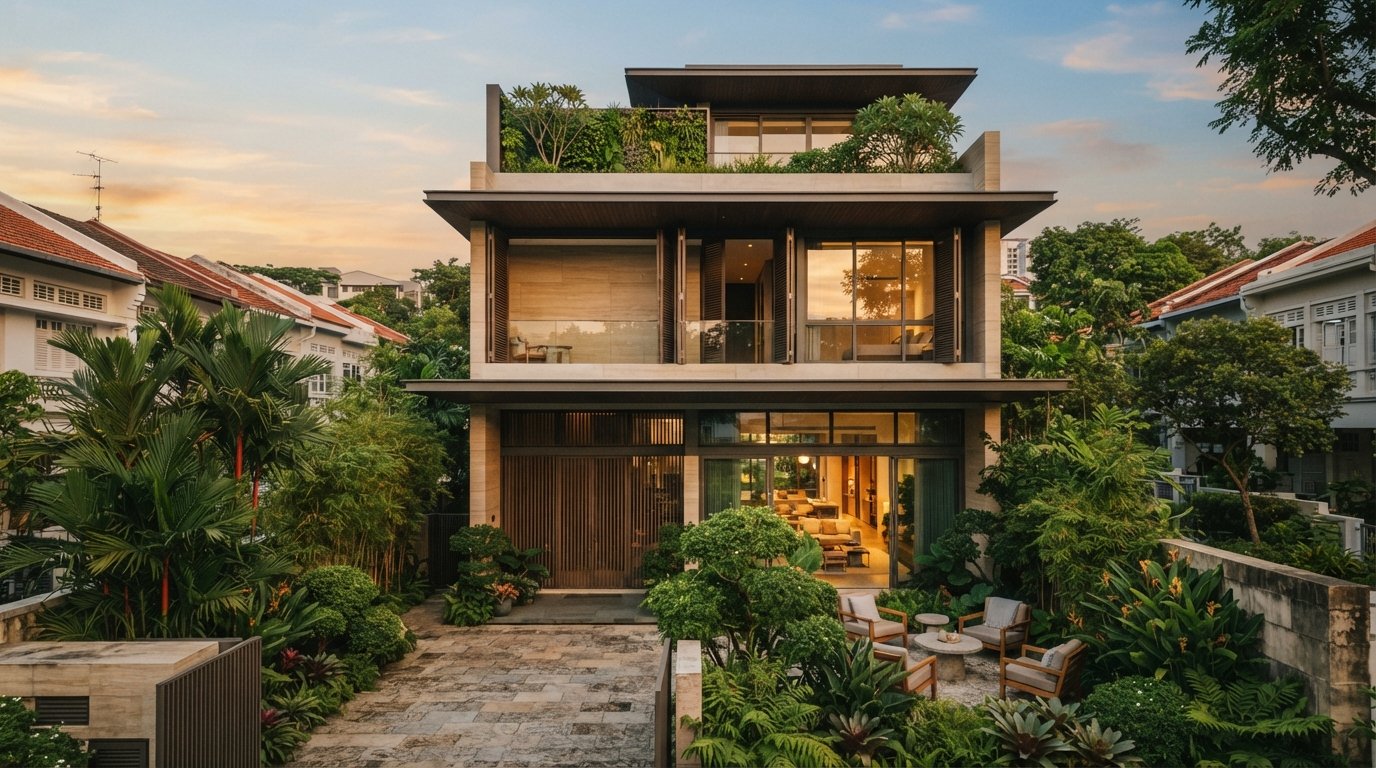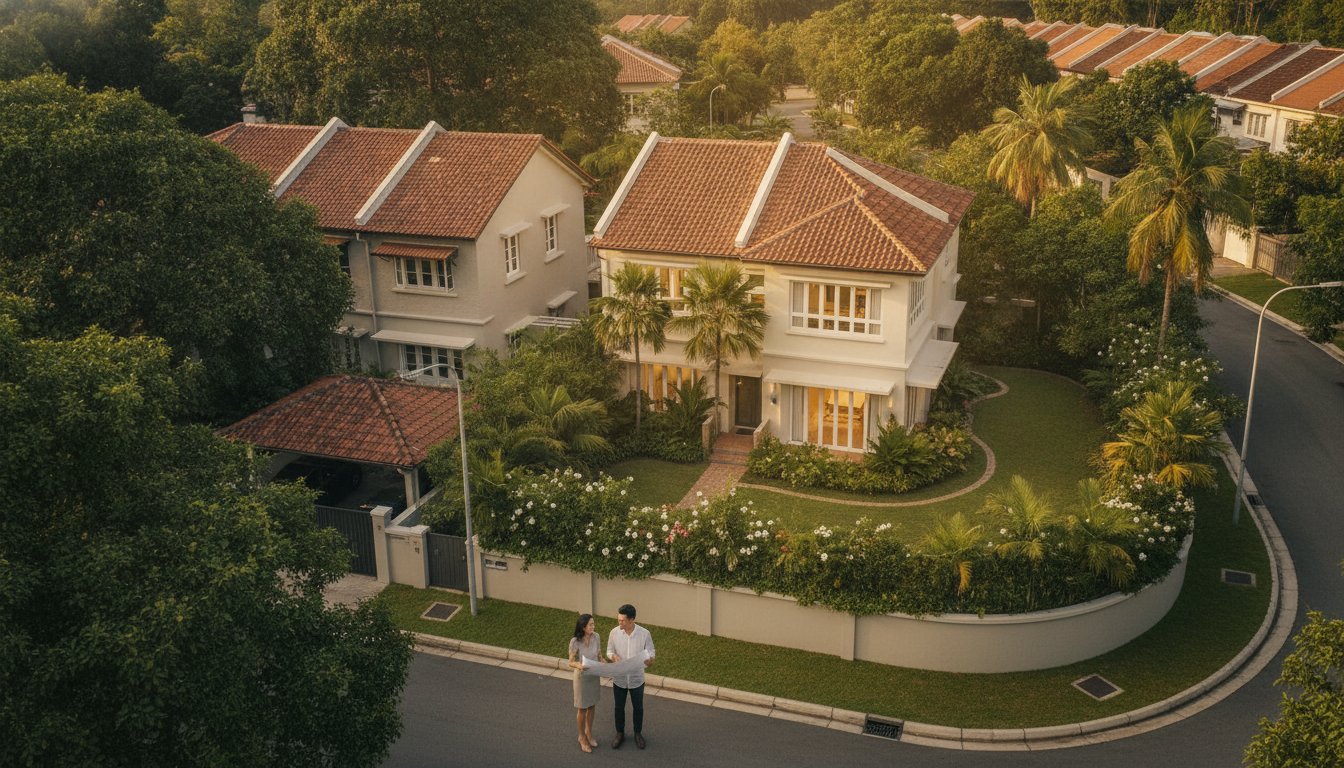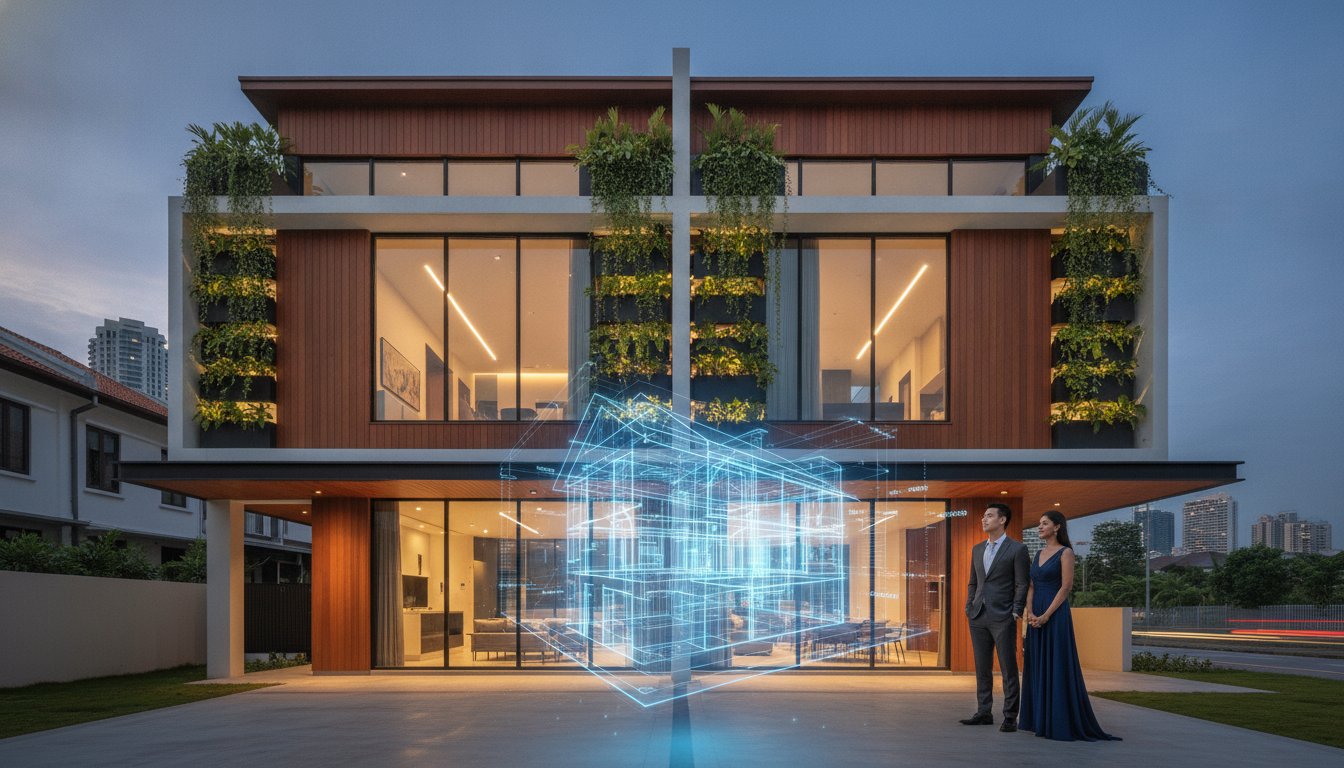
With landed properties comprising only 5% of all dwellings in Singapore, your terrace house is a rare asset that requires a meticulous investment approach. You’ve likely watched construction material costs climb by 20% to 30% over the last three years, leaving you uncertain about the actual cost to rebuild terrace house singapore in the current market. It’s a high-stakes environment where the distinction between a standard renovation and a full reconstruction often feels obscured by complex URA “Envelope Control” guidelines and BCA hurdles.
Mastering these financial and regulatory complexities is the essential step to transforming your property into a high-value legacy asset. This strategic guide provides the clarity you need to budget with confidence, ensuring your investment aligns with your long-term asset progression goals. We’ll examine current per-square-foot benchmarks, the impact of the “50% rule” on your property’s valuation, and the necessary roadmap for navigating the mandatory CORENET X submission process.
Key Takeaways
- Distinguish between Addition & Alteration (A&A) and full reconstruction by applying the URA 50% Gross Floor Area threshold to your project.
- Develop a comprehensive budget for the cost to rebuild terrace house singapore that integrates current construction rates with essential professional consultancy fees.
- Navigate the complexities of Envelope Control and setback requirements to unlock the maximum buildable volume of your land.
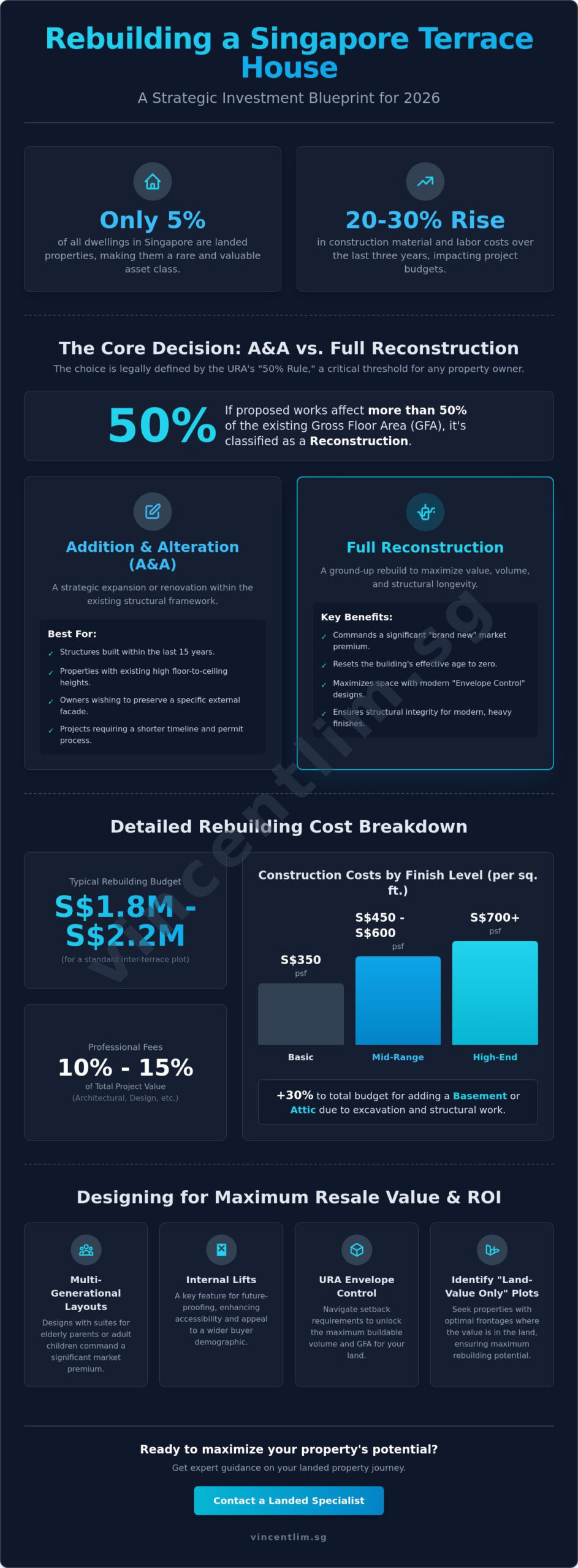
- Target high-ROI design features like multi-generational layouts and internal lifts to command a significant premium in the resale market.
- Identify “land-value only” properties with optimal frontages to ensure your rebuilding project achieves its full asset progression potential.
Rebuilding vs. Renovation: Making the Strategic Choice in 2026
Owning one of the many Terraced houses in Singapore often presents a crossroads: should you opt for a cosmetic facelift or a total structural reset? In the current 2026 market, this choice determines your property’s future liquidity and its ultimate ceiling price. The distinction between an Addition & Alteration (A&A) and a full reconstruction isn’t merely a matter of scale; it’s a legal classification governed by the Urban Redevelopment Authority (URA).
The “50% Rule” serves as the primary legal threshold. If your proposed works affect more than 50% of the existing Gross Floor Area (GFA) or involve significant changes to the structural framework, such as the replacement of columns or floor slabs, the project is classified as a reconstruction. While an A&A project might seem faster, it often forces you to work within the constraints of an aging foundation. Older terrace houses were rarely designed for the open-concept layouts and heavy marble finishes popular today. Choosing a ground-up rebuild ensures structural longevity and provides the freedom to implement modern “Envelope Control” designs that maximize internal volume and natural light.
The Financial Logic of Reconstruction
A newly rebuilt terrace house commands a significant “brand new” premium that often outstrips the capital appreciation of a renovated older unit. Investors looking at the cost to rebuild terrace house singapore recognize that a modern structure offers a superior valuation-to-cost ratio because it resets the building’s effective age to zero. This strategic repositioning is particularly effective for inter-terrace plots where maximizing every square inch of GFA is the only way to drive asset progression. In 2026, URA defines reconstruction as any building works where the resulting GFA increase exceeds 50% of the original structure or where major structural components are replaced.
When to Choose A&A Over a Full Rebuild
There are specific scenarios where A&A remains the more prudent path. If the existing structure was built within the last 15 years and already possesses a high floor-to-ceiling height, you might achieve your goals through strategic expansion without total demolition. This approach is ideal for owners who wish to preserve a specific external facade or avoid the longer timelines associated with full reconstruction permits. If you’re currently evaluating potential properties, our guide on Terrace House for Sale Singapore: A Strategic Guide helps you identify plots where the existing structure offers high A&A potential. Choosing A&A can save on certain professional fees, provided the existing structure doesn’t require extensive reinforcement to meet current safety codes.
Detailed Breakdown of Rebuilding Costs for Singapore Terrace Houses
Quantifying the cost to rebuild terrace house singapore in 2026 requires a granular analysis of both tangible construction materials and the intangible professional expertise required for a high-tier project. Recent data from The Business Times in April 2026 indicates that a comprehensive rebuilding budget typically ranges between S$1.8 million and S$2.2 million. This reflects a significant 20% to 30% increase in construction costs over the last three years, driven primarily by material inflation and a consistent scarcity of skilled labor. As a strategic investor, you must account for these shifts to ensure your project remains financially viable and delivers a strong return on investment.
Construction Costs by Finish Level
The final price point is heavily influenced by the specification level of your finishes and the architectural complexity of the build. For a basic rebuild, homeowners can expect to budget approximately S$350 per square foot (psf) of Gross Floor Area (GFA). However, mid-range projects typically fall between S$450 and S$600 psf, while high-end, bespoke residences often exceed S$700 psf; many owners even choose to buy carpet online UK to source premium materials that elevate the home’s interior aesthetic. Incorporating a basement or an attic addition can swing the total budget by an additional 30% due to the specialized excavation and structural reinforcement required. In the 2026 market, labor costs remain a primary variable, making it essential to lock in contracts with reputable builders early in the planning phase.
Professional and Regulatory Fee Estimates
Beyond the physical construction, professional fees constitute a vital portion of your capital outlay. Architectural and interior design fees for landed homes often range from S$280,000 to over S$800,000, or approximately 10% to 15% of the total project value. Engaging a Qualified Person (QP) is a non-negotiable requirement under the Building Control Regulations to ensure structural safety and regulatory compliance. You must also budget for essential submission fees, including the URA Change of Use application at S$500 and various BCA or SCDF clearances that range from S$100 to S$1,000 each. As you evaluate these figures, consulting with a landed property specialist can help you align your budget with the highest potential for future resale value.
Ancillary expenses often catch unprepared owners by surprise. Demolition of the existing terrace structure, piling works, and site insurance are foundational costs that must be cleared before the first brick is laid. Additionally, it’s prudent to budget for temporary housing and storage during the 18 to 24 month construction window. For those with specialized requirements such as relocating heavy equipment or industrial assets, machinery movers UK offers the expert logistics and handling necessary for such high-stakes moves. By centralizing these costs into a single strategic roadmap, you can navigate the complexities of a rebuild with the confidence that your asset progression remains on a steady, profitable trajectory.
Navigating URA Guidelines and Technical Constraints
Strategic rebuilding is far more than an exercise in financial management; it is a discipline of regulatory precision. While the cost to rebuild terrace house singapore is a primary concern, the ultimate success of your project depends on how effectively your architect navigates the Urban Redevelopment Authority (URA) guidelines. These regulations dictate the physical boundaries of your home, from its total height to its proximity to the street. Failing to account for these constraints early in the design phase can lead to costly plan rejections or, worse, a building that fails to utilize the full potential of the land.
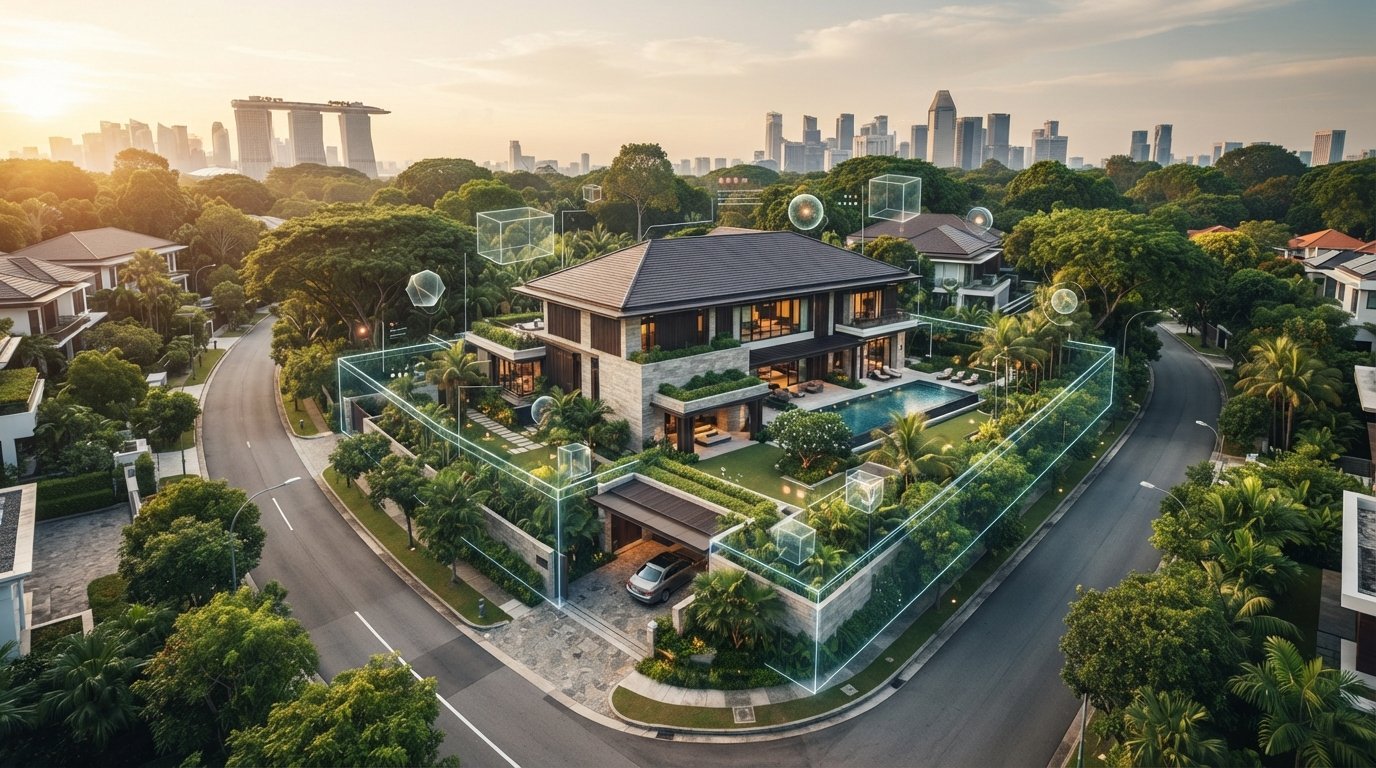
Envelope Control guidelines serve as the primary framework for modern landed developments. These rules define the maximum three-dimensional space your house can occupy. In two-storey landed housing estates, the maximum building height is capped at 12 meters. In three-storey zones, this increases to 15.5 meters. Within this “envelope,” you have the flexibility to design creative floor plates, but you must respect the mandatory setback requirements. For most inter-terrace plots, this involves a 7.5-meter road buffer at the front and a 2-meter setback at the rear. Optimizing Gross Floor Area (GFA) within these boundaries requires a sophisticated understanding of how to integrate light wells and internal courtyards without sacrificing liveable square footage.
URA Planning Parameters for Terrace Houses
Terrace houses are classified into different categories, each with distinct rebuilding rules. Category I refers to intermediate terrace houses, while Category II and III cover corner units with varying land widths and frontage requirements. A significant change in recent years is the treatment of the attic space. Envelope Control guidelines replaced the traditional storey-height system by defining a three-dimensional limit within which the building must be contained, allowing for greater architectural flexibility. This means your third storey and attic can now be more seamlessly integrated, provided they remain within the permissible building envelope.
BCA Structural and Safety Compliance
Beyond aesthetics, the Building and Construction Authority (BCA) ensures your rebuild is structurally sound and safe for the community. The technical challenge of the party wall is a major factor for terrace owners. Since your home is structurally joined to your neighbor’s, your Professional Engineer must implement rigorous protection measures. Pre-construction surveys of neighboring properties are essential to document existing conditions and prevent legal disputes over hairline cracks or settlement issues. Your choice of piling, whether it is jack-in piles or bored piles, will depend heavily on your specific soil conditions. These structural decisions are critical for long-term integrity and compliance with the latest Green Mark sustainability standards.
Maximising ROI: Designing for Resale and Asset Progression
Viewing the cost to rebuild terrace house singapore as a mere construction expense is a missed opportunity for capital growth. In the 2026 market, a newly rebuilt terrace house acts as a high-performance asset that resets the property’s lifecycle and commands a significant “brand new” premium. While an old terrace unit might transact around S$4 million, a newly reconstructed intermediate terrace can command between S$6.2 million and S$7 million. This price gap represents more than just the cost of materials; it reflects the market’s appetite for modern structural standards and immediate move-in readiness. Strategic owners don’t just build for their current needs; they design for the next buyer’s aspirations.
Successful asset progression requires a focus on features that drive liquidity. Multi-generational layouts with an internal lift are no longer optional for high-end resale; they’re a baseline expectation. As Singapore’s demographic shifts, homes that accommodate elderly parents alongside growing families attract a wider pool of affluent buyers. Integrating sustainable energy systems and EV charging readiness further future-proofs the investment, ensuring the property remains relevant as green regulations tighten. You can explore deeper insights on this transition in our Asset Progression to Landed Property: The Elite Strategist’s Guide.
GFA Optimisation as a Value Driver
Maximising Gross Floor Area (GFA) is the most direct way to increase your property’s valuation. While the initial cost to rebuild terrace house singapore might seem high, the resulting increase in buildable area often offsets the capital outlay through substantial equity gains. By utilizing the Envelope Control guidelines discussed earlier, you can incorporate mezzanines or attics that add significant liveable square footage without exceeding height limits. The challenge lies in balancing taxable GFA with “void spaces” that create a sense of volume and luxury. High ceilings in the living area, while technically “empty” space, often justify a higher price-per-square-foot in the resale market because they distinguish the home from standard layouts.
Modern Amenities and Market Demand
The 2026 buyer profile prioritizes functional sophistication. A “dry and wet kitchen” configuration is a staple for landed homes, allowing for heavy cooking while maintaining a pristine social space for entertaining. Smart home infrastructure and robust security systems are also essential components of a modern rebuild. If you’re planning to exit the market shortly after reconstruction, consult our Strategic Guide to Selling Your Landed Property to ensure your design choices align with current buyer preferences. To ensure your rebuilding project translates into maximum market value, contact us for a bespoke asset valuation today.
Identifying Rebuild-Ready Plots with a Landed Specialist
The foundation of a successful redevelopment isn’t the concrete poured on-site; it’s the strategic selection of the plot itself. Identifying “land-value only” properties requires a discerning eye for units where the structure’s value has fully depreciated, leaving only the intrinsic value of the freehold land. These plots are ripe for transformation, allowing you to bypass the premium often attached to well-maintained but outdated homes. When calculating the total cost to rebuild terrace house singapore, the acquisition price of the land serves as your primary baseline. Securing a plot at the right price point ensures that your subsequent construction investment doesn’t lead to over-capitalisation relative to the district’s ceiling price.
Plot geometry significantly influences your architectural possibilities and eventual ROI. Regular, rectangular shapes are preferred over irregular lots because they minimize wasted space and simplify structural engineering. Wide frontages are particularly valuable, as they allow for more impressive curb appeal and greater flexibility in internal layout design. A narrow frontage can restrict your ability to include a car porch for multiple vehicles or a grand entrance, features that 2026 buyers increasingly demand. We focus on these technical nuances to ensure the land you acquire can actually support the “brand new” vision you intend to build.
The Acquisition Strategy
Effective due diligence is the safeguard of your investment. You must check for drainage reserves or road line markings that might significantly shrink your buildable area. These technical encumbrances can reduce your effective Gross Floor Area (GFA) more than you’d expect. By analyzing historical PSF trends in specific districts, we can determine the optimal purchase price. Negotiating from a position of data-driven strength allows you to factor the estimated cost to rebuild terrace house singapore into your offer, ensuring the numbers work before you commit to the purchase. This methodical approach transforms a simple purchase into a calculated real estate play.
The Vincent Lim (OrangeTee & Tie) Advantage
Navigating the landed market requires more than just access to listings; it demands an elite network. Vincent Lim (OrangeTee & Tie) provides access to off-market, rebuild-ready opportunities that never reach public portals. We act as your high-level partner, coordinating between architects, bankers, and regulatory consultants to ensure a seamless transition from acquisition to completion. This “white-glove” approach alleviates the stress of high-stakes transactions, providing the peace of mind that your asset progression is managed with calculated competence. Consult Vincent Lim (OrangeTee & Tie) for your Landed Property Strategy to begin your journey toward a bespoke landed legacy.
Securing Your Legacy Through Strategic Redevelopment
Rebuilding a terrace house in Singapore is a sophisticated maneuver that demands more than just capital; it requires a deep understanding of regulatory nuances and market timing. By mastering the 50% GFA rule and optimizing your build within the Envelope Control framework, you transform a depreciating structure into a premier asset. While the initial cost to rebuild terrace house singapore is significant, the resulting equity growth and resale premium provide a robust foundation for long-term asset progression. This process isn’t merely about construction; it’s about repositioning your wealth within a limited landed market.
Navigating this journey alone can be complex. As an Executive Associate Director at Vincent Lim (OrangeTee & Tie) specializing in GCBs and luxury landed assets, I bring over 20 years of Singapore real estate expertise to your project. I ensure every acquisition and design choice aligns with your specific financial objectives. Partner with Vincent Lim (OrangeTee & Tie) to identify your next high-ROI rebuild project and unlock the full potential of your landed portfolio. Your path to a bespoke, high-value home starts with a single, calculated step. Let’s build your future together.
Frequently Asked Questions
How much does it cost to rebuild a terrace house in Singapore in 2026?
A comprehensive rebuild in 2026 typically requires a budget between S$1.8 million and S$2.2 million for a standard plot. This figure covers construction costs, which currently range from S$450 to over S$700 per square foot depending on your choice of finishes. You must also account for professional fees and regulatory submissions, which have climbed by 20% to 30% recently due to global material inflation and labor scarcity.
What is the difference between A&A and reconstruction for a terrace house?
The primary distinction lies in the “50% rule” governed by the URA. A project is legally classified as a reconstruction if the proposed works affect more than 50% of the existing Gross Floor Area or involve replacing major structural components like columns and floor slabs. Addition & Alteration (A&A) projects are less invasive and usually involve shorter approval timelines, though they offer less flexibility for modernizing the home’s internal volume.
How long does it take to demolish and rebuild a terrace house?
The entire process from initial demolition to obtaining the Temporary Occupation Permit (TOP) generally takes 18 to 24 months. This timeline incorporates the physical construction phase and the mandatory 12 to 20 week window required for URA and BCA plan approvals. Complex soil conditions or bespoke architectural features can extend this duration, so it’s vital to engage a Qualified Person early to manage the project’s methodical progression.
Do I need to move out during a terrace house rebuild?
Yes, you must vacate the property because a full reconstruction involves the total demolition of the existing structure. Unlike minor cosmetic renovations where certain wings of a house might remain habitable, a rebuild requires a completely vacant site for piling and heavy structural works. Most homeowners strategically budget for alternative accommodations for the duration of the 18 to 24 month construction cycle to ensure a smooth transition.
Can I get a construction loan for rebuilding my landed property?
Most major banks in Singapore offer specialized construction loans for landed property owners. These facilities typically cover a significant portion of the construction cost and are disbursed in stages based on the architect’s certification of work completed on-site. Securing your financing early allows you to manage the cost to rebuild terrace house singapore effectively, ensuring that the project maintains steady momentum from groundbreaking to final completion.
What are the URA setback requirements for an inter-terrace house?
URA guidelines for inter-terrace houses mandate a front road buffer of 7.5 meters and a rear setback of 2 meters. These requirements are designed to maintain a consistent streetscape and provide adequate ventilation and fire safety access between properties. Corner terrace plots may face additional side setback requirements of 2 meters or more, depending on the width of the adjacent road or any existing drainage reserves.
How much GFA can I add to my existing terrace house?
The maximum Gross Floor Area (GFA) you can achieve is determined by the “Envelope Control” guidelines rather than a fixed plot ratio. In a designated two-storey zone, your building height is capped at 12 meters, while a three-storey zone allows for 15.5 meters. By optimizing the volume within this three-dimensional envelope and incorporating mezzanines or attics, you can maximize your liveable space while strictly adhering to mandatory setback rules.
Is it worth rebuilding a 99-year leasehold terrace house?
Rebuilding a 99-year leasehold property is a strategic decision that hinges on the remaining lease term and your intended holding period. If the lease has more than 60 years remaining, the cost to rebuild terrace house singapore can be justified by the significant increase in rental yields or the creation of a modern multi-generational home. However, you must carefully weigh the capital outlay against the diminishing lease value to ensure the investment aligns with your long-term exit strategy.