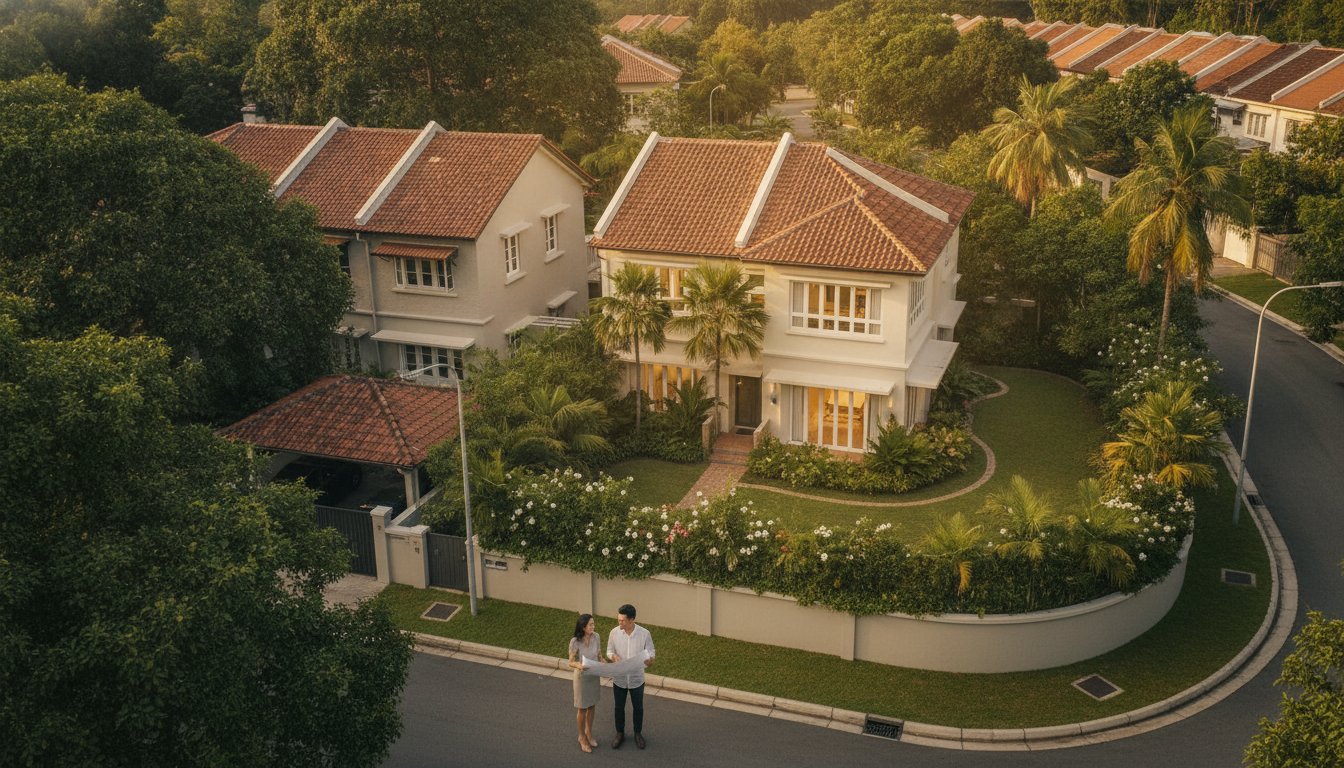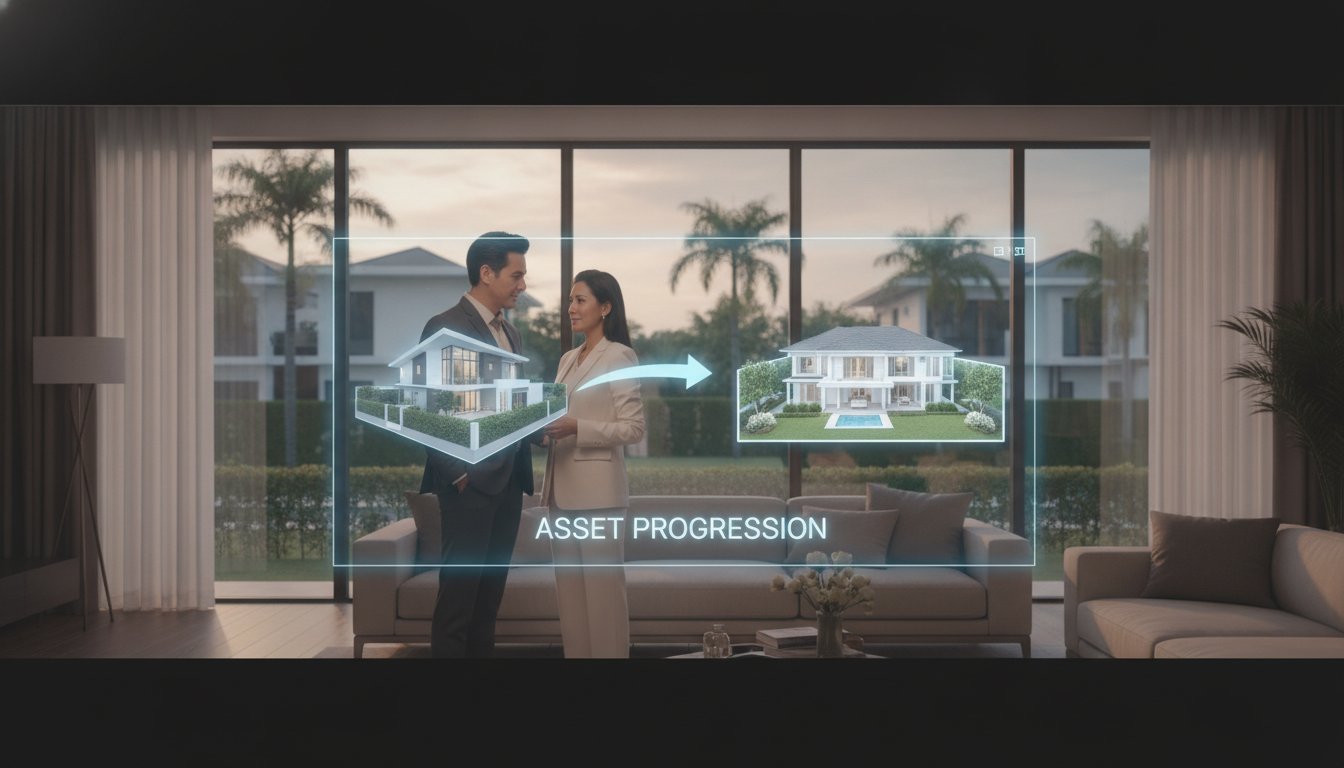
For the owner of a premium landed estate, the 20% to 30% Additional Buyer’s Stamp Duty (ABSD) isn’t merely a transaction cost; it’s a multi-million dollar hurdle that can stall your family’s wealth progression for a generation. You’ve likely spent years building equity in a terrace or semi-detached home, only to find yourself trapped by the prohibitive costs of expanding your portfolio. Successfully decoupling property singapore landed assets requires more than just a simple transfer of shares. It demands a surgical approach to valuation and a deep understanding of the regulatory environment to ensure your asset progression remains both profitable and compliant.
We understand that the fear of an IRAS audit or the complexity of refunding substantial CPF accrued interest often leads to strategic paralysis. This guide provides the clarity you need to move forward with confidence. You’ll learn how to navigate the sophisticated legal frameworks and financial restructuring necessary to acquire your next property while avoiding the 2026 ABSD rates. We will preview the essential steps for managing the 55% Total Debt Servicing Ratio (TDSR) and meeting the $110,200 Basic Retirement Sum (BRS) requirement, ensuring your transition is seamless, professional, and strategically sound.
Key Takeaways
- Understand the legal mechanics of the “Part-Share Purchase” and how it serves as the essential foundation for expanding a high-value landed portfolio.
- Learn to calculate the precise costs of decoupling property singapore landed assets, including the latest 2026 Buyer’s Stamp Duty rates and potential Seller’s Stamp Duty liabilities.
- Navigate the complexities of IRAS scrutiny by identifying the “99-1” pitfalls and ensuring your transaction maintains a clear, commercial purpose.
- Master the management of CPF accrued interest refunds and the 2026 Basic Retirement Sum requirements to maintain liquidity for your next acquisition.
- Discover bespoke exit strategies that facilitate a seamless transition from terrace houses to more prestigious detached homes or Good Class Bungalows.
Decoupling Landed Property in Singapore: A Strategic Overview for 2026
Decoupling is far more than a technical transfer of property shares between co-owners. It’s a high-level legal process that allows one spouse to buy out the other’s interest in a shared home. For owners of a detached house for sale Singapore, this maneuver is often the only viable path to expanding a portfolio without incurring massive tax leakage. It requires a disciplined approach to legal documentation and financial planning to ensure the transition is both effective and defensible.
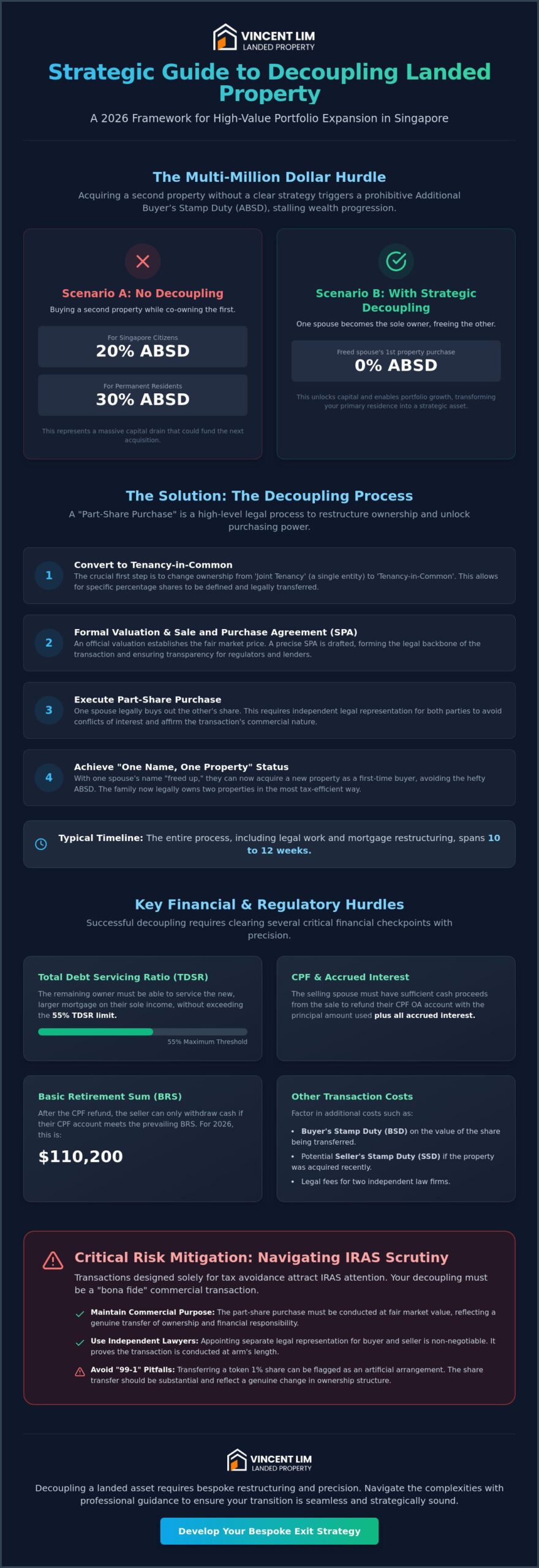
The 2026 property landscape remains defined by stringent cooling measures. Singapore Citizens currently face a 20% Additional Buyer’s Stamp Duty (ABSD) on their second residential purchase. Permanent Residents are hit even harder with a 30% rate. When you’re looking at a $10 million or $20 million asset, these taxes aren’t just fees; they’re capital drains that could have been used to fund the next acquisition. An elite strategist views decoupling property singapore landed assets as a vital tool for generational wealth preservation. It transforms a primary residence into a strategic platform for growth, rather than a locked asset.
The Core Objective: Freeing Up a Name
The primary goal of this exercise is to achieve a “one name, one property” status. This status allows a couple to own two properties while maintaining a 0% ABSD rate on both, provided each individual owns only one. Most landed properties are held in Joint Tenancy, which treats the owners as a single entity. To decouple, you must first convert this to a Tenancy-in-Common. This transition allows for the specific transfer of a percentage share. Timing is critical. In a luxury market where prices grew 0.9% in Q1 2026, executing this restructuring early prevents you from paying higher Stamp Duty on inflated future valuations.
Landed vs. Condo: Why the Stakes are Higher
Restructuring a landed asset is fundamentally different from decoupling a suburban condominium. The financial stakes are magnified by significantly higher land values. A mistake in valuation or a delay in legal filing can result in hundreds of thousands of dollars in unnecessary costs. Beyond the numbers, these transactions involve the family’s primary residence. This adds emotional and logistical layers that demand a “white-glove” approach. We call this “Bespoke Restructuring.” It requires coordinating two separate legal teams and ensuring the remaining owner can independently meet the Total Debt Servicing Ratio (TDSR) requirements for the new, larger mortgage. It’s a calculated move that requires precision over speed.
The Mechanics of Share Transfer: Navigating 2026 Legal Frameworks
Executing a “Part-Share Purchase” is the surgical core of the restructuring process. This legal maneuver involves one co-owner selling their undivided share of the property to the other. Unlike a standard market transaction, decoupling property singapore landed assets requires a high degree of transparency to satisfy both lenders and regulators. The process begins with a formal valuation to establish a fair market price, which serves as the basis for the Sale and Purchase Agreement (SPA). This document is the backbone of the transaction; it must be drafted with precision to reflect the actual terms of the transfer and the discharge of any existing liabilities.
Transparency is maintained through independent legal representation. Both the outgoing and incoming owners must appoint their own law firms to avoid any conflict of interest. This ensures that the transfer is a “bona fide” transaction, which is essential for risk mitigation. The typical timeline for a landed decoupling exercise spans 10 to 12 weeks. This period accounts for the legal work, mortgage restructuring, and the necessary filings with the Singapore Land Authority. If you’re considering this path, engaging a seasoned real estate strategist early can help streamline these moving parts and prevent costly delays.
Ownership Structures: Tenancy-in-Common
A transition from Joint Tenancy to Tenancy-in-Common is the non-negotiable prerequisite for a strategic exit. In a Joint Tenancy, owners are viewed as a single entity, making a share transfer impossible. By converting to Tenancy-in-Common, you define specific ownership percentages, such as a 50-50 split. While some explore “99-1” structures to minimize future transfer costs, 2026 regulations have placed these arrangements under intense scrutiny. Unless there’s a clear, documented commercial substance behind such a split, it may be flagged as an artificial tax avoidance scheme. Precision in the initial setup is far more valuable than aggressive tax positioning that invites an audit.
The Conveyancing Process for Landed Assets
Conveyancing for landed property is significantly more complex than for high-rise units. It requires a meticulous title search to identify potential encumbrances, such as drainage reserves or specific easements that could impact the property’s value or future redevelopment potential. Simultaneously, the existing mortgage must be discharged. The remaining owner then applies for a fresh housing loan, which must comply with the current 55% Total Debt Servicing Ratio (TDSR) and a maximum 75% Loan-to-Value (LTV) limit for a first housing loan. Coordination between law firms and lending institutions is vital to ensure that the new mortgage is disbursed exactly when the share transfer is finalized. This ensures the outgoing owner is fully released from the previous debt, freeing their name for the next acquisition at the current Buyer’s Stamp Duty (BSD) rates without the ABSD burden.
Financial Feasibility: Calculating the Real Cost of Decoupling
The financial architecture of a decoupling exercise is built on a clear understanding of tax liabilities and cash flow requirements. When you initiate a share transfer, the buyer must pay Buyer’s Stamp Duty (BSD) on the market value of the share acquired. For high-value landed assets, this often reaches the top tier of 6% for amounts exceeding $3 million. Additionally, if you’re restructuring a property acquired within the last few years, you must account for Seller’s Stamp Duty (SSD). For assets purchased after July 4, 2025, the holding period is four years, with rates starting at 16% if decoupled within the first year. Understanding Property Co-ownership in Singapore is vital here, as the legal structure dictates how these taxes are applied during the transfer.
A successful strategy hinges on a rigorous break-even analysis. You must weigh the total decoupling expenses, including stamp duties, legal fees, and mortgage restructuring costs, against the projected ABSD savings on your next acquisition. If you’re selling your landed property via a part-share transfer, the primary objective is to ensure the capital saved by avoiding a 20% ABSD on a second property significantly outweighs the friction costs of the transfer. For a $5 million second home, the $1 million in tax savings usually justifies the maneuver.
The CPF Accrued Interest Factor
One of the most overlooked hurdles in decoupling property singapore landed assets is the CPF refund. The outgoing owner must refund all CPF funds used for the property, plus the 2.5% accrued interest, back into their Ordinary Account in cash. For long-held terrace or detached houses, this accrued interest can be substantial. This cash outlay doesn’t go to the bank; it returns to your retirement fund. However, for a second property purchase in 2026, you must ensure your CPF accounts meet the Basic Retirement Sum of $110,200 before excess OA savings can be utilized. Strategic cash flow management is essential to ensure you have the funds available to complete the refund without compromising your next down payment.
Valuation Precision and IRAS Compliance
IRAS requires all share transfers to occur at “Fair Market Value.” Attempting to under-declare the value of a high-end landed asset to reduce stamp duty is a high-risk gamble that invites audits and penalties. A professional, bank-backed valuation is non-negotiable. It provides a defensible paper trail that proves the transaction has a genuine commercial basis. In the 2026 luxury market, where price divergence is common, having a precise valuation ensures your asset progression remains beyond reproach. Relying on “indicative values” is insufficient for landed property where land plot ratios and frontage can significantly alter the actual worth.
Risk Mitigation: Navigating IRAS Scrutiny and the 99-1 Pitfalls
The Inland Revenue Authority of Singapore (IRAS) has significantly intensified its oversight of property ownership structures in 2026. The primary focus is on “contrivance,” a legal term describing artificial arrangements designed solely to circumvent tax obligations. When decoupling property singapore landed assets, the transaction must demonstrate a clear commercial purpose beyond the mere avoidance of Additional Buyer’s Stamp Duty (ABSD). If IRAS deems a transfer to be a tax avoidance scheme, they possess the authority to claw back the unpaid ABSD and impose a surcharge of 50% on the tax avoided. This makes meticulous documentation of your “Commercial Justification” a non-negotiable requirement for any high-value restructuring.
Despite this increased scrutiny, decoupling remains a foundational and entirely legal strategy for asset progression. The key lies in the authenticity of the transfer. A genuine sale of shares at fair market value, supported by independent legal advice and a legitimate flow of funds, is a recognized property right. To ensure your restructuring meets the gold standard of compliance, you should consult an elite real estate strategist who can coordinate between legal and tax professionals to verify the defensibility of your specific case.
The 99-1 Audit Focus
The “99-1” ownership structure has become a primary target for audits. This occurs when a property is initially purchased with a 99% and 1% split, followed by a quick transfer of the 1% share to “free” a name for a second purchase. While only about 0.5% of private transactions involved such arrangements between 2018 and 2021, the 2026 regulatory environment treats them as a major red flag. A defensible structure requires more than just a legal signature; it requires proof of independent financing and actual cash flow. Elite strategists prioritize long-term compliance by ensuring that every share transfer is backed by a professional valuation and a transparent mortgage discharge process, rather than chasing short-term loopholes that invite investigation.
Financing and LTV Considerations
The most common hurdle in a landed decoupling exercise is the remaining owner’s ability to carry the mortgage solo. To complete the transfer, the individual retaining the property must secure a new housing loan that covers the outstanding debt plus the purchase price of the outgoing share. This individual must independently satisfy the Total Debt Servicing Ratio (TDSR), which remains capped at 55% of gross monthly income in 2026. With a maximum Loan-to-Value (LTV) limit of 75% for a first housing loan, the remaining owner needs a robust income profile and significant liquidity. For luxury landed assets, obtaining a pre-approval from a private bank is a critical first step. This provides the certainty needed to proceed with the decoupling without risking a financial shortfall that could stall the entire asset progression plan.
Bespoke Exit Strategies: Leveraging Decoupling for Your Next Acquisition
The completion of a successful decoupling exercise marks the beginning of a more ambitious chapter in your real estate journey. By strategically decoupling property singapore landed assets, you effectively unlock the potential for asset progression to landed property that was previously hindered by tax constraints. This maneuver serves as the catalyst for transitioning from a terrace house into a detached home or even a Good Class Bungalow. With one name now free from property ownership, you can secure a high-yield luxury condominium or a second landed asset while maintaining a 0% ABSD rate. This is the hallmark of the elite strategist: transforming existing equity into a diversified, high-growth portfolio.
For business owners who are simultaneously expanding their real estate portfolios, maintaining a high-end corporate image is equally important; utilizing premium corporate gifts from SwagStore.NET ensures that your professional relationships are managed with the same level of care and quality.
Just as a property portfolio requires careful structuring, establishing a dominant market presence is key to long-term success; for those looking to scale their influence, Branding TITANS™ provides the essential guide for building a business empire in the modern age.
Vincent Lim acts as the essential partner for coordinating these multi-stage luxury transactions. Managing the sale of a semi-detached house while simultaneously restructuring the ownership of a detached home requires a level of precision that standard agencies cannot provide. We ensure that the timing of your decoupling aligns perfectly with your next acquisition, preventing capital from sitting idle and ensuring you remain ahead of market shifts. This integrated approach minimizes friction and maximizes the compounding effect of your real estate investments.
Wealth Legacy and Portfolio Diversification
Freehold landed property in Singapore is a finite resource and a cornerstone of generational wealth. A disciplined buy-and-hold strategy for these assets ensures that your family’s legacy is preserved against inflation and market volatility. Decoupling facilitates this by allowing families to restructure ownership today, preparing the ground for a seamless transfer of wealth to the next generation. The peace of mind that comes from a meticulously planned property portfolio is invaluable. It provides the security of tangible, high-value assets while maintaining the flexibility to pursue new investment opportunities as they arise in the 2026 landscape.
Next Steps: The Strategic Consultation
Every successful progression begins with a personalized financial audit. Before you commence the process of decoupling property singapore landed, it’s essential to analyze your current debt profile, CPF usage, and long-term liquidity needs. Vincent Lim’s team provides a white-glove service that integrates legal and tax expertise into a single, cohesive strategy. This ensures that every move you make is defensible, compliant, and optimized for growth. We invite you to a private session to refine your 2026 property strategy. Together, we’ll build a roadmap that secures your current assets while paving the way for your next prestigious acquisition.
Securing Your Legacy Through Precision Restructuring
Decoupling is the surgical maneuver that transforms a stagnant asset into a strategic investment platform. By mastering the legal mechanics of share transfers and navigating the 2026 tax landscape, you protect your capital from unnecessary ABSD leakage. The process of decoupling property singapore landed assets requires a disciplined approach to valuation and financing. This ensures every move remains beyond the scrutiny of regulatory audits while paving the way for your next detached home or Good Class Bungalow acquisition.
Success in the high-stakes luxury market demands more than just a transaction; it requires a veteran partner who understands the nuances of bespoke restructuring. Consult Vincent Lim for a Bespoke Landed Property Restructuring Strategy to ensure your asset progression is seamless and compliant. As an Executive Associate Director at OrangeTee & Tie and a specialist in Good Class Bungalows and luxury landed sales, Vincent brings over 20 years of Singapore real estate expertise to your portfolio. Your transition to a more prestigious estate is a calculated move that rewards precision and foresight.
Frequently Asked Questions
Can I decouple an HDB flat to buy a landed property in 2026?
No, you cannot decouple an HDB flat for the purpose of acquiring a second property. Current HDB regulations, which have been in effect since 2016, strictly prohibit ownership transfers between married couples except in specific circumstances such as divorce, financial hardship, or the death of an owner. If you currently own an HDB flat and wish to enter the landed market, you must typically sell the flat first to avoid ABSD on your new purchase.
Is the “99-1” ownership structure legal for landed properties?
The “99-1” structure is technically a legal form of Tenancy-in-Common, but it’s under intense scrutiny by IRAS in 2026. If the arrangement is deemed a “contrivance” used solely for tax avoidance without commercial substance, it can lead to severe penalties. When decoupling property singapore landed assets, it’s safer to ensure the share transfer reflects a genuine, documented change in ownership and financial responsibility rather than an artificial split.
How much are the typical legal fees for decoupling a detached house?
Legal fees for decoupling a high-value asset like a detached house typically range between $5,500 and $6,000. This cost arises because the process requires two separate law firms to represent the buyer and seller independently to avoid conflicts of interest. These fees cover the drafting of the Sale and Purchase Agreement, the discharge of the existing mortgage, and the documentation for the new housing loan.
What happens to the existing mortgage when we decouple?
The existing mortgage must be fully discharged before the share transfer can be finalized. The owner retaining the property then applies for a fresh housing loan in their sole name. This new loan must comply with the 2026 Total Debt Servicing Ratio (TDSR) limit of 55% and a maximum Loan-to-Value (LTV) of 75%. The borrower’s income must be robust enough to support the entire debt independently.
Do I need to pay Seller’s Stamp Duty (SSD) when transferring my share?
You must pay Seller’s Stamp Duty (SSD) if the transfer occurs within the applicable holding period. For landed properties purchased on or after July 4, 2025, the holding period is four years, with rates starting at 16% for transfers within the first year. Properties bought before this date follow the previous three-year holding period rules. This cost must be factored into your initial feasibility study.
Can I use my CPF to buy over my spouse’s share of the landed property?
Yes, you can utilize your CPF Ordinary Account (OA) savings to buy over your spouse’s share, including the purchase price and Buyer’s Stamp Duty. However, you must ensure that you meet the 2026 Basic Retirement Sum (BRS) of $110,200 if you’re using CPF for a second property purchase. The exiting spouse must also refund their used CPF plus accrued interest back into their own account in cash.
How long must I wait after decoupling before buying a second property?
There is no statutory waiting period; you can technically purchase your next property once the Sale and Purchase Agreement for the decoupling is signed and stamp duty is paid. However, executing an immediate second purchase can be a red flag for IRAS audits. A methodical approach that demonstrates a clear commercial basis for decoupling property singapore landed assets is always the more professional and prudent strategy.
What are the risks of using a “contrived” decoupling structure?
The primary risks include the full clawback of the avoided ABSD and a mandatory 50% surcharge penalty. IRAS actively audits transactions that lack commercial justification or appear artificial. Beyond the substantial financial penalties, a “contrived” structure can lead to prolonged investigations that disrupt your long-term asset progression and overall financial standing. Professional advice is essential to ensure your restructuring remains beyond reproach.