In a nation where 77.2% of households reside in HDB flats and almost every plot of land is governed by a ticking clock, owning a piece of Singapore that you truly hold forever is the ultimate mark of distinction. With only about 73,000 landed homes in existence, you understand that you aren’t just buying a residence; you’re securing one of the rarest assets in the world. Many high net worth individuals share your concern that leasehold depreciation will eventually devalue their hard earned assets, especially as the 99 year countdown continues to accelerate.
Understanding the benefits of owning a freehold landed property is essential for any serious investor looking to protect their capital from inflation. This article will show you why freehold tenure remains the gold standard for wealth preservation and long term legacy planning in our land scarce market. We’ll analyze how these properties defy the gravity of lease decay, offer superior redevelopment potential, and provide the peace of mind that comes with a permanent family seat. From current 2026 tax rebates to the resilience of the landed price index, we provide the strategic clarity you need to navigate this elite segment with confidence.
Key Takeaways
- Understand why freehold land is a finite resource in Singapore and how this scarcity fundamentally protects your capital.
- Learn how the benefits of owning a freehold landed property include immunity from the accelerated depreciation typically caused by lease decay.
- Discover how to maximize your land’s potential through total redevelopment autonomy without the cost of lease top-up premiums.
- Explore strategic legacy planning to ensure your property remains a permanent, multi-generational asset for your family.
- Gain a competitive advantage by understanding the role of specialized brokerage and off-market listings in the luxury landed segment.
The Scarcity Factor: Why Freehold Landed Property is a Finite Asset
Ownership in Singapore is typically a race against a 99-year clock. A freehold property breaks this cycle by offering perpetual rights to the land. Unlike leasehold titles that eventually revert to the state, freehold tenure grants you absolute control for generations. This distinction is vital because the Singapore Land Authority (SLA) has shifted its policy toward leasehold land sales for almost all new residential developments. This means that the existing pool of freehold land is effectively frozen; it’s a finite resource that cannot be replenished through future government land sales.
The scarcity factor isn’t just a marketing buzzword. It’s a structural reality of the Singaporean economy. When you consider the benefits of owning a freehold landed property, you must look beyond the physical structure of the house. You’re acquiring a trophy asset that the elite prize for its rarity and permanence. As the population grows and urban density increases, these permanent titles become increasingly valuable. They represent a sovereign-like claim in one of the world’s most stable economies.
The Rarity of Permanent Land Ownership
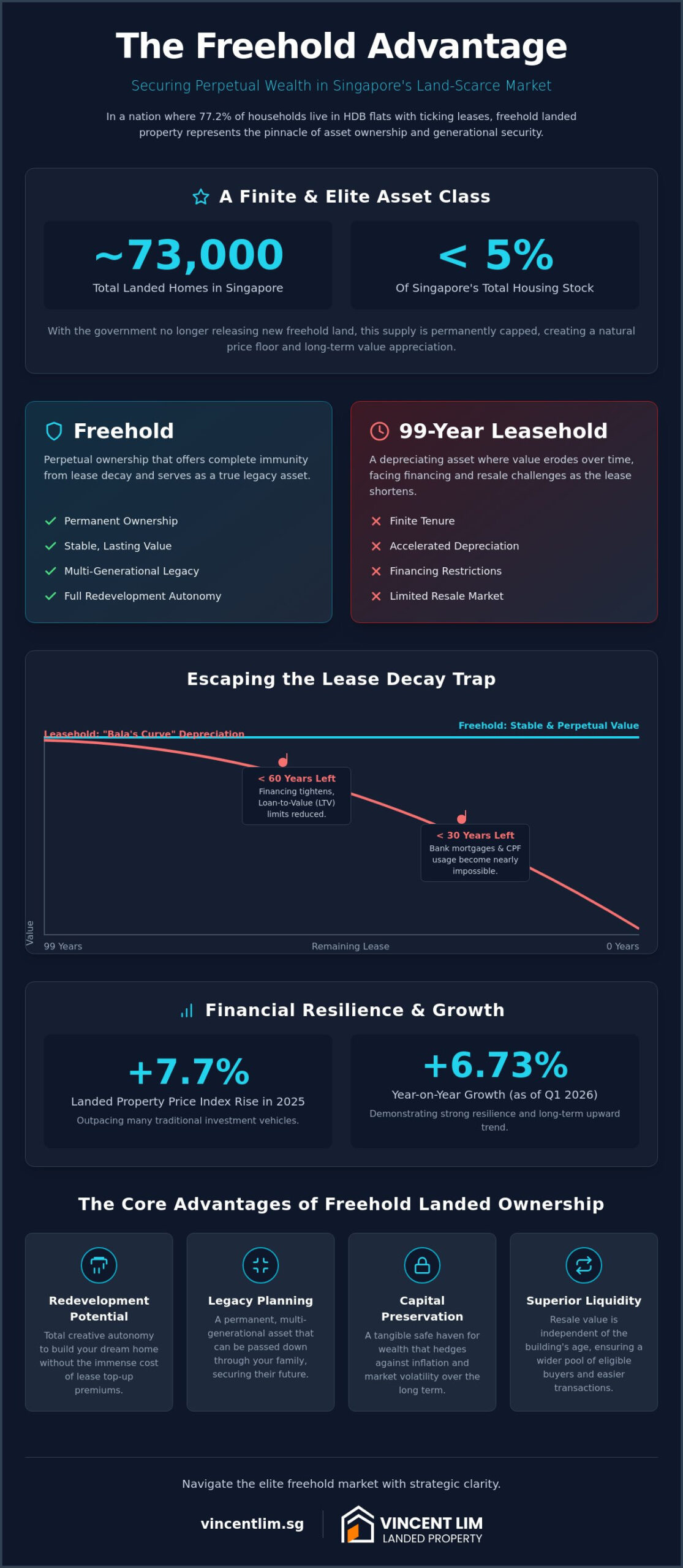
With fewer than 73,000 landed homes in Singapore, these properties represent less than 5% of the total housing stock. Most new developments are strictly 99-year leasehold, which makes legacy freehold plots even more desirable. The prestige of owning land is amplified when it carries a freehold title. This is particularly evident when discussing what is a Good Class Bungalow, as these properties represent the pinnacle of Singapore’s real estate hierarchy. This extreme scarcity creates a natural price floor. Even during market corrections, the limited supply prevents the sharp devaluations often seen in high-density leasehold projects.
Freehold as a Hedge Against Inflation
Landed assets have historically served as a premier safe haven for wealth. In 2025, the landed property price index rose by 7.7%, outpacing many traditional investment vehicles. High net worth individuals prioritize land because it’s a tangible asset that resists the eroding effects of inflation. While the market saw a slight 0.40% dip in Q1 2026, prices remained 6.73% higher year-on-year. This resilience proves that land values in Singapore tend to trend upward over the long term. One of the primary benefits of owning a freehold landed property is this ability to store value without the ticking clock of lease decay affecting your eventual exit strategy or valuation.
Immunity to Lease Decay: Protecting Your Capital for Decades
The most significant risk for any property owner in Singapore is the invisible erosion of value known as lease decay. Most leasehold assets follow “Bala’s Curve,” a theoretical model used to determine the value of land based on its remaining tenure. Under Singapore’s official land tenure system, leasehold values don’t decline at a steady, linear rate. Instead, depreciation accelerates as the lease shortens. Freehold owners are entirely immune to this phenomenon. Their capital isn’t subject to the “accelerated depreciation” that plagues 99-year titles once they cross the mid-life mark. This immunity ensures that your investment remains a stable store of value regardless of how many decades pass.
Understanding the Leasehold Depreciation Trap
Financial institutions become increasingly cautious as a leasehold property approaches the 60-year and 30-year marks. Once a property has less than 60 years remaining, lenders often reduce the Loan-to-Value (LTV) limit, making it harder for future buyers to secure financing. When the remaining lease drops below 30 years, securing a standard bank mortgage becomes nearly impossible. This creates a liquidity trap. Even if the house is in pristine condition, the pool of eligible buyers shrinks because they can’t use their CPF or obtain a bank loan. Freehold assets remain liquid regardless of age. You can sell a 50-year-old freehold terrace house with the same ease as a brand-new one because the underlying land value never expires.
Resale Value Resilience in 2026
In the current 2026 market, we’re seeing a distinct “pricing stand-off” where sellers of landed homes are holding firm on their valuations. This resilience is a direct result of the “well-held” nature of freehold ownership. Owners don’t feel the pressure to sell before a lease expires, allowing them to wait for the right offer. This stability is reflected in the average price of semi-detached house in Singapore, which continues to show strength despite broader economic shifts. One of the key benefits of owning a freehold landed property is the psychological peace of mind it provides. You’ll never have to worry about your family home becoming a wasting asset that eventually returns to zero value.
Securing a freehold title means you’re buying time as much as you’re buying land. If you’re currently weighing the long-term implications of your property portfolio, it helps to consult a seasoned strategist who understands these technical nuances and can help you navigate the high-end market with precision. This proactive approach ensures your capital is protected for the next generation and beyond.
Redevelopment Potential and Creative Autonomy
Control defines elite land ownership. When you own the land in perpetuity, you possess the absolute right to reshape your environment without the looming shadow of lease expiration. One of the most significant financial benefits of owning a freehold landed property is the total absence of “lease top-up” premiums. For leasehold owners, any major intensification of land use or redevelopment often requires a substantial payment to the state to reset the clock to 99 years. Freehold owners bypass this hurdle entirely; every dollar spent on construction goes directly into the quality and value of the structure itself.
Developers and boutique investors prioritize freehold plots for this exact reason. The ability to subdivide a large plot or maximize the built-up area through Additions & Alterations (A&A) is far more lucrative when the underlying tenure is permanent. You have the freedom to transform an aging property into a multi-generational estate without asking for permission from a ticking clock. This creative autonomy allows you to future-proof your home against changing lifestyle needs or architectural trends.
Building Your Bespoke Vision
Redeveloping an “original condition” home into a modern masterpiece is a preferred strategy for savvy investors. In the segment of detached house for sale Singapore transactions, the land’s size and shape often matter more than the existing building. Because the tenure is permanent, you can justify the high capital expenditure required for premium materials and bespoke architectural designs. You aren’t just building a house; you’re creating a permanent monument to your family’s success. This is why “original condition” freehold homes often command high interest; they are blank canvases for a legacy vision.
En-Bloc and Collective Sale Advantages
The advantages extend into the logic of collective sales. Developers actively seek freehold plots because they offer higher margins and fewer regulatory complications. According to NUS research on freehold property value, these assets command a significant premium because they capture the full long-run growth of the land. In an en-bloc scenario, freehold owners typically receive a larger share of the proceeds. They don’t have to deduct the cost of tenure renewal from their payout, giving them superior leverage during negotiations with developers who are hungry for land in a supply-constrained market.
Legacy Planning: The Multi-Generational Wealth Strategy
Legacy planning in Singapore requires a strategic shift from high-yield speculation to long-term capital preservation. While luxury condominiums serve as excellent stepping stones, they remain wasting assets if held on a leasehold basis. One of the primary benefits of owning a freehold landed property is its capacity to serve as a permanent, intergenerational gift. Because the title never expires, you’re transferring a sovereign-like asset that retains its utility and value regardless of market cycles or changing urban landscapes. You aren’t just passing down a building; you’re bequeathing a piece of a finite nation.
The legal framework in Singapore supports this long-term vision. Since the abolition of estate duty in 2008, the transfer of real estate to the next generation has become a highly efficient method of wealth transmission. A freehold title ensures that this transfer can happen repeatedly over a century without the threat of the state reclaiming the land. This permanence allows families to build a “family headquarters” that acts as a financial and emotional anchor for descendants, providing them with a secure base in one of the world’s most expensive real estate markets.
Securing Your Family’s Future
Sophisticated investors often view a freehold home as the core component of a family office’s real estate portfolio. The stability of land provides a hedge against the volatility found in equity markets. Many clients follow a disciplined path of asset progression to landed property Singapore, moving from luxury apartments to terrace houses, and eventually into detached estates. This progression ensures that the family’s net worth is eventually consolidated into land, which is the most resilient asset class in our city-state. For the 2026 fiscal year, owner-occupiers also benefit from a 10% property tax rebate, capped at S$500, which adds a layer of immediate fiscal efficiency to long-term ownership.
The Emotional Value of a Permanent Home
Beyond the balance sheet, a freehold estate offers an emotional stability that leasehold properties cannot match. There is a profound sense of pride in owning the ground you stand on. In a high-density city where privacy is the ultimate luxury, a landed home provides a sanctuary for family traditions to take root. You have the space to host multi-generational gatherings and the privacy to live without the constraints of shared walls or communal facilities. This permanence fosters a sense of belonging and continuity that is essential for preserving a family’s history over multiple decades. It’s a sanctuary that remains yours, forever.
If you’re ready to secure your family’s future with a permanent asset, speak with an elite property strategist today to begin your acquisition journey with precision and care.
Navigating the Freehold Market with an Elite Strategist
Acquiring a landed home is one of the most complex financial maneuvers you’ll undertake in Singapore. While the general market focuses on unit prices and floor plans, the landed segment demands a rigorous understanding of land-use regulations and technical constraints. One of the subtle but critical benefits of owning a freehold landed property is the long-term flexibility it offers, but this value is only realized if you perform meticulous due diligence before the purchase. Issues like drainage reserves, road line plans, and specific setbacks can significantly restrict your redevelopment plans if they aren’t identified early.
Privacy is a currency in the luxury segment. Many of the most coveted freehold plots are held by families who prefer discreet transactions. Accessing these off-market listings requires an established network and a reputation for handling high-stakes deals with absolute discretion. This is where an elite strategist becomes indispensable, acting as your bridge to opportunities that remain invisible to the general public. We ensure that every acquisition is backed by a calculated strategy that accounts for both current market conditions and future capital appreciation.
The Importance of Specialized Expertise
A generic agent might understand the transaction process, but they often lack the technical depth required for high-end landed assets. Understanding the nuances of Good Class Bungalow (GCB) zones or the specific requirements for luxury detached homes is essential to protecting your capital. If you’re on the other side of the transaction, our strategic guide to selling your landed property outlines how we position these unique assets to command a premium in a competitive market. We prioritize precision over volume, ensuring your interests are represented with seasoned authority.
Your Journey to Permanent Ownership
Our approach to landed acquisitions is built on a foundation of transparency and calculated competence. We don’t just show you houses; we curate a bespoke search that aligns with your legacy goals. This involves analyzing the technical potential of every plot and coordinating with experts to ensure your vision is achievable. By understanding the full range of benefits of owning a freehold landed property, you’re better positioned to make a decision that serves your family for generations. Secure your future with a partner who values your success as much as you do. Consult with Vincent Lim for a bespoke landed property strategy today and take the first step toward securing a permanent family legacy.
Securing Your Sovereign Footprint in Singapore
Owning land in a city-state is a rare privilege; owning it forever is a deliberate strategy. We’ve explored how permanent tenure removes the anxiety of lease decay and provides the creative freedom to build a bespoke family estate. These core benefits of owning a freehold landed property ensure that your capital remains protected against the inflationary pressures of an evolving urban landscape. By choosing freehold, you’re prioritizing long-term stability and multi-generational security over short-term speculation.
Navigating this high-stakes market requires more than just a transaction; it demands a partnership with a guide who understands the technical and emotional weight of your investment. With over 20 years of Singapore real estate expertise, Vincent Lim serves as a specialist in Good Class Bungalows (GCB) and luxury landed homes. As an Executive Associate Director at OrangeTee & Tie, he provides the meticulous planning and seasoned authority your portfolio deserves.
Secure your legacy with a bespoke freehold property consultation with Vincent Lim today. It’s time to anchor your family’s wealth in the most resilient asset class Singapore has to offer. Your future starts with the ground you stand on.
Strategic Insights: Frequently Asked Questions
Is it always better to buy freehold over leasehold in Singapore?
The choice depends on your investment horizon and specific financial objectives. Leasehold properties often provide higher rental yields and a lower entry price point, which may suit investors seeking short term cash flow. However, if your priority is capital preservation or creating an intergenerational legacy, the benefits of owning a freehold landed property are superior because they eliminate the risks of lease decay and terminal value loss.
How much more does a freehold landed property cost compared to a leasehold one?
Freehold properties typically command a price premium of 10% to 20% over comparable leasehold assets. This gap reflects the value of permanent ownership and the absence of future lease top up costs. In the 2026 market, this premium is often viewed as a necessary insurance policy against the accelerated depreciation that leasehold homes face as their remaining tenure drops below 60 years.
Can foreigners buy freehold landed property in Singapore?
Foreigners and Permanent Residents are generally restricted from purchasing landed property unless they obtain special approval from the Land Dealings Approval Unit (LDAU). This requirement applies to both freehold and leasehold titles. The government typically grants approval only to individuals who have made significant economic contributions to the nation and intend to use the property for their own occupation.
Does freehold property really last forever, or can the government take it back?
Freehold tenure implies perpetual ownership, yet it remains subject to the Land Acquisition Act. The state retains the power to acquire any land for essential public infrastructure projects, such as new MRT lines or expressways. While such acquisitions are rare in established landed estates, owners are legally entitled to market rate compensation based on the property’s value at the time of acquisition.
What are the maintenance costs associated with freehold landed homes?
Landed homeowners are entirely responsible for the upkeep of their property since there are no monthly management fees. You should budget for regular expenses such as pest control, garden maintenance, and roof inspections. One of the long term benefits of owning a freehold landed property is that every dollar spent on structural maintenance directly enhances an asset that you will own forever, rather than a wasting leasehold interest.
How do I identify if a landed property is truly freehold?
You can confirm a property’s legal tenure by performing a title search through the Singapore Land Authority (SLA) INLIS portal. The title will specifically state if the land is “Estate in Fee Simple” or a “Statutory Land Grant,” both of which are forms of freehold ownership. We recommend conducting this search as part of your initial due diligence to ensure the marketing descriptions align with official records.
Is a 999-year leasehold property the same as a freehold property?
A 999-year leasehold is effectively treated as freehold by both banks and the secondary market. Because the expiry date is so distant, the property doesn’t experience the valuation drop associated with leasehold decay. You’ll find that these titles command similar premiums and offer the same financing flexibility as standard freehold plots, making them a highly desirable alternative for long term wealth storage.
What is the “en-bloc” potential for freehold landed houses?
Freehold landed estates often have higher en-bloc potential because developers don’t need to pay the state for a lease extension. This makes the acquisition more profitable for developers looking to intensify land use by rebuilding multiple smaller units on a large plot. Owners typically enjoy greater bargaining power in these collective sale negotiations because they aren’t facing the pressure of a ticking lease clock.