With less than 5% of Singapore’s total housing stock consisting of landed homes, the transition from a premium condominium to a freehold estate is no longer a simple upgrade. It’s a strategic entry into a diminishing asset class defined by extreme scarcity. You’ve likely noticed the widening price gap between the luxury condo market and landed segments, making the leap feel increasingly complex. Navigating the 2026 tax landscape, including the 20% ABSD for a Singapore citizen’s second property or the 55% TDSR threshold, requires a level of precision that traditional real estate advice often lacks.
This guide delivers the definitive asset progression strategy singapore landed property investors need to secure a multi-generational legacy and maximize capital appreciation. We’ll examine the strategic framework for identifying properties with genuine redevelopment potential and provide a clear roadmap toward owning a prestigious Good Class Bungalow. You’ll gain the insights necessary to move beyond standard market participation and into the realm of elite wealth preservation, ensuring your next move is both calculated and highly profitable. By understanding the nuances of land scarcity and refined tax management, you can confidently secure your family’s financial future in Singapore’s most exclusive neighborhoods.
Key Takeaways
- Identify the strategic shift from lifestyle-based luxury condominiums to high-yield scarcity assets within the 2026 market.
- Implement a methodical asset progression strategy singapore landed property framework to move seamlessly from terrace houses to prestigious Good Class Bungalows.
- Navigate complex 2026 financial structures, including ABSD management and the strategic viability of “Sell One, Buy Two” maneuvers.
- Leverage the URA Master Plan 2026 to identify landed properties with the highest potential for long-term capital appreciation and land scarcity value.
- Gain a competitive edge by accessing off-market GCB listings and bespoke pocket deals through a partnership with an elite strategist.
Defining Asset Progression for the Singapore Landed Market
Asset progression in the 2026 market is no longer a simple linear journey from public housing to a private apartment. It has evolved into a disciplined wealth-building framework designed to move capital into the most resilient asset class in the country. While many investors focus on rental yield or temporary market trends, the elite strategist views real estate through the lens of long-term capital recycling. This asset progression strategy singapore landed property owners utilize focuses on the transition from “lifestyle assets”, such as luxury condominiums, to “scarcity assets” that derive their value from the ground they occupy. It’s a methodical process of refining your portfolio to ensure every dollar is anchored in tangible, finite land.
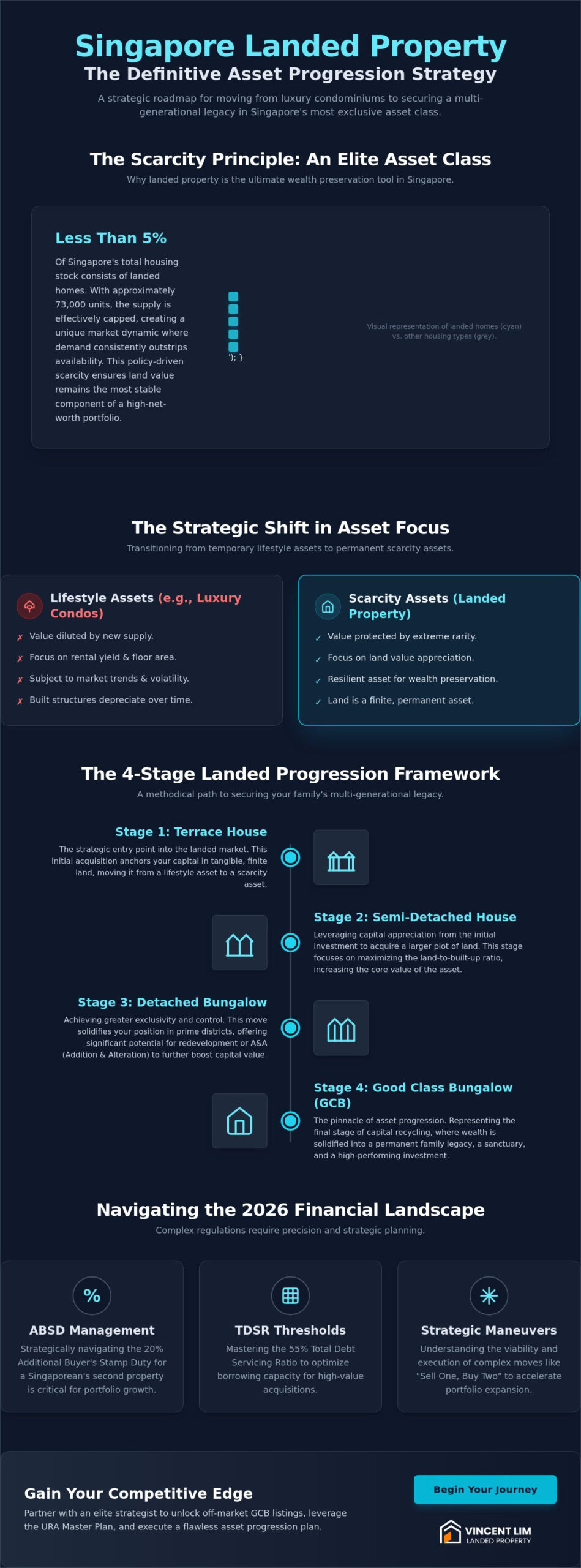
The fundamental strength of the landed segment lies in its extreme rarity. When you examine Singapore’s housing landscape, it becomes clear that the vast majority of the population resides in high-rise, high-density developments. Landed homes constitute less than 5% of the total housing stock, creating a natural floor for valuations. This scarcity ensures that while the broader market might fluctuate, the landed segment remains the most resilient asset class for wealth preservation. It acts as a fortress for capital, protecting wealth from the volatility often seen in the high-end condo market where new supply can frequently dilute value.
The Shift from Rental Yield to Land Value
High-net-worth individuals prioritize land over floor area because land is the only component of real estate that cannot be manufactured. In a successful asset progression strategy singapore landed property owners often accept lower immediate rental yields in exchange for the intrinsic value of freehold tenure. They understand that the price-per-square-foot of land usually appreciates faster than that of built-up area. Built structures depreciate over time; however, the underlying land value in a land-scarce nation remains a stable pillar of growth. By focusing on land-to-built ratios, savvy investors ensure they’re buying the asset that truly matters for long-term appreciation.
The Landed Property Pinnacle
The ultimate end-goal for most domestic investors is the Good Class Bungalow, yet the journey often begins with a strategic terrace house for sale Singapore acquisition. This progression represents more than just a financial victory. It’s a hedge against inflation and a method of securing a multi-generational legacy. Land is finite. Its value is permanent. Owning a prestigious landed address provides emotional and social capital that even the most expensive penthouse cannot replicate. It represents the final stage of capital recycling, where wealth is solidified into a permanent family asset that serves as both a sanctuary and a high-performing investment.
The Scarcity Principle: Why Landed Property is the Ultimate End-Game
The allure of Singapore’s landed market isn’t merely prestige; it’s a matter of mathematics. With only approximately 73,000 units available, landed properties represent less than 5% of the total housing stock. This fixed supply creates a unique market dynamic where demand consistently outstrips availability. Unlike the condominium segment, where new launches can add thousands of units to a specific district, the landed supply is effectively capped. The URA Master Plan 2026 continues to prioritize high-density living to accommodate a growing population, which means the zoning for landed estates is unlikely to expand. This policy-driven scarcity ensures that “land value” remains the most stable component of a high-net-worth individual’s portfolio.
While various property cooling measures have been implemented to manage market exuberance, the fundamental value of a detached house remains intact. These assets are often the final destination in a sophisticated asset progression strategy singapore landed property owners follow. Because land-use policies are increasingly restrictive, owning a significant plot of land in a prime district becomes a defensive play against inflation. It’s a tangible asset that doesn’t just store wealth but actively appreciates as the surrounding city becomes more densely populated.
Freehold vs Leasehold: The 2026 Perspective
Choosing between freehold vs leasehold landed property is a critical decision that dictates your long-term exit strategy. In 2026, lease decay is a more prominent concern for investors as older 99-year titles approach their mid-life point. For those focused on legacy planning, freehold or 999-year leasehold titles are the gold standard. They provide peace of mind that the asset won’t lose value due to an expiring clock. If you’re looking to refine your current holdings, exploring bespoke landed opportunities can help you identify titles with the best longevity.
Redevelopment Potential as a Value Driver
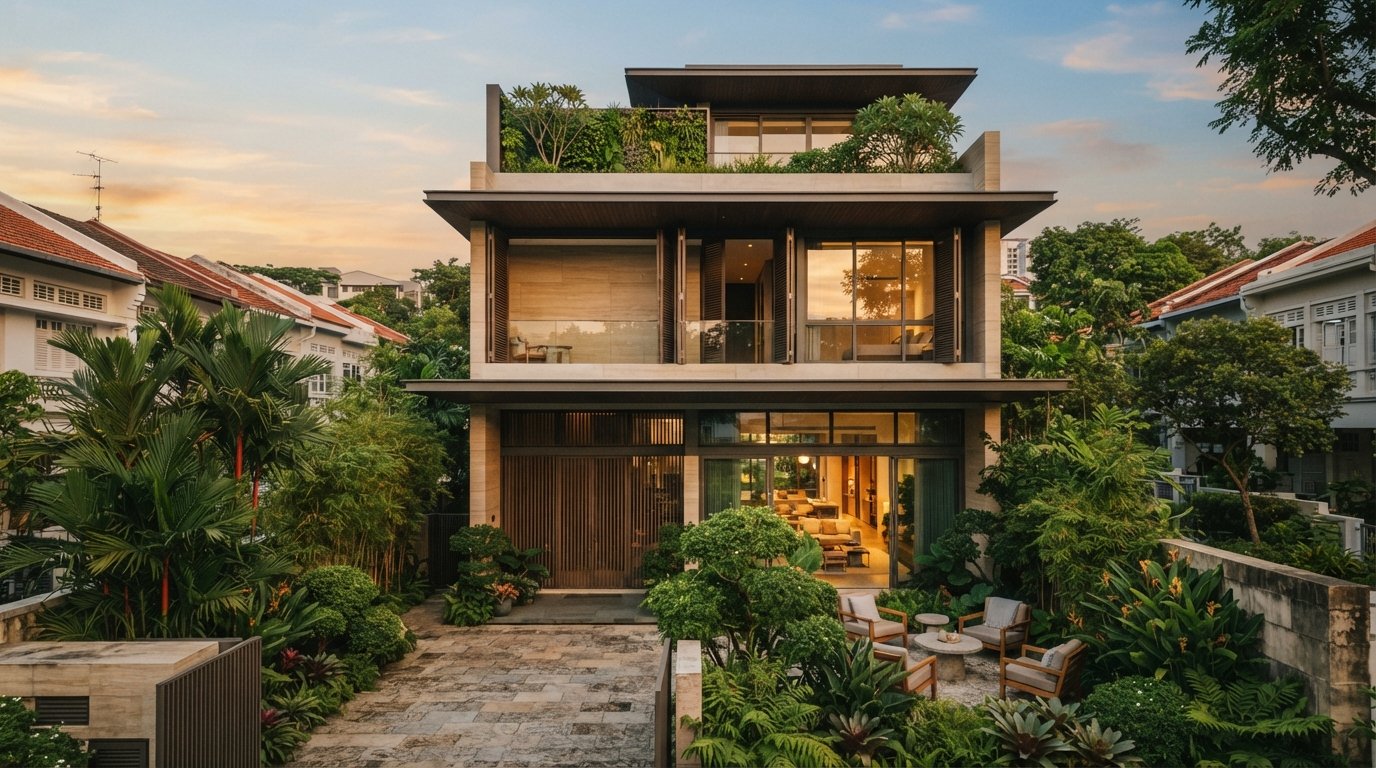
The most lucrative gains in the landed market often come from identifying “under-developed” plots. These are typically older properties where the built-up area is significantly smaller than what current plot ratios allow. By acquiring a legacy semi-detached house and rebuilding it into a modern, three-story masterpiece, you can unlock substantial “exit value.” The math of rebuilding is precise. It requires a deep understanding of construction costs versus the projected market value of a brand-new build. A well-executed redevelopment can outperform the broader market by creating a product that meets the exacting standards of today’s luxury buyers.
The 4-Stage Landed Progression Framework
Most property guides focus on the transition from public housing to private apartments, yet the elite strategist understands that a penthouse is often just the beginning. Achieving the pinnacle of Singapore real estate requires a methodical asset progression strategy singapore landed property owners use to navigate the tiers of land ownership. This journey isn’t merely about increasing square footage; it’s about shifting capital into increasingly rare land titles that offer greater autonomy and long-term capital protection. By following a structured four-stage framework, you can systematically build the equity required to secure a legacy asset.
Stage 1 & 2: The Entry into Landed Living
The first step typically involves transitioning from a high-floor luxury condominium or penthouse into a terrace house. This move trades communal facilities for land control. Many investors use this “stepping stone” phase to build substantial equity as land prices appreciate. Once sufficient capital is consolidated, the next logical move is to a semi-detached house. It’s vital to evaluate the average price of semi-detached house in Singapore against corner terraces, as the price gap can vary significantly by district. A common pitfall during this stage is underestimating the shift in responsibility. You’re no longer paying an MCST to manage your roof or facade; you’re now the sole decision-maker for all structural maintenance and upgrades.
Stage 3 & 4: Reaching the Luxury Pinnacle
Stage 3 represents the leap to a detached house. This stage is defined by the prestige of a private compound with no shared walls, offering a level of privacy that even the finest semi-detached homes cannot match. Identifying a detached house for sale Singapore investors find attractive requires looking for plots with wide frontages and redevelopment potential. This sets the foundation for the final stage: the Good Class Bungalow (GCB).
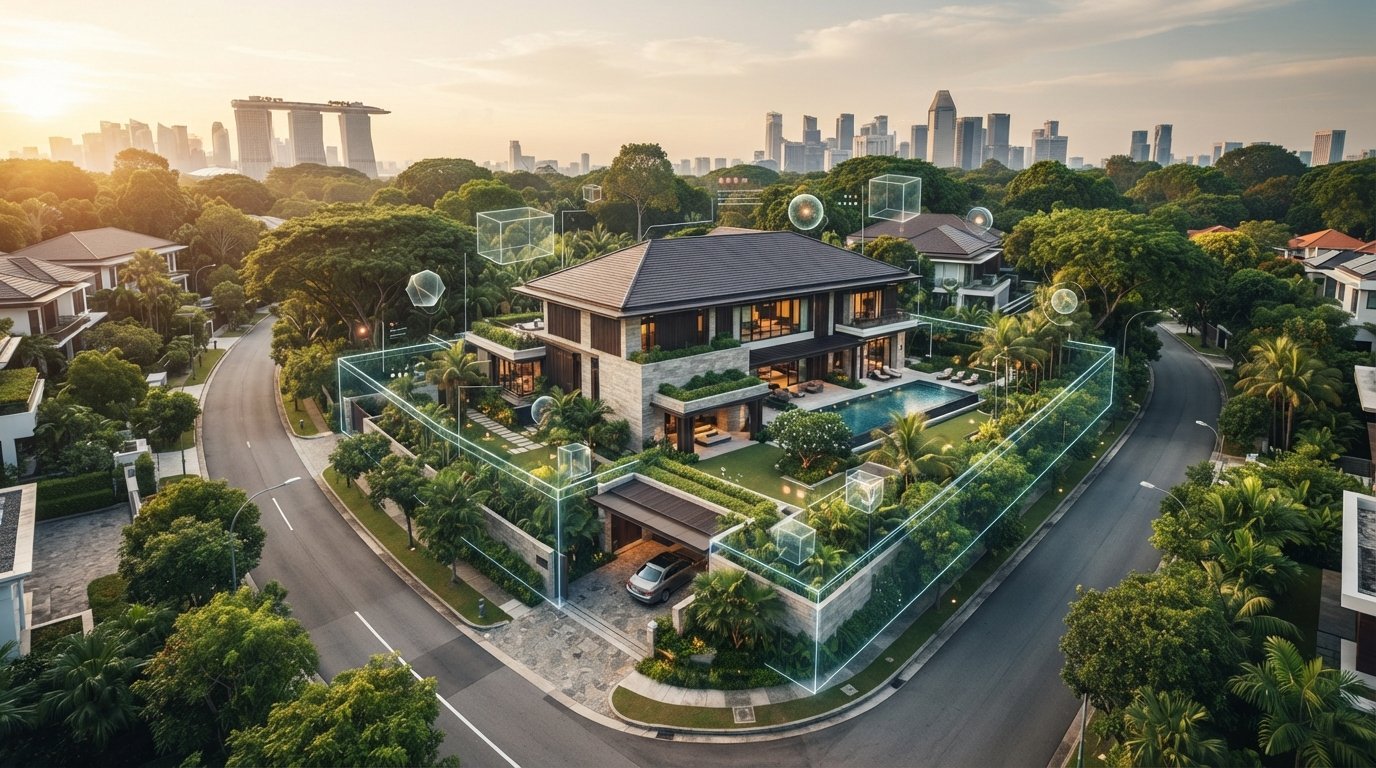
Understanding what is a Good Class Bungalow is essential for anyone aiming for the “Gold Standard” of Singapore wealth planning. GCBs are restricted to 39 designated areas and come with strict planning requirements, such as a minimum land plot of 1,400 square metres. These assets are the ultimate hedge against economic volatility. They serve as multi-generational family seats that maintain their value through decades of market cycles. At this level, the asset progression strategy singapore landed property experts recommend focuses less on short-term gains and more on the preservation of a permanent family legacy.
Strategic Financial Structuring for High-Value Acquisitions
Navigating the 2026 tax landscape requires more than just capital; it demands meticulous planning. For Singapore Citizens, the 20% Additional Buyer’s Stamp Duty (ABSD) on a second residential property makes the traditional “Sell One, Buy Two” strategy significantly more expensive than it was a decade ago. To execute a successful asset progression strategy singapore landed property owners often utilize decoupling or “tenants-in-common” structures. These methods allow couples to separate their property ownership, effectively freeing up one individual to purchase a landed asset as a first property, thereby qualifying for the 0% ABSD rate. However, this requires a high degree of financial discipline and a robust buffer to manage the 55% Total Debt Servicing Ratio (TDSR) threshold across the household.
A robust financial buffer is non-negotiable in the landed segment. Unlike condominiums, landed houses often require substantial capital for renovations or structural maintenance. Unexpected costs can easily reach six figures, so relying solely on your 75% Loan-to-Value (LTV) limit is risky. High-net-worth individuals maintain a liquidity reserve that covers at least 12 to 24 months of mortgage obligations and potential upkeep. This calculated approach ensures that market fluctuations or personal cash flow changes don’t jeopardize your long-term holding power.
Legacy Planning and Trust Structures
Elite strategists frequently employ family trusts to secure landed assets for the next generation. By purchasing property under a trust for a minor child, investors can potentially navigate ABSD requirements while ensuring the asset is protected from future creditors or marital disputes. It’s a sophisticated form of inheritance protection that keeps the family seat intact. You must be aware of the legal nuances here; the child must be the sole beneficial owner, and the property cannot be used for the parents’ benefit. This structure ensures that the “Gold Standard” of your portfolio remains a multi-generational legacy rather than a liquidable asset.
Mortgage Management for HNWIs
Managing liquidity is just as important as securing the property itself. In scenarios where you need to sell my landed property Singapore while simultaneously acquiring a new one, bridging loans become essential. These short-term facilities provide the necessary cash flow to cover the downpayment of your new purchase before your existing asset is liquidated. In 2026, interest rate hedging remains a priority for large-quantum loans. Balancing high property equity with sufficient cash liquidity ensures you aren’t “asset rich but cash poor.” To refine your financial roadmap and identify the most tax-efficient path forward, it is advisable to consult with a dedicated landed strategist who understands these high-stakes variables.
Navigating the 2026 Market with an Elite Strategist
Landed property transactions in Singapore require a level of sophistication that transcends simple brokerage. When you’re managing assets worth tens of millions, a transactional agent who merely facilitates a viewing is insufficient. The 2026 market is defined by high stakes and tight regulations, making a comprehensive asset progression strategy singapore landed property owners can rely on more critical than ever. Success at this level depends on coordinating multiple moving parts, from tax optimization to identifying hidden redevelopment potential. It’s about seeing the value that others miss and managing the risks that others ignore.
Discretion is the currency of the elite landed market. Many of Singapore’s most prestigious Good Class Bungalows and detached houses never reach public portals. They’re traded through “pocket deals” and off-market listings within exclusive networks. Accessing these opportunities requires a partner who is deeply embedded in the luxury segment. Vincent Lim provides this bridge, offering clients first-look access to assets that aren’t visible to the broader market. This ensures you aren’t just competing for what’s available, but rather selecting from the best the city has to offer.
Coordinating simultaneous sell-buy transactions is a high-wire act that requires meticulous timing. Vincent Lim specializes in managing these complex timelines, ensuring that your transition from a luxury condominium to a landed estate is seamless. By utilizing data-driven valuations and rigorous due diligence, the risk of overpaying or selling under market value is eliminated. Every decision is backed by cold, hard data, providing the peace of mind that comes from knowing your capital is being deployed with surgical precision.
The Vincent Lim Advantage
Choosing Vincent Lim means engaging a white-glove service level that handles every facet of the acquisition process. It isn’t just about the property search; it’s about the ecosystem required to maintain and grow that asset. Clients gain immediate access to a vetted network of architects, builders, and legacy planners who specialize in landed estates. Whether you’re looking to rebuild a semi-detached house or restore a GCB, the transition is supported by professionals who understand the gold standard of luxury living. With a proven track record in high-quantum sales, Vincent Lim acts as a dedicated partner invested in your long-term success.
Securing Your Future in Singapore Real Estate
The year 2026 is a pivotal moment for those looking to solidify their position in the Singapore real estate market. As land scarcity continues to drive valuations, the window for strategic entry into certain districts is narrowing. The first step toward securing your family’s multi-generational legacy is a comprehensive portfolio review and wealth planning session. This isn’t a sales pitch; it’s a strategic deep dive into your current holdings and future objectives. Contact Vincent Lim today to develop a bespoke asset progression strategy singapore landed property that turns your real estate aspirations into a tangible, high-performing reality.
Securing Your Multi-Generational Legacy in 2026
The transition from premium condominiums to Singapore’s most prestigious landed estates is more than a lifestyle upgrade; it’s a definitive move toward permanent wealth preservation. By mastering the 4-stage framework and understanding the scarcity principles that drive land value, you’ve established the foundation for a resilient portfolio. Success in this elite segment requires a blend of disciplined financial structuring and access to off-market opportunities that aren’t visible to the average investor. A well-executed asset progression strategy singapore landed property owners rely on ensures that every transaction is a calculated step toward a lasting family legacy.
Vincent Lim, Executive Associate Director at OrangeTee & Tie, brings over 20 years of Singapore real estate expertise to your side. As a specialist in Good Class Bungalows and luxury residences, he provides the white-glove service and strategic oversight necessary to navigate high-stakes acquisitions with ease. You don’t have to manage these complex transitions alone. Consult Vincent Lim for your bespoke Asset Progression Strategy today and begin refining your path to Singapore’s ultimate real estate pinnacle. Your future in the city’s most exclusive neighborhoods starts with a single, expert-led conversation.
Frequently Asked Questions
How does the asset progression strategy work for landed property?
An asset progression strategy singapore landed property owners use involves systematically recycling capital from high-yield condominiums into land-scarce assets. This process focuses on capital preservation and long-term appreciation rather than immediate rental returns. By moving through the stages of landed ownership, you consolidate equity into larger plots that offer greater autonomy. It’s a disciplined approach that prioritizes the intrinsic value of the ground over the built-up structure.
Is it better to buy a leasehold or freehold landed property for progression?
Freehold landed property is typically the preferred choice for long-term wealth preservation because it eliminates the risks associated with lease decay. In the 2026 market, leasehold properties with less than 60 years remaining often face financing restrictions and a diminishing pool of buyers. While leasehold options might offer a lower entry price, freehold assets provide a permanent family legacy and maintain their value more effectively during market downturns.
Can I upgrade from a condo to a terrace house without paying high ABSD?
You can avoid high Additional Buyer’s Stamp Duty (ABSD) by selling your existing condominium before completing the purchase of your terrace house. This allows the landed property to be classified as your first residential asset, qualifying for a 0% ABSD rate as a Singapore Citizen. Alternatively, some couples utilize legal decoupling to ensure one spouse can purchase the landed home as a sole owner, provided they meet the 55% TDSR requirements independently.
What is the minimum land size required for a property to be considered a GCB?
A property must have a minimum land area of 1,400 square metres, or approximately 15,070 square feet, to be classified as a Good Class Bungalow. Additionally, the asset must be located within one of the 39 designated GCB areas defined by the URA. These exclusive estates have strict planning guidelines, including a site coverage limit of 35% and a maximum height of two storeys, ensuring the neighborhood retains its lush, low-density character.
How does the redevelopment potential affect the resale value of a landed home?
Redevelopment potential significantly enhances resale value by attracting buyers who wish to build a bespoke modern home. Plots with wide frontages or those that are “under-developed” relative to their allowable plot ratio command a premium in the market. When an older property is sold, the buyer is often paying for the land’s potential rather than the existing structure. Identifying these high-potential sites is a core component of a successful asset progression strategy singapore landed property.
What are the main risks of an asset progression strategy in 2026?
The primary risks in 2026 include liquidity constraints and potential shifts in government cooling measures. High-quantum transactions require a significant cash outlay and a robust financial buffer to manage interest rate fluctuations. If your capital is entirely locked in property equity, you may face challenges if you need immediate liquidity. It’s essential to maintain a diversified portfolio and ensure your debt obligations remain well within the 55% TDSR threshold.
Can foreigners or PRs engage in landed property asset progression in Singapore?
Foreigners are generally restricted from purchasing landed property on the Singapore mainland, though they may apply for approval to buy in Sentosa Cove. Permanent Residents must obtain approval from the Land Dealings Approval Unit (LDAU) before acquiring a landed home. It’s important to note that Good Class Bungalows are strictly reserved for Singapore Citizens. These regulations ensure that the country’s limited land supply remains primarily in the hands of its citizens.
How do I identify the best landed property agent for a high-value transaction?
Identify an agent who demonstrates a proven track record in high-quantum transactions and offers a “white-glove” level of service. You should look for a professional like Vincent Lim, who provides more than just a listing service. The right strategist offers data-driven valuations, access to off-market GCB deals, and a network of legacy planners. This holistic approach ensures your transaction is handled with the precision and discretion required for elite real estate acquisitions.