A landed property viewing in Singapore is not a simple house tour; it’s a forensic audit of land potential and structural liability. While many buyers are captivated by aesthetic finishes, the true value lies in what’s hidden beneath the plaster and within the URA master plan. You likely understand that knowing what to look for when viewing a landed property is the difference between securing a high-yield legacy asset and inheriting a multi-million dollar renovation burden. With the average price of landed homes reaching $5.9 million in 2026, the stakes for your capital have never been higher.
We recognize the pressure of identifying hidden structural defects and the complexity of navigating modern envelope control guidelines. This article provides a disciplined framework to evaluate any property in 30 minutes, focusing on untapped Gross Floor Area (GFA) potential and long-term investment resilience. You’ll gain a strategic checklist that covers everything from the 4.0% increase in Land Betterment Charge rates to technical structural indicators. By the end of this guide, you’ll possess the clarity needed to distinguish between temporary lifestyle appeal and permanent resale value, ensuring your next purchase stands as a secure pillar of your portfolio.
Key Takeaways
- Shift your perspective from simple home viewing to auditing a strategic land acquisition that prioritizes long-term capital preservation.
- Refine your inspection process to identify what to look for when viewing a landed property, focusing on structural red flags that could lead to significant rebuilding costs.
- Identify properties with untapped Gross Floor Area (GFA) potential by deciphering URA zoning and height controls to ensure your asset remains a high-value legacy.
- Perform a “Prestige Audit” of the surrounding enclave to evaluate how neighbourhood upkeep and traffic patterns impact future resale value.
- Understand how a landed property specialist provides a competitive edge by securing off-market opportunities and navigating complex, high-stakes negotiations.
The Strategic Mindset: Viewing Landed Property as a Legacy Asset
Approaching a landed property viewing with the mindset of a typical homeowner is a tactical error. To secure a high-performing asset, you must transition from a lifestyle buyer to a strategic land acquirer. While aesthetic finishes and modern interiors are enticing, they’re depreciating components. The true value of a landed home is anchored in the soil it sits on. When determining what to look for when viewing a landed property, your primary objective is to evaluate the land’s intrinsic worth and its future redevelopment potential. Land is finite; buildings are not.
In the 2026 market, where 3-month compounded SORA rates sit at approximately 1.07%, the cost of capital is manageable but requires disciplined planning. A deep understanding property valuation reveals that the land-to-building ratio is the most accurate metric of long-term wealth. If the structure represents the majority of the purchase price, you’re acquiring a wasting asset. Conversely, properties where the land value dominates the transaction offer a robust hedge against inflation and market volatility. The lens through which you evaluate these factors changes based on classification; viewing a detached house for sale Singapore requires a forensic look at setbacks and site coverage that a terrace house buyer might overlook.
Tenure and Land Classification
Tenure remains the ultimate arbiter of legacy. While leasehold properties can offer attractive yields, they face the inevitable pressure of lease decay, which impacts both financing and future resale liquidity. Banks often tighten Loan-to-Value (LTV) limits as a lease drops below 60 years. For those focused on multi-generational wealth, freehold status is the gold standard. It provides the peace of mind that your capital is protected indefinitely. This prestige factor reaches its peak in the GCB market; understanding what is a good class bungalow status is vital, as these 2,500-unit-only assets operate on entirely different scarcity principles than standard detached homes.
The Asset Progression Perspective
Every acquisition should be viewed as a milestone in your broader asset progression to landed property Singapore journey. Even an “entry-level” terrace can be a powerful vehicle if it possesses high exit potential. Look for properties in districts where URA rejuvenation is planned or where the plot size allows for future subdivision. Matching a specific land plot to your 10-year wealth horizon ensures that you aren’t just buying a place to live, but a strategic reserve that will appreciate alongside Singapore’s limited landed housing stock.
Forensic Inspection: Identifying Structural Integrity and Maintenance Liabilities
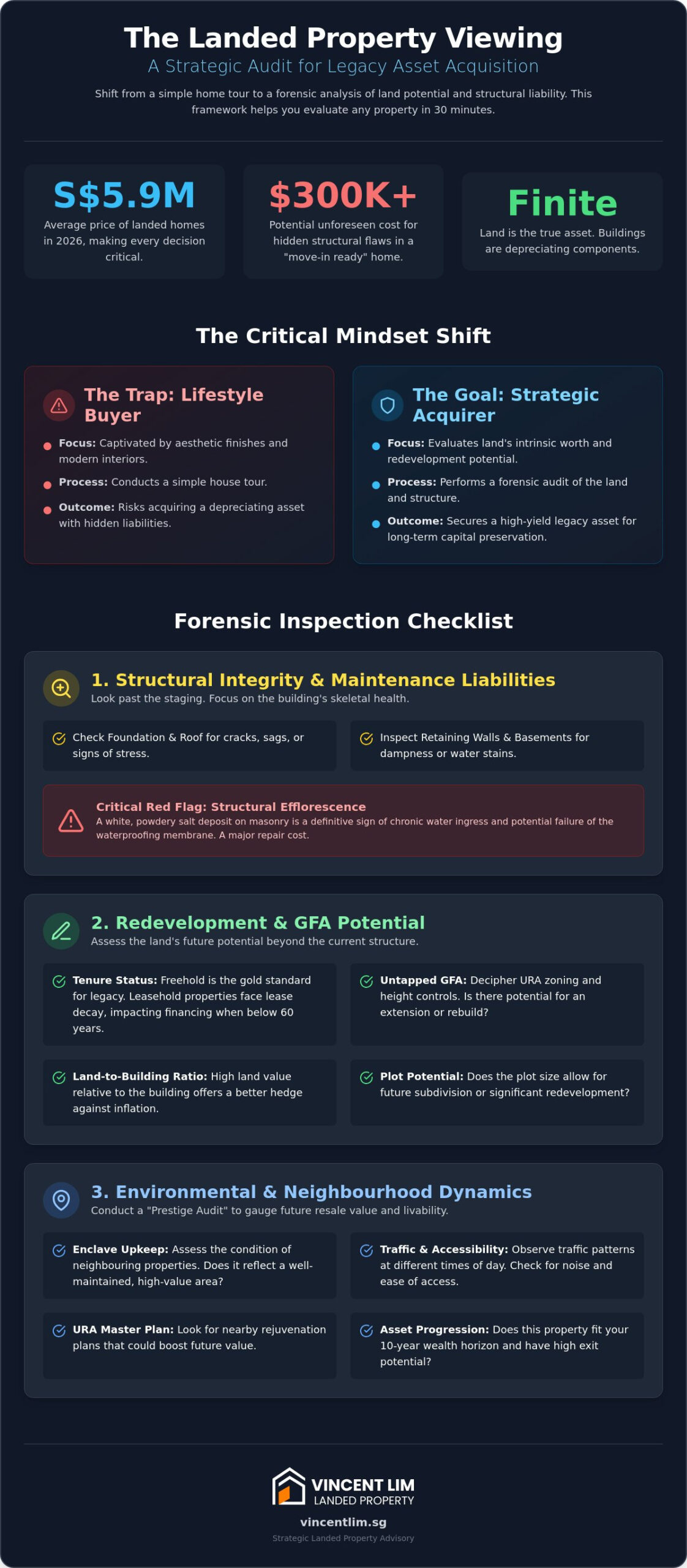
A sophisticated viewing requires you to look past the staging furniture and designer lighting. You’re conducting a forensic audit of the building’s skeletal health. When considering what to look for when viewing a landed property, it’s essential to establish a “Red Flag” hierarchy. Cosmetic issues like peeling paint or outdated cabinetry are minor negotiations. True deal-breakers involve the foundation, the roof, and the integrity of the soil. If you’re planning a full reconstruction, these defects might be irrelevant; however, if you’re paying a premium for a “move-in ready” home, a hidden structural flaw can easily add $300,000 to $1,000,000 in unforeseen renovation costs.
Water is the primary enemy of landed assets in Singapore’s tropical climate. Inspect the “wet zones” such as bathrooms and kitchens, but pay closer attention to the retaining walls and basement levels. Look for structural efflorescence. Structural efflorescence is a white, powdery salt deposit on masonry surfaces that serves as a definitive sign of chronic water ingress and potential mineral leaching within the concrete. If you spot this on a boundary wall or a lower-ground floor, it suggests a failure in the original waterproofing membrane. This isn’t just an eyesore; it’s a symptom of a deeper, more expensive maintenance liability that requires professional remediation.
The External Shell and Foundation
Walk the perimeter of the plot to inspect the boundary walls and fences. Noticeable shifts or large diagonal cracks often indicate soil movement or a subsiding foundation. Pay attention to the garden’s drainage; “ponding” or standing water after a rain suggests poor grading that can eventually compromise the structure. Inside the house, check for “hollow” tiles or uneven flooring, which can suggest sub-floor issues or poor compaction during the last major Additions & Alterations (A&A). Understanding the age of the last structural intervention is vital. A property that hasn’t seen a major overhaul in twenty years likely requires a complete M&E refresh to meet modern standards.
Mechanical and Electrical (M&E) Health
The “invisible” costs of a resale home often reside in the distribution board. Evaluate the current wiring capacity. Is it sufficient for high-load luxury appliances, electric vehicle chargers, or a comprehensive smart home system? In 2026, connectivity is a baseline requirement. If the property lacks CAT6a cabling or a dedicated server closet, you’re looking at a disruptive and costly retrofit. Assessing these elements early ensures you don’t overpay for a property that’s technically obsolete. If you require a more detailed assessment of a specific plot’s health, consulting with a seasoned professional can provide the technical oversight necessary to protect your capital.
Deciphering URA Guidelines: Assessing Redevelopment and GFA Potential
While the previous section focused on the physical structure, a strategic acquisition requires you to look beyond the existing walls. In the 2026 regulatory environment, a landed property is essentially a defined volume of “permissible air” governed by the Urban Redevelopment Authority (URA). When determining what to look for when viewing a landed property, you must evaluate the delta between the current built-up area and the maximum potential allowed under Envelope Control guidelines. This untapped Gross Floor Area (GFA) represents your profit margin or your legacy’s expansion room. If a property is significantly “under-built,” you’re buying land with a hidden discount on its future utility.
The math of “rebuild vs. renovate” has shifted in 2026. With Land Betterment Charge rates for landed residential sectors increasing by an average of 4.0% earlier this year, the cost of intensifying land use has grown. You must calculate whether the existing structure’s “lifestyle value” justifies forgoing a full redevelopment. For a detached house, URA typically caps site coverage at 50%, whereas Good Class Bungalows are restricted to 35%. If the current footprint is inefficient, a total teardown might be the only way to maximize your 10-year wealth horizon. Understanding these limits prevents you from overpaying for a house that has already reached its maximum legal capacity.
Land Plot Geometry and Topography
The shape of the plot dictates its architectural flexibility. Regular, rectangular, or square plots command a premium because they minimize “dead space” caused by setback requirements. Frontage is equally critical; a wide plot width allows for a more imposing architectural presence and easier multi-car parking. You should also assess the “road level” relative to the “land level.” If the land sits significantly higher than the road, you gain natural privacy and the potential for a “basement” level that doesn’t count towards your height limit, effectively adding a floor of value for free.
URA Master Plan 2026 Implications
Strategic viewing involves consulting the URA Master Plan to identify “Special and Detailed Control Plans” that may apply to specific enclaves. These can include restrictive height controls or specific conservation requirements that limit your redevelopment options. Be mindful of the upcoming CORENET-X submission requirements becoming mandatory in October 2026, which will streamline but also tighten the scrutiny on new development applications. Always verify the official plot boundary against the topographical survey; never rely solely on the physical fence line, as encroachments can lead to costly legal disputes during a rebuild.
Environmental and Neighbourhood Dynamics: Assessing Long-Term Livability
Beyond the boundary walls, the surrounding enclave determines the ceiling of your property’s appreciation. A “Prestige Audit” is a non-negotiable step in your evaluation process. You must look closely at the upkeep of neighbouring homes. Are they well-maintained, or do they show signs of neglect? In a market where landed homes comprise less than 5% of Singapore’s total housing stock, the collective standard of a street directly impacts the liquidity of your asset. A single dilapidated property nearby can act as a drag on your resale value, while a street of newly reconstructed homes signals a rising tide of capital injection.
Timing is a critical factor when determining what to look for when viewing a landed property. A serene 3 PM visit often masks the reality of a 7 PM traffic bottleneck or a 7 AM school-run congestion. You should visit the site at multiple intervals to gauge noise patterns and street parking availability. If the road is used as a “rat run” for commuters avoiding expressways, your peace of mind will be compromised. Additionally, identify any nearby sites with en-bloc potential or vacant land. Living next to a three-year construction project is a significant lifestyle deterrent that can hamper future rental yields or resale efforts.
Sun orientation remains a technical priority for thermoregulation. A house with a direct West Sun exposure will incur higher cooling costs and require specialized glazing to maintain comfort. Assessing how the light hits the main living areas and bedrooms at different times of day ensures your home remains a sanctuary rather than a heat trap. If you’re ready to secure a property that meets these rigorous standards, explore our curated listings of elite landed homes to find an asset that aligns with your legacy goals.
Connectivity and Amenities
Proximity to elite schools isn’t just about convenience; it’s a proven driver of price resilience. Properties within a 1-kilometre radius of Tier-1 primary schools often command a premium and experience faster capital growth. However, you must balance this against the trade-off of increased traffic. True luxury often lies in the “sweet spot” where major expressways are accessible within minutes, yet the immediate street remains insulated from the noise of the PIE or CTE. Walking distance to essential services should be evaluated carefully; it must add convenience without compromising the “exclusive” feel of a private residential enclave.
Neighbourhood Evolution
Observe whether the area is transitioning into a modernized enclave with new-build detached houses or if it remains dominated by original, aging structures. A modernizing street suggests active reinvestment by other high-net-worth individuals, which lifts the entire neighbourhood’s profile. Conversely, check for high-rise condominium developments overlooking the plot. Privacy is a finite resource in Singapore; a property that is “looked into” by a hundred apartment balconies loses its exclusive feel and long-term legacy value. A cul-de-sac often provides a “Safe Haven” factor, offering superior security and a quieter environment for your family.
Navigating the Acquisition: Why Professional Representation is Non-Negotiable
Acquiring a landed asset is a high-stakes deployment of capital that extends far beyond the physical inspection. While you now understand what to look for when viewing a landed property, the transition from viewing to ownership requires a different set of strategic competencies. The landed market in Singapore is notoriously opaque, with many of the most prestigious opportunities never reaching public portals. Engaging a landed property specialist provides you with access to these off-market “pocket listings,” ensuring you aren’t limited to the leftovers of the open market.
The “White-Glove” transaction process is designed to alleviate the friction of high-value acquisitions. From the initial Option to Purchase (OTP) to the final legal completion, every step must be managed with calculated competence. A luxury property agent acts as your elite strategist, conducting due diligence that goes deeper than a standard title search. They serve as your primary defense against “buyer’s remorse” by validating the property’s long-term investment thesis against real-time market data and URA planning shifts. In a landscape where a single oversight can lead to a multi-million dollar liability, professional representation is your most valuable asset.
The Value of a Seasoned Negotiator
Negotiation in the landed sector is an art form, not a simple price haggle. It’s about structuring an offer that addresses the seller’s motivations while protecting your capital. Whether it’s managing the delicate timeline of a “sell one, buy one” transition or justifying a bid through forensic market analysis, a veteran professional ensures you don’t overpay in a high-demand climate. We leverage deep data to ensure your purchase price is a reflection of the property’s intrinsic value and future growth potential, rather than just market sentiment.
- Strategic Offer Structuring: Moving beyond price to include terms that favor your financial timeline.
- Market Data Leverage: Using granular transaction history to anchor negotiations in reality.
- Timeline Coordination: Ensuring seamless transitions for families moving between significant assets.
Your Next Steps in Landed Acquisition
Success in the 2026 market requires a ready “war chest.” You must have your financing pre-approved and your capital for the Buyer’s Stamp Duty (BSD) and Additional Buyer’s Stamp Duty (ABSD) — which remains at 20% for Singapore Citizens on their second property — liquid and ready. The most sought-after detached and semi-detached homes move quickly. Aligning your goals with market reality through a private consultation is the first step toward securing a legacy asset that will appreciate over the next decade.
If you’re ready to move from observation to acquisition, Schedule a strategic viewing consultation with Vincent Lim. We’ll refine your search criteria and provide the forensic oversight necessary to identify your next high-potential landed investment.
Securing Your Legacy in Singapore’s Landed Market
A landed property acquisition is a multi-generational commitment that demands more than a cursory glance at aesthetics. By adopting a forensic approach to structural integrity and a strategic lens for URA redevelopment potential, you ensure your capital is anchored in a high-performing asset. Mastering what to look for when viewing a landed property is the critical foundation for any successful luxury portfolio. You’ve learned to identify hidden liabilities and calculate untapped GFA; now, you must execute the transaction with precision.
Vincent Lim (OrangeTee & Tie) brings over 20 years of experience to your search. As a specialist in Good Class Bungalows (GCB) and high-end landed assets, he offers a proven track record in luxury asset progression and wealth planning. Navigating the 2026 market requires this level of seasoned authority to secure off-market opportunities and manage complex transactions with calm, calculated competence. Your path to a secure legacy begins with professional, white-glove guidance that prioritizes your long-term success.
Partner with Vincent Lim (OrangeTee & Tie) to find your legacy home and transform your property goals into a tangible, appreciating reality. We look forward to guiding you through your next strategic acquisition with the excellence your portfolio deserves.
Frequently Asked Questions
What is the most important structural thing to check in an old landed house?
The primary priority is the integrity of the foundation and the waterproofing system. You should focus on identifying signs of soil subsidence, such as large diagonal cracks in the boundary walls or uneven floor levels. Chronic water ingress, often evidenced by structural efflorescence or dampness in the basement, is a critical factor in what to look for when viewing a landed property. These issues often indicate systemic failures that require expensive remediation rather than simple cosmetic fixes.
How do URA setbacks affect my ability to build a swimming pool?
URA setback requirements define the mandatory green buffer and physical distance between your structure and the boundary line. Typically, a swimming pool must maintain a specific clearance from the boundary, which varies based on your house classification. If a plot has narrow side setbacks, you may be forced to reduce the pool’s size or reposition it entirely. Always verify the buildable area against the latest Envelope Control guidelines to ensure your lifestyle requirements are legally permissible.
Is it better to buy a “move-in condition” home or a “rebuild” potential plot?
The decision hinges on the land-to-building value ratio and your long-term wealth horizon. A “move-in condition” home allows for immediate occupation but often includes a premium for someone else’s aesthetic choices. A “rebuild” potential plot allows you to maximize the untapped Gross Floor Area (GFA) and customize the structure to modern 2026 standards. For legacy planning, acquiring a plot with high redevelopment potential typically offers superior capital protection as the building depreciates over time.
What are the red flags to look out for in the surrounding neighbourhood?
Neighbouring neglect and high-density developments are significant red flags for any landed asset. If adjacent properties show signs of poor upkeep, it suggests a lack of collective pride that can drag down your resale value. Additionally, check for high-rise condominiums that overlook the garden or pool area. Privacy is a premium commodity in Singapore; a plot that is overlooked by hundreds of balconies loses the exclusivity that defines the landed property experience.
How does the URA Master Plan affect the resale value of my landed property?
The URA Master Plan dictates the future zoning and infrastructure surrounding your home. New transport links or commercial hubs can significantly enhance price resilience and demand. However, the plan also outlines “Special and Detailed Control Plans” that may restrict your redevelopment height or site coverage. Understanding these designations is essential when determining what to look for when viewing a landed property, as it reveals the true ceiling of the asset’s future valuation.
Can I check if a landed property has a history of flooding before buying?
You can verify flood risks by consulting the PUB’s list of flood-prone areas and checking the topography of the specific street. During a viewing, perform a forensic check of the lower-ground floors and external drains for historical water marks or silt deposits. A property that sits significantly lower than the road level is at a higher risk of ponding. Ensuring the land is elevated relative to the surrounding drainage network is a key defensive measure.
How much extra should I budget for maintenance in a detached house vs. a condo?
Landed owners assume 100% of the maintenance responsibility, which is a departure from the shared costs of a luxury condominium. You must account for the upkeep of the roof, external facade, private garden, and pest control systems. While there are no monthly management fees, periodic costs for repainting and waterproofing are substantial. It’s prudent to maintain a dedicated reserve fund to manage these long-term maintenance liabilities without compromising your cash flow.
What is the difference between an A&A and a full reconstruction in terms of cost?
An Additions & Alterations (A&A) project retains a significant portion of the existing structure, whereas a full reconstruction involves a total teardown. While an A&A is generally less capital-intensive, it limits your ability to fully optimize the floor plan. A full reconstruction allows you to build a completely new volume under the latest Envelope Control guidelines, which often yields a higher resale premium. The choice depends on whether the existing structure’s skeletal health justifies preservation.