The most cost-effective way to expand your landed home isn’t always the one with the lowest initial quote. In fact, miscalculating your Addition and Alteration (A&A) cost singapore by even a small margin can inadvertently trigger a full reconstruction mandate, potentially doubling your budget overnight. You likely recognize that the line between a strategic renovation and a regulatory nightmare is razor-thin; the 50% rule governing structural retention remains the most significant hurdle for any owner looking to enhance their property’s footprint without a total teardown.
It’s natural to feel a sense of hesitation when navigating the 5% to 7% construction cost inflation projected for 2026 alongside the mandatory shift to the CORENET-X submission platform. This guide provides the professional clarity you need to transform your residence into a high-value asset. You’ll gain a precise understanding of current market dynamics, regulatory compliance, and the strategic math required to maximize your return on investment. We’ll provide a clear roadmap to help you decide between A&A and reconstruction, ensuring your project is executed with the precision that your legacy deserves.
Key Takeaways
- Identify the precise structural thresholds of the 50% rule to maintain your project’s classification as an Addition and Alteration rather than a full reconstruction.
- Evaluate the current Addition and Alteration (A&A) cost singapore for 2026 to develop a realistic budget that accounts for structural upgrades and high-end finishes.
- Assess the strategic trade-offs between A&A and reconstruction, focusing on how shorter timelines can accelerate your property’s market entry and capital growth.
- Navigate the updated 2026 regulatory landscape, including mandatory CORENET-X submissions and URA Envelope Control guidelines, with professional confidence.
- Implement design and planning strategies that specifically appeal to luxury buyers, ensuring your renovation translates into significant long-term asset progression.
Defining Addition and Alteration (A&A) in the Singapore Landed Context
In Singapore’s prestigious landed property market, the decision to refine an existing asset requires a deep understanding of regulatory definitions. The Urban Redevelopment Authority (URA) classifies Addition and Alteration (A&A) as works that don’t involve significant demolition or total replacement of the existing structure. For owners of terrace and semi-detached homes, this path is often the most efficient way to increase floor area and improve layout without the immense logistical burden of a total rebuild. It’s a strategic choice that balances modern luxury with the preservation of existing structural value.
Calculating a realistic Addition and Alteration (A&A) cost singapore starts with a professional assessment of your current house. If your plans involve adding a new attic or extending the rear of the property, you’ve got to ensure the work stays within the technical bounds of A&A. Crossing these lines shifts your project into the “Reconstruction” category, which brings a different set of building codes and significantly higher financial commitments. It’s about surgical precision rather than wholesale destruction.
The 50% Structural Retention Rule Explained
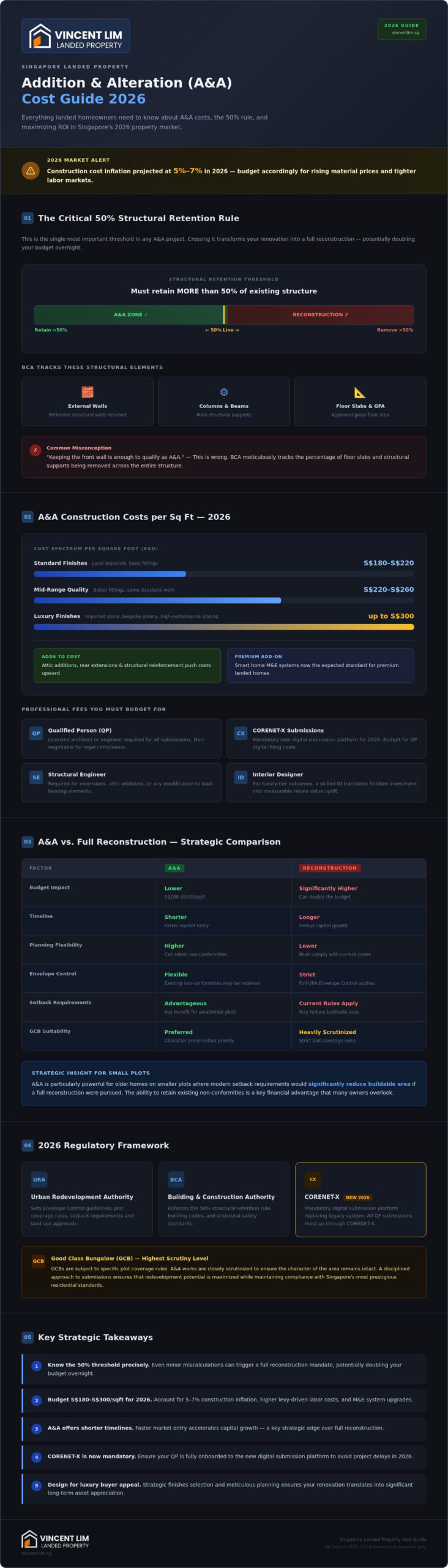
The 50% rule serves as the definitive boundary between A&A and Reconstruction. To maintain an A&A status, your project must retain more than 50% of the existing external walls, main structural elements like columns and beams, and the approved Gross Floor Area. Many owners mistakenly believe that keeping the front wall is enough to qualify. However, the BCA meticulously tracks the percentage of floor slabs and structural supports being removed. If you replace more than half of these core components, the project is mandated as a reconstruction. Precision in these calculations is vital to avoid unexpected regulatory delays and cost overruns.
A&A vs. Reconstruction: A Strategic Overview
The strategic advantage of A&A lies in its relative flexibility regarding modern planning constraints. While a full reconstruction must adhere strictly to current “Envelope Control” guidelines and updated setback requirements, an A&A project can often retain certain existing non-conformities. This is particularly beneficial for older homes on smaller plots where modern setbacks would significantly reduce the buildable area. For Good Class Bungalow (GCB) owners, the stakes are even higher. Because GCBs are subject to specific plot coverage rules, A&A works are scrutinized to ensure the character of the area remains intact. A disciplined approach to these submissions ensures that your property’s redevelopment potential is maximized while staying compliant with the gold standard of Singapore’s urban planning.
Comprehensive Breakdown of A&A Costs in 2026
Understanding the financial landscape of 2026 is critical for any landed owner planning a significant renovation. With construction cost inflation projected at 5% to 7% this year, your budget needs to account for rising material prices and a tighter labor market influenced by the current foreign worker levy rates. A realistic Addition and Alteration (A&A) cost singapore isn’t just about the bricks and mortar; it’s a strategic allocation of capital that ensures your property remains a high-value asset. Accurate budgeting requires a granular look at both visible construction expenses and the professional fees that secure your project’s legality.
Estimated Construction Costs per Square Foot
In the 2026 market, construction costs for A&A projects typically range from S$180 to S$300 per square foot. This variance depends heavily on your chosen finish tier and the structural complexity of your design. While standard finishes might sit at the lower end of that spectrum, luxury projects utilizing imported stone, bespoke joinery, and high-performance glazing will quickly move toward the S$300 mark. If your plans include adding an attic or extending a rear section, expect higher costs for structural reinforcement. Mechanical and electrical (M&E) system overhauls also represent a significant portion of the budget, especially as energy-efficient smart home systems become the expected standard for premium landed homes.
Professional and Consultancy Fees
Securing the right expertise is non-negotiable for a successful A&A project. You’ll need to engage a Qualified Person (QP), typically an architect or professional engineer, to handle submissions to the Building and Construction Authority (BCA). Professional Engineer (PE) fees for structural endorsements generally range from S$1,500 to S$10,000, depending on the project’s scope. Architectural fees can be structured as a percentage of total construction costs, often between 5% and 10%, or as a fixed lump sum for specific design phases. These experts ensure your project meets safety standards and regulatory requirements, protecting you from costly compliance errors.
Beyond the primary contract, you should budget for hidden expenses that often catch owners by surprise. These include 9% GST on all services, utility capacity upgrades for EV chargers, and the logistical cost of temporary housing. If you’re unsure how these investment layers will impact your property’s eventual resale price, consulting a specialist in luxury landed assets can provide the market perspective needed for a sound decision. Meticulous planning at this stage prevents budget overruns and ensures your capital is deployed effectively to enhance your home’s long-term value.
Strategic Evaluation: A&A vs. Full Reconstruction for ROI
Deciding between a surgical upgrade and a complete teardown is a pivotal moment in asset management. While the Addition and Alteration (A&A) cost singapore is generally lower than a total rebuild, the true value lies in the speed of execution. A typical A&A project can be completed within 6 to 9 months, whereas a full reconstruction often requires 18 to 24 months. For investors and homeowners in high-value districts, this 12-month difference represents a significant saving in holding costs and a faster path to capital appreciation. You aren’t just saving on construction; you’re reducing the time your capital is tied up in a non-productive asset.
Preserving the heritage of older detached houses is another strategic consideration. These properties often possess a unique character and generous setback exemptions that modern builds struggle to replicate under current guidelines. By choosing A&A, you can modernize the internal infrastructure while maintaining the architectural soul that commands a premium in the resale market. However, if the existing structure has reached the end of its functional life or the layout is fundamentally incompatible with modern luxury standards, a full reconstruction becomes the only logical path to avoid future maintenance liabilities. It’s about knowing when to refine and when to replace.
Maximizing Gross Floor Area (GFA)
Strategic A&A allows you to extract maximum value from your plot ratio without the regulatory friction of a new build. By identifying redevelopment potential in old homes, owners can add specialized lifestyle spaces such as soundproof home offices or private wellness gyms. These additions directly address the needs of modern high-net-worth buyers who prioritize functional versatility. Utilizing the remaining GFA through an attic or rear extension often yields a higher ROI than a full rebuild because the incremental cost of the new space is offset by the existing structure’s utility.
Investment Longevity and Marketability
Marketability is the ultimate test of any renovation. A well-executed A&A project can significantly elevate your property’s market value while avoiding the complex tax assessments and longer vacancy periods associated with a total rebuild. It’s essential to avoid over-capitalization, where your total spend exceeds the price ceiling of your specific neighborhood. By focusing on high-impact finishes and functional layout improvements, you ensure that your terrace house appeals to the elite market without pricing yourself out of a successful exit. A disciplined approach to A&A ensures that every dollar spent contributes directly to the asset’s liquidity and long-term capital growth.
Navigating Regulatory Frameworks: URA, BCA, and Submissions
The success of any landed renovation depends on a meticulous alignment with Singapore’s regulatory bodies. You must engage a Qualified Person (QP), usually a registered architect or professional engineer, to lead the submission process. This isn’t merely a procedural requirement; the QP assumes legal responsibility for ensuring that your Addition and Alteration (A&A) cost singapore accounts for every safety and planning standard. Their role is to navigate the often-overlapping requirements of the URA and BCA, protecting you from the severe penalties associated with unauthorized building works. They act as your strategic advocate, ensuring that your vision remains within the bounds of the law.
Compliance is also a critical factor in wealth preservation. Unapproved alterations often emerge during the bank valuation process or the legal due diligence of a sale. If a property’s physical state doesn’t match its approved drawings, it can lead to collapsed transactions or significant price devaluations. Buyers in the elite market expect a “clean” asset. Ensuring every modification is documented and approved is the only way to safeguard your asset’s liquidity and ensure a smooth exit when the time comes. It’s about maintaining the integrity of your investment from the first brick to the final sale.
URA Planning Permission and GFA Guidelines
Before finalizing any design, your QP must verify your property’s status against the URA Master Plan. This determines your building’s allowable height, typically restricted to two or three stories plus an attic, depending on your specific landed housing area. Under the Envelope Control guidelines, you have more flexibility in internal layout, but you’ve got to stay within the defined volumetric limits. You’ve also got to consider the impact of road line plans and drainage reserves, which can restrict where you’re allowed to build on your plot. These “invisible” constraints can significantly reduce your buildable area, making early consultation essential to avoid designing a space that the authorities will never approve.
The Approval Timeline
The journey from conceptual sketches to the final Certificate of Statutory Completion (CSC) is a multi-stage process. From October 1, 2026, all submissions must move through the CORENET-X platform, a streamlined digital system that requires high-level coordination between your consultants. Once the Building and Construction Authority (BCA) grants structural approval, you’ll issue a Notice of Commencement to begin works. After construction, the property must pass site inspections to receive a Temporary Occupation Permit (TOP). Understanding this timeline is as vital as mastering the landed property transaction process, as delays in regulatory approval directly impact your project’s carrying costs.
If you’re concerned about how current regulations might impact your property’s marketability, consult an elite landed strategist to ensure your project aligns with both legal requirements and market expectations.
Maximizing Resale Value Through Meticulous A&A Planning
Positioning your property for an elite exit requires a shift in perspective from personal preference to market demand. While the technical and regulatory aspects discussed previously ensure your project’s legality, the design and planning phases determine its eventual profitability. Your Addition and Alteration (A&A) cost singapore should be viewed as a capital injection intended to trigger a disproportionate increase in valuation. In a market where the price gap between new launches and resale homes continues to widen, a meticulously renovated landed asset offers a compelling value proposition to buyers who desire modern luxury without the wait of a full reconstruction.
Future-proofing is no longer a luxury; it’s a requirement for wealth preservation. High-net-worth buyers in 2026 are increasingly focused on environmental efficiency and seamless architectural flow. Incorporating sustainable materials and smart home infrastructure doesn’t just lower operational costs; it aligns your property with the “flight to quality” trend identified in recent market reports. As a specialist who has identified “A&A gems” for savvy investors since 2004, I’ve seen how strategic updates to a home’s core systems and aesthetic appeal can transform a dated structure into a highly liquid asset.
High-ROI Design Features for 2026
Success in the resale market often hinges on first impressions and functional versatility. Modern facades that utilize high-performance glazing and architectural screening significantly reduce “days on market” by establishing an immediate sense of prestige. Internally, the focus should remain on open-plan layouts that facilitate “indoor-outdoor” living transitions, a feature that remains a top priority for families in the Outside Central Region (OCR) and beyond. Investing in a professional-grade kitchen and an expansive master suite serves as a primary value driver, as these are the spaces where luxury buyers are least willing to compromise on quality or finish.
The Role of a Landed Specialist in A&A Strategy
Consulting with an experienced agent before finalizing your renovation plans is a strategic necessity. An elite strategist can provide district-specific benchmarking, ensuring your project doesn’t exceed the price ceiling of your neighborhood. This prevents over-capitalization and ensures every dollar of your renovation spend contributes to a higher exit price. By analyzing recent sales data for terrace and semi-detached homes, we can identify the specific features that are currently commanding a premium. If you are preparing to sell my landed property singapore, aligning your A&A strategy with current market appetites is the most effective way to ensure a swift and lucrative transaction.
Ultimately, a successful A&A project is a blend of disciplined budgeting, regulatory precision, and market-aware design. When these elements are coordinated effectively, your landed property becomes more than just a home; it becomes a high-performing component of your legacy planning and wealth progression strategy.
Secure Your Property’s Legacy Through Strategic Refinement
Transforming a landed residence into a high-value asset requires more than just an aesthetic vision. It demands a precise understanding of the 50% structural rule and a disciplined approach to budgeting. By mastering the current Addition and Alteration (A&A) cost singapore, you position yourself to enhance your property’s footprint while avoiding the extended timelines of a full rebuild. This strategic path ensures your capital is deployed efficiently, focusing on high-ROI design features that resonate with the elite market’s focus on quality and functional luxury.
Navigating these complexities is simpler with a partner who understands the nuances of luxury asset progression. With over 20 years of expertise in GCB and high-value landed sales, Vincent Lim provides the data-driven insights needed to ensure your renovation spend translates into significant market premiums. Whether you’re refining a terrace home or a detached house, professional guidance protects your investment from over-capitalization and regulatory risk. Strategize your landed property investment with Vincent Lim today to ensure your next move is both calculated and rewarding. Your property’s future value begins with the decisions you make today.
Frequently Asked Questions
What is the difference between A&A and Reconstruction in Singapore?
The primary distinction lies in the extent of structural modification. An Addition and Alteration (A&A) project must retain more than 50% of the existing external walls and main structural elements like columns and beams. If your plans involve demolishing more than half of these components or significantly increasing the Gross Floor Area beyond 50%, the authorities will mandate a full reconstruction instead.
How much does a typical A&A project cost for a terrace house in 2026?
While final figures depend on your choice of finishes and structural complexity, the Addition and Alteration (A&A) cost singapore for 2026 generally ranges between S$180 and S$300 per square foot. For a standard terrace house, this often results in a total investment that reflects the current 5% to 7% construction cost inflation. Choosing premium materials or adding complex features like an attic will move your budget toward the higher end of this spectrum.
Do I need URA approval for internal renovations in a landed property?
You don’t generally require URA planning permission for internal works that are purely cosmetic or non-structural. However, if your internal renovations involve adding floor area, such as a mezzanine or an attic, or if they change the building’s structural integrity, you must obtain formal approval. It’s always prudent to have your Qualified Person verify the scope to ensure you’re compliant with the latest Master Plan guidelines.
How long does the A&A approval and construction process take?
A standard A&A project typically requires 6 to 9 months from the initial design phase to the final Certificate of Statutory Completion. This timeline includes approximately 2 to 3 months for regulatory submissions through the CORENET-X platform. Choosing A&A over a full reconstruction can save you up to a year in construction time, allowing for a faster return on your investment or quicker move-in date.
Can I increase the Gross Floor Area (GFA) of my house through A&A?
Yes, you can expand your home’s GFA through A&A by adding extensions or an attic. The critical constraint is that the total new floor area must not exceed 50% of the existing approved area. This allows you to add significant value and lifestyle spaces, such as home offices or larger master suites, while still benefiting from the streamlined regulatory process of an A&A project.
Is it possible to stay in the house while A&A works are being carried out?
While it’s technically possible for minor works, we strongly advise against staying in the property during major A&A projects. The presence of heavy dust, noise, and the necessary disconnection of utilities can make the environment unsuitable for living. Furthermore, an empty site allows contractors to work more efficiently, which can help keep your Addition and Alteration (A&A) cost singapore within the projected budget by avoiding logistical delays.
What happens if I carry out A&A works without proper BCA approval?
Unauthorized building works carry severe penalties, including heavy fines and legal orders to reinstate the property to its original approved state. Beyond the legal risks, unapproved alterations will cause significant complications during property valuation or resale. Most banks will refuse to finance a property with unauthorized structures, which can effectively collapse a high-value transaction and damage your asset’s marketability.
How does A&A affect the property valuation of my landed home?
Strategic A&A works are a powerful tool for asset progression, often leading to a substantial increase in market valuation. By modernizing the facade and optimizing the internal layout, you align the property with the expectations of the elite market. A well-executed project ensures that your renovation spend translates into a higher capital gain, making your home more attractive to high-net-worth buyers who prioritize move-in-ready luxury.