Securing a landed home in Singapore is often viewed as the ultimate mark of success; however, for many global investors, the path to ownership feels like an impenetrable fortress. You likely recognize that the Residential Property Act exists to preserve limited land for citizens, which makes the criteria for foreign acquisition exceptionally rigorous. The uncertainty of a potential rejection often stalls even the most significant investment plans. This guide provides the high-level strategy you need to master these complexities and secure LDAU approval for landed property with absolute confidence.
We’ll move beyond basic definitions to examine the specific economic contribution benchmarks and the 30-working-day processing timeline established for 2026. You’ll learn how to present your application not merely as a transaction, but as a documented commitment to Singapore’s future. By understanding the nuances of the Singapore Land Authority’s requirements, you can transform a daunting regulatory hurdle into a structured, successful acquisition of your legacy home. This is your roadmap to navigating the elite landscape of Singapore’s most exclusive real estate with precision and peace of mind.
Key Takeaways
- Understand the core objectives of the Residential Property Act and how the Singapore Land Authority regulates the acquisition of limited landed assets.
- Identify the specific benchmarks for “economic contribution” and residency required to secure LDAU approval for landed property in the 2026 market.
- Master the step-by-step application process, including the preparation of critical IRAS and CPF documentation to ensure a seamless 30-day processing window.
- Explore Sentosa Cove as a strategic alternative for non-PR foreigners, offering a significantly expedited approval path for luxury waterfront homes.
- Learn why professional technical evaluation of land size and URA redevelopment potential is essential for protecting your long-term capital investment.
Understanding the Residential Property Act and the Role of the LDAU
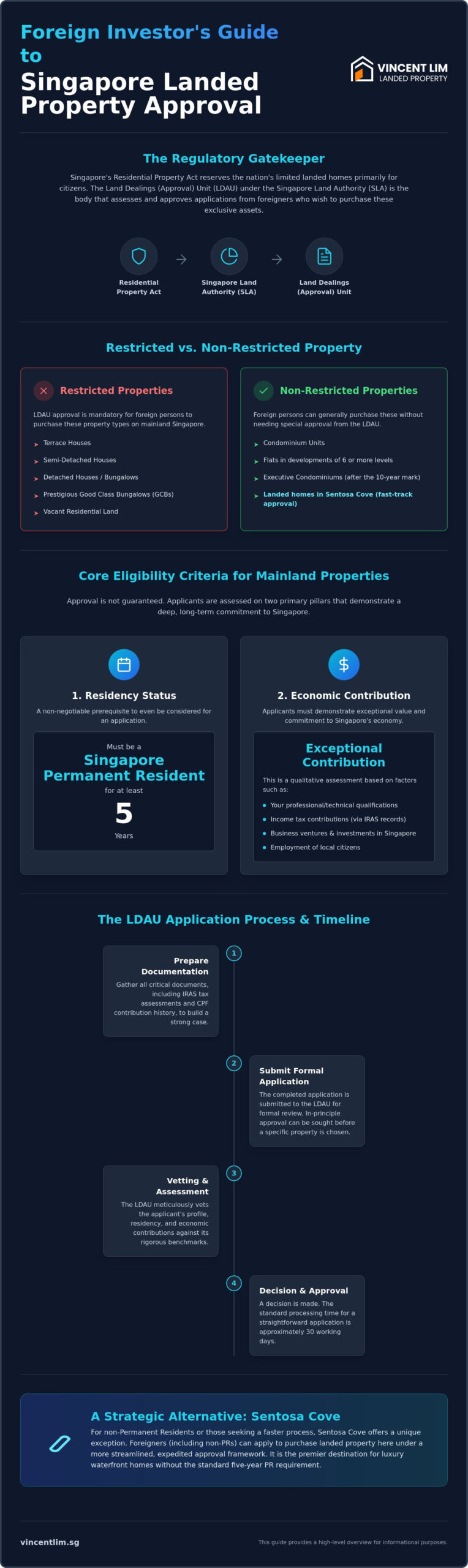
Singapore’s real estate market is governed by a robust framework designed to balance open investment with national interests. At the heart of this framework is the Residential Property Act, a piece of legislation that ensures landed residential property remains primarily within the hands of Singapore citizens. To manage this, the Land Dealings (Approval) Unit (LDAU), a specialized department under the Singapore Land Authority (SLA), serves as the gatekeeper. This unit meticulously vets every foreign applicant to ensure they meet the stringent criteria set by the state. Understanding this regulatory landscape is essential for any high-net-worth individual looking to anchor their legacy in the city-state.
The LDAU isn’t just a processing office; it’s a strategic regulatory body. It interprets the broader mandates of Singapore’s legal system to ensure that the scarce resource of land is allocated to those who demonstrate a deep, long-term commitment to the nation. For a foreign investor, obtaining LDAU approval for landed property is the most critical milestone in their asset acquisition journey. Without this green light, any private treaty or option to purchase a restricted property remains legally unenforceable. It’s the foundation upon which your entire Singapore property portfolio is built.
“Restricted” property encompasses almost all forms of landed housing on the mainland. This includes terrace houses, semi-detached houses, detached houses, and the prestigious Good Class Bungalows (GCBs). It also covers vacant residential land and shophouses that aren’t zoned for commercial use. Identifying these restrictions early prevents costly legal errors and ensures your property search is grounded in regulatory reality.
Who is Considered a “Foreign Person”?
Under the Act, the term “foreign person” is broader than many realize. It includes Singapore Permanent Residents (SPRs), who, despite their residency status, must still seek approval before purchasing landed assets. Foreign-owned companies and trusts also fall under this category. To acquire landed property, a company must be incorporated in Singapore, and all its directors and shareholders must be Singapore citizens. Trusts are scrutinized with equal rigor to ensure the ultimate beneficiary isn’t circumventing the Act’s intent. We help you navigate these definitions to determine exactly where you stand before you commit capital.
Restricted vs. Non-Restricted Property Types
Navigating the market requires a clear distinction between what you can buy freely and what requires a formal application. Most condominium units and executive condominiums (after their tenth year) are non-restricted. However, the premium landed market is almost entirely restricted. This includes bungalows, semi-detached houses, and terrace houses. The only major exception is Sentosa Cove, where non-PR foreigners can acquire landed homes under a more relaxed framework. Strategic buyers often secure an “in-principle” LDAU approval for landed property before they even identify a specific home. This proactive step signals to sellers that you’re a serious, qualified buyer, giving you a distinct advantage in high-stakes negotiations.
Eligibility Criteria: How the LDAU Evaluations Foreign Applicants
The bar for entry into Singapore’s landed market is intentionally high. Under the Residential Property Act 1976, every application is scrutinized to ensure the buyer aligns with the nation’s long-term interests. While the process is rigorous, understanding the specific metrics the Minister considers can significantly improve your chances of success. Securing LDAU approval for landed property requires more than just wealth; it requires a strategic presentation of your personal and professional profile. It’s not a mere box-ticking exercise; it’s a qualitative assessment of your value to the city-state.
A fundamental prerequisite for mainland acquisitions is your residency status. You must have been a Singapore Permanent Resident (SPR) for a minimum of five years before your application is even considered. This timeframe serves as a vital filter, ensuring that prospective owners have established a stable foundation within the country. However, residency alone is insufficient. The unit looks for “exceptional” contributions that justify the privilege of land ownership, generally limiting approvals to properties that don’t exceed 15,000 sq ft for the applicant’s own occupation.
The Economic Contribution Factor
Quantifying your economic impact is the cornerstone of a strong application. The LDAU evaluates your professional qualifications, employment history, and the total tax contributions you’ve made to the Inland Revenue Authority of Singapore (IRAS). For entrepreneurs and business owners, the focus shifts to the scale of your investments and the employment opportunities you’ve created for the local workforce. High-net-worth individuals who bring specialized technical expertise or lead ventures in strategic growth sectors often find their applications viewed more favorably. We help you synthesize these achievements into a compelling narrative that highlights your strategic value to the economy.
Social Integration and Community Ties
Beyond financial metrics, the government seeks individuals who have a genuine stake in Singapore’s social fabric. This involves assessing your family ties, the duration of your residence, and your philanthropic efforts within local communities. Factors such as having children enrolled in local schools or serving in community organizations demonstrate a commitment that transcends capital investment. The review process is deeply qualitative; the Minister evaluates whether your presence enriches the community as much as it does the economy. If you’re unsure how to document these intangible ties, consulting a specialist in luxury landed property can provide the clarity needed to present a holistic profile.
Every decision is ultimately made on a case-by-case basis. There is no automated approval system. This individual attention ensures that every successful recipient of LDAU approval for landed property is someone who truly embodies the spirit of a long-term stakeholder in Singapore’s future. It’s a gold standard of ownership that requires a sophisticated approach to documentation and presentation.
The Step-by-Step LDAU Application Process and Timeline
Navigating the administrative requirements for LDAU approval for landed property demands meticulous attention to detail. The process is designed to be thorough, ensuring that every successful applicant is a suitable stakeholder in Singapore’s limited land resources. You’ll begin by gathering a comprehensive suite of supporting evidence. This includes your latest IRAS tax assessments, CPF contribution statements, and educational certificates. These documents don’t just prove your income; they illustrate your long-term economic footprint within the country.
The submission itself is handled through the SLA portal via the LDAU E-Services platform. It’s essential to account for the non-refundable application fee, which currently stands at S$1,220 per property in 2026. Once your application is lodged, the waiting period begins. Managing expectations during this phase is vital. While the standard review window is approximately 30 working days, the complexity of your professional profile can influence the duration. We recommend a patient, methodical approach to this timeline to ensure all queries from the authorities are handled with precision.
Applying for In-Principle Approval (IPA)
Seeking an In-Principle Approval (IPA) is the most strategic move a prospective buyer can make. It allows you to verify your eligibility before you even identify a specific home. An IPA typically remains valid for one year, providing a window of certainty. Without this clearance, signing an Option to Purchase (OTP) is a high-stakes gamble. If your LDAU approval for landed property is subsequently denied, you risk forfeiting the option fee, which is often a significant sum in the luxury market. Having an IPA in hand also significantly strengthens your negotiating position with sellers.
Conditions of Approval
Success in your application comes with specific legal obligations that you must respect to maintain your ownership rights. The most critical is the Minimum Occupation Period (MOP). You’re restricted from selling the property for the first five years of ownership. Additionally, the property must be for your own occupation only. Renting out the entire house is strictly prohibited under the Act. These conditions are designed to prevent speculative flipping and ensure that landed homes remain vibrant parts of the local community. Failing to comply with these terms can lead to severe legal consequences, including the potential forced sale of your asset.
Exceptions and Strategic Alternatives: Sentosa Cove and Beyond
While the mainland requirements for LDAU approval for landed property are exceptionally stringent, Singapore provides specific enclaves and asset classes that offer more accessible entry points for foreign investors. Sentosa Cove stands alone as the only location where non-Permanent Residents can legally acquire landed homes. This integrated resort enclave operates under a distinct regulatory framework, reflecting its status as a global lifestyle destination. For many high-net-worth individuals, this represents a strategic alternative to the five-year residency requirement imposed on the mainland.
The efficiency of the approval process in Sentosa Cove is a significant advantage. Unlike the 30-working-day review period for mainland assets, applications for Sentosa properties are typically processed within 48 hours. However, investors must recognize the trade-offs involved. While mainland landed properties are often freehold or 999-year leasehold, Sentosa assets are almost exclusively 99-year leasehold. The decision involves weighing the lifestyle appeal of waterfront living against the long-term capital preservation typical of mainland detached houses. We help you evaluate these factors to ensure your acquisition aligns with your broader wealth management goals.
Acquiring Landed Property in Sentosa Cove
In this exclusive enclave, the Sentosa Development Corporation (SDC) works in tandem with the LDAU to facilitate transactions. While the criteria are more relaxed, restrictions still apply. The land area must not exceed 1,800 square meters, and the property is strictly for owner-occupation. Understanding the difference between What is a Good Class Bungalow on the mainland and a luxury villa in Sentosa is essential for managing expectations regarding prestige and land value. If you’re ready to explore these unique waterfront opportunities, you can consult with our luxury property team for a bespoke market analysis.
Identifying “Non-Restricted” Landed Assets
Strategic investors also look toward “non-restricted” assets that provide the experience of landed living without the standard LDAU approval for landed property. These include strata-landed homes, often referred to as townhouses, located within approved condominium developments. Because these units share a common land plot under a single title, they’re classified as non-restricted residential property. Additionally, certain commercial-residential zoned properties or shophouses can occasionally offer loopholes for foreign acquisition. Identifying these rare opportunities requires an elite strategist who understands the nuances of URA zoning and the Residential Property Act. By focusing on these technical exceptions, we help you secure high-value assets that others might overlook.
Securing Your Legacy: Why Professional Guidance Is Essential for Landed Acquisitions
Obtaining LDAU approval for landed property represents the legal threshold of your acquisition, but it’s only the beginning of a sophisticated investment process. The landed market in Singapore is exceptionally nuanced. A property’s value isn’t determined by its current structure alone, but by its future potential. We analyze technical factors like plot frontage, land depth, and soil conditions according to URA guidelines to ensure your asset can be redeveloped or refined to meet your legacy requirements. For those targeting specific mainland assets, our strategic guide to detached house sales in Singapore offers deep insights into legacy planning and technical acquisition.
Navigating the intersection of legal compliance and luxury acquisition requires a partner who understands both the spirit of the law and the mechanics of the market. Vincent Lim brings over 20 years of experience to this high-stakes environment, acting as an elite strategist for families and investors. We don’t just facilitate a transaction; we coordinate a multi-disciplinary effort that involves legal counsel, tax professionals, and the Singapore Land Authority. This white-glove approach ensures that every detail, from the initial application to the final title transfer, is executed with calculated competence.
The Value of a Landed Property Specialist
The landed market often features undervalued assets that meet the strict 15,000 sq ft limit for foreign owners but require a keen eye to identify. We specialize in finding these rare opportunities before they reach the open market. Successfully managing LDAU approval for landed property involves more than just submitting paperwork. It requires a proactive strategy to address potential concerns from the authorities regarding your economic contribution or social integration. Asset progression to landed property in Singapore is a journey that demands a partner who can bridge the gap between regulatory requirements and your personal wealth goals. We provide the stability and expertise needed to move through this process without the stress of uncertainty.
Next Steps for Your Landed Journey
Your path to ownership begins with a clear, honest assessment of your current standing. We recommend starting with a preliminary eligibility review to determine the strength of your profile before capital is committed. Once we establish a baseline, we curate a shortlist of properties that align with your specific criteria for land size, location, and redevelopment potential. This methodical approach ensures that when you do apply for approval, you’re doing so with a property that truly serves your long-term interests. If you’re ready to begin this transition, you can consult with Vincent Lim for a bespoke landed property strategy tailored to your unique profile. We’re here to ensure your entry into Singapore’s most prestigious asset class is seamless, secure, and successful.
Architecting Your Future in Singapore’s Landed Market
The journey toward acquiring a landed estate on the mainland is defined by precision and strategic positioning. Success hinges on your ability to present a compelling narrative of economic contribution and social integration that aligns with the state’s long-term vision. Whether you’re navigating the 30-working-day review for mainland assets or exploring the expedited lifestyle opportunities in Sentosa Cove, understanding the nuances of the Residential Property Act is the first step in protecting your capital. These regulations are not merely hurdles; they’re the framework that ensures the enduring value of your investment.
Securing LDAU approval for landed property is a high-stakes endeavor that leaves no room for administrative oversight. As an Executive Associate Director at OrangeTee & Tie and a specialist in GCB and luxury landed sales since 2004, Vincent Lim provides the seasoned authority required to manage these complex restrictions. With a proven track record in high-stakes foreign ownership transactions, our team ensures your application is handled with the meticulous care it deserves. We provide the calculated competence needed to translate regulatory requirements into a successful acquisition.
Secure your Singapore legacy—consult with luxury landed specialist Vincent Lim today. Your vision for a prestigious Singapore home is within reach when guided by a dedicated and experienced advocate.
Frequently Asked Questions
Can a foreigner buy a Good Class Bungalow (GCB) in Singapore?
Foreigners are generally restricted from purchasing Good Class Bungalows on the mainland. These assets are reserved for Singapore citizens to preserve the nation’s most exclusive land. In extremely rare cases, the Minister may grant approval to a Permanent Resident who has made truly exceptional economic contributions, but this remains a significant exception rather than the rule for most international investors.
How long does the LDAU approval process take in 2026?
The standard processing window for a mainland application is approximately 30 working days. This timeline allows the authorities to conduct a thorough review of your professional and financial background. While Sentosa Cove applications are typically expedited within 48 hours, mainland acquisitions require this more deliberate period to ensure all regulatory criteria are meticulously evaluated.
What happens if my LDAU application is rejected?
If your application is rejected, you may submit an appeal or re-apply once there’s a significant change in your circumstances, such as an increase in your economic contribution or duration of residency. There’s no limit on the number of times you can apply, but it’s essential to address the specific reasons for the initial refusal. Professional guidance is vital here to refine your profile before a subsequent submission.
Is the LDAU application fee refundable if I do not buy the property?
The application fee of S$1,220 is strictly non-refundable regardless of the outcome. This fee covers the administrative costs of the investigation and review process conducted by the Singapore Land Authority. Because this capital isn’t recovered if you decide not to proceed or if the application is denied, we strongly recommend obtaining In-Principle Approval before committing to a specific property.
Can I rent out my landed property after getting LDAU approval?
You cannot rent out a landed property acquired under this framework; it must be for your own occupation only. The Residential Property Act requires that the owner resides in the property to ensure that landed land remains a home for stakeholders rather than a speculative rental asset. Violating this condition can lead to severe legal penalties or the forced divestment of your asset.
Do I need LDAU approval to buy a penthouse or a luxury condominium?
You don’t typically require LDAU approval for landed property when purchasing a penthouse or a luxury condominium unit. These are classified as non-restricted residential properties. However, if the development is a strata-landed project (like a townhouse within a condo), it’s important to verify the specific zoning, as some unique developments may still fall under restricted categories depending on their land title.
Is there a minimum occupation period for landed property bought by foreigners?
Yes, there’s a mandatory five-year Minimum Occupation Period (MOP) during which you cannot sell the property. This restriction begins from the date of the property’s legal completion. This policy is designed to encourage long-term commitment to Singapore and discourage short-term flipping, ensuring that the landed market remains stable and focused on genuine residents who intend to stay.
Can I buy landed property through a company to avoid LDAU?
Purchasing through a company doesn’t allow you to bypass the requirement for LDAU approval for landed property. A company is only exempt from these restrictions if every one of its directors and shareholders is a Singapore citizen. If even a single shareholder is a foreign person or a Permanent Resident, the entity is classified as a “foreign company” and must undergo the same rigorous vetting process as an individual.