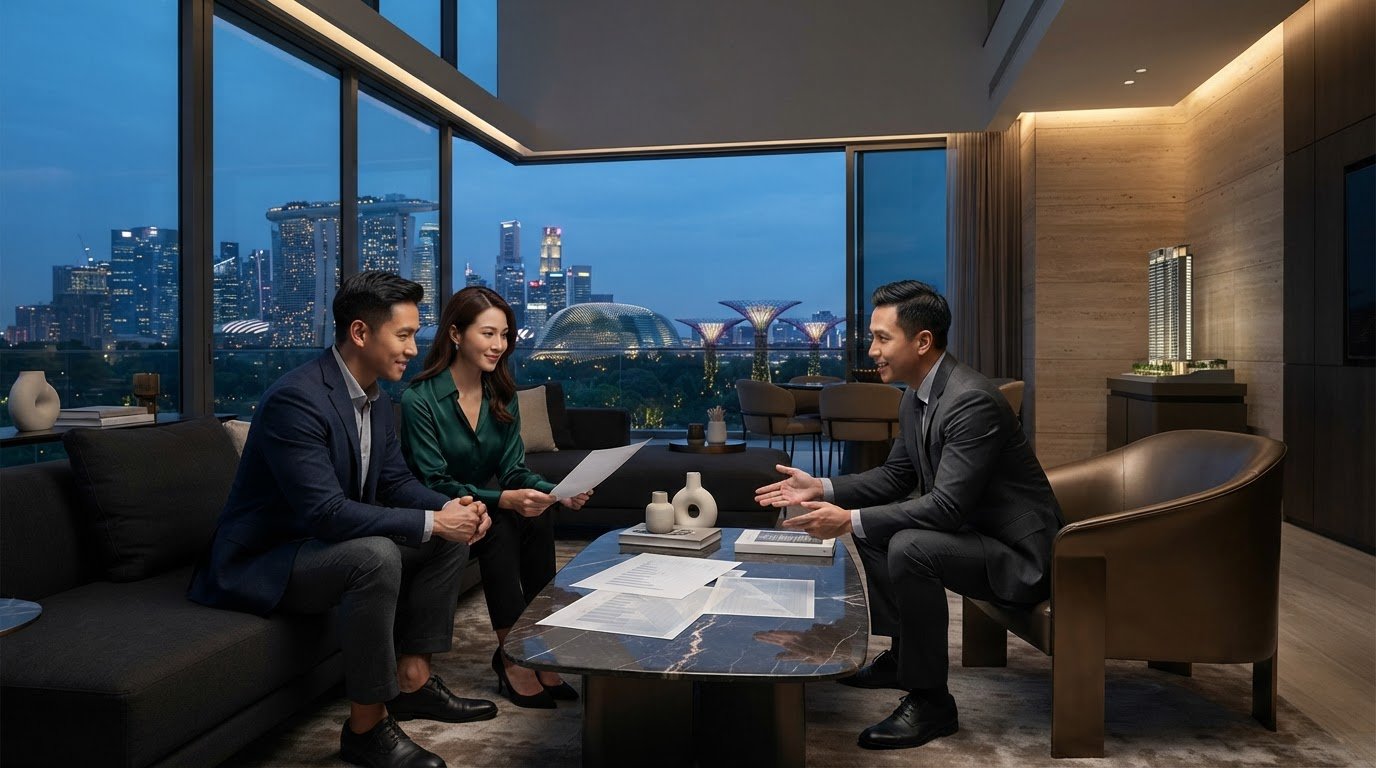
In high-stakes property markets, long-term wealth preservation isn’t determined by striking architecture or developer prestige; it’s won or lost at the level of regulatory execution. Successfully buying a luxury condo in Singapore requires a disciplined strategy that treats private residential acquisition as an exacting portfolio allocation rather than an emotional transaction.
You already understand that securing a top-tier asset demands looking far beyond marketing brochures and showroom finishes. When balancing multi-tiered stamp duties like ABSD, strict debt financing frameworks, and extended holding regulations, deploying capital efficiently can quickly feel like an uphill battle. True liquidity rarely matches developer projections, making disciplined underwriting essential before committing funds.
This guide equips you with the financial frameworks, regulatory clarity, and asset selection criteria needed to acquire premier residential developments with complete confidence. You’ll examine the structural benchmarks that protect your equity, evaluate genuine liquidity across market cycles, and establish a clear roadmap for a seamless acquisition backed by seasoned advisory.
Key Takeaways
- Define authentic premier developments by assessing spatial volume, architectural pedigree, and acoustic privacy beyond showroom finishes.
- Navigate regulatory debt frameworks, equity thresholds, and taxation structures essential to buying a luxury condo in singapore with capital efficiency.
- Assess the defensive investment merits of freehold versus leasehold tenures while scrutinizing floorplate efficiency and private lift access design.
- Execute a disciplined, multi-stage acquisition sequence from off-market inventory sourcing through conveyancing under seasoned advisory guidance.
Understanding the Luxury Condominium Landscape in Singapore
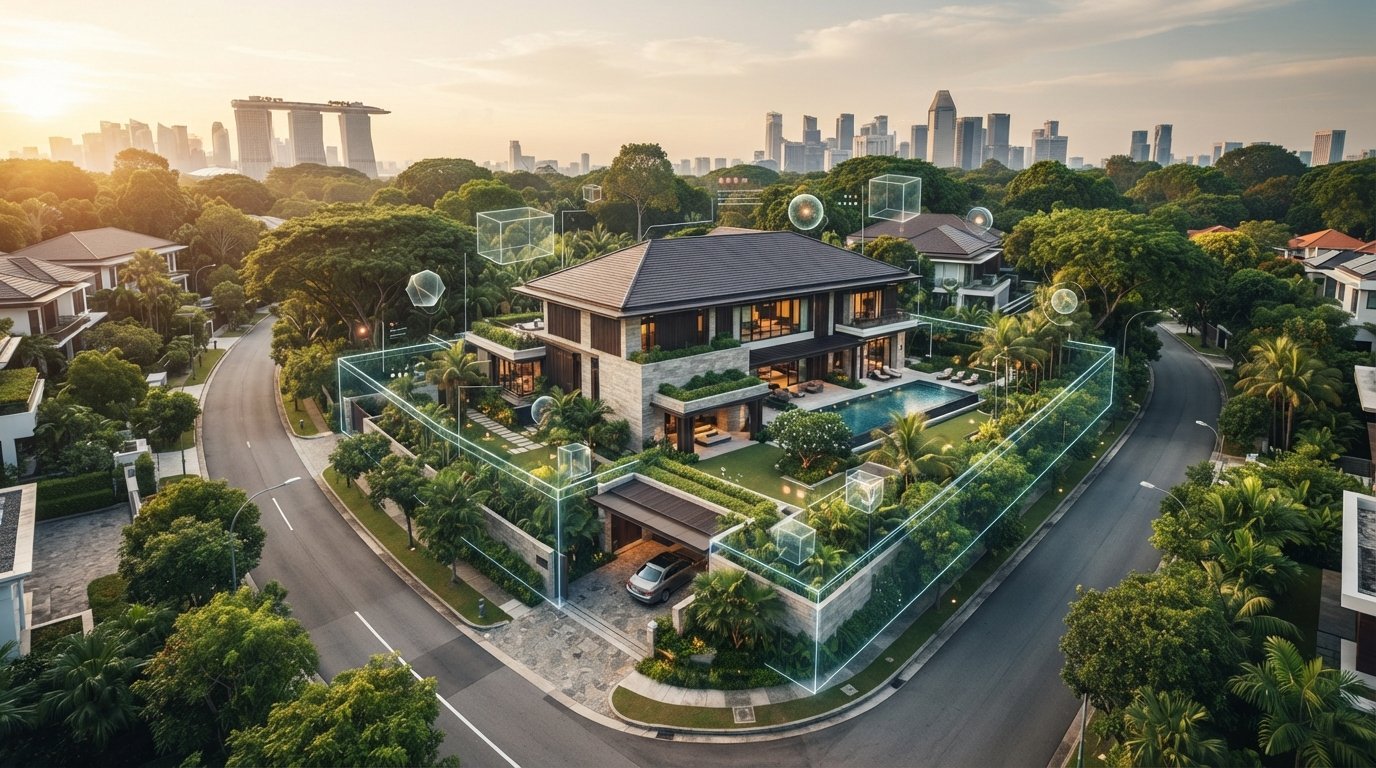
Acquiring a premier residence requires distinguishing genuine prestige assets from standard mass-market developments. While conventional developments focus on maximizing unit density and shared amenities, true high-end residences prioritize spatial volume, uncompromised acoustic privacy, and architectural distinction. Discerning buyers recognize that these properties operate under a distinct asset tier. For sophisticated allocators buying a luxury condo in Singapore, the acquisition represents both an immediate lifestyle enhancement and a stable anchor for multi-generational wealth preservation.
Singapore residential real estate continues to attract substantial safe-haven capital from both domestic high-net-worth families and global investors. Strong legal protections, clear title registries, and disciplined urban governance shield private balance sheets from broader market turbulence. However, capturing long-term defensive value requires navigating these complex capital environments with seasoned, independent advisory rather than relying on promotional marketing claims.
Defining the Hallmarks of a True Luxury Condominium
Authentic premier residences are defined by deliberate architectural and engineering choices that protect long-term market value:
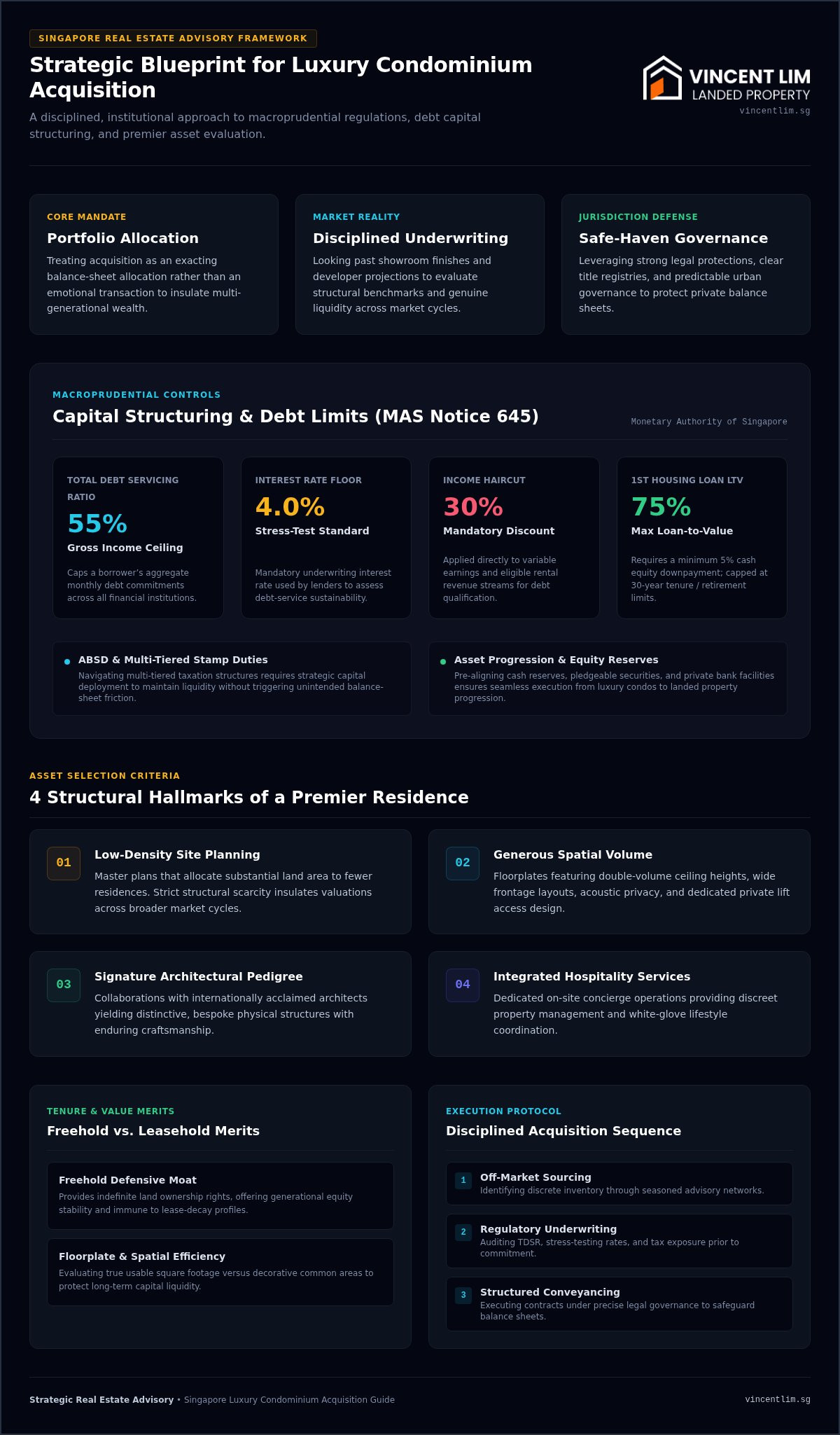
- Low-Density Site Planning: Master plans that allocate substantial land area to fewer residences ensure elevated privacy, personal space, and exclusivity.
- Generous Spatial Volume: Floorplates featuring double-volume ceiling heights, wide frontage layouts, and dedicated private lift access separate elite properties from conventional stock.
- Signature Architectural Pedigree: Collaborations with internationally acclaimed architects yield distinctive structures finished with bespoke, enduring materials.
- Integrated Hospitality Services: Dedicated on-site concierge operations provide discreet property management and white-glove lifestyle coordination.
Because these developments limit total unit counts, strict structural scarcity insulates valuations across broader market cycles nationwide.
The Role of Premier Condominiums in Strategic Asset Portfolios
Within a balanced balance sheet, luxury residences provide equity stability alongside dependable capital preservation. These assets allow investors to deploy capital under a globally recognized condominium ownership framework that pairs individual title rights with shared governance over world-class physical infrastructure.
For many family offices and affluent homeowners, buying a luxury condo in Singapore serves as an initial footprint or a strategic complement to larger residential commitments, such as planning an asset progression to landed property. Sustained institutional governance and predictable urban planning ensure that high-tier residential assets remain robust stores of private capital, providing an enduring foundation across generations.
Financing for Luxury Condominiums: Capital Structuring and Regulatory Frameworks
Executing a high-tier property acquisition requires precise capital coordination. While standard residential transactions rely on routine credit approvals, buying a luxury condo in Singapore demands an institutional approach to capital deployment. Navigating national macroprudential policies alongside private bank underwriting ensures that balance-sheet liquidity remains intact without triggering unintended taxation friction.
Structuring leverage effectively begins with calculating exposure under established debt ratios while maintaining flexible reserve capital. Aligning cash reserves, pledgeable securities, and debt facilities early protects your acquisition timeline from institutional bottlenecks.
Managing TDSR and Loan-to-Value Parameters
The Monetary Authority of Singapore enforces the Total Debt Servicing Ratio (TDSR) framework under Notice 645. This caps a borrower’s total monthly debt obligations at 55% of gross monthly income. Lenders assess credit using an interest rate stress-test floor of 4.0%, while applying a mandatory 30% haircut to variable earnings and eligible rental revenue streams.
- First Housing Loan Limits: Capped at 75% Loan-to-Value (LTV) with a mandatory 5% cash equity downpayment, provided tenure does not exceed 30 years or retirement thresholds.
- Subsequent Facilities: Drops to 45% LTV for a second mortgage, with the minimum cash downpayment increasing to 25%.
- Corporate Borrowers: Non-individual corporate entities face strict borrowing restrictions, with allowable LTV limited to 15%.
Balancing conservative borrowing against liquidity preservation keeps private capital agile for other strategic opportunities.
Navigating Buyer’s Stamp Duty and ABSD Obligations
Every transaction incurs statutory duties calculated across progressive tiers. Standard Buyer’s Stamp Duty (BSD) ranges up to 6% on qualifying tier thresholds. Simultaneously, buyers must account for the official Additional Buyer’s Stamp Duty (ABSD) regulations enforced by the Inland Revenue Authority of Singapore (IRAS).
Citizens face 0% on a first property, rising to 20% on a second, and 30% thereafter. Permanent residents incur 5% initially, increasing to 30% and 35%. Foreign purchasers without qualifying Free Trade Agreement status face a flat 60% duty, whereas entities and corporate trusts incur 65%. Structuring acquisitions cleanly prevents costly audits under Section 33A anti-avoidance statutes.
Structuring Private Capital and Mortgage Facilities
Private wealth desks offer bespoke mortgage arrangements, often integrating asset-backed facilities and securities pledges to optimize borrowing capacity. Benchmark lending tracks the compounded Singapore Overnight Rate Average (SORA), allowing borrowers to choose between dynamic floating margins and fixed facilities during rate transitions. If you want to structure your liabilities efficiently, working with a specialist in luxury condominium sales ensures every debt and tax parameter aligns with your family wealth objectives.
Critical Selection Criteria: Evaluating Value, Tenure, and Spatial Utility
Marketing brochures and curated show units often obscure the structural realities of an address. Discerning purchasers recognize that sustained value stems from fundamental property attributes rather than cosmetic enhancements. When buying a luxury condo in Singapore, thorough underwriting demands a clinical assessment of title tenure, architectural ergonomics, and the underlying financial health of the development’s management corporation.
A premier property must deliver lasting comfort alongside balance-sheet resilience. Evaluating these variables systematically prevents capital erosion and ensures that your residence remains highly liquid when returning to the open market.
Freehold versus Leasehold: Balancing Longevity and Yield
The choice between 99-year leasehold and freehold titles fundamentally shapes your capital horizon. Leasehold developments often present compelling rental returns and impressive physical scales during their initial years. However, progressive lease decay becomes an unavoidable consideration for portfolios targeting multi-decade succession.
Freehold titles permanently remove tenure depreciation risk. For family offices prioritizing multi-generational preservation, this perpetual ownership parallels the long-term defensive ethos seen when analyzing what is a good class bungalow. Long-term asset longevity must also align with institutional lending criteria, as bank underwriting rigorously factors remaining lease tenures alongside national Total Debt Servicing Ratio (TDSR) rules when evaluating exit liquidity.
Floorplate Ergonomics and Architectural Quality
True luxury reveals itself in space efficiency and acoustic serenity rather than aggregate square footage alone:
- Functional Living Area: Prioritize wide frontage layouts over disproportionate circulation corridors, non-functional planter margins, or unconditioned voids.
- Acoustic Separation and Privacy: Premium developments incorporate dedicated private lift vestibules, heavy structural subfloors, and double-glazed façade engineering to isolate interiors from ambient sound.
- Strata Management and Sinking Funds: Review the managing agent’s operational record and audit the sinking fund’s balance to confirm adequate provisions for long-term mechanical maintenance.
- Environmental Orientation: Optimal cross-ventilation and strategic north-south orientation protect interior finishes from excessive solar heat while lowering passive cooling requirements.
Thoughtfully planned residential floorplates consistently preserve secondary-market liquidity. By prioritizing structural integrity and efficient layouts, you safeguard capital through every stage of the property cycle.
The Step-by-Step Acquisition Methodology for Luxury Condominiums
High-value residential acquisitions demand methodical execution rather than hasty commitments. When buying a luxury condo in Singapore, moving through an established sequence ensures transactional clarity, protects private equity, and eliminates avoidable contractual pitfalls. A structured process bridges the gap between private property evaluation and final settlement.
- Capital and Portfolio Structuring: Audit liquidity reserves, secure institutional credit pre-approvals, and confirm the legal holding structure prior to entering the market.
- Curated Property Sourcing: Access premier residences through discreet off-market channels, private client networks, and priority developer allocations.
- Contractual Option Securing: Negotiate commercial terms, price covenants, and issuance terms to secure the Option to Purchase (OTP).
- Legal Due Diligence and Auditing: Execute title verification, encumbrance searches, and comprehensive physical condition surveys.
- Conveyancing Settlement and Handover: Finalize balance funding settlements, discharge statutory taxes, and take formal possession of the residence.
Securing the Option to Purchase and Managing Due Diligence
Securing the Option to Purchase grants the exclusive right to purchase the property. In private transactions, this traditionally involves a 1% option fee, which provides a standard 14-day validity window. For complex transactions, seasoned advisory can extend this duration to 21 days or longer to facilitate thorough due diligence.
During this critical period, your conveyancing solicitor reviews the Singapore Land Authority title register, confirms the absence of lingering caveats, and reviews existing tenancies. Concurrently, independent building surveyors must inspect the residence. They evaluate structural glazing, air-conditioning infrastructure, and plumbing conduits to uncover any hidden defects before you exercise the option.
Execution, Legal Settlement, and Final Handover
Exercising the option requires remitting the remaining 4% exercise fee, completing the standard 5% contractual deposit. The Inland Revenue Authority of Singapore requires all applicable stamp duties, including BSD and ABSD, to be settled within 14 days of this exercise date.
The conveyancing completion period typically spans 8 to 12 weeks. During this window, your legal team coordinates incoming mortgage drawdowns, CPF Board fund releases, and liquid cash balances. Prior to legal completion, you will conduct a pre-completion vacant possession walk-through to confirm that any agreed defect rectifications are fulfilled before final keys and title deeds transfer to your ownership.
To navigate each contractual milestone with complete discretion and rigorous oversight, connect with Vincent Lim for bespoke luxury condominium sales advisory.
Partnering with an Elite Real Estate Strategist for Your Acquisition
High-stakes residential investments require strategic clarity, not retail salesmanship. Standard transactional brokerage focuses on closing deals quickly, often glossing over nuanced structural risks or debt inefficiencies. When buying a luxury condo in Singapore, collaborating with a dedicated strategist transforms a convoluted process into a calculated, orderly asset deployment. You receive independent underwriting that prioritizes capital safety over commission volumes.
Operating as an Executive Associate Director under the established OrangeTee & Tie agency brand, Vincent Lim provides this rigorous level of client advocacy. Active in Singapore real estate since approximately 2004, he combines seasoned market instinct with the institutional research muscle of one of the nation’s premier agencies. This veteran background ensures every portfolio recommendation rests on verified transaction intelligence rather than developer hyperbole.
The Advantage of Experienced High-End Advisory
Navigating premier residential asset classes demands a partner with deep transactional fluency across multiple property segments:
- Multi-Segment Fluency: Vincent’s demonstrated track record spans luxury condominiums, landed properties, and Good Class Bungalows, giving him an objective perspective on cross-asset valuations.
- Defensive Analytical Screening: By filtering out vanity marketing claims, your advisory screens for structural resilience, operational maintenance quality, and long-term liquidity.
- Discreet Private Treaty Execution: Ultra-prime acquisitions demand total confidentiality. Controlled communication channels protect your identity and negotiating posture throughout private bilateral discussions.
Seasoned advisory replaces speculation with empirical evidence. This disciplined oversight ensures that every dollar deployed strengthens your broader family office balance sheet.
Initiating Your Bespoke Property Acquisition Plan
A successful acquisition begins well before viewing properties. It starts with building an exacting strategic brief that reflects your liquidity parameters, holding timeline, and tax considerations. Through an extensive private client network, Vincent unlocks off-market inventory and priority developer allocations that never reach public property portals.
Whether you’re acquiring a generational family home or structuring a defensive residential allocation, professional guidance protects your balance sheet at every contractual juncture. Take the decisive first step toward securing your next prime residence. Connect with Vincent Lim for Strategic Luxury Advisory to align your real estate investments with institutional rigor and complete peace of mind.
Executing Your Strategic Acquisition with Confidence
Mastering premier property acquisition requires viewing residential assets through the lens of capital discipline. Successfully buying a luxury condo in Singapore hinges on aligning your leverage with strict lending frameworks, while selecting homes defined by functional volume, low density, and enduring structural quality over showroom finishes. When these fundamentals align, your acquisition delivers generational security and long-term equity defense.
Navigating these multi-layered decisions demands an experienced advocate in your corner. Active in Singapore real estate since approximately 2004, Vincent Lim serves as an Executive Associate Director at OrangeTee & Tie. He combines institutional research with an established track record spanning luxury condominiums, landed properties, and Good Class Bungalows. When you’re ready to deploy capital with total clarity, connect with Vincent Lim for strategic luxury advisory and secure your premier residence with absolute confidence.
Frequently Asked Questions
Can foreigners legally buy a luxury condominium in Singapore?
Yes, foreign nationals can acquire private condominium units without prior regulatory approval under the Residential Property Act. Unlike landed houses or Good Class Bungalows, which require Land Dealings Approval Unit consent, private strata apartments remain freely accessible. Foreign purchasers are subject to standard Buyer’s Stamp Duty and Additional Buyer’s Stamp Duty, unless qualifying under specific Free Trade Agreements that grant national treatment.
What is the current Additional Buyer’s Stamp Duty rate for Singapore Citizens and Permanent Residents?
Singapore Citizens pay 0% ABSD on their first residential acquisition, 20% on their second, and 30% on third and subsequent properties. Singapore Permanent Residents incur 5% ABSD on their primary residential purchase, rising to 30% on their second, and 35% on subsequent transactions. These statutory tax tiers apply directly to the higher of the purchase price or market valuation.
How does the Total Debt Servicing Ratio (TDSR) restrict high-end mortgage borrowing limits?
The TDSR framework limits a borrower’s total monthly debt obligations to a maximum of 55% of gross monthly income across all credit facilities. When assessing mortgage affordability for high-end residences, financial institutions apply a mandatory 4.0% interest rate stress-test floor. Lenders also impose a 30% regulatory haircut on variable compensation, bonuses, and eligible rental revenue streams.
Is freehold tenure strictly superior to leasehold when acquiring a luxury condominium?
Freehold status is not automatically superior, but it offers permanent equity defense against lease decay. It suits family offices prioritizing multi-generational holding horizons. Conversely, premier 99-year leasehold developments often deliver higher immediate rental yields, superior spatial scales, and comprehensive integrated lifestyle amenities. Your selection should balance your anticipated investment timeline against generational succession objectives.
What initial deposit is required when securing an Option to Purchase for private residential property?
Securing an Option to Purchase for a completed resale private property requires paying an option fee equal to 1% of the agreed purchase price. This grants the buyer an exclusive validity window to review title documents and coordinate mortgage approvals. Exercising the option involves submitting a further 4% exercise fee, completing the standard 5% contractual cash deposit.
How does a dedicated luxury property specialist protect a buyer’s financial interests during negotiation?
A dedicated luxury specialist conducts rigorous comparative transaction audits, shielding purchasers from emotional overbidding driven by developer sales campaigns. In complex private treaty negotiations, an experienced strategist manages discrete communication channels, audits title caveats, and restructures option timelines. This objective guidance safeguards balance-sheet liquidity throughout the entire process of buying a luxury condo in Singapore.
What are the typical recurring maintenance charges associated with premier residential developments?
Recurring maintenance contributions fund the physical upkeep of communal grounds, mechanical infrastructure, private elevators, and dedicated concierge teams. Rather than a flat fee, these liabilities are apportioned according to each unit’s assigned share value within the strata title plan. Expansive layouts with higher share allocations contribute proportionally larger quarterly sums toward the property’s management fund and long-term sinking fund.