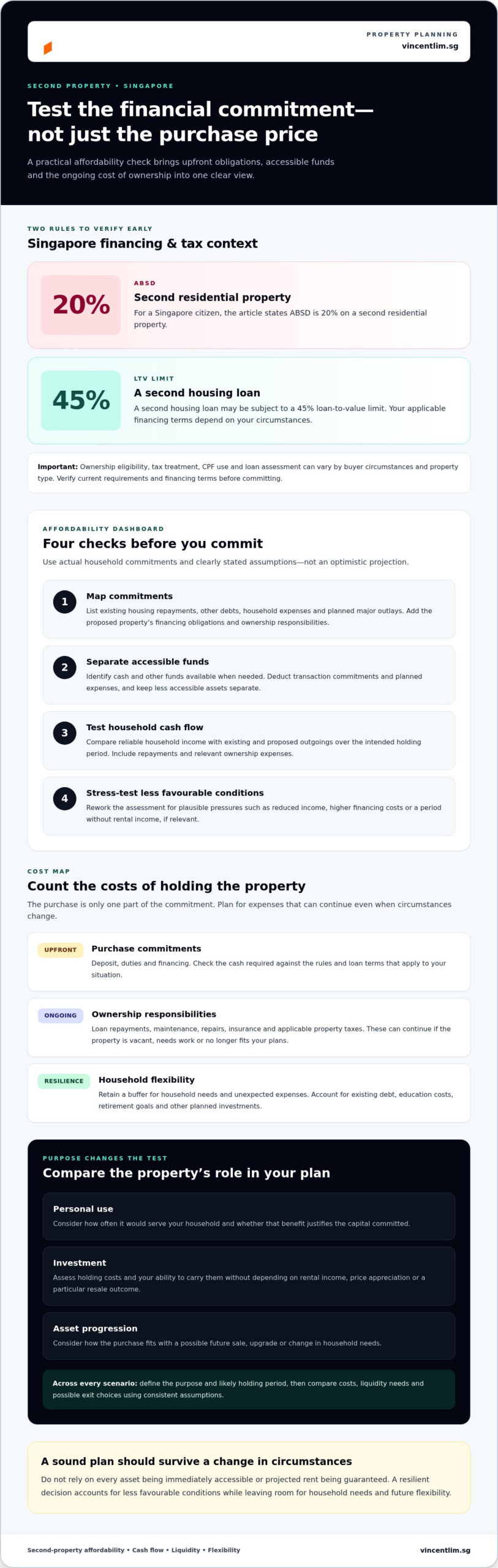
A second property can look affordable on paper and still leave your household short of liquidity. Sound financial planning for a second property starts with more than the purchase price: for a Singapore citizen, ABSD on a second residential property is 20%, and a second housing loan may be subject to a 45% LTV limit. These obligations can shape the decision before potential rental income or future gains come into play.
It’s reasonable to question whether the numbers work. Financing rules, taxes and ongoing ownership costs all affect the outcome. This guide offers a practical way to test affordability beyond the initial purchase, assess the impact on household cash flow and separate possible returns from commitments you’ll need to meet.
You’ll compare personal-use, investment and asset-progression scenarios, then consider liquidity, loan repayments, interest-rate resilience and possible exit plans. The aim is to identify the questions to resolve before committing. For a landed-property transaction, Market Analysis and Property Valuation can provide relevant inputs as you move from a financial framework towards an informed purchase or sale.
Key Takeaways
- Use financial planning for a second property to assess its purpose, obligations, liquidity demands and effect on future flexibility.
- Map household commitments and accessible funds before testing whether cash flow can sustain ownership under less favourable conditions.
- Compare personal use, investment and asset progression by holding capacity, liquidity needs and possible exit choices.
- Review ownership eligibility, financing assessment and tax obligations separately, since requirements can depend on your circumstances and property type.
- Set a clear decision sequence, and know when to pause, revise assumptions or reconsider the property type before proceeding.
Why financial planning for a second property in Singapore starts beyond the purchase price
Choosing a second property is one decision. Determining whether your finances can support it through changing circumstances is another. A home may suit your preferences or appear to have investment potential, yet still be a poor fit if the purchase drains accessible reserves or limits other choices. Financial planning for a second property means assessing its purpose, ownership obligations, liquidity demands and effect on future flexibility together.
Financial resilience in a second-property decision means being able to meet the purchase and ongoing obligations while retaining enough flexibility to manage setbacks and pursue other priorities. That assessment should account for Singapore-specific rules, rather than assumptions drawn from overseas markets. For example, as of October 2026, a Singapore citizen buying a second residential property faces ABSD at 20%. The applicable tax treatment depends on the buyer’s circumstances, so verify current requirements with official guidance before committing.
Singapore’s economic context, outlined in the Economy of Singapore, provides useful background, but broad market conditions can’t establish whether a purchase suits an individual household. Assess affordability against your own commitments and plans.
What should a second-property financial plan account for?
Separate the initial purchase commitment from the costs and responsibilities of holding the property. Alongside the deposit, duties and financing, allow for recurring loan repayments, maintenance, repairs, insurance and applicable property taxes. These obligations can continue when the property is vacant, needs work or no longer fits your plans.
Next, distinguish accessible reserves from wealth tied up in assets that may take time to sell or convert into cash. Set aside a buffer for household needs and unexpected expenses before deciding how much capital is genuinely available. Account for competing priorities such as existing debt, education costs, retirement goals or other planned investments. A plan that works only if every asset can be accessed immediately is fragile.
Mark assumptions that need current verification: ownership eligibility, tax treatment, CPF use, loan assessment and the property’s expected upkeep. Rules can differ by buyer circumstances and property type. Confirm the requirements and financing terms that apply to your situation instead of relying on an outdated estimate.
How does the property’s purpose change the decision?
For personal use, assess how often the property would serve your household and whether that benefit justifies the capital committed. For an investment, examine the holding costs and your ability to carry them without relying on rental income, price appreciation or a particular resale outcome. For asset progression, consider how the purchase fits with a possible future sale, upgrade or change in household needs.
Time horizon matters. A buyer intending to hold for years may assess ongoing costs and flexibility differently from someone who may need to sell sooner. Define the purpose and likely holding period first, then compare scenarios using consistent assumptions. This helps show which costs, liquidity needs and exit choices matter most, and whether the property remains suitable if your plans change.
Build a second-property affordability test around cash flow and liquidity
A purchase can meet a lender’s assessment and still put pressure on your household budget. Build a separate test for your own resilience, using actual commitments and clearly stated assumptions rather than an optimistic projection. Make financial planning for a second property practical: identify what must be paid, which funds are accessible and whether the plan holds when conditions become less favourable.
- Map commitments. List existing housing repayments, other debts, household expenses and planned major outlays. Add the proposed property’s financing obligations and expected ownership responsibilities.
- Assess accessible funds. Identify cash and other funds you can use when needed, then deduct transaction commitments and planned expenses. Keep less accessible assets separate.
- Test cash flow. Compare reliable household income with existing and proposed outgoings over the intended holding period.
- Stress-test. Rework the assessment with less favourable but plausible assumptions, such as reduced income, higher financing costs or a period without rental income, if relevant.
For financing assumptions, refer to the MAS Housing Loan Guidelines. Loan-to-value limits and loan tenure affect the amount of financing available and the cash required. Use the rules applicable to your circumstances rather than assuming a particular loan outcome.
How can you test ongoing cash-flow capacity?
Build a monthly view that includes existing commitments alongside the proposed property’s repayments. Add relevant maintenance, repairs, insurance and property-related expenses. If the property is intended for rental, model a vacancy period and don’t treat projected rent as guaranteed income. For personal use, include the costs of maintaining a property that may not be occupied all the time.
Compare a baseline case with a less favourable one. Test what happens if household income falls, expenses rise or rental income pauses. The purpose isn’t to predict every event. It’s to see whether you could continue meeting obligations without relying on a quick asset sale or giving up essential priorities.
How much liquidity should remain after a purchase?
Set a minimum reserve based on your household’s needs, upcoming commitments and tolerance for uncertainty. There’s no single buffer that fits every buyer. Decide what must remain accessible after completion, rather than letting the purchase absorb every available dollar. A share portfolio, business interest or property equity may contribute to net worth but may not be immediately available without a sale, delay or change in value.
Affordability includes the liquidity you retain after completion, not just your ability to assemble the purchase funds. For a landed-property purchase, the landed property downpayment guide can provide relevant context on purchase funding. Market Analysis and Property Valuation can also help refine property assumptions when you’re considering a landed-property transaction. Learn more through Vincent Lim’s services.
Compare second-property scenarios: personal use, investment, or asset progression
A second property can serve very different aims, so compare options against the same criteria before deciding. The table below helps clarify what each scenario requires; it doesn’t predict which will perform best. In financial planning for a second property, treat rental income, appreciation and resale value as assumptions to test, not outcomes to rely on.
| Scenario | Purpose | Holding capacity | Liquidity demands | Possible exit choices |
|---|---|---|---|---|
| Personal use | Provide space for your household, family or future needs. | Can you sustain ownership for the period you expect to use it? | Funds must cover purchase and ongoing costs without weakening household reserves. | Continue using, rent out if appropriate, or sell if needs change. |
| Investment | Acquire a property with potential rental or resale value. | Can you carry costs if the property is vacant or income is lower than expected? | Allow for ongoing expenses and funds that may be needed before any income arrives. | Continue holding, sell, or reallocate capital, subject to circumstances. |
| Asset progression | Reshape property holdings as longer-term needs evolve. | Can you manage the transition and hold the property if a planned sale takes longer? | Consider funds tied up during a purchase, sale or change in ownership strategy. | Hold, sell an existing property, or revise the intended next step. |
When might personal use outweigh investment considerations?
Personal value may be central if the property supports a genuine household need, such as more space or a planned change in how the family lives. Assess that practical benefit alongside the full financial commitment. A strong lifestyle reason doesn’t replace the need to maintain cash flow and reserves. Consider whether your expected use fits your likely holding period; a short-lived need may not justify a long-term commitment.
How should an investment or asset-progression case be tested?
Keep each assumption separate. Estimate potential rental income independently from operating costs and periods without a tenant. Assess possible appreciation separately, without treating past movement as a forecast. Then consider resale: what would make you sell, and could you hold if the timing or proceeds differed from your expectations? Compare that with retaining the property or reallocating assets without assuming any option will deliver a particular return. For buyers also evaluating prime international real estate investments, advisory firms like MaddisonV Properties offer guidance on stress-testing tenancy assumptions and holding structures in global markets.
For landed-property decisions, asset progression also involves how one property choice relates to a possible next purchase or sale. The landed property asset-progression guide provides further context, while this strategic terrace-house acquisition guide can inform consideration of a terrace house. Use these perspectives to sharpen your questions, then compare each scenario against your holding capacity, liquidity needs and preferred exit choices.
Stress-test the plan against Singapore ownership and financing rules
Before relying on an affordability model, check the rules that shape whether and how you can buy. Separate the review into three questions: are you eligible to own the property, how might a lender assess the proposed borrowing, and what taxes or other obligations apply? The answer can depend on factors such as buyer status, existing property ownership and property type. A rule that applies in one situation may not apply in another.
Use Singapore sources rather than importing tax or financing assumptions from overseas articles. Treat this as a verification step in financial planning for a second property, not a substitute for personalised financial, tax or legal advice. Recheck requirements close to the intended transaction because rules and guidance can change.
Which Singapore rules and obligations require current verification?
Check whether Additional Buyer’s Stamp Duty (ABSD) applies to your circumstances and how it would affect the funds needed for the purchase. The IRAS ABSD guidance is the starting point for current rates, remission conditions and eligibility. Review Buyer’s Stamp Duty separately, as it is a distinct consideration.
Ownership and property-type requirements also merit a separate check. For HDB-related rules, use current HDB guidance; for the use of CPF savings, consult the CPF Board. Don’t assume that a rule for one property type, buyer profile or ownership sequence automatically applies to another. If your plan involves selling one property while acquiring another, verify the relevant timing and conditions before relying on a remission or other treatment.
How should financing capacity be assessed?
A lender’s assessment can differ from your household’s view of comfortable repayments. Loan terms, existing debts, income and applicable debt-servicing rules can all affect borrowing capacity. The Monetary Authority of Singapore explains the Total Debt Servicing Ratio (TDSR); consult its current guidance to understand how the framework may apply. The bank’s assessment remains specific to the borrower and proposed loan.
Keep regulatory eligibility distinct from personal affordability. You may satisfy a lender’s criteria yet prefer to borrow less to preserve reserves or accommodate future plans. Conversely, an initial estimate of available borrowing isn’t approval. Confirm financing terms and applicable rules before making a commitment, then update your cash-flow assessment using those verified assumptions.
For a landed-property purchase or sale, Market Analysis and Property Valuation can help clarify the property decision alongside your separate checks of financing, ownership and tax obligations.
Turn your second-property decision into a disciplined transaction plan
A sound decision should lead to a clear sequence of actions, not an automatic commitment. Write down the purchase purpose and the assumptions behind it, then test whether the plan remains workable if income, expenses or timing differ from expectations. Financial planning for a second property is about making a considered decision with verified information, including the option to pause.
- Confirm the purpose. State whether the property is for personal use, investment or asset progression, and identify the expected holding period.
- Test resilience. Review cash flow, accessible reserves and the effect of less favourable but plausible scenarios.
- Verify the rules. Confirm current ownership, tax and financing requirements with relevant official sources and professionals.
- Compare scenarios. Consider holding, selling or changing the intended property type against the same financial assumptions.
- Decide deliberately. Proceed only when the purpose, obligations and exit considerations align with your wider plans.
Pause if the purchase depends on optimistic rental income, a quick sale or using reserves needed for other commitments. Revise the assumptions if verified financing terms differ from estimates. Reconsider the property type if the purchase would leave too little flexibility or the intended use no longer fits your likely holding period. Changing the timing can also be a sound decision.
What should be settled before moving toward a transaction?
Before taking a next step, record the intended use, holding assumptions, financing assessment and possible exit choices. Mark any tax, legal or loan details that still require current official guidance or professional advice. If your plan includes selling a landed property, the landed property selling guide can help frame the sale considerations alongside your purchase plan.
How can landed-property transaction support fit the plan?
Once the financial framework is established, transaction information can help you assess the property decision itself. For a landed-property purchase or sale, Market Analysis and Property Valuation provide relevant market and value inputs. Expert Negotiation and Legal and Paperwork Assistance support transaction steps, while remaining separate from financial, tax or legal advice about your personal circumstances.
Vincent Lim has been active in real estate since 2000, and 70 % of Vincent’s transactions are in landed property. He is an Executive Associate Director at OrangeTee & Tie, with CEA Registration Number R026632B. His experience in landed residential property transactions supports buyers and sellers as they move from a considered decision framework towards an informed transaction.
If you’re considering a landed-property purchase or sale, explore landed-property transaction support after completing your own financial and rule checks.
Make your next property move with clarity
A second-property decision doesn’t need to end with an immediate yes or no. It can lead to a clearer purchase brief, a revised timeline or a decision to preserve flexibility for now. The value of financial planning for a second property lies in making the next step deliberate, with the assumptions behind it visible and the property choice aligned with your longer-term direction.
If you’re considering a landed-property purchase or sale, transaction support can help turn your decision framework into a more informed property process. Market Analysis and Property Valuation provide relevant inputs as you assess a property, while Expert Negotiation and Legal and Paperwork Assistance support transaction steps. Vincent Lim received the EdgeProp Excellence Awards’ Top 6 Transactor – Landed for 2022 and 2023, with the awards audited by KPMG.
Explore Vincent Lim’s landed-property transaction services and take your next step with greater clarity and confidence.
Frequently Asked Questions
Can I use CPF savings when buying a second property?
You may be able to use CPF savings, but eligibility depends on current CPF rules, the property and your account circumstances. Check whether the property meets the applicable conditions and how using savings could affect your retirement planning. Before relying on CPF funds in your calculations, review the CPF Board’s current property guidance and verify how the rules apply to your ownership and property details.
Does owning a second property affect my eligibility to buy an HDB flat?
It may affect your eligibility, but the outcome depends on current HDB rules and your circumstances. Requirements can differ according to the flat type, your ownership situation and the application pathway. For example, someone planning to retain a private property shouldn’t assume the rules are identical to those for an applicant selling an existing home. Check current official HDB guidance before making a purchase or sale commitment.
How does rental income affect a second-property loan assessment?
A lender may consider rental income, but its treatment depends on the lender’s current assessment criteria, your circumstances and supporting documentation. A tenancy agreement or rental records may be relevant, but don’t assume projected rent will be counted in full or increase your borrowing capacity by a set amount. Ask the lender how it assesses your application and use only confirmed figures in your affordability calculations.
Can I sell my first property after buying a second one?
You may be able to sell your first property after purchasing another, but the sequence can carry ownership, financing and tax implications. The timing of each transaction and your circumstances as a buyer may affect how requirements apply. Don’t assume a later sale automatically removes or changes an obligation incurred when buying. Before choosing this order, confirm current rules with relevant official sources and obtain advice on the specific transaction.
Should I buy a second property before selling my current home?
Neither sequence is right for every household. Buying first may mean carrying both properties and managing a longer period before sale proceeds are available. Selling first can reduce that overlap, but may require temporary housing or a different purchase timeline. Compare confirmed financing capacity, cash reserves, transaction timing and a contingency plan if a sale or purchase is delayed. Verify the ownership and tax implications for your circumstances before committing.
Is a second property a reliable source of retirement income?
A second property may generate rental income, but it isn’t guaranteed or necessarily consistent retirement income. Vacancy periods, maintenance, other ownership expenses and the timing and proceeds of a future sale can all affect what you receive. Test a conservative scenario that doesn’t rely on continuous rental income or property appreciation. Consider whether having a large share of your assets in property suits your wider retirement plan.
What should I do if my second-property plan fails the affordability test?
Revisit the assumptions before stretching your finances to make the purchase work. Check whether expected income, holding period or planned expenses are realistic, then consider changing the timing, purpose or intended property type. Preserve funds needed for household commitments rather than relying on assets that may take time to access. Pausing is a valid outcome; financial planning for a second property should support a sustainable decision, not force a transaction.