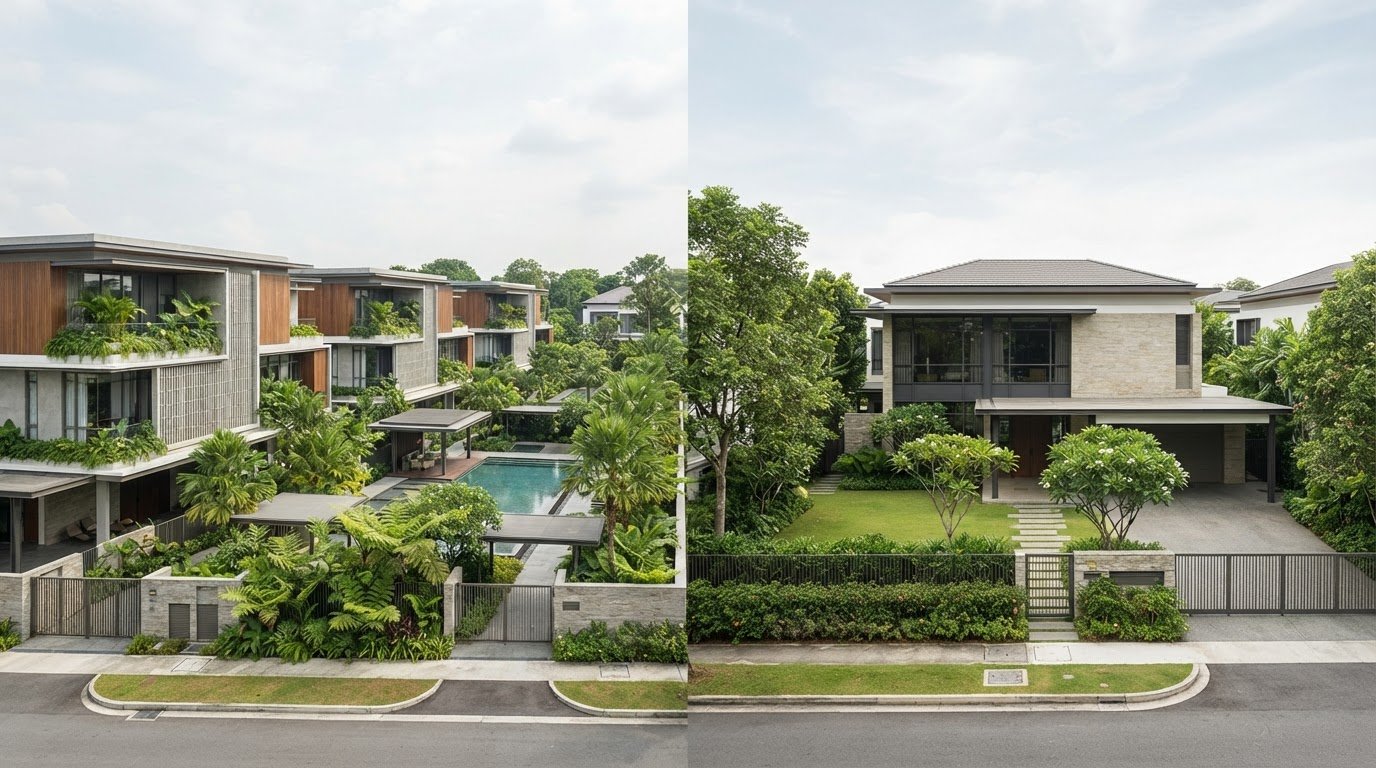
A lower purchase price is only part of the comparison. In Singapore, the key difference in strata landed vs pure landed homes is ownership: a pure landed home has its own land title, while a strata landed home has a strata title within a larger development. Strata homes may cost less than comparable standalone homes, but the difference depends on factors such as location, land and floor area, tenure, condition and shared facilities.
Price matters, but the title also affects upkeep, use of common areas and the scope for changes to the property. This guide explains how those differences shape a like-for-like comparison and what to consider beyond the asking price.
You’ll also learn what bungalow, semi-detached and terrace mean in Singapore, so you can compare both the property type and its ownership structure. The sections ahead explain the main differences, highlight relevant price factors and offer a practical way to assess which type of landed home better fits your priorities.
Key Takeaways
- Compare similar homes by location, tenure, land and floor area, condition, and sale date rather than relying on broad price-per-square-foot averages.
- Include maintenance contributions and shared facilities when assessing the total cost of owning a strata-landed home.
- Use the title and development documents to understand what is privately owned, what is shared, and which changes may need approval.
- Learn how bungalow, semi-detached, and terrace categories differ before comparing properties or setting your shortlist.
- Use matched sales and total holding costs to make a more balanced comparison between freehold terraces and strata-landed homes.
Property prices and comparison with standalone landed homes
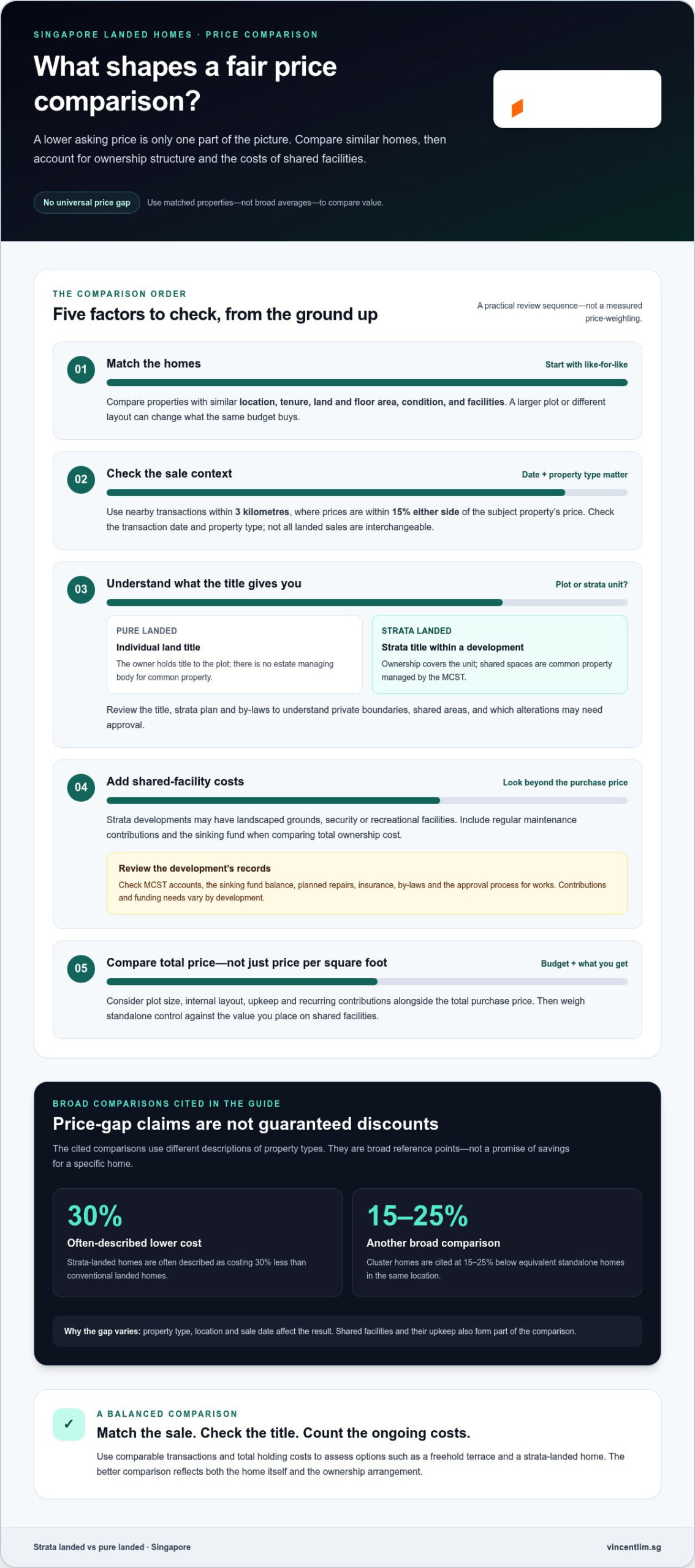
There is no single price gap that applies to every Singapore development. Strata-landed homes are often described as costing 30% less than conventional landed homes, while another comparison places cluster homes 15-25% below equivalent standalone homes in the same location. These are broad comparisons, not guaranteed discounts; the property type, location and sale date affect the result.
Shared facilities account for part of the difference. A strata development may include landscaped grounds, security features or recreational facilities, and owners contribute to their upkeep. The sinking fund contribution depends on the development’s accounts and funding needs, so review it alongside the regular maintenance contribution.
What should buyers check in a strata landed development, including management, leases and by-laws? Review the MCST accounts, sinking fund, insurance, by-laws and approval process for works. Compare tenure and remaining lease too, as lease differences can affect value and future ownership decisions.
To compare developments fairly, match homes with similar locations, tenure, floor area, condition and facilities. Use nearby transactions within three kilometres where prices fall within 15% either side of the subject property’s price. Then compare the transaction date and property type, rather than treating all landed sales as interchangeable.
Compare the total purchase price, not just the average price per square foot. A larger land area, different internal layout or better upkeep can change what a buyer gets for the same overall budget. Include recurring maintenance contributions in your ownership-cost comparison, and consider whether you value the shared facilities.
Which maintenance fees and sinking fund costs apply? Requirements vary by development, so review the MCST accounts to understand the fund balance and planned repairs.
| Option | Ownership | Facilities and costs | Comparison focus |
|---|---|---|---|
| Pure landed home | Individual land title | No estate managing body for common property | Plot, condition, tenure and matched sales |
| Strata terrace | Strata title within a development | Shared facilities and MCST contributions | Comparable unit, facilities, fees and title |
| Strata bungalow | Strata title within a development | Shared grounds and development-level costs | Comparable location, area, condition and tenure |
Choose a comparison that reflects your priorities: weigh standalone control against shared facilities, then compare matched transactions and total holding costs.
What Is Strata-Titled Landed Property?
In Singapore, the title determines whether ownership includes a specific plot or a strata unit within a larger development. That distinction affects shared areas, alteration controls and how buyers assess eligibility.
Strata and Conventional Ownership
A conventional landed home is held under an individual land title for its plot. A strata landed home is held under a strata title within a larger parcel, so ownership covers the unit rather than a separately titled plot. This distinction matters for terrace houses: similar-looking homes can have different ownership arrangements and rules for alterations. The title and development documents establish the relevant rights.
Land and Common Area Ownership
In a strata development, owners hold strata units, while shared spaces are common property. The strata title plan and by-laws define the boundary between a private home and common areas. Owners are automatically members of the Management Corporation Strata Title, or MCST, which manages common property under the Building Maintenance and Strata Management Act, Cap. 30C. A pure landed owner instead holds an individual title to the plot.
Ownership eligibility also depends on the development’s legal classification. The ownership-approval treatment of strata-landed homes can depend on the development’s legal status and title structure. Singapore Permanent Residents may buy cluster houses without Singapore Land Authority approval under the Residential Property Act, Cap. 274. Standalone landed homes are restricted residential property, and non-citizens generally need approval.
How do financing, stamp duties, and taxes compare for strata landed and pure landed homes? The stated maximum loan-to-value ratio for a first private residential purchase is 75%, subject to conditions, and Singapore’s Total Debt Servicing Ratio limit is 55%. Buyer’s Stamp Duty is progressive at 1-6%; Additional Buyer’s Stamp Duty varies by buyer profile and property count, including 0%, 20% and 30% for Singapore Citizens, and 60% for foreign buyers, according to the Inland Revenue Authority of Singapore.
What renovation and rebuilding rules apply? Strata owners need MCST approval for rebuilds or additions and alterations, and exterior changes require management committee approval. Pure landed owners can seek approval to rebuild, but works remain subject to URA and BCA rules.
CPF use and HDB ownership have separate eligibility conditions, which the property title alone does not settle. Before committing, assess the buyer’s CPF eligibility and any HDB ownership or disposal conditions that apply to their circumstances.
For a property-specific comparison, review the title, strata plan and by-laws together, then assess how each affects your intended use. Singapore landed-home guidance can help frame that comparison.
Bungalow, semi-detached and terrace house definitions
Singapore’s landed-home labels describe how houses sit on their plots, not whether they are strata-titled. URA groups landed property into four types: terrace houses, semi-detached houses, detached houses and Good Class Bungalows. A strata development can contain bungalow, semi-detached and terrace forms, so appearance alone does not establish the ownership type.
How the landed forms differ
A terrace house belongs to a row of more than two homes joined by common walls. A Type 1 terrace has a minimum plot size of 150 square metres and minimum plot width of 6 metres; a Type 2 terrace has a minimum plot size of 80 square metres. A semi-detached house shares one side wall with a neighbouring home and has a minimum plot size of 200 square metres.
A detached house stands apart from neighbouring homes, rather than sharing a party wall. A bungalow outside a Good Class Bungalow area has a minimum plot size of 400 square metres. A Good Class Bungalow requires a minimum land area of 1,400 square metres and is limited to two storeys, excluding an attic and basement. These plot thresholds help distinguish property forms, but don’t by themselves determine a home’s title.
Strata versions retain the visible form while placing homes within a shared development. Strata terrace houses are attached along a common boundary party wall and form part of a row of at least three units. A single development site may combine terrace houses, semi-detached homes and bungalows, with communal facilities serving the estate. Distinguish the architectural category from the title and common-area arrangements.
HDB terrace houses and private outdoor space
HDB terrace houses provide a distinct example of Singapore’s landed homes. There are 285 such units across selected historical public housing estates islandwide. Their leases date back to the late 1960s and early 1970s. These are public-housing terrace properties, so their specific estate history and lease terms matter when comparing them with private landed homes.
The HDB terrace houses were built in the 1950s by the Singapore Improvement Trust, HDB’s predecessor. They have private backyards or gardens, but no private carparks, and use common block numbers. This contrasts with developments where shared estate facilities shape the ownership experience.
Private outdoor areas also need careful classification. A backyard, garden or roof terrace may form part of a home’s private area, while surrounding grounds may be shared. In a strata development, the strata title plan and by-laws define the boundaries. Review them to determine whether a particular outdoor space is exclusive or common property.
Freehold terrace and strata landed home prices
Singapore’s transaction figures show why property type and tenure must stay distinct in a price comparison. The available figures also record 57 freehold strata-landed transactions, compared with 447 freehold terrace transactions. These counts show a difference in transaction volume, not a direct measure of demand or future resale performance.
These figures provide dated reference points, but shouldn’t be treated as a year-by-year price path. A broader measure found average landed-property prices per square foot rose about 169% between 1996 and 2021; that long period covers landed homes generally, not strata terraces alone.
HDB terrace houses are a distinct comparison. This figure represents public housing, so it should not be used as a proxy for private cluster houses or freehold terraces. Differences in title, tenure, location, property condition and sale date affect what each transaction can tell a buyer.
Leasehold and freehold houses also need separate comparisons. Freehold tenure does not make two homes equivalent if they differ in floor area, estate setting or communal facilities. Likewise, a cluster unit and a standalone landed house may have different management arrangements and private outdoor space. Where possible, compare similar homes in the same locality, with the same property form and tenure.
Price changes from 2017 to 2021 should be read against like-for-like evidence, not inferred from the 2017 and 2022 strata benchmarks. The 2021 HDB terrace range relates to a separate housing category, while the broad 1996-2021 growth figure covers landed property overall. Keeping those datasets separate prevents a market-wide movement from being mistaken for the change in one estate or cluster.
For a practical review, separate the evidence into three groups: freehold strata landed sales, freehold terrace sales and HDB terrace transactions. Note each sale’s date, tenure, floor area, condition and access to communal facilities. Compare matched examples rather than relying on a single average. This helps show whether a price difference reflects the estate, the house itself or the ownership format.
Pure landed and strata landed classification
In Singapore, the title, not whether a home looks detached, determines its ownership classification. A landed house with its own land title is classified as pure landed property. A strata landed home has a strata title within a larger parcel. This distinction affects what the title covers and how shared areas in the development are organised.
URA describes strata landed housing as landed units on a common development site, with shared communal facilities and a single vehicular access point. The development can include different housing forms, while its units remain strata-titled. Strata landed housing is not allowed in Singapore’s designated landed housing areas, although strata landed houses may be part of a flats development site. Such a hybrid development is not accorded condominium status.
Classification also changes how size is recorded. URA records an ordinary landed house by its land area, but records a strata landed home by its floor space. Each strata-landed housing unit must have a building footprint with a minimum ground contact of 50 square metres. Buyers comparing transactions should therefore distinguish land area from floor area rather than treating them as equivalent measures.
Use the legal documents to establish the property’s classification. The Singapore Land Authority issues Certificates of Title for landed developments and Subsidiary Strata Certificates of Title for strata properties. The strata title plan and by-laws identify private areas and common property. For example, a visible garden does not establish whether the ground is privately owned or shared.
- Read the title to identify whether the property has an individual land title or a strata title.
- Check the strata plan and by-laws to understand the unit boundary and common areas.
- Compare transactions using the correct measurement: land area for ordinary landed houses, floor space for strata homes.
Tenure is separate from ownership form. A property can be freehold or leasehold, and that detail should be assessed independently of whether it is pure landed or strata landed. Housing types such as terrace, semi-detached and bungalow describe physical forms, not the title. Keeping these categories separate gives buyers a clearer basis for comparing listings and transactions.
Good Class Bungalows are located across 39 gazetted areas in Singapore. Their location and property category are separate from the title question, so buyers should assess both rather than assuming the label alone explains ownership. For a focused discussion of this property type, discuss a Good Class Bungalow purchase.
Vincent Lim (OrangeTee & Tie): Terrace House Sales
Vincent Lim (OrangeTee & Tie) offers Terrace House Sales for buyers and owners comparing terrace properties with other landed homes. This can help when narrowing your options and weighing title, location, tenure, condition and recent transaction evidence. A clear comparison separates the home’s physical form from its ownership structure.
His sales work also covers Semi-Detached House Sales, detached houses and Good Class Bungalow (GCB) Sales. These options suit different property searches, so the relevant comparison depends on the home type and your priorities. For a terrace-focused discussion of your landed-property plans, contact Vincent Lim (OrangeTee & Tie) or visit vincentlim.sg.
Make Your Next Property Move With Clarity
Your next step is to turn the comparison into a practical brief: what kind of home suits your plans, which locations you’ll consider and how much flexibility you want in managing the property. A considered choice between strata landed and pure landed homes in Singapore starts with your priorities, not the label alone.
Vincent Lim (OrangeTee & Tie) offers Terrace House Sales, Semi-Detached House Sales and detached house sales. If you’re refining a shortlist or preparing to sell, his property-specific perspective can help you focus on the home type that fits your objectives.
Set out your priorities, then take the next step at a pace that suits your plans. Contact Vincent Lim (OrangeTee & Tie) to discuss your landed-property requirements and move forward with greater confidence.
Frequently Asked Questions
What defines a Landed Build Type?
A landed build type describes a home’s physical form and how it relates to neighbouring homes. In Singapore, categories include terrace houses, semi-detached houses, detached houses and Good Class Bungalows. Terrace houses, for example, join in a row, while detached houses stand apart. This classification describes the building and site, not whether the home has an individual land title or a strata title.
What defines whether it is a Pure Landed or Strata Landed?
The property title determines whether a home is pure landed or strata landed. An individual land title for the plot indicates pure landed ownership; a strata title indicates a unit within a larger parcel. A visual inspection may not reveal the difference, especially in a cluster development. Use the title documents and strata plan to identify the legal classification and understand the unit’s boundaries.
What is strata landed property in Singapore?
Strata landed property is a landed-style home held under a strata title within a shared development. The unit forms part of a larger parcel, and communal areas are managed collectively. For instance, a row of terrace homes may share access and estate facilities while each household occupies its own unit. The strata plan and by-laws clarify which spaces belong to individual units and which are common property.
What is pure landed property in Singapore?
Pure landed property is a house held under an individual land title for its plot. The owner’s title relates to the land and home, rather than a strata unit within a larger estate. A standalone terrace or detached house may fall into this category if it has an individual title. The title documents establish the property’s status, so architectural form alone is not enough to classify it.
What are the main differences between strata landed and pure landed homes in Singapore?
The main difference is the ownership structure and its effect on shared areas and property works. A pure landed owner holds an individual land title and manages the home without an estate body overseeing common property. A strata owner holds a unit within a shared development, where an MCST manages common areas and exterior alterations may require approval. Compare the title, by-laws and management arrangements before deciding which structure suits your priorities.
What are current prices for strata landed and pure landed homes in Singapore?
Market pricing for strata landed and pure landed homes varies significantly based on district, tenure, and property size, meaning there is no fixed price gap between the two categories. These represent distinct market segments rather than direct substitutes for comparable homes. To accurately assess a specific property when evaluating strata landed vs pure landed singapore, buyers should compare recent transactions for similar tenure, location, floor area, condition, and sale date.
What are the eligibility rules for Singapore citizens, PRs, and foreigners buying landed property?
Singapore Citizens can buy landed homes subject to the property’s usual transaction requirements; Good Class Bungalows are restricted to Singapore Citizens. Singapore Permanent Residents may buy cluster houses without Singapore Land Authority approval under the Residential Property Act, Cap. 274. Foreign buyers may face restrictions when purchasing landed homes, and eligibility can depend on the property’s classification. Strata status can affect approval treatment, so the specific unit’s classification matters.
What are the pros and cons of strata landed versus pure landed property in Singapore?
Strata landed homes can offer communal facilities and shared management, but owners contribute to upkeep and may need approval for exterior works. Pure landed homes have an individual land title and give owners greater control, but the owner manages the home independently. Neither structure guarantees stronger appreciation or easier resale. Compare the title, estate condition, maintenance obligations and matched transactions against your intended use and ownership preferences.