Is the dream of owning a private landed estate in Singapore truly out of reach for non-citizens, or is it simply a matter of knowing which strategic doors to unlock? You likely feel the weight of the 60% Additional Buyer’s Stamp Duty (ABSD) and the perceived ambiguity of Land Dealings Approval Unit (LDAU) criteria. It’s natural to feel hesitant when the stakes involve such significant capital and complex legal frameworks. This guide provides the clarity you need to determine exactly how can foreigners buy landed property singapore while ensuring your investment aligns with the latest 2026 regulatory standards.
We’ll move beyond the basic restrictions to explore high-level strategies for successful acquisition. You’ll gain a clear understanding of the LDAU application process, the unique exemptions available within Sentosa Cove, and the financial metrics that define this resilient market. By the end of this briefing, you’ll have a definitive roadmap for managing the Residential Property Act with the confidence of a seasoned market participant. Our goal is to replace uncertainty with a calculated plan for your property portfolio.
Key Takeaways
- Define the legal requirements and LDAU approval standards that clarify exactly how can foreigners buy landed property singapore within the current regulatory environment.
- Discover strategic enclaves like Sentosa Cove and strata-titled options that provide high-end landed living through streamlined eligibility paths.
- Evaluate the 2026 financial implications of the 60% ABSD and tiered Permanent Resident taxes to protect your capital and optimize portfolio growth.
- Identify the “Economic Contribution” pillars that the Land Dealings Approval Unit prioritizes when assessing foreign applicants for restricted residential assets.
- Secure a competitive edge by utilizing professional strategic guidance to avoid valuation pitfalls and streamline the complex approval journey.
Understanding Landed Property Restrictions Under the Residential Property Act
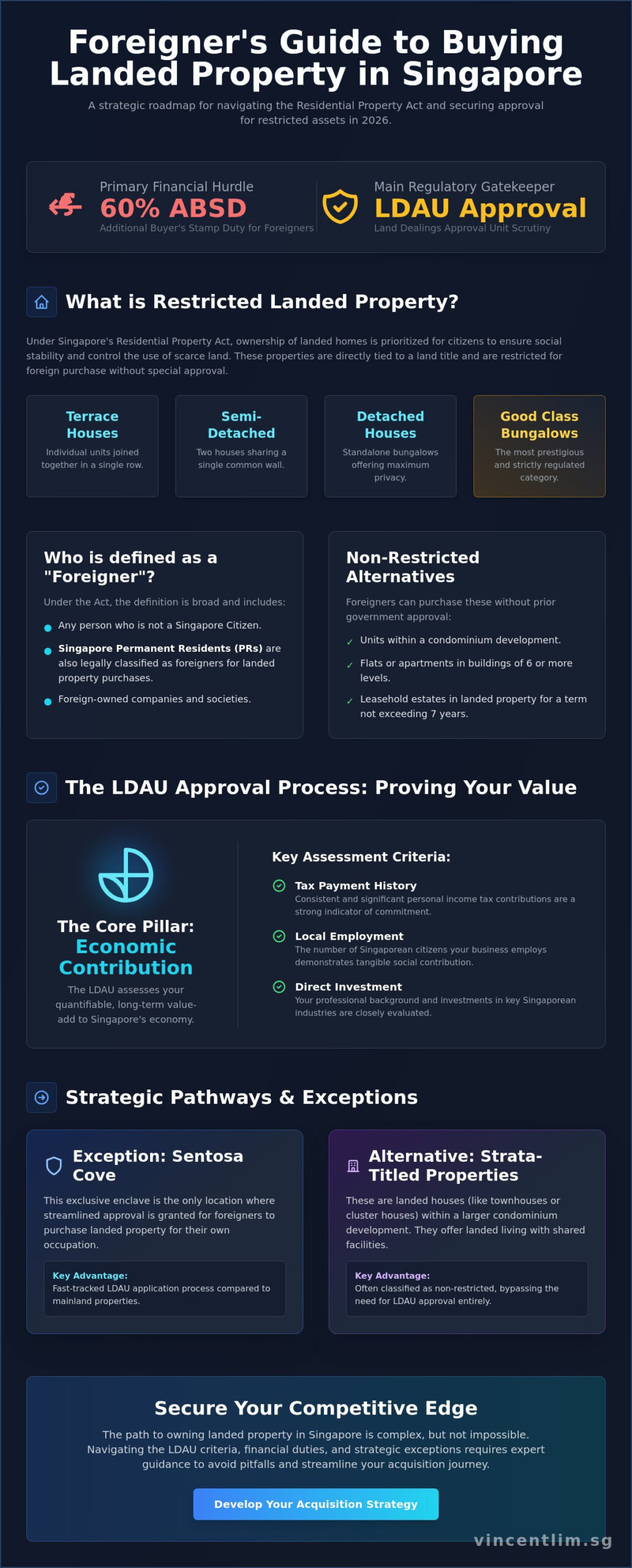
Singapore’s land is a finite and precious resource. This scarcity is the primary reason why the government maintains such rigorous control over landed residential assets through the Residential Property Act. For those asking can foreigners buy landed property singapore, the answer starts with a clear understanding of what the state defines as restricted property. Unlike high-rise apartments, landed homes are tied directly to the soil of the nation. The state prioritizes these assets for citizens to ensure social stability and long-term residency. By restricting land ownership, the government prevents speculative bubbles and ensures that the limited supply of land remains accessible to those who have a vested interest in the country’s future.
Restricted property encompasses several distinct types of housing:
- Terrace houses: Individual units joined in a row.
- Semi-detached houses: Two units sharing a common wall.
- Detached houses: Standalone bungalows that offer the highest level of privacy.
- Good Class Bungalows (GCBs): The most prestigious and strictly regulated category of landed property.
The Legal Definition of a Foreigner
Under the Residential Property Act, the term foreigner is broader than many realize. It doesn’t just refer to non-residents. Singapore Permanent Residents (PRs) are legally classified as foreigners when it comes to purchasing restricted property. This means even if you’ve lived and worked here for years, you still face the same baseline restrictions as a new arrival. Foreign-owned companies and societies also fall under this umbrella. The Singapore Land Authority (SLA) is the governing body responsible for enforcing these rules. They ensure every transaction involving a non-citizen undergoes rigorous scrutiny to maintain the integrity of the Act and protect the national interest.
Restricted vs. Non-Restricted Residential Property
Understanding the boundary between restricted and non-restricted assets is vital for any investment strategy. Most condominiums and apartments are non-restricted. This allows non-citizens to purchase units without seeking prior government approval. However, once a property involves a land title or is part of a low-rise development, it often enters the restricted category. The pinnacle of these restricted assets is found in detached houses for sale in Singapore. These properties represent the height of exclusivity and privacy. While the barriers to entry are high, they offer a level of prestige and legacy planning that standard non-restricted units cannot match. Knowing exactly where these lines are drawn helps you determine how can foreigners buy landed property singapore while remaining fully compliant with the law.
The LDAU Approval Process: Strategic Criteria for Success
The Land Dealings Approval Unit (LDAU) acts as the primary gatekeeper for the Singapore Land Authority. Its mandate is clear: ensure that the ownership of restricted residential land remains aligned with the national interest. For those wondering can foreigners buy landed property singapore, this unit is the most significant hurdle you’ll face. The LDAU doesn’t merely check boxes; it evaluates every applicant based on their long-term commitment to the city-state. This is a discretionary process, meaning the quality of your presentation matters just as much as your financial standing.
The “Economic Contribution” pillar is the most critical element of your application. The authorities look for quantifiable proof that you’ve added value to Singapore’s economy. This might include your history of paying personal income tax, the number of local employees your business supports, or your direct investments in key industries. Navigating these financial commitments, including the current Additional Buyer’s Stamp Duty (ABSD) rates of 60% for foreigners, requires a comprehensive understanding of both tax law and administrative policy. You aren’t just buying a house; you’re applying to be a stakeholder in the nation’s physical landscape.
Securing the right representation can transform a complex application into a streamlined success story. A specialist agent does more than find a property; they help you curate a professional profile that resonates with the LDAU’s objectives. They understand the nuances of what the board seeks and can help you avoid common pitfalls that lead to rejection. You’ll benefit from bespoke real estate strategies that prioritize your legacy goals while maintaining strict compliance with the Residential Property Act.
Key Eligibility Requirements for Applicants
While every case is unique, the LDAU typically looks for a few standard benchmarks. Being a Singapore Permanent Resident (PR) for at least five years is a common baseline, though it doesn’t guarantee success. You must also prove that the property is for owner-occupation. The government is very strict about this; you cannot buy a restricted landed home for the purpose of renting it out or holding it as a vacant investment. The goal is to ensure that land is used for genuine residency by those contributing to the community.
Steps to Applying for LDAU Approval
The journey from selection to ownership is methodical and requires patience. First, you must identify a property that fits within the restricted guidelines, typically avoiding Good Class Bungalow areas unless you have exceptional status. Once a property is selected, you’ll submit a formal application through the SLA portal, accompanied by a comprehensive package of supporting documents. You should expect a wait time of one to three months for a final decision. Crucially, you must ensure that your Option to Purchase (OTP) is legally conditional upon receiving LDAU approval. Executing a contract without this clause can lead to severe financial penalties if your application is declined.
Exceptions to the Rule: Sentosa Cove and Strata-Titled Alternatives
While the mainland’s restrictions are stringent, the Singapore property market offers two primary avenues for non-citizens to bypass the standard five-year PR requirement. These exceptions provide a sophisticated route for those seeking the prestige of landed living without the administrative weight of a mainland LDAU application. Understanding these nuances is essential for any high-net-worth individual evaluating how can foreigners buy landed property singapore while maintaining a focus on wealth preservation and lifestyle excellence.
Sentosa Cove remains the premier destination for global investors. As an “Integrated Resort” zone, it’s the only enclave in the country where non-PR foreigners are permitted to purchase landed homes, including bungalows and villas. The approval process here is notably streamlined, typically yielding results much faster than mainland applications. Beyond the legal ease, these properties offer a lifestyle that is impossible to replicate elsewhere in the city. Private berths, direct waterfront access, and an atmosphere of secluded luxury make these assets a cornerstone of elite global portfolios.
For those who prefer mainland proximity, strata-titled landed property, or cluster housing, offers a compelling alternative. These developments provide the physical experience of a landed home, such as multiple levels and private basements, but they operate under a Management Corporation Strata Title (MCST). Because the land is shared among all owners within the development, many of these projects are classified as non-restricted. This classification allows foreigners to acquire them with the same ease as a standard luxury condominium, providing a strategic entry point into the landed market.
Landed Living in Sentosa Cove
The strategic value of Sentosa assets lies in their scarcity and unique legal status. While mainland bungalows are often subject to grueling “economic contribution” tests, Sentosa acquisitions follow a fast-track path. These homes aren’t just residences; they’re instruments of wealth preservation. The ability to own a waterfront detached house with a private berth in a stable, AAA-rated jurisdiction is a rare proposition that continues to attract significant capital from international markets. It’s a bespoke solution for those who value both privacy and efficiency.
Strata-Titled Landed (Cluster Housing)
Strata-titled homes bridge the gap between apartment living and traditional estates. Owners enjoy the space and privacy of a house while benefiting from shared amenities like 24-hour security and professional landscaping. When evaluating the resale potential of these homes, they often show different growth trajectories compared to traditional terrace houses. While they don’t offer sole land ownership, their accessibility to a wider pool of foreign buyers often supports healthy liquidity in the secondary market. This makes them an excellent choice for investors who prioritize flexibility and ease of exit.
Financial Essentials: ABSD and Investment Outlook for 2026
Establishing legal eligibility is only the first step. The financial framework of 2026 requires a sophisticated approach to capital management. When you evaluate how can foreigners buy landed property singapore, the 60% Additional Buyer’s Stamp Duty (ABSD) is the most prominent fiscal consideration. This rate, established to prioritize local homeownership, has fundamentally shifted the market profile. It’s no longer a space for speculative traders. Instead, it’s a sanctuary for ultra-high-net-worth individuals who view Singaporean land as a generational asset. ABSD serves as a market stabilizer for high-end assets, ensuring the sector remains resilient against global economic volatility by attracting only the most committed investors.
The investment outlook remains robust despite these high entry costs. In 2025, the transaction value for landed properties rose by 19.3% to approximately S$12.31 billion. While the landed property price index saw a slight dip of 0.4% in the first quarter of 2026, this follows a significant 3.4% surge in late 2025. This pricing stand-off suggests that sellers of prime landed estates aren’t under pressure to liquidate. They recognize the inherent scarcity of their holdings. For those seeking long-term capital appreciation, landed property continues to outperform luxury condominiums in terms of land-to-structure value ratios.
Navigating the 2026 ABSD Landscape
Calculating the total cost of acquisition involves more than just the purchase price. You must account for the tiered structures of ABSD for landed property, which varies significantly if you’re a Permanent Resident (PR). PRs benefit from lower rates on their first home, typically around 5%, though this escalates sharply for subsequent properties. Beyond stamp duty, a critical component of your total capital commitment is structuring your landed property downpayment in Singapore to account for LTV limits, Cash Over Valuation risks, and the interplay between your initial 5% cash and 20% CPF components. To manage these high-stakes transactions effectively, it’s vital to consult with an elite real estate strategist who can help you structure your portfolio for maximum tax efficiency and long-term security.
Freehold vs. Leasehold: The 2026 Investor Choice
The distinction between freehold vs leasehold landed property is a critical decision point for legacy-focused investors. Freehold status is the gold standard in Singapore. It offers perpetual ownership and protection against the lease decay that affects older 99-year leasehold properties. In the current market, freehold assets command a significant price premium, often 20% to 30% higher than their leasehold counterparts. This premium is a reflection of the absolute scarcity of freehold land in a country with a growing population and limited geography. For those building a multi-generational legacy, the peace of mind offered by freehold title is often the deciding factor.
The Vincent Lim Advantage: Bespoke Guidance for Elite Acquisitions
Acquiring restricted property in Singapore is a journey that demands more than just capital; it requires a sophisticated strategy. While the legal frameworks provide the boundaries, a veteran strategist identifies the opportunities within those limits to secure your family’s future. The question of how can foreigners buy landed property singapore is often met with bureaucratic complexity, but the right guidance transforms these hurdles into a structured roadmap. Vincent Lim provides a white-glove service that prioritizes your peace of mind, ensuring that every high-stakes transaction is handled with calculated competence and absolute transparency.
Risk mitigation is the cornerstone of a successful acquisition. Many applicants face rejection because they fail to quantify their economic contributions or they select properties that don’t align with LDAU preferences. By conducting a thorough pre-assessment of your profile and the target asset, we eliminate the anxiety of the unknown. This meticulous approach extends to valuation as well. We ensure you don’t overextend on price, protecting your capital from the outset. You gain access to a gold standard of service where integrity and results-oriented planning are the only benchmarks that matter.
A Strategic Approach to Luxury Real Estate
Success in this segment isn’t about viewing dozens of homes. It’s about translating complex regulations into clear, actionable benefits for your portfolio. We begin with a deep dive into your long-term goals, whether you’re looking for a primary residence or a legacy asset for your children. Meticulous planning occurs long before the first viewing. This ensures that when you do step into a property, it’s one that you’re legally eligible to acquire and one that fits your asset progression strategy. For international families, this level of precision is essential for maintaining a seamless transition into the Singaporean landscape.
Securing Your Legacy in Singapore
For the most discerning investors, Good Class Bungalows remain the ultimate trophy asset. These estates represent the pinnacle of privacy and prestige, serving as a powerful anchor for your family’s legacy. Navigating the acquisition of such a significant asset requires coordination with your legal and financial advisors to ensure tax efficiency and compliance. We act as the central coordinator, refining every detail of the purchase to guarantee a smooth handover. If you’re ready to explore the elite tiers of the market, it’s time to partner with Vincent Lim for your landed property journey and secure your place in Singapore’s most exclusive enclaves.
Securing Your Future in the Singapore Landed Market
The path to owning a landed estate in Singapore is defined by rigorous standards but remains open to those who approach it with a long-term perspective. You’ve seen that the Land Dealings Approval Unit (LDAU) prioritizes genuine economic contribution and that enclaves like Sentosa Cove provide a streamlined alternative for international capital. Determining exactly how can foreigners buy landed property singapore involves a sophisticated understanding of both legal frameworks and market timing. By aligning your investment with the current 2026 financial landscape, you turn regulatory hurdles into a structured roadmap for wealth preservation.
Navigating these high-stakes transactions requires a partner who understands the nuances of the Residential Property Act and the 60% ABSD landscape. Vincent Lim, Executive Associate Director at OrangeTee & Tie, brings over 20 years of industry experience to every consultation. As a specialist in Good Class Bungalows and high-end landed estates, he possesses the expertise to refine your application and coordinate a seamless acquisition. He’s mastered the complexities of LDAU approvals and tax frameworks to ensure his clients operate with total confidence. You don’t have to manage these intricate processes alone.
Consult with Vincent Lim for a Strategic Landed Property Assessment to begin your journey with a trusted guide. Your legacy in Singapore’s most exclusive neighborhoods is within reach.
Frequently Asked Questions
Can a foreigner buy a Good Class Bungalow (GCB) in Singapore?
Foreigners are generally prohibited from purchasing Good Class Bungalows as these are the most protected residential assets in the nation. Ownership is strictly reserved for Singapore Citizens to preserve the country’s limited land for its people. While exceptional individuals making extraordinary economic contributions may apply via the LDAU, approval for a GCB is exceedingly rare. Most non-citizens find that detached houses outside GCB enclaves or Sentosa Cove are more viable strategic alternatives for their portfolios.
How long does it take for LDAU to approve a landed property purchase?
The Land Dealings Approval Unit typically takes between one to three months to process a formal application. This duration allows the Singapore Land Authority to conduct a thorough review of your professional background, tax history, and economic contributions. It’s essential to ensure your Option to Purchase includes a clause making the transaction conditional upon this approval. Meticulous preparation of supporting documents can prevent unnecessary delays during this critical evaluation period and provide you with peace of mind.
Are there any landed properties that foreigners can buy without SLA approval?
Yes, non-citizens can acquire landed homes in Sentosa Cove without the standard mainland restrictions, though they still require a simplified fast-track approval. Additionally, strata-titled landed properties, often referred to as cluster housing, are frequently classified as non-restricted assets. This allows you to experience “landed living” within a condominium framework without navigating the complex LDAU process. These options are excellent for those evaluating how can foreigners buy landed property singapore with greater efficiency and less administrative friction.
What happens if a foreigner inherits a landed property in Singapore?
If a foreigner inherits a landed property, they must still obtain approval from the Singapore Land Authority to retain ownership. If approval isn’t granted, the individual is typically required to sell the property within a specified timeframe, which can be up to 10 years. This ensures that the land remains in the hands of those who meet the state’s eligibility criteria. It’s advisable to consult with a legal strategist to manage such transitions smoothly and protect the underlying value of the estate.
Is the LDAU application fee refundable if my request is rejected?
The LDAU application fee, which is currently S$1,220 per application, is non-refundable regardless of the final outcome. This administrative fee covers the cost of the Singapore Land Authority’s investigative and processing work. Because the fee is lost if the application is rejected, it’s vital to ensure your profile meets the “Economic Contribution” benchmarks before submission. A calculated approach to the application process helps mitigate the risk of both financial loss and professional disappointment during your acquisition journey.
Can a foreigner buy a landed house through a company?
Foreigners cannot use a company or a corporate entity to purchase restricted landed property in Singapore. The Residential Property Act explicitly requires that the property be held by an individual for the purpose of owner-occupation. This regulation prevents corporate land hoarding and ensures that landed homes serve as genuine residences for those committed to the country. Any attempt to use a corporate structure for restricted assets will be flagged by the Singapore Land Authority during the mandatory approval phase.
What is the minimum stay requirement for a PR to be eligible for landed property?
While there’s no rigid statutory stay requirement, the Land Dealings Approval Unit generally considers five years of Permanent Residency as a primary benchmark for eligibility. This duration demonstrates a long-term commitment to Singapore’s society and economy. However, simply reaching the five-year mark doesn’t guarantee success. The authorities will also scrutinize your tax contributions and professional impact to determine if you meet the high standards required for land ownership in such a competitive market.
Can a foreigner buy more than one landed property in Singapore?
A foreigner is typically restricted to owning only one landed property in Singapore at any given time. The law mandates that this single property must be used strictly for owner-occupation rather than as a rental investment. This policy ensures that the limited supply of land is distributed fairly among those who contribute to the nation’s growth. If you’re considering how can foreigners buy landed property singapore, focus on selecting a primary residence that meets your long-term legacy and lifestyle goals.