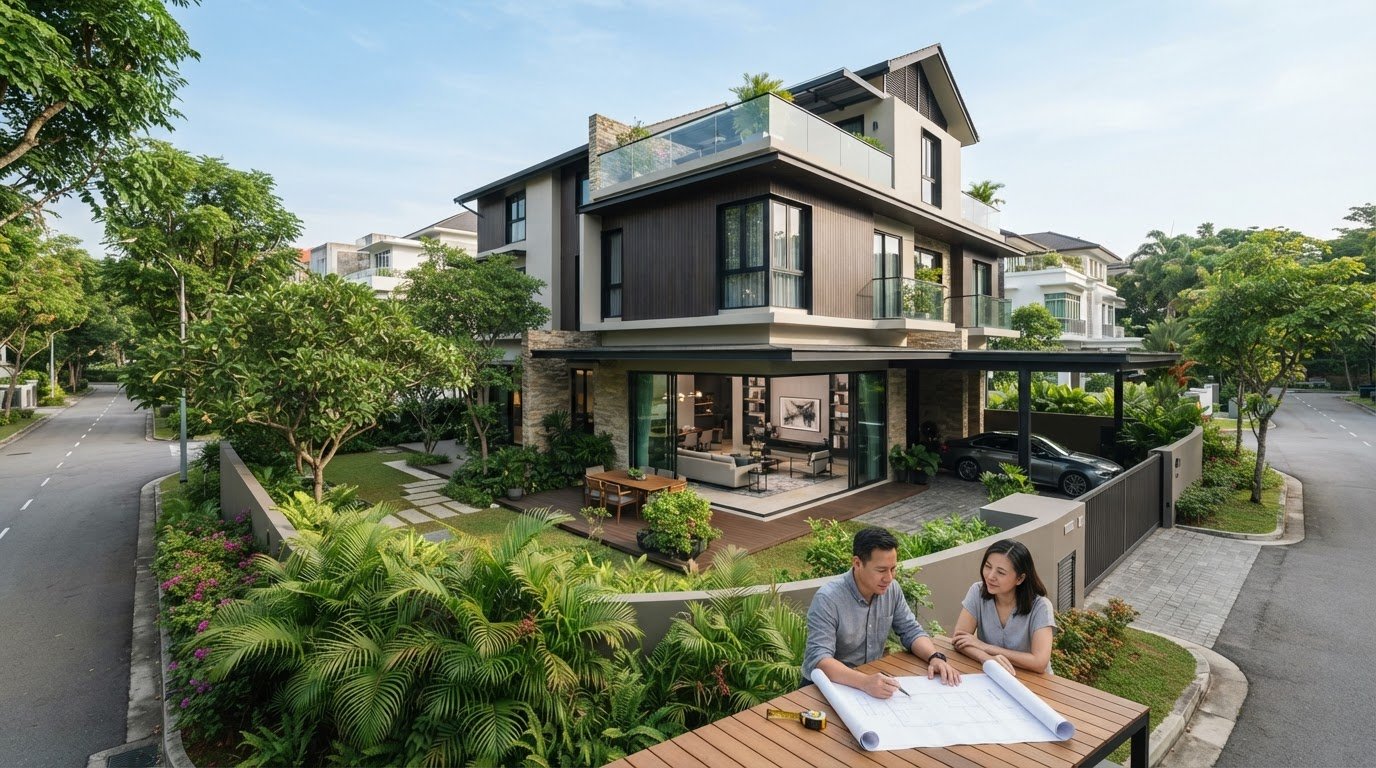
While Singapore’s landed property price index rose by 7.6% in 2025, the real challenge for the 2026 buyer isn’t just the entry price; it’s the strategic allocation of capital. You recognize that financing a landed property purchase in Singapore requires more than a standard mortgage application. It demands a surgical approach to the 55% Total Debt Servicing Ratio (TDSR) and a clear plan for the valuation gaps that often necessitate substantial cash-over-valuation. Managing the 25% downpayment while protecting your liquidity is a delicate balance that separates the casual observer from the elite investor.
This guide provides the sophisticated roadmap you need to master the financial frameworks of the current market. You’ll learn how to optimize your Loan-to-Value (LTV) limits, navigate complex ABSD structures for multi-property portfolios, and leverage construction loans to transform a legacy asset. We’ll examine the specific mortgage strategies that allow high-net-worth individuals to secure prestigious detached or semi-detached homes while maintaining the flexibility required for a 20-year wealth horizon. This expert insight is brought to you by Vincent Lim (OrangeTee & Tie).
Key Takeaways
- Identify the distinct capital requirements between terrace houses and Good Class Bungalows to determine your most effective entry point.
- Learn how to bridge the valuation gap by understanding how banks assess unique land features such as frontage, shape, and terrain.
- Discover advanced debt optimization techniques for financing a landed property purchase singapore that maximize your TDSR within the current 2026 regulatory framework.
- Explore the strategic role of family offices and trusts in securing multi-generational legacy assets and managing complex ABSD structures.
- Access a precise 2026 financial roadmap that helps you refine your mortgage strategy and protect your liquidity before the first viewing.
The Financial Architecture of Singapore Landed Property Acquisitions
Acquiring a landed home in Singapore is a distinct exercise in capital management that differs fundamentally from purchasing a luxury condominium. While high-end apartments offer standardized valuations, landed assets are priced on land area, plot width, and redevelopment potential. Successfully financing a landed property purchase singapore involves navigating a landscape where the land’s value often outweighs the structure’s worth. This shift requires a strategist’s eye, especially when moving from terrace houses to the elite Good Class Bungalow (GCB) segment where transaction prices frequently exceed S$30 million.
Your financing strategy must also account for the asset’s tenure. Freehold properties remain the gold standard for long-term legacy planning, but leasehold options exist. The broader context of Singapore’s housing leasehold system influences how banks view these assets as they age. For properties with fewer than 60 years remaining, loan tenures are often curtailed, and CPF usage is restricted. This makes the choice between freehold and leasehold a pivotal decision that dictates your leverage and exit strategy.
The LTV Threshold and Downpayment Reality
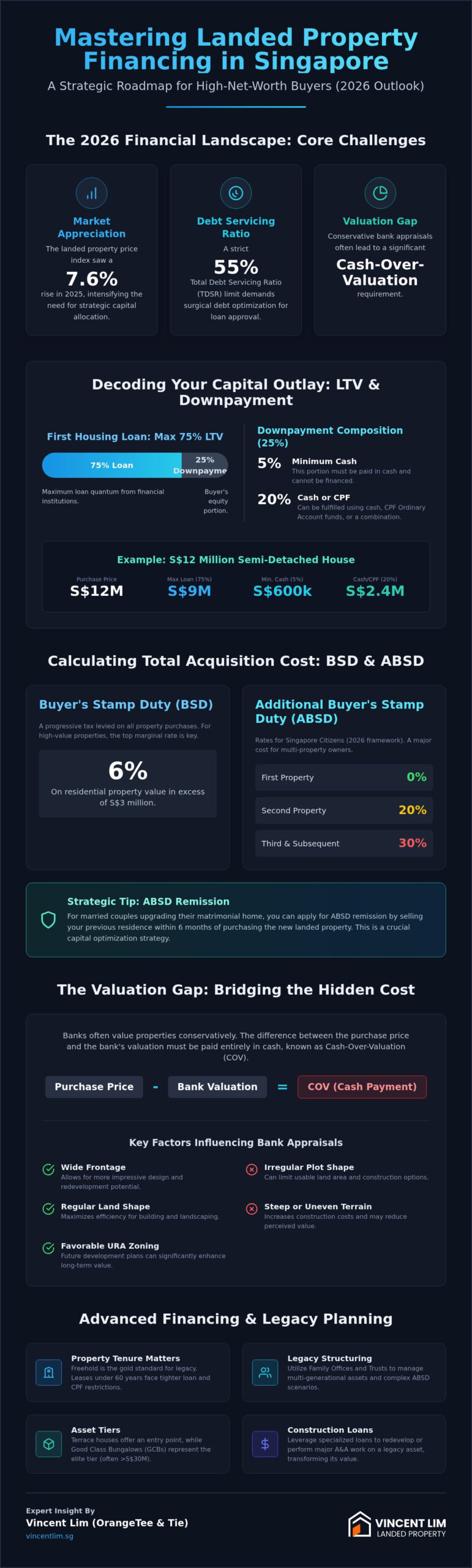
In 2026, the maximum Loan-to-Value (LTV) limit for your first housing loan stands at 75%. While this appears straightforward, the scale of landed transactions creates significant cash flow requirements. When financing a landed property purchase singapore, a S$12 million semi-detached house requires a S$3 million downpayment. At least 5% of the property value (S$600,000) must be paid in cash, while the remaining 20% can be a mix of cash and CPF. If you have an existing mortgage, your LTV for a second property drops significantly, often requiring a 55% downpayment.
The ABSD Factor in 2026
The 2026 tax landscape remains a critical component of the “Total Acquisition Cost.” Beyond the Buyer’s Stamp Duty (BSD) which reaches 6% for amounts exceeding S$3 million, the Additional Buyer’s Stamp Duty (ABSD) remains a significant hurdle for multi-property owners. Singapore Citizens pay 20% on their second property and 30% on their third. However, strategic buyers often utilize the ABSD remission for matrimonial home upgrades. By selling your current residence within six months of purchasing the new landed home, you can reclaim the ABSD paid, provided specific criteria are met. This maneuver is essential for optimizing your capital for the next stage of your asset progression.
Navigating LTV Limits and the Valuation Gap Challenge
The most significant hurdle in the 2026 market isn’t just the sticker price; it’s the valuation gap. Banks in Singapore often adopt a conservative stance, leading to indicative values that lag behind real-time transaction data. This discrepancy creates a Cash-Over-Valuation (COV) scenario. When financing a landed property purchase singapore, you must be prepared to cover this gap entirely in cash. It’s a high-stakes variable that can shift your capital requirements by hundreds of thousands, or even millions, of dollars. Successful buyers don’t just look at the asking price; they look at the bank’s willingness to match it.
Bank appraisers scrutinize unique land features that don’t apply to high-rise units. A wide frontage, a regular rectangular shape, or a flat terrain can command a premium. Conversely, an irregular plot or a steep slope might lead to a lower appraisal, regardless of the house’s internal finishings. Adhering to the housing loan rules set by MAS ensures your leverage remains within legal limits, but it doesn’t protect you from a low valuation. Professional valuation reports are essential tools for securing the high-quantum loans required for these assets. Relying on a single bank’s indicative value is a common mistake that can jeopardize your deposit.
Understanding Bank Valuations for Detached Homes
Securing an accurate appraisal for a detached house for sale Singapore involves more than comparing recent caveats. Major lenders often have differing risk appetites for specific districts or land types. Appraisers also factor in the URA Master Plan, looking for future zoning changes that could enhance long-term land value. Redevelopment potential often adds a significant premium to the asking price that banks may not initially fund, as they typically base valuations on the existing structure’s utility. This means your “future-proofing” premium must often be funded out of pocket.
Bridging the Gap: Strategies for HNWIs
High-net-worth individuals have several levers to pull when the valuation falls short. You can pledge liquid assets, such as stocks or fixed deposits, to enhance your loan eligibility and overall quantum. Some clients utilize “uncommitted” facilities to manage short-term liquidity needs during the transition between properties. A specialist agent plays a vital role here, coordinating with multiple bankers to find the most favorable valuation before you commit to an Option to Purchase. If you’re facing a complex appraisal, seeking strategic valuation support can ensure your capital is deployed efficiently and your interests are protected throughout the acquisition.
Debt Optimization: TDSR and Mortgage Strategies for HNWIs
Managing a mortgage exceeding S$10 million requires a different level of precision than a standard residential loan. In the 2026 financial environment, the Total Debt Servicing Ratio (TDSR) remains capped at 55%. This regulation dictates that your total monthly debt obligations cannot exceed 55% of your gross monthly income. For many high-net-worth individuals, traditional salary streams may not fully reflect their true repayment capacity. This is where asset-based lending becomes essential for financing a landed property purchase singapore. Banks can “recognize” liquid assets like stocks, bonds, or fixed deposits, converting them into a “deemed income” to significantly bolster your TDSR profile.
Choosing between a floating rate, currently around 1.32% p.a., and a fixed rate of approximately 1.40% p.a. is a strategic decision for your portfolio. On a S$15 million loan, even a 0.1% difference in interest equates to S$15,000 annually. You’ll need to weigh the peace of mind offered by a fixed rate against the potential savings of a SORA-pegged floating rate in a moderating interest rate environment. For elite strategists, the goal is to maintain liquidity while ensuring debt remains a productive tool rather than a burden.
Strategic Debt Management
Effective asset progression to landed property in Singapore often involves leveraging existing equity from your current luxury portfolio. Decoupling remains a viable strategy for couples to free up one name for a second property purchase without incurring the 20% ABSD rate. However, this requires careful legal navigation under Singapore real estate law regarding ownership structures. You must also balance loan tenure with age-based restrictions. Since the maximum age for residential loans is typically 75, starting your landed journey earlier allows for a longer tenure, which optimizes your monthly cash flow.
Financing for Rebuilding and A&A
If you’re acquiring an older property with the intent to rebuild, a standard mortgage will not suffice. You’ll need a unified facility that combines a land loan with a construction loan. These facilities operate on a progressive disbursement basis, where the bank releases funds only as the builder completes specific milestones. It’s vital to budget for professional fees, such as architects and quantity surveyors, as these costs are often not fully covered by the loan quantum. Proper coordination ensures your construction project moves from foundation to finishing without liquidity gaps.
Legacy Planning and the Good Class Bungalow (GCB) Factor
The Good Class Bungalow (GCB) represents the absolute pinnacle of the Singapore real estate hierarchy. With only about 2,800 such plots in existence, their extreme scarcity ensures they remain resilient even during broader market fluctuations. Banks view GCBs as highly secure collateral, often classifying them as recession-proof assets due to their historical price stability and the high-net-worth profile of the owners. Financing a landed property purchase singapore at this level moves away from retail banking into the sophisticated world of private wealth management and bespoke credit facilities.
The GCB Financing Niche
Acquiring such a prestigious asset requires a deep understanding of what is a good class bungalow and why its valuation process is so specialized. Standard bank appraisers often lack the data to value a S$50 million plot accurately. Instead, lenders engage “prestige” appraisers who factor in historical significance, privacy levels, and even the profile of neighboring residents. For ultra-high quantum deals, private banks may offer syndicated loans or lombard lending, where your global investment portfolio serves as additional security. If you’re a Permanent Resident, you’ll also face Land Dealings Approval Unit (LDAU) hurdles, which require proof of exceptional economic contribution before financing can be finalized.
Trusts and Family Legacy
In 2026, many families utilize family offices and trust structures to manage their landed acquisitions. While a 65% ABSD (Trust) rate applies upfront to residential properties transferred into a trust, there are specific legal avenues for remission if a clear, identifiable beneficiary is named. Financing a landed home as a core asset in a wealth preservation strategy ensures that the property remains protected for future generations. Legacy value often overrides short-term yield considerations in GCB financing, as these assets are primarily viewed as multi-generational stores of wealth. If you’re ready to secure your family’s future, you should consult with a GCB strategist to structure your acquisition for maximum efficiency and long-term security.
Securing Your Legacy: The Strategic Path to Landed Ownership
Success in the 2026 luxury market is reserved for those who treat acquisition as a calculated financial maneuver. Finalizing your financial roadmap before the first viewing isn’t just a precaution; it’s a competitive necessity. When financing a landed property purchase singapore, the difference between a standard mortgage and a strategically structured debt facility can result in millions of dollars saved over the asset’s lifecycle. You must ensure that your TDSR calculations, ABSD remission plans, and valuation buffers are verified long before you sign an Option to Purchase (OTP).
Coordinating the timeline from OTP to legal completion requires meticulous planning. Typically, the OTP stage involves a 1% option fee followed by the exercise of the option at 4% or 9%. This is followed by a 10 to 12-week period for legal completion. During this window, your legal and banking teams must work in perfect synchronization to ensure funds are disbursed without delay. Any friction in this process can jeopardize your deposit or lead to missed opportunities in a market where high-potential plots are snapped up by prepared buyers.
The Vincent Lim Advantage
Navigating the complexities of the landed market requires a partner who offers more than just transaction support. My approach provides access to exclusive, off-market landed opportunities through an established luxury network built over two decades. We utilize custom financial modeling to compare the ROI of different landed archetypes, ensuring your capital is deployed in the most resilient assets. If you’re looking to transition from your current residence, my strategic guide to selling your landed property offers a blueprint for maximizing value to fund your next GCB move.
Take Action on Your Investment
The first step toward securing a multi-generational asset is a bespoke portfolio review. We’ll assess your landed readiness by analyzing your current equity, income streams, and long-term legacy goals. In a market where “New Price Acceptance” has pushed prime district values to record highs, having a pre-approved loan is your most powerful negotiation tool. It signals to sellers that you operate with the discipline of an elite strategist. I invite you to Partner with Vincent Lim for Your Next Landed Acquisition and experience a standard of service that prioritizes your success and peace of mind.
Mastering the 2026 Landed Market
Success in Singapore’s elite property circles requires a shift from simple borrowing to sophisticated capital management. You’ve seen how bridging the valuation gap and utilizing asset-based lending can protect your liquidity while securing prestigious assets. Mastering the nuances of financing a landed property purchase singapore ensures that your acquisition serves as both a luxury residence and a robust pillar of your wealth portfolio. It’s about aligning your debt structure with a long-term legacy horizon to ensure your capital remains productive.
Navigating these high-stakes transactions demands the expertise of a seasoned professional who understands the unique dynamics of Good Class Bungalows and high-value landed estates. As an Executive Associate Director at OrangeTee & Tie with over 20 years of market expertise since 2004, I specialize in refining these complex financial structures for high-net-worth clients. We’ll coordinate every detail of your asset progression to ensure a seamless transition into your next legacy home. Partner with Vincent Lim for Your Next Landed Acquisition. Your journey toward owning a piece of Singapore’s limited landed inventory begins with a calculated, strategic first step.
Frequently Asked Questions
What is the maximum LTV for a landed property purchase in Singapore for 2026?
The maximum Loan-to-Value (LTV) limit for a first housing loan in 2026 is 75% of the purchase price or market valuation, whichever is lower. You must fund the remaining 25% through a combination of cash and CPF. For a second property loan, the LTV drops significantly to 45%, requiring a much larger upfront capital commitment. These thresholds are strictly enforced by MAS to ensure financial stability across the private residential sector.
Can I use my CPF to pay for the downpayment of a Good Class Bungalow?
You can use your CPF Ordinary Account savings to fund the downpayment of a Good Class Bungalow, but only after the mandatory 5% cash component is paid. The CPF usage is capped at the lower of the purchase price or the bank’s valuation. If the property is leasehold with less than 60 years remaining, the amount of CPF you can deploy is pro-rated based on whether the youngest owner’s age plus the remaining lease equals at least 95 years.
How does the TDSR affect business owners looking to buy landed property?
Business owners often face a 30% haircut on variable income or dividends when banks calculate their Total Debt Servicing Ratio (TDSR). In 2026, the TDSR threshold is 55%, meaning your total monthly debt cannot exceed this percentage of your recognized income. To optimize your eligibility for financing a landed property purchase singapore, business owners should consider asset-based lending, where liquid portfolios are converted into a deemed income to offset the variable nature of their primary earnings.
What is a construction loan, and how does it differ from a standard mortgage?
A construction loan is a specialized facility that releases funds in stages, known as progressive disbursement, as building milestones are achieved. This differs from a standard mortgage, which is typically disbursed in a single lump sum upon the legal completion of a sale. If you’re rebuilding a detached house, your lender will usually package the land loan and construction loan together, requiring you to pay interest only on the amount disbursed at each stage of the build.
Are interest rates for landed properties higher than for condominiums?
Interest rates for landed properties are generally comparable to those for luxury condominiums, with 2026 floating rates averaging 1.32% p.a. and fixed rates at 1.40% p.a. However, because landed transactions involve significantly higher loan quantums, high-net-worth buyers can often negotiate bespoke preferential rates through private banking channels. These specialized packages may offer lower spreads over the 3-month compounded SORA, reflecting the borrower’s broader assets under management and lower risk profile.
Can foreigners obtain financing for landed property if they have PR status?
Permanent Residents (PRs) can obtain financing for landed property, but only after receiving written approval from the Land Dealings Approval Unit (LDAU). Without this approval, banks cannot legally disburse a loan for a landed asset on the mainland. PRs must have held their status for at least five years and demonstrated exceptional economic contribution to Singapore. Once the LDAU grant is secured, the financing process follows the same LTV and TDSR frameworks as Singapore Citizens.
What happens if the bank valuation is lower than my purchase price?
If the bank valuation is lower than your purchase price, you must pay the difference, known as the valuation gap, entirely in cash. The bank’s 75% LTV limit is always applied to the lower of the two values. For example, if you buy a terrace house for S$5 million but the bank values it at S$4.8 million, your loan is capped at S$3.6 million. This leaves a S$1.4 million gap to be covered by your own cash and CPF.
Is it better to use a fixed or floating rate for a high-quantum landed loan?
Choosing between a fixed or floating rate for a high-quantum loan depends on your outlook for the 2026 interest rate environment. A fixed rate of 1.40% provides peace of mind and protection against sudden market volatility, which is vital when managing a S$20 million debt facility. A floating rate, currently around 1.32%, may offer lower initial costs if you believe SORA will remain stable. Most elite strategists prefer the certainty of fixed rates for long-term legacy assets.