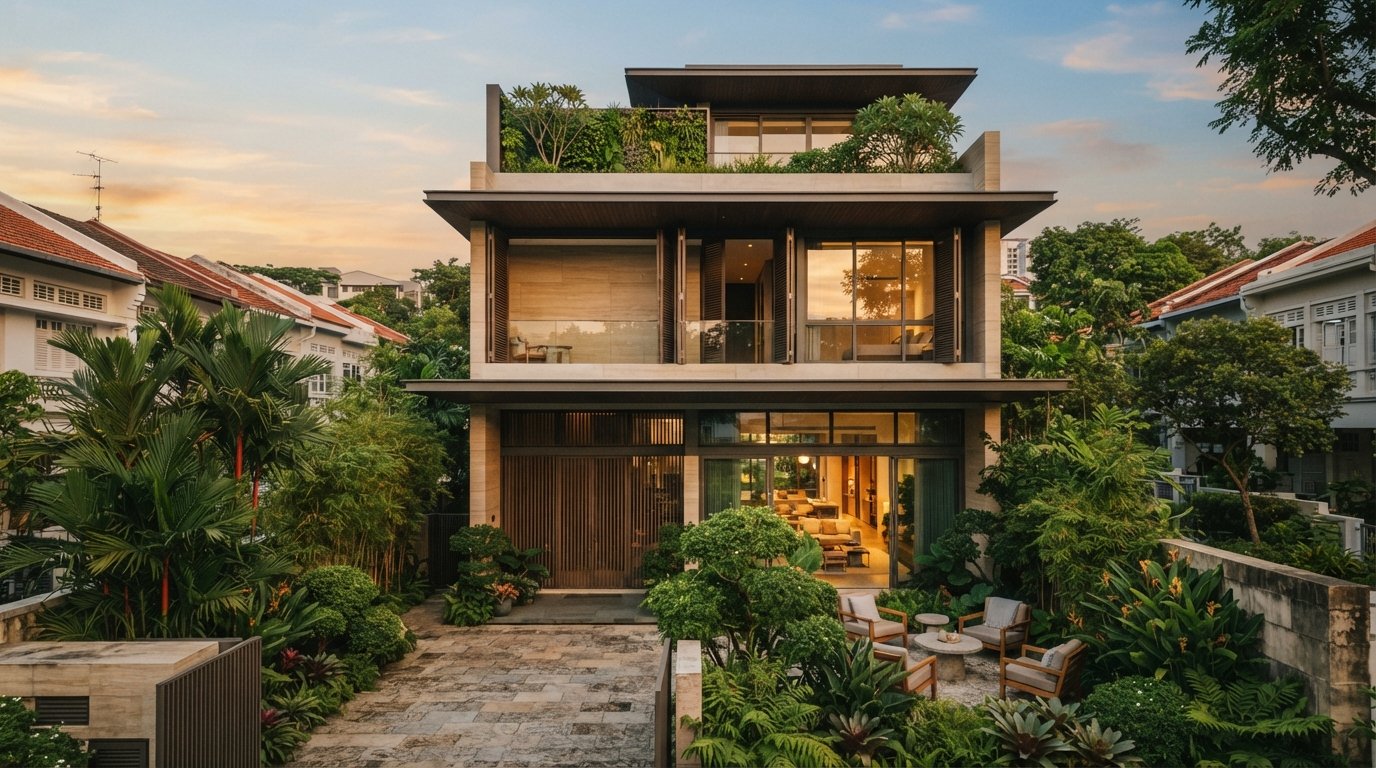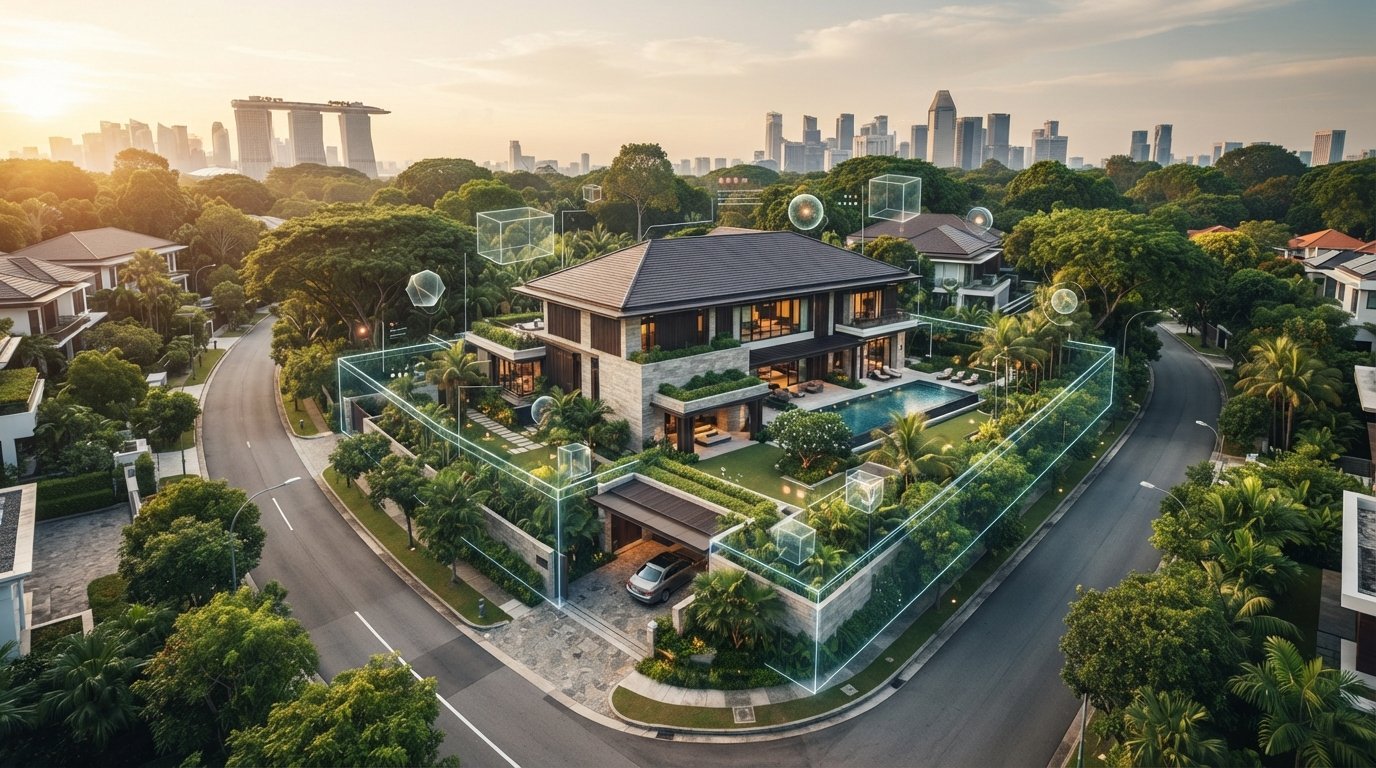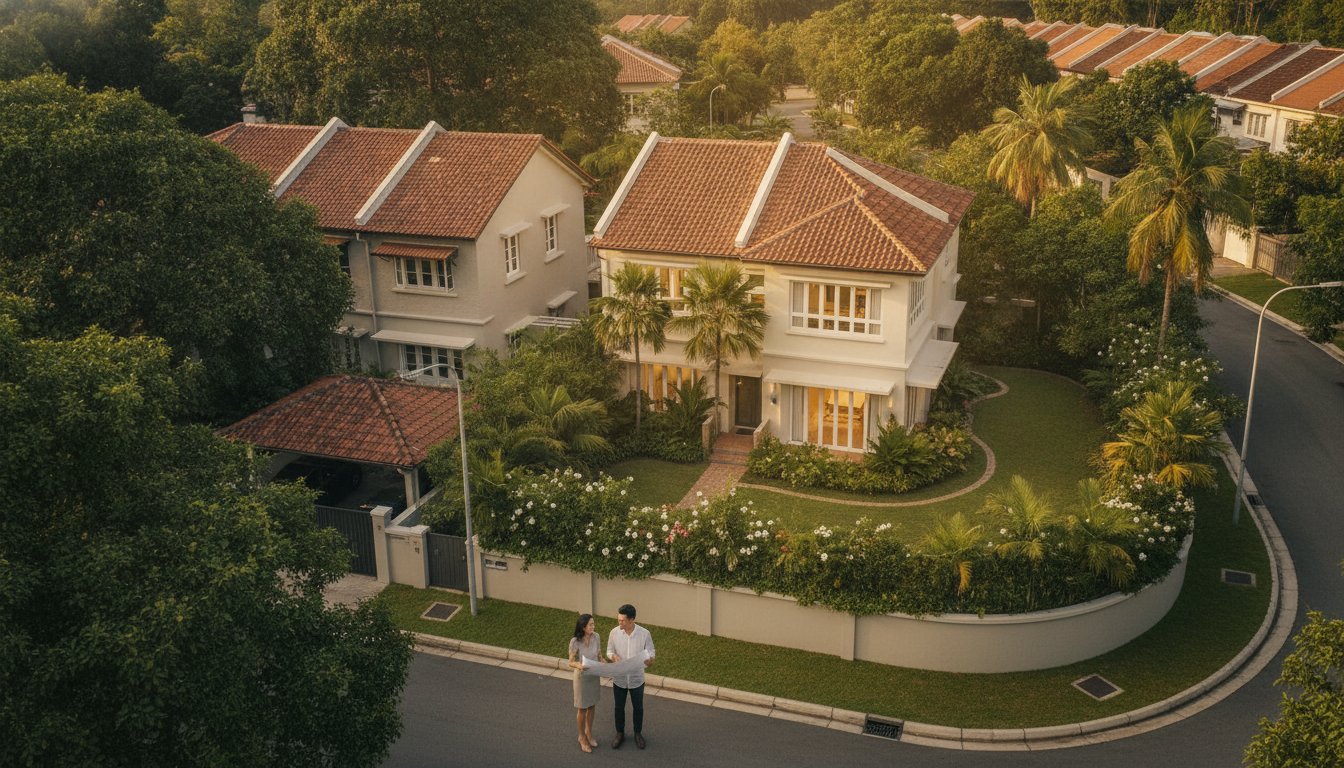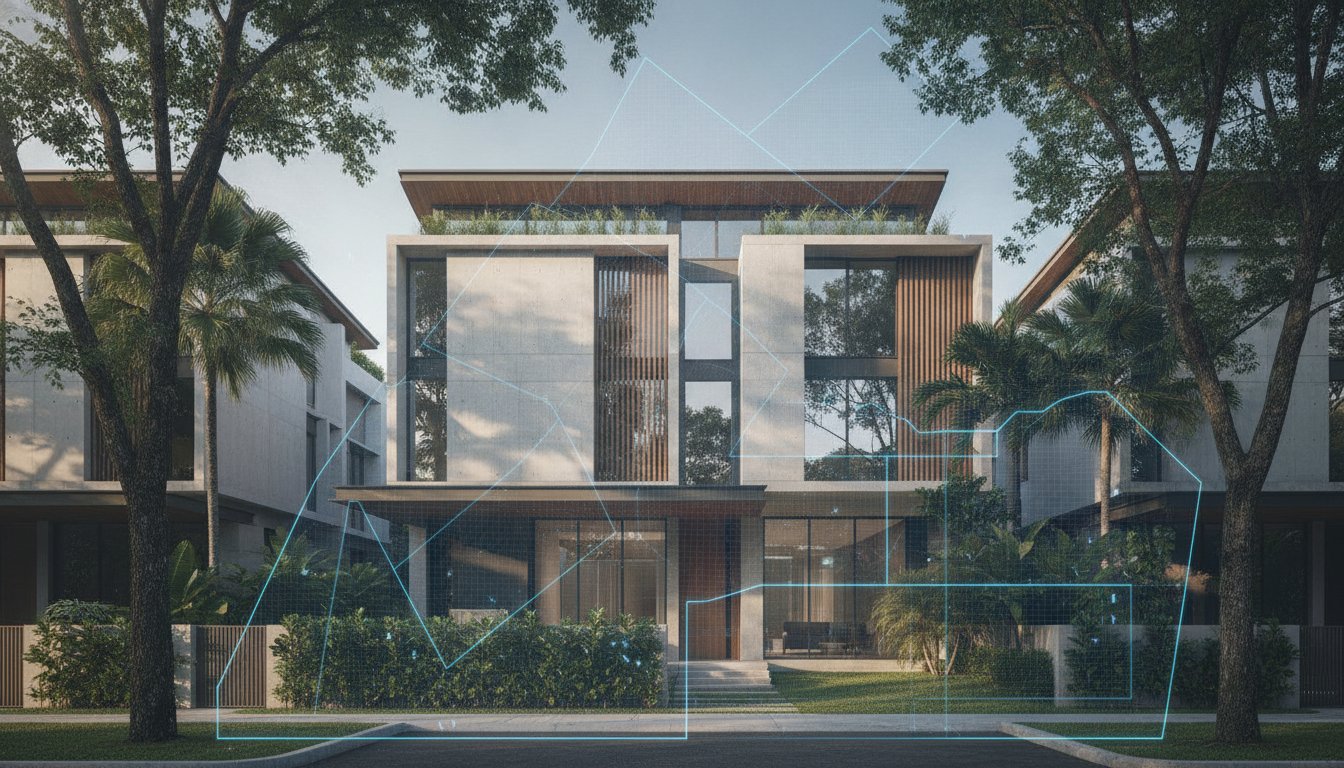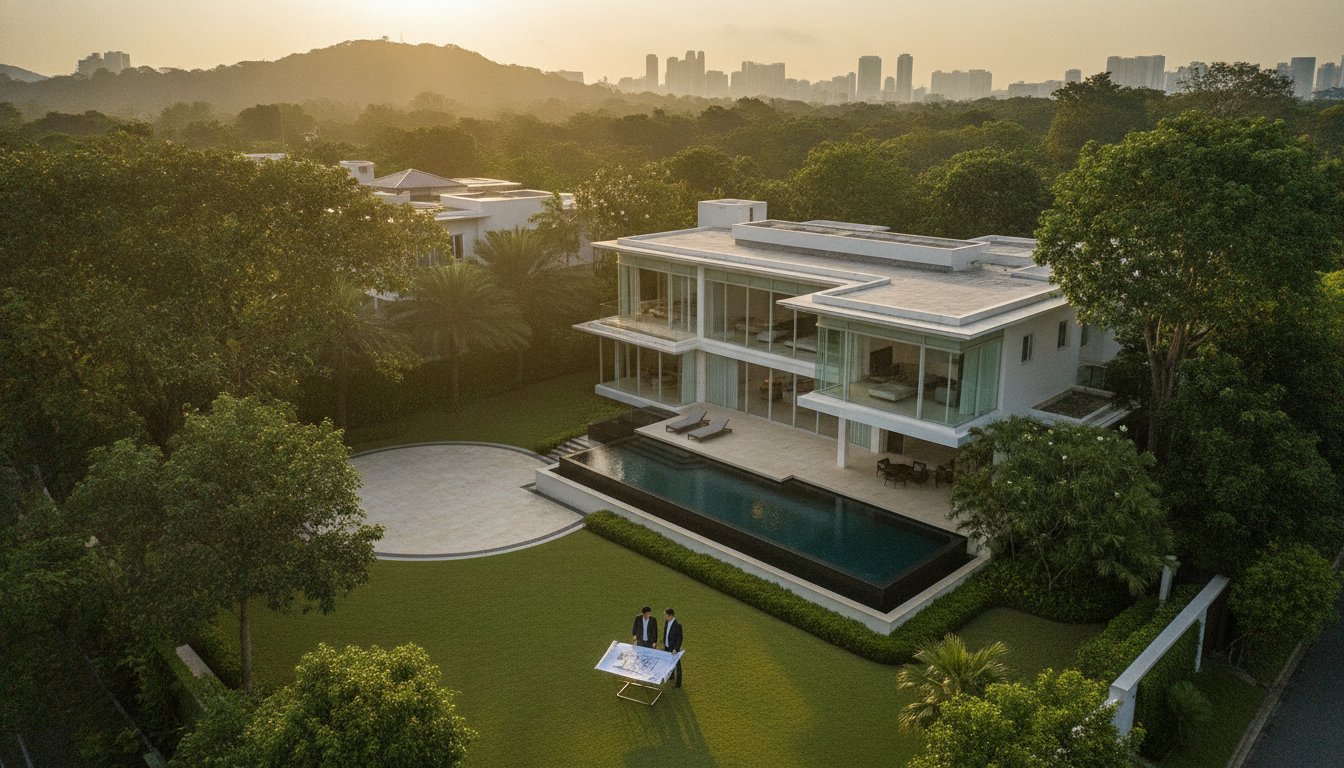
In a city-state where land is constitutionally finite, acquiring a freehold detached house in Singapore is not simply a real estate transaction. It is a generational decision. While the broader property market offers a spectrum of options, the freehold detached house Singapore buyers covet sits at the absolute apex of that hierarchy, and for good reason: you are purchasing sovereign land that no lease can reclaim and no government tenure can erode.
You already sense this. That instinct driving you toward landed freehold over a leasehold condominium is well-founded. The challenge is not recognising the asset’s value; it’s executing the acquisition with the precision and strategic clarity that a transaction of this magnitude demands. URA land use regulations, plot ratio constraints, redevelopment potential, and the ever-present risk of overpaying for a site with limited upside are complexities that demand more than a capable agent. They require a seasoned strategist.
This guide delivers exactly that. Drawing on over 20 years of specialist experience in Singapore’s luxury landed market, it provides a structured acquisition framework covering everything from decoding land classifications and assessing true redevelopment value to structuring your purchase for multi-generational legacy planning.
Key Takeaways
- Understand the structural scarcity of detached land and why these assets represent the pinnacle of the residential property hierarchy.
- Evaluate the historical capital appreciation trends that establish a freehold detached house singapore as a premier vehicle for multi-generational legacy planning.
- Learn to identify high-potential plots by decoding URA setback requirements and technical buildability constraints.
- Gain clarity on the 2026 financial landscape, specifically regarding total acquisition costs and the latest Additional Buyer’s Stamp Duty (ABSD) frameworks.
- Discover the advantages of a bespoke search strategy to access exclusive, off-market landed opportunities through a seasoned industry network.
The Scarcity of Freehold Detached Land in Singapore
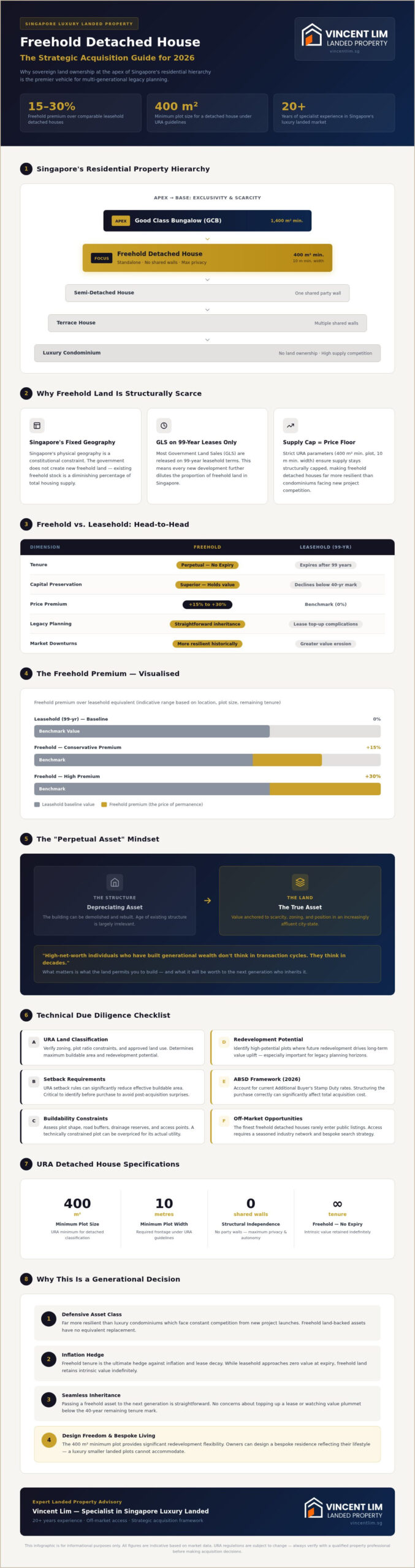
Singapore’s physical geography is a fixed constraint. This reality defines the local property market, placing a massive premium on land ownership. A detached house, commonly referred to as a bungalow, represents the pinnacle of residential autonomy. Unlike terrace or semi-detached homes, a detached house is a standalone structure with no shared walls. It requires a minimum plot size of 400 square metres and a minimum width of 10 metres under Urban Redevelopment Authority (URA) guidelines. These strict parameters ensure that the supply remains structurally capped, making a freehold detached house singapore one of the most defensive assets in any portfolio.
In the hierarchy of landed property, detached houses sit just below Good Class Bungalows (GCBs). They offer the same level of privacy and structural independence but are found in a wider variety of prime residential districts. As we move through 2026, the value of these assets is being driven by a simple economic truth: the government does not create more freehold land. Most Government Land Sales (GLS) sites are released on 99-year leases, which means the existing stock of freehold land is a diminishing percentage of the total housing supply. This scarcity makes land-backed assets far more resilient than luxury condominiums, which face constant competition from new project launches.
Detached House vs. Semi-Detached and Terrace
The primary appeal of a detached house lies in its structural independence. You don’t share a party wall with a neighbour, which eliminates the noise transfer and boundary disputes often associated with terrace or semi-detached living. This physical separation provides a level of privacy that is increasingly rare in a densifying city. From a strategic perspective, the 400 square metre minimum plot size provides significant redevelopment potential. Owners have the flexibility to design a bespoke residence that reflects their lifestyle, a luxury that smaller landed plots cannot always accommodate. It’s a clear status symbol that signals both wealth and a commitment to family legacy.
The Resilience of Freehold Tenure
Freehold tenure is the ultimate hedge against inflation and lease decay. While leasehold properties eventually face the “zero-value” reality as their tenure winds down, freehold land retains its intrinsic value indefinitely. This makes it an ideal vehicle for legacy planning. Passing a freehold asset to the next generation is straightforward; there are no concerns about “topping up” a lease or watching the asset’s value plummet as it hits the 40-year mark. When you compare freehold vs leasehold landed property, the historical data consistently shows that freehold assets enjoy superior capital preservation during market downturns. In 2026, as buyers become more discerning about long-term wealth preservation, the demand for these finite plots continues to outpace the available supply.
The Freehold Advantage: Tenure, Capital Appreciation, and Legacy
The price gap between a freehold and leasehold detached house in Singapore is not arbitrary. It reflects a fundamental difference in what you are actually acquiring. A leasehold property is, in essence, a long-term rental from the state. A freehold asset is sovereign land ownership with no expiration. Discerning buyers understand this distinction intuitively, which is why freehold detached houses consistently command a significant premium over their 99-year leasehold counterparts, often in the range of 15 to 30 percent depending on location, plot size, and remaining lease on comparable properties. That premium is not a cost; it’s the price of permanence.
High-net-worth individuals who have built generational wealth don’t think in transaction cycles. They think in decades. The “perpetual asset” mindset reframes the acquisition entirely: the building is secondary, a depreciating structure that can be demolished and rebuilt. The land is the asset. Its value is anchored to its scarcity, its zoning classification, and its position within an increasingly affluent city-state. Age of the existing structure becomes largely irrelevant once you adopt this perspective. What matters is what the land permits you to build, and what it will be worth to the next generation who inherits it.
Capital Growth Drivers for Detached Houses
Two structural forces drive landed property valuations upward over time. First, supply is constitutionally fixed. The government does not release freehold residential land through the GLS programme, meaning every freehold detached plot that transacts is drawn from a pool that only shrinks. Second, the affluent resident population in Singapore continues to grow, driven by both domestic wealth accumulation and the city-state’s position as Asia’s premier wealth management hub. The intersection of contracting supply and expanding demand is the most reliable engine of capital appreciation in any asset class.
A subtler but equally powerful driver is the “GCB Aspiration” effect. Detached houses located in proximity to designated Good Class Bungalow areas benefit from a valuation halo. Buyers who cannot yet access the GCB market, which requires a minimum plot of 1,400 square metres, frequently target adjacent detached house neighbourhoods as a strategic entry point, compressing the price differential between the two tiers over time. The land-value-to-built-value ratio, which measures what proportion of a property’s total price is attributable to the land itself rather than the structure, is the key metric savvy investors use to identify assets with the strongest long-term appreciation potential.
Redevelopment Potential: The Hidden Value
Freehold tenure simplifies the redevelopment calculus considerably. Owners are free to pursue Additions and Alterations (A&A) works or full demolition and rebuild without the lease-decay pressure that constrains leasehold owners from committing capital to improvements. The critical analytical step is identifying plots with what experienced practitioners call “land-beat” potential: sites where the existing footprint underutilises the permissible plot ratio, where irregular lot shapes create subdivision opportunities, or where a large plot could be intensified within URA’s Residential Envelope Control framework.
URA’s Residential Envelope Control governs the maximum building envelope for landed housing, dictating height, setbacks, and floor area ratios. Understanding these parameters is not optional for a serious buyer; it’s the foundation of any accurate valuation. The URA guidelines on buying residential property in Singapore provide the regulatory baseline, but interpreting how those rules interact with a specific plot’s geometry and orientation requires specialist knowledge. For a comprehensive framework covering the full acquisition process, the detached house for sale Singapore guide provides deeper strategic analysis on identifying high-potential sites before they reach the open market.
A freehold detached house Singapore buyers acquire today should be evaluated not only on its current condition but on what it enables over a 30-year horizon. That forward-looking discipline is what separates a strategic acquisition from a reactive purchase. If you’re at the stage of assessing specific sites, engaging a specialist who can read both the URA Master Plan and the market dynamics simultaneously is the most consequential decision you’ll make in this process.
Navigating the Technical Due Diligence of Detached House Acquisition
Most buyers approach a freehold detached house Singapore acquisition with a clear sense of what they want: space, privacy, and permanence. What they’re often less prepared for is the technical complexity that determines whether a specific plot can actually deliver on those expectations. The difference between a strategically superior site and a costly disappointment frequently comes down to dimensions, setbacks, and subsurface conditions that no listing photograph will reveal.
Plot frontage deserves particular attention. A wide frontage, the measurement of a plot’s boundary along the road, often carries more practical value than equivalent raw square footage. A 600 square metre plot with a narrow, deep configuration may yield a house that feels constrained and poorly lit, while a 500 square metre plot with generous frontage allows for a more commanding facade, better natural ventilation, and greater architectural flexibility. When evaluating comparable sites, always examine the width-to-depth ratio alongside total area.
Road line plans and drainage reserves introduce another layer of complexity that buyers frequently overlook. A road line plan indicates the government’s intended future road width, and if a reserve line cuts through your plot, the effective buildable area shrinks considerably without any reduction in the purchase price. Drainage reserves function similarly, sterilising strips of land that cannot be built over. Obtaining and correctly interpreting these plans before committing to a purchase is non-negotiable. Singapore’s Urban Redevelopment Authority property guidelines provide the regulatory framework for these encumbrances, but translating their site-specific implications requires specialist interpretation.
Soil conditions and topography are the hidden cost variables that can materially alter your construction budget. Sloped sites in districts such as Bukit Timah or Holland Road may require significant retaining wall works and foundation engineering before a single structural column is poured. Soft ground conditions, particularly in reclaimed or low-lying areas, can necessitate deep piling solutions that add substantially to project costs. A geotechnical assessment prior to exchange of contracts is a prudent investment, not an optional formality.
The URA Residential Envelope Control Framework
The 2015 URA guidelines fundamentally restructured how detached houses are designed and, by extension, valued. The Residential Envelope Control introduced a maximum building envelope defined by height, setback distances, and a sky terrace methodology that governs how floor area can be distributed across storeys. Under current rules, a 2-metre setback on both side boundaries and the rear boundary of a standard 400 square metre plot reduces the buildable footprint considerably, leaving a core area that demands disciplined architectural planning to maximise gross floor area. Basements and attics, subject to specific URA criteria, offer legitimate pathways to recover usable space within the permitted envelope. A basement level that doesn’t breach the permissible parameters can add meaningful living area without consuming above-ground envelope allowance. An attic, defined by URA’s specific pitch and headroom criteria, provides additional space that doesn’t count fully against the gross floor area calculation. Identifying plots where these strategies are viable is a core component of what a landed property specialist brings to the acquisition process.
Environmental and Structural Considerations
In Singapore’s equatorial climate, a plot’s orientation is a design asset or liability. North-south facing sites allow for deeper natural ventilation and reduce solar heat gain on primary living facades, lowering long-term cooling costs and improving liveability. For older detached houses, the critical question is whether the existing structure merits Additions and Alterations works or a full demolition and rebuild. A structural engineer’s assessment should examine the integrity of the original foundations, beam-and-column system, and any prior A&A works that may have been executed without full compliance. The condition of the existing structure directly informs your total acquisition cost projection and your development timeline.
Financial Planning for High-Value Landed Transactions
The purchase price of a freehold detached house Singapore buyers negotiate is only the opening figure in a considerably larger financial equation. High-net-worth buyers who have navigated complex transactions before understand this instinctively; first-time landed acquirers frequently do not. Getting the total cost of acquisition precisely right before you commit to an Option to Purchase is not a procedural formality. It is the foundation of sound financial strategy.
Beyond the agreed purchase price, your acquisition budget must absorb Buyer’s Stamp Duty (BSD), Additional Buyer’s Stamp Duty (ABSD) where applicable, legal conveyancing fees, an independent valuation report, and any survey or geotechnical assessments you commission during due diligence. BSD is tiered, with the highest marginal rate applying to the portion of the purchase price above S$1.5 million. On a transaction at the S$8 million to S$12 million price point typical of prime detached houses, the BSD component alone represents a material sum that must be factored into your liquidity planning from day one.
Stamp Duty and Tax Implications
The ABSD framework is the single most consequential tax variable in any landed acquisition. For 2026 transactions, Singapore Citizens purchasing a second residential property are subject to a 20% ABSD rate, while Permanent Residents face a 30% rate on their second property and 35% on subsequent ones. Foreign nationals bear a 60% ABSD on any residential purchase. These rates are applied to the full purchase price or the property’s market value, whichever is higher, making the tax implication on a S$10 million detached house a figure that demands precise modelling before any offer is submitted.
For families structuring multi-generational ownership, the choice between joint tenancy, tenancy-in-common, and trust structures carries both legal and tax dimensions that a conveyancing solicitor and a tax adviser should address in tandem. Each structure has distinct implications for future stamp duty exposure, estate planning, and CPF usage eligibility. The asset progression to landed property Singapore guide provides a detailed framework for buyers upgrading from an existing property and managing the sequencing of sale and purchase to minimise ABSD exposure.
Financing Strategy and Liquidity Management
Landed residential properties are subject to the Total Debt Servicing Ratio (TDSR) framework, which caps total monthly debt obligations at 55% of gross monthly income. The Loan-to-Value (LTV) limit for a first housing loan stands at 75% of the lower of the purchase price or valuation, dropping to 45% for a second outstanding loan. At the price points typical of detached houses, these parameters require careful liquidity planning, particularly for buyers simultaneously managing the sale of an existing property.
Bridging loans serve a specific and valuable function here. When a buyer’s existing property has not yet completed its sale at the point of exercising the Option to Purchase on the new detached house, a bridging facility covers the interim capital requirement. The cost of that bridge must be factored into your total acquisition cost, and the timeline must be structured with sufficient buffer to avoid forced selling under market pressure.
On a S$10 million loan at a 25-year tenure, a 1% increase in the prevailing interest rate translates to a meaningful increase in total interest paid over the loan’s life, a figure that can reach several hundred thousand dollars depending on the amortisation schedule. Stress-testing your debt serviceability against rate movements of 1.5% to 2% above your entry rate is prudent discipline, not excessive caution.
The Cost of Ownership and Maintenance
Acquisition costs are a single event. Ownership costs are perpetual, and they’re frequently underestimated for detached houses. Annual maintenance for a property with a swimming pool, landscaped garden, and full mechanical and electrical systems routinely encompasses pool servicing contracts, landscape maintenance, pest control programmes, and periodic repainting or waterproofing works. Property tax for owner-occupied detached houses is calculated on the Annual Value at a progressive rate, but properties held as investment assets attract a significantly higher non-owner-occupier tax schedule, a distinction that directly affects the holding cost calculus for buyers who may lease the property during an interim period.
Structuring the financial architecture of a landed acquisition with this level of precision is where specialist guidance delivers measurable value. Engage Vincent Lim for a confidential financial planning consultation tailored to your specific acquisition profile and ownership objectives.
The Vincent Lim Approach: Sourcing Exclusive Freehold Opportunities
The most consequential freehold detached house Singapore transactions rarely appear on property portals. They are negotiated quietly, between principals who trust each other, through relationships built over decades. This is the structural reality of the high-end landed market, and it’s the single most important reason why your choice of representation determines not just the quality of your experience, but the quality of the asset you ultimately acquire.
Vincent Lim’s approach begins where most agents’ capabilities end: with access. Over 20 years of specialist focus on detached houses and Good Class Bungalows has produced a network of vendor relationships, co-broking partnerships, and professional contacts that surface opportunities before they are publicly listed, or in many cases, before a vendor has formally decided to sell. That off-market intelligence is not a marketing claim. It is the product of consistent, long-term presence in a market where trust is the primary currency.
The curation process is equally rigorous. Every site presented to a client has been pre-screened against a defined set of technical and strategic criteria: plot geometry, road line encumbrances, URA envelope compliance, redevelopment potential, and neighbourhood trajectory. Buyers are not shown properties that merely meet a price bracket. They are shown properties that meet their legacy objectives.
Why a Specialist Matters in the Landed Market
Generalist agents operate competently across a broad market. Landed transactions demand something different. The interaction between plot ratio, setback requirements, soil conditions, and subdivision potential is a technical discipline that takes years to master. A misjudgement on any one of these variables can result in a site that cannot accommodate your intended design, or a purchase price that significantly overstates the land’s actual development value.
Understanding the Good Class Bungalow market is directly relevant here. GCB pricing establishes the ceiling against which detached house values in adjacent districts are calibrated. A specialist who operates across both tiers reads that relationship with precision, identifying detached house sites that are undervalued relative to their GCB-proximate location, and avoiding those where the price has already overshot the fundamentals.
Vincent’s affiliation with OrangeTee & Tie provides a further structural advantage. The institutional-grade transactional data, research infrastructure, and compliance frameworks that come with one of Singapore’s leading agencies underpin every advisory engagement. Clients benefit from both the independence of a specialist strategist and the resources of a major brokerage.
Your Journey to a Legacy Home Starts Here
The process begins with a private consultation. That conversation is not a listing presentation. It’s a structured discovery session designed to define your family’s spatial requirements, your financial parameters, your development ambitions, and your timeline. From that foundation, a targeted search strategy is built and executed with discipline.
When sites are identified for viewing, you’ll be guided on how to evaluate each plot strategically, not just aesthetically. Orientation, frontage, drainage reserves, and neighbouring land use all factor into the assessment before any offer is considered.
Schedule a private consultation with Vincent Lim to begin your landed asset journey. The right freehold detached house Singapore acquisition starts with the right conversation.
Your Next Move in Singapore’s Most Finite Asset Class
Acquiring a freehold detached house Singapore buyers will value for generations requires more than capital. It demands a clear-eyed understanding of land scarcity, technical due diligence, and the financial architecture that protects wealth across decades. The stakes are too high for guesswork, and the market is too opaque for generalist representation.
Three principles should anchor your approach: evaluate land over structure, understand every dollar of your total acquisition cost before signing, and access opportunities through relationships rather than portals. These disciplines separate strategic acquisitions from reactive ones.
Vincent Lim brings over 20 years of specialist expertise in GCBs and high-value landed assets to every engagement, operating as Executive Associate Director at OrangeTee and Tie with the network and institutional resources that this market demands. The right acquisition starts with the right conversation.
Partner with the Elite Strategist for your next freehold detached house acquisition. Your family’s legacy asset is worth getting precisely right.
Frequently Asked Questions About Freehold Detached Houses in Singapore
What is the minimum land size for a detached house in Singapore?
Under URA guidelines, a detached house requires a minimum plot size of 400 square metres and a minimum plot width of 10 metres. These parameters apply to both new subdivisions and existing plots. It’s worth emphasising that while 400 square metres is the regulatory floor, plots in this size range leave limited architectural flexibility once setback requirements are applied. Serious buyers typically target plots of 500 square metres or above to unlock meaningful design latitude.
Can Permanent Residents (PRs) buy a freehold detached house in Singapore?
PRs can purchase landed residential property in Singapore, but they must obtain approval from the Singapore Land Authority (SLA) under the Residential Property Act before completing the transaction. This approval process adds a layer of administrative lead time that buyers should factor into their transaction timeline. PRs are also subject to a 30% Additional Buyer’s Stamp Duty on their second residential property and 35% on subsequent ones, making ABSD planning a critical component of any acquisition strategy.
How does freehold tenure affect the resale value of a detached house?
Freehold tenure consistently supports stronger resale values compared to leasehold equivalents because the asset doesn’t depreciate through lease decay. A freehold detached house Singapore buyers acquire today retains its intrinsic land value indefinitely, which insulates it against the sharp valuation discounts that affect leasehold properties as they approach the 40-year mark. In practice, freehold detached houses typically command a premium of 15 to 30 percent over comparable leasehold sites, and that differential tends to widen during periods of broader market softness.
What is the difference between a detached house and a Good Class Bungalow (GCB)?
The primary distinction is plot size and designated zoning. A GCB requires a minimum land area of 1,400 square metres and must be located within one of 39 gazetted GCB Areas. Detached houses sit on plots from 400 square metres upward and are distributed across a wider range of residential districts. GCBs are also restricted to Singapore Citizens only, while detached houses outside GCB Areas can be purchased by PRs with SLA approval. Detached houses in GCB-adjacent districts often benefit from a valuation halo effect as buyers use them as a strategic entry point into that tier of the market.
Are there specific districts where freehold detached houses are more common?
Freehold detached houses are concentrated in Singapore’s established residential districts, particularly Districts 10, 11, 21, and 23, covering areas such as Holland Road, Bukit Timah, Stevens Road, and Clementi Park. These districts developed during an era when freehold land was more readily available, and the existing stock has remained largely intact. Newer residential areas on the city’s periphery tend to feature leasehold land released through the Government Land Sales programme, making the older established districts the primary hunting ground for freehold detached acquisitions.
What are the typical setback requirements for a detached house under URA rules?
URA’s Residential Envelope Control specifies setback distances that vary based on the storey height of the proposed structure. For a standard detached house, the front setback is generally 7.5 metres from the road reserve line, while side and rear setbacks are typically 2 metres each. These requirements directly reduce the buildable footprint on any given plot. On a 400 square metre site, applying all required setbacks can compress the ground floor footprint considerably, which is why understanding the interaction between plot geometry and setback rules is essential before any offer is made.
Is it better to buy an old detached house for redevelopment or a brand-new one?
The answer depends on your objectives and timeline. An older detached house on a well-proportioned plot often represents a superior long-term acquisition if the land fundamentals are sound, because you’re acquiring the asset at a price that reflects the structure’s depreciated value rather than a premium for someone else’s design choices. A new or recently rebuilt home commands a higher entry price but eliminates construction risk and delivers immediate liveability. For buyers with a 10-year-plus horizon and a clear design vision, a redevelopment site frequently offers better land value per square metre and greater architectural control.
How long does the transaction process take for a landed property in Singapore?
A standard landed property transaction in Singapore typically completes within 10 to 12 weeks from the grant of the Option to Purchase (OTP). The OTP grants the buyer a 14-day window to exercise the option, after which the completion period is usually 8 to 10 weeks. For PR buyers requiring SLA approval, additional lead time of several weeks should be anticipated. Transactions involving bridging loans, trust structures, or complex ownership arrangements may require additional legal coordination, making early engagement with both a conveyancing solicitor and your financial institution a practical necessity.