Is your aging terrace or semi-detached house a cherished family sanctuary or a stagnating asset that’s quietly eroding your portfolio’s potential? With construction costs for premium specifications now frequently exceeding $700 per square foot, the high-stakes decision to rebuild or sell landed property singapore has become a complex financial calculation. You’re likely weighing the dream of a bespoke home against the logistical burden of temporary housing and the fear of over-capitalizing on a plot with limited capital upside.
This strategic framework provides the clinical clarity required to navigate these 2026 market realities. We provide a meticulous financial comparison of both paths, ensuring you understand the true ROI of a reconstruction versus a strategic sale. By learning how to rebuild or sell landed property singapore with the mindset of an elite strategist, you’ll gain a firm grasp of URA envelope control guidelines and the “rebuild premium” currently sought by high-net-worth buyers. We’ll show you exactly how to rebuild or sell landed property singapore to ensure your next move secures both your lifestyle and your long-term property portfolio.
Key Takeaways
- Identify the critical “Aging Asset” threshold where rising maintenance costs and structural depreciation begin to outweigh your property’s long-term capital growth.
- Analyze 2026 construction benchmarks to avoid the “PSF Illusion” and ensure your redevelopment budget remains proportionate to the land’s actual market value.
- Apply a rigorous 10-year decision matrix to determine if you should rebuild or sell landed property in Singapore based on your specific lifestyle needs and portfolio goals.
- Explore the strategic advantages of liquidating “dead equity” to upgrade into modern semi-detached or detached houses without the complexities of managing a construction project.
- Learn how specialist valuations and bespoke marketing narratives can effectively position your property to attract high-intent buyers seeking prime redevelopment plots.
Evaluating Your Landed Asset: The Dilemma of Aging Property in 2026
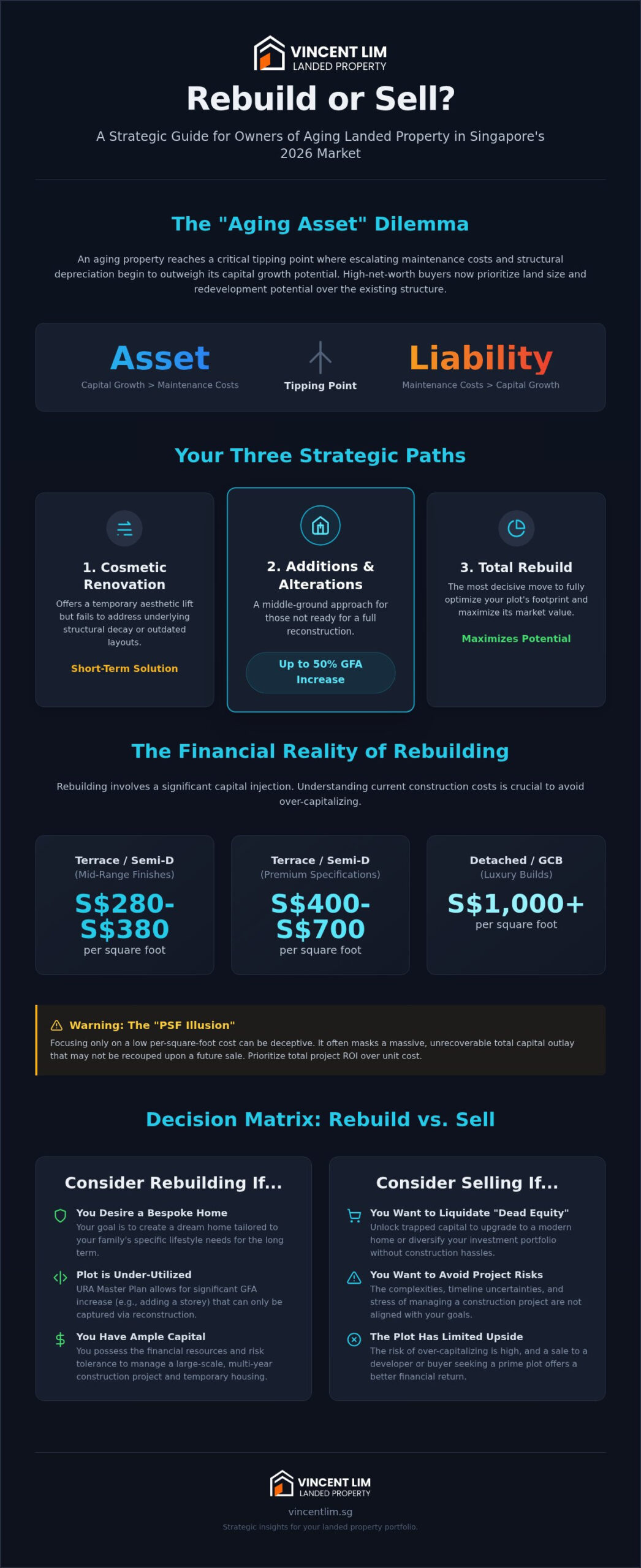
Owning a landed home remains the pinnacle of Singapore’s housing landscape, but an aging structure can eventually transition from a prestigious sanctuary into a stagnating financial burden. In the 2026 market, the decision to rebuild or sell landed property singapore rests on identifying the “Aging Asset” threshold. This is the precise moment when the escalating costs of maintenance and the physical depreciation of the structure begin to outweigh the property’s potential for capital growth. Most high-net-worth buyers today prioritize land size and plot efficiency over the existing built-up area, meaning your home’s “as-is” value is increasingly dictated by its raw redevelopment potential.
Homeowners typically navigate three distinct paths when their property reaches this crossroads. A cosmetic renovation offers a temporary aesthetic lift but fails to address underlying structural decay. Additions & Alterations (A&A) allow for Gross Floor Area (GFA) increases of up to 50%, providing a middle ground for those not ready for a total reconstruction. However, a total rebuild remains the most decisive move for those looking to fully optimize their footprint. This analysis is crucial when deciding to rebuild or sell landed property singapore, as the choice between these paths will define your asset’s performance for the next decade.
The Structural Tipping Point
Assessing the integrity of older terrace and semi-detached foundations is a prerequisite for any strategic move. Many legacy properties suffer from foundational fatigue or outdated drainage systems that aren’t immediately visible. When “minor repairs” to gutters or facade cracks become a bottomless financial pit, the structure has reached its tipping point. Outdated layouts with dark, narrow corridors simply don’t align with modern luxury living standards. If the shell of the house cannot support contemporary lifestyle requirements, its value as a residence diminishes significantly compared to its value as a prime redevelopment plot.
URA Master Plan and Plot Ratio
The URA Master Plan serves as the strategic blueprint for unlocking your property’s hidden value. Many older landed plots contain significant unutilized GFA that can only be captured through a total reconstruction. You must verify if your land allows for an increase in height, such as moving from a two-storey to a three-storey envelope. Understanding these height restrictions and envelope control guidelines is the first step for anyone looking to rebuild or sell landed property singapore to capitalize on their plot’s true potential. If your current structure doesn’t maximize these height and setback allowances, you’re effectively holding an underperforming asset in a market that rewards efficiency and volume.
The Economics of Rebuilding: GFA, Construction Costs, and the PSF Illusion
Rebuilding a landed home involves a sophisticated financial architecture that extends far beyond simple contractor quotes. Many homeowners fall victim to a narrow focus on unit costs, failing to account for the total capital injection required to bring a project to fruition. The PSF Illusion is the trap of prioritizing unit cost over total capital commitment. While a lower cost per square foot might seem attractive on paper, it often masks a massive, unrecoverable capital outlay that can’t be clawed back during a future sale. In the 2026 market, achieving a balance between luxury and liquidity is the hallmark of a seasoned property owner deciding whether to rebuild or sell landed property singapore.
Current construction benchmarks reflect the inflationary pressures of recent years. For a standard new-build terrace or semi-detached house, owners should budget between S$280 and S$380 per square foot for mid-range finishes. If you’re aiming for premium specifications, those figures escalate to a range of S$400 to S$700. For those managing detached houses or Good Class Bungalows, the costs frequently exceed S$1,000 per square foot. These figures are heavily influenced by official land policies and regulatory requirements that dictate everything from drainage to structural setbacks. Beyond the bricks and mortar, professional architectural fees typically add another 8% to 12% to your total budget. This makes the math behind the choice to rebuild or sell landed property singapore far more complex than simple renovation.
Calculating the Total Quantum Outlay
Total price determines your future exit liquidity. If you max out the Gross Floor Area (GFA) on an intermediate terrace, you might create a home that is “too expensive” for its specific segment. A massive capital outlay for $200,000 Italian marble or bespoke basement theaters often sees diminishing returns, as future buyers may not share your specific aesthetic tastes. You can consult with a landed specialist to model these financial outcomes and ensure your final valuation aligns with the neighborhood’s ceiling price.
The Opportunity Cost of Time
A total rebuild isn’t just a financial investment; it’s a lifestyle sacrifice. Most projects require a 24 to 36 month timeline from the first architectural draft to the final handover. During this period, you must factor in the “lost” time and the substantial cost of temporary housing. In 2026, managing the risk of contractor delays and material cost fluctuations is paramount. If the goal is asset progression rather than a “forever home,” the three-year disruption often makes it more efficient to rebuild or sell landed property singapore based on speed of execution.
The Case for Selling: Strategic Asset Progression
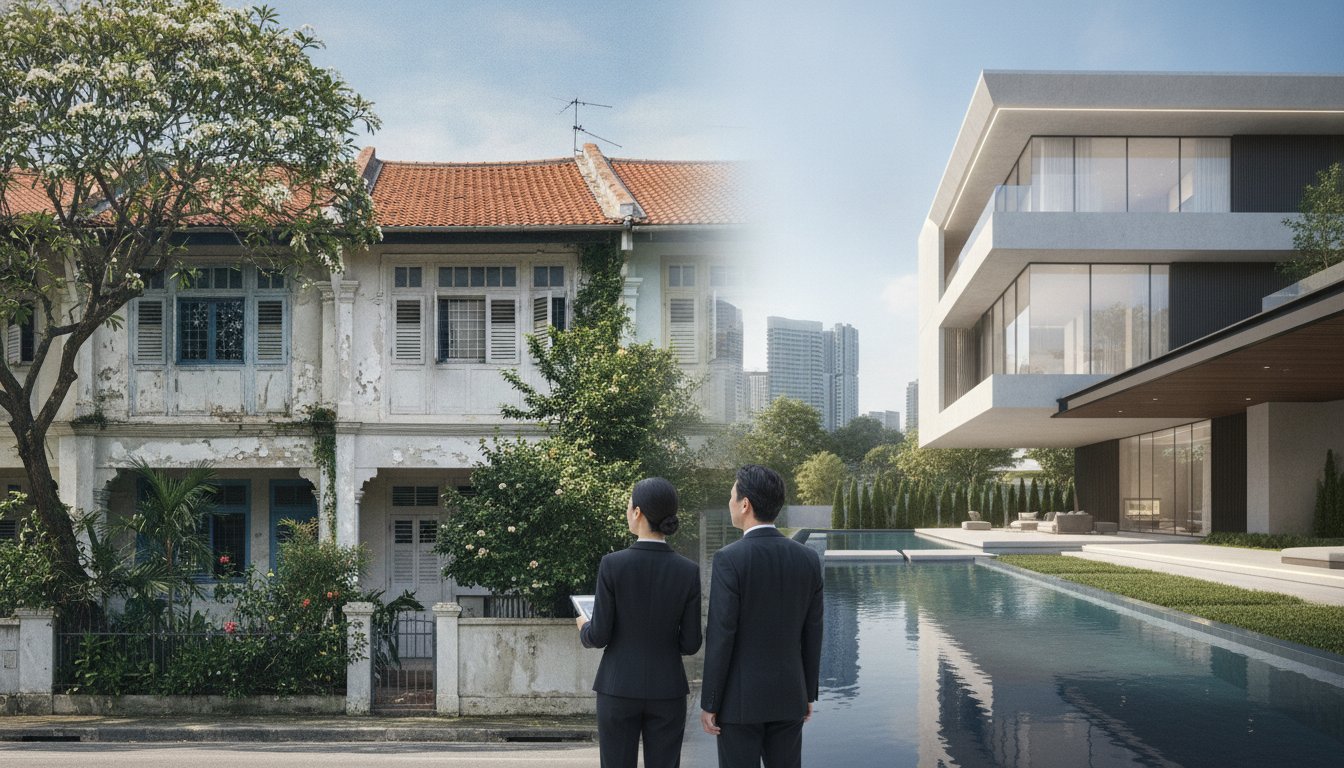
While redevelopment offers a path to a bespoke residence, selling your property often serves as the more efficient catalyst for wealth preservation. Many homeowners are currently sitting on “dead equity” in properties where the aging structure actually detracts from the total land value. By liquidating these assets, you can reallocate capital into modern, higher-yielding properties that require zero structural intervention. If you are debating whether to rebuild or sell landed property in Singapore, consider the strategic advantage of targeting the “rebuild buyer.” These are high-intent developers or wealthy families specifically seeking a prime canvas to execute their own vision, often paying a premium for the land’s potential rather than its history.
The “sell and upgrade” strategy allows you to transition from a terrace house to a semi-detached or detached property without the multi-year stress of project management. In a market where landed prices increased by 6.7% year-on-year in early 2026, timing your exit is critical to capturing peak valuation. This path eliminates the risks associated with renovation and rebuilding costs, which can fluctuate unpredictably during a 36-month construction cycle. Instead, you secure a move-in ready asset that begins appreciating the moment you take possession.
Navigating ABSD and Financing
Success in asset progression requires a meticulous understanding of the current 2026 cooling measures. For Singapore Citizens, the Additional Buyer’s Stamp Duty (ABSD) remains at 0% for the first property but rises to 20% for the second. Permanent Residents face a 5% rate on their first purchase and 30% on subsequent ones. To optimize these transactions, many elite owners utilize legal frameworks like “decoupling” to free up one spouse’s name for a new purchase. Managing the transition between homes often involves bridging loans; these require a disciplined financial plan to ensure you aren’t forced into a rushed sale that compromises your exit price.
The Premium for “Brand New” vs. “Move-in Condition”
There is a distinct “impatience premium” in the 2026 market. Many affluent buyers are willing to pay significantly more for a completed new-build to avoid the logistical headaches of the rebuilding phase. If your current property is well-maintained or recently renovated, you can capture this demand from buyers who prioritize immediate occupancy. This approach is a core pillar of asset progression to landed property Singapore, as it allows you to compound your gains by moving into higher-tier housing classes while the market remains resilient. Selling a property that is already optimized for modern living often yields a faster transaction and a cleaner capital gain than embarking on a speculative reconstruction.
Landed Owners Decision Matrix: Rebuild or Exit
Deciding whether to rebuild or sell landed property in Singapore requires a cold-eyed assessment of your long-term intentions. The 10-Year Horizon Test is the most effective filter for this dilemma. Since a total reconstruction typically consumes 24 to 36 months, an owner who intends to relocate within five years will only enjoy the new structure for a fraction of the time they spent building it. In such cases, the emotional and financial toll rarely justifies the effort. A plot efficiency check is equally vital. If your land’s topography or shape prevents you from maximizing the Gross Floor Area, the cost per square foot of the build will skyrocket, leading to a diminished return on investment.
Market liquidity analysis also plays a role in this calculation. Certain districts see high demand for “as-is” plots from developers, while others favor finished, move-in ready homes. For many families, the ultimate goal is multi-generational stability. A detached house for sale Singapore often represents the pinnacle of this legacy planning. If your current plot allows for such a transition, rebuilding can solidify your family’s footprint for decades. However, if the land itself is the primary value driver, selling may be the more prudent way to secure that wealth.
Scenario A: The Case for Rebuilding
Rebuilding is the logical path when your location is truly irreplaceable. Proximity to elite primary schools or a rare position within a specific enclave creates a value floor that protects your investment. You should also consider a total rebuild when the current structure is so inefficient that any prospective buyer would demand a massive discount for “tearing it down.” In this instance, you’re already paying the price for an old house; you might as well be the one to capture the value of a new one. This path is ideal for owners with bespoke lifestyle requirements that simply don’t exist in the current market.
Scenario B: The Case for Selling
The case for selling becomes undeniable when construction costs threaten to outpace the neighborhood’s historical price growth. If your “as-is” land value has reached a peak due to nearby infrastructure developments, liquidating allows you to exit at the top. This strategy provides the liquidity needed to pivot your portfolio before market cycles shift. You might choose to reallocate capital into luxury condominiums or multiple smaller assets to diversify your risk. To determine where your property sits on this matrix, you can schedule a strategic portfolio review to analyze your specific plot’s potential.
Executing Your Strategy: Navigating High-Stakes Landed Transactions in 2026
Executing a high-stakes real estate move requires more than just market data; it demands a tactical execution plan. When you decide to rebuild or sell landed property in Singapore, your first hurdle is often the valuation gap. General bank valuations frequently fail to capture the latent redevelopment potential of a plot, focusing instead on historical transactions of similar aging structures. A specialist valuation looks forward, calculating the Gross Floor Area (GFA) upside and the “as-is” land value that developers and high-net-worth individuals prioritize. This precision ensures you don’t leave money on the table or price yourself out of a swift transaction.
Crafting a bespoke marketing narrative is the next pillar of success. To attract an elite buyer, you must position the property as either a rare architectural legacy or a prime canvas for future creation. Coordinating the timeline between a sale and a subsequent purchase is a complex orchestration involving legal deadlines and financial bridging. This is where the guidance of a veteran strategist becomes invaluable. Understanding what is a good class bungalow and how to navigate the specific regulations of GCB enclaves is essential for maintaining your portfolio’s momentum in the 2026 market.
The White-Glove Brokerage Experience
Professionalism in the landed market is defined by discretion. Many high-value transactions occur off-market, away from the noise of public listings. By leveraging deep industry networks, you gain access to exclusive opportunities that never reach the general public. This “white-glove” approach ensures that your privacy is maintained while you explore potential upgrades. Integrity and transparency are the foundations of every negotiation; they provide the peace of mind that your interests are being advocated for with calculated competence and seasoned authority.
Your Next Steps in Landed Asset Progression
The path forward begins with a comprehensive land potential analysis. This involves a complimentary portfolio review to determine if your current asset is reaching its structural tipping point. We’ll help you define a clear exit plan, whether that involves realizing your capital gains today or building a legacy for the next generation. Secure your position in the 2026 market by partnering with a specialist who understands the nuances of asset progression. Contact Vincent Lim today to begin your strategic consultation and refine your property trajectory.
Securing Your Legacy in the 2026 Landed Market
The decision to rebuild or sell landed property in Singapore is fundamentally a choice between a customized lifestyle and strategic capital reallocation. We’ve explored how construction cost benchmarks and URA envelope control guidelines dictate the true ROI of redevelopment. You now understand that “dead equity” in aging structures can often be better utilized through a strategic sale, especially when the “impatience premium” of the current market favors move-in ready assets. Success in this segment requires moving beyond simple PSF calculations to evaluate the total capital quantum and long-term exit liquidity.
Whether you choose to optimize your current plot or transition into a higher-tier detached home, the execution requires a meticulous approach. As an Executive Associate Director at OrangeTee & Tie with over 20 years of industry expertise, I specialize in navigating these high-stakes transactions. My focus on Good Class Bungalows and luxury detached homes ensures that your portfolio benefits from the highest standards of transparency and strategic planning.
Consult Vincent Lim for a Strategic Landed Asset Review to align your property trajectory with your long-term wealth goals. Taking the right action today will ensure your landed asset remains a source of both pride and performance for years to come.
Frequently Asked Questions
Is it always better to maximize GFA when rebuilding a landed property in Singapore?
It’s not always advantageous to maximize Gross Floor Area (GFA) because the total price quantum must remain aligned with the neighborhood’s market ceiling. If the resulting price is too high for the specific housing class, you risk creating an illiquid asset. It’s better to focus on layout efficiency and quality finishes that appeal to the target demographic in your district rather than just building the largest possible structure.
How does rebuilding a house affect property taxes and AV in Singapore?
Rebuilding typically leads to an increase in your property’s Annual Value (AV) as the Inland Revenue Authority of Singapore (IRAS) reassesses the market rental potential of the new structure. Since property tax is a percentage of the AV, you should budget for higher annual holding costs. However, during the reconstruction phase, you might be eligible for a property tax remission under specific conditions for owner-occupiers who intend to move back in.
What is the average cost per square foot for a landed rebuild in 2026?
In 2026, the average construction cost for a landed house ranges between S$300 and S$500 per square foot of built-up area. For premium specifications or Good Class Bungalow (GCB) grade builds, these figures often exceed S$700 to S$1,000 per square foot. These benchmarks include basic construction but exclude professional architectural and engineering fees, which typically add another 8% to 12% to your total project budget.
Can I stay in my house while Additions & Alterations (A&A) works are being done?
Staying in your home during Additions & Alterations (A&A) is technically possible for minor interior works but highly impractical for major structural changes. Significant dust, noise, and the temporary disconnection of essential utilities like water and electricity make the environment unsuitable for daily living. Most owners choose to rent temporary housing for the duration of the project to avoid the stress and health hazards of living in an active construction zone.
Should I sell my intermediate terrace and upgrade to a semi-detached house instead of rebuilding?
Selling an intermediate terrace to upgrade to a semi-detached house is often more efficient than rebuilding if your goal is long-term asset progression. A semi-detached plot typically offers better land efficiency and a higher valuation ceiling than a terrace house. When homeowners decide to rebuild or sell landed property singapore, they often find that moving to a larger land class yields better capital appreciation than over-capitalizing on a smaller plot.
What are the URA “Envelope Control” guidelines and how do they affect my rebuild?
URA “Envelope Control” guidelines regulate the maximum allowable building volume based on height limits and setbacks rather than just Gross Floor Area. For instance, a two-storey zone has a 12-meter height limit, while a three-storey zone allows up to 15.5 meters. These rules provide more design flexibility for double-volume spaces while ensuring the new structure remains compatible with the surrounding neighborhood’s character and maintains sufficient spacing between neighbors.
How do I determine the “as-is” value of my old landed property for redevelopment?
The “as-is” value of your old landed property is primarily determined by its land size, plot width, and the unutilized GFA permitted under the URA Master Plan. Buyers looking for redevelopment plots will discount the existing structure and focus on the land’s potential to host a modern, maximized building. Factors like a wide frontage or a regular plot shape can command a significant premium over irregular or narrow lots.
Will I pay ABSD if I sell my current landed home and buy a new one immediately?
You won’t pay Additional Buyer’s Stamp Duty (ABSD) if you complete the sale of your current landed home before signing the contract for your new purchase. When you rebuild or sell landed property singapore, timing is everything. If you choose to buy the new property first, you must pay the prevailing ABSD rates upfront, though Singapore Citizens can subsequently apply for a remission if they sell their first home within six months.