Spending S$600,000 on a bespoke renovation could be the very thing that prevents you from achieving a record-breaking sale price. In the current 2026 market, where rebuilding costs have climbed as high as S$800 per square foot, the decision to renovate or sell landed property singapore owners must make has become a high-stakes calculation. It’s natural to feel concerned about whether a major investment in your current home will actually translate to a higher valuation or if you’re simply funding a buyer’s future demolition project.
This guide provides the elite strategic framework you need to determine if your property is a lifestyle asset to be refined or a strategic exit to be timed for maximum capital gains. You’ll discover how to navigate the latest URA “Envelope Control” guidelines and the mandatory CORENET X digital submissions that now define the development landscape. We will examine the financial indicators that signal when to capitalize on your plot’s redevelopment potential and how to secure the best possible ROI in a stabilizing market.
Key Takeaways
- Identify the critical differences between a cosmetic refresh and full reconstruction to align your property strategy with 2026 land scarcity trends.
- Analyze the financial impact of material inflation and labor shortages to protect your capital from over-investment in low-yield renovations.
- Determine if you should renovate or sell landed property singapore by evaluating your plot’s frontage, shape, and untapped redevelopment potential.
- Discover the specific “Green Luxury” and multi-generational design features that are currently commanding the highest premiums from elite buyers.
- Learn how a bespoke valuation approach identifies the highest and best use for your land, ensuring you don’t leave money on the table during an exit.
The Dilemma: Should You Renovate or Sell Your Landed Property As-Is?
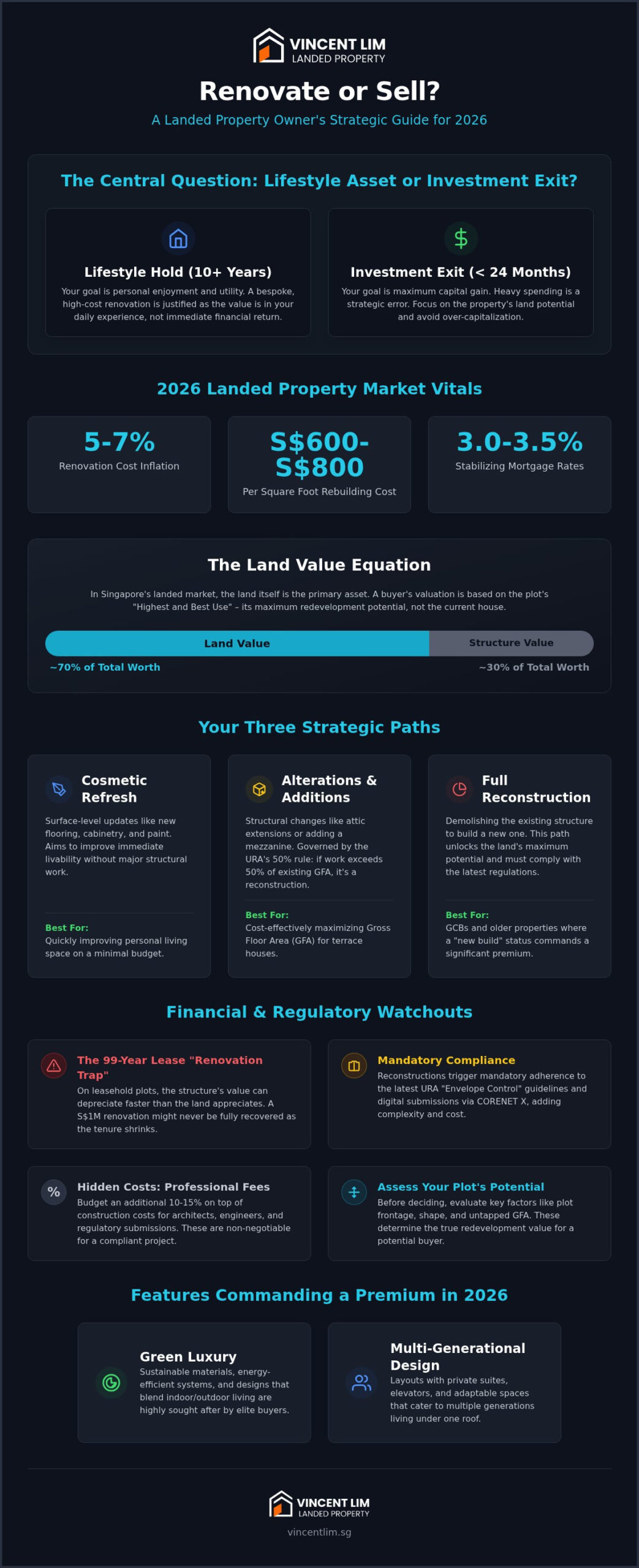
Deciding whether to renovate or sell landed property singapore owners hold requires more than just a contractor’s quote. It demands a strategic evaluation of the land’s potential value versus its current utility. Unlike the vast market for public housing in Singapore, the landed segment operates on extreme scarcity and redevelopment potential. In 2026, land value often accounts for over 70% of a property’s total worth, making the structure itself secondary to the plot’s future possibilities.
Owners typically face three distinct paths. A Cosmetic Refresh involves surface-level updates like cabinetry and flooring to improve immediate livability. Alterations & Additions (A&A) involve structural changes that stay within specific regulatory limits. Finally, Full Reconstruction involves demolishing the existing house to build a modern masterpiece from the ground up. Choosing the wrong path can lead to “over-capitalization,” where you spend more on renovations than the market is willing to pay back.
To make a sound decision, you must understand the concept of Highest and Best Use. This is the specific utilization of a plot that is physically possible, legally permissible, and financially feasible, resulting in the highest land value. If your current house only utilizes 50% of its allowable Gross Floor Area (GFA), the highest and best use is likely a reconstruction, and a buyer will value the land based on that potential, regardless of your recent kitchen upgrades.
The “Lifestyle Hold” vs. “Investment Exit” Framework
Assess whether you’re prioritizing emotional utility or financial capital gains. If your horizon is ten years, a bespoke renovation provides personal value that justifies the cost. However, if you plan to exit within 24 months, heavy spending is a strategic error. With mortgage rates stabilizing around 3.0% to 3.5% in 2026, the high cost of financing a massive project can quickly erode your margins. Owners of older semi-detached houses often find more value in selling as-is. This attracts developers or upgraders who want to implement their own vision, sparing you from the 5% to 7% renovation cost inflation seen this year.
Understanding A&A vs. Full Reconstruction
The URA’s 50% rule is the definitive boundary for your planning. If your proposed works exceed 50% of the existing GFA, external walls, or structural elements, the project is legally classified as a reconstruction. This distinction is vital because a reconstruction triggers mandatory compliance with the latest Envelope Control guidelines and modern setback requirements. While adding a mezzanine might offer a cost-effective GFA boost, owners of Good Class Bungalows (GCB) almost always opt for full reconstruction. At the elite level, a “new build” status carries a significant premium that far outweighs the savings of a partial renovation.
Financial Realities: Landed Renovation Costs and ROI in 2026
In 2026, the financial landscape for landed property has shifted significantly. Material inflation and persistent labor shortages have driven renovation costs up by approximately 5% to 7% this year alone. For owners deciding whether to renovate or sell landed property singapore has become a market where “over-capitalizing” is a genuine risk. On 99-year leasehold plots, spending S$1 million on a structure with a decaying lease can be a fatal financial error. The value of the building often depreciates faster than the land appreciates in these specific zones. Unlike freehold assets, leasehold structures face a “Renovation Trap” where the capital injected may never be recovered as the remaining tenure shrinks.
Beyond the visible finishes, professional fees for architects and structural engineers often add another 10% to 15% to your total budget. Compliance with BCA building and construction regulations is non-negotiable and requires meticulous technical planning. These regulatory requirements, combined with the mandatory CORENET X submissions, mean that “hidden” costs are often the difference between a profitable project and a financial drain. For luxury Detached and GCB homes, construction costs now regularly range between S$600 and S$800 per square foot, making every design decision a high-stakes investment.
Cost Breakdowns by Property Type
Terrace house owners frequently find the highest ROI through attic extensions and internal reconfiguration. These moves maximize Gross Floor Area (GFA) without the astronomical cost of a full rebuild. For Semi-Detached and Detached homes, modern buyer expectations often include private lifts and swimming pools, which add significant structural complexity. In the Good Class Bungalow (GCB) segment, the definition of luxury has shifted toward entirely bespoke solutions. With high-end finishes and advanced automation, GCB renovation budgets frequently exceed S$3 million in 2026 to meet the standards of the ultra-high-net-worth market.
ROI Analysis: Which Upgrades Pay for Themselves?
Strategic investors should prioritize “invisible” upgrades such as rewiring, modern plumbing, and solar integration. These provide peace of mind to future buyers and support the home’s fundamental value. While designer kitchens and bathrooms drive emotional “buy-in,” highly personalized aesthetics can actually shrink your buyer pool. Generic, high-quality finishes typically yield better resale ROI as they allow a new owner to project their own lifestyle onto the space. If you’re unsure how your specific land plot would be valued in its current state, consulting a specialist in luxury landed sales can provide the clarity needed for a confident decision.
Maximising Exit Value: Strategic Upgrades for the 2026 Buyer
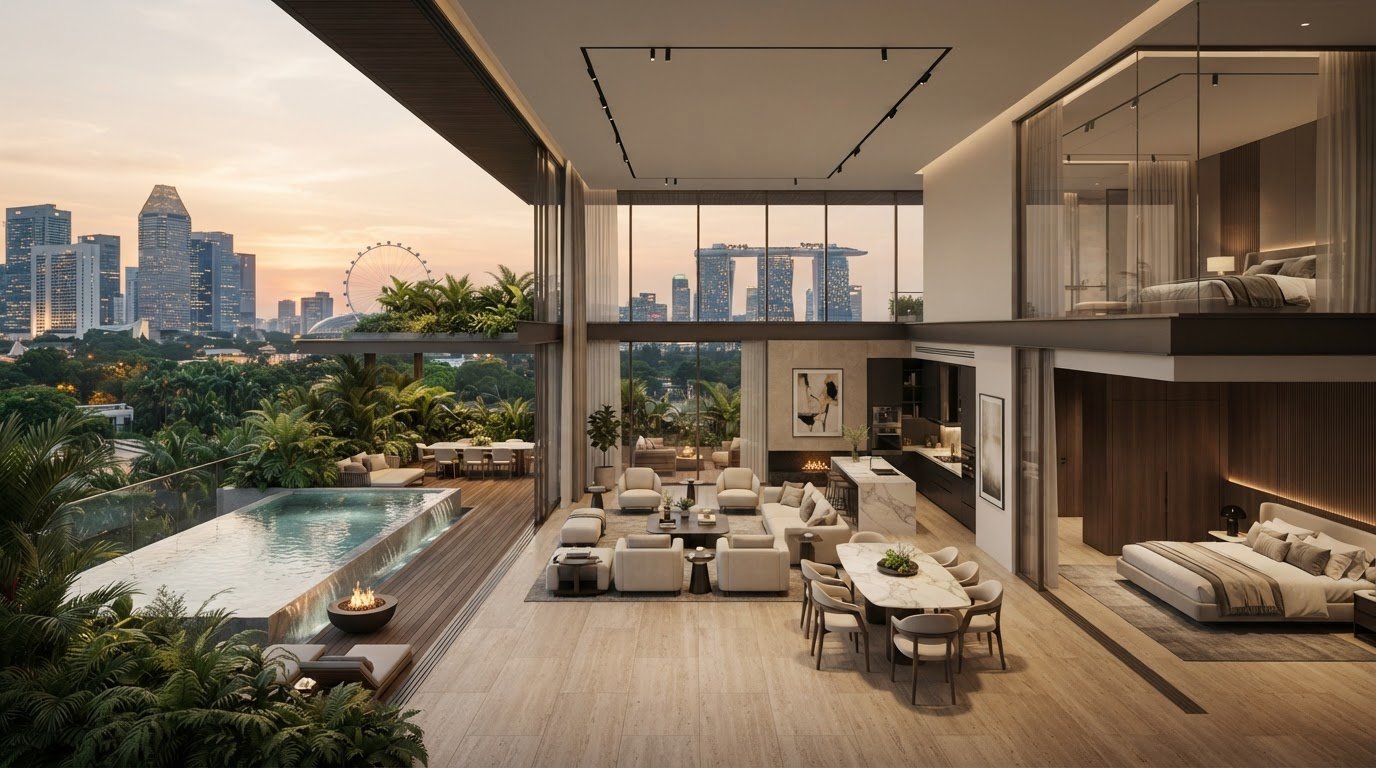
The elite buyer in 2026 isn’t merely searching for a residence; they’re acquiring a future-proofed asset that reflects their status and values. When navigating the choice to renovate or sell landed property singapore owners must understand that modern luxury is now defined by efficiency and technological integration. Curb Appeal 2.0 has moved beyond simple landscaping. It’s the psychological impact of the first 30 seconds of a viewing, where the presence of a sleek, integrated EV charging station and a high-security biometric gate system signals that the property is meticulously maintained and ready for the next decade.
Smart Home Ecosystems have transitioned from “optional extras” to “standard requirements” for landed homes. Buyers expect a unified platform where climate control, lighting, and advanced security are managed through a single, intuitive interface. This level of sophistication provides the seamless living experience that justifies a premium valuation. By implementing these systems during a strategic renovation, you differentiate your property from older “as-is” listings that would require a costly and invasive technological overhaul by the next owner.
The Rise of the Sustainable Landed Home
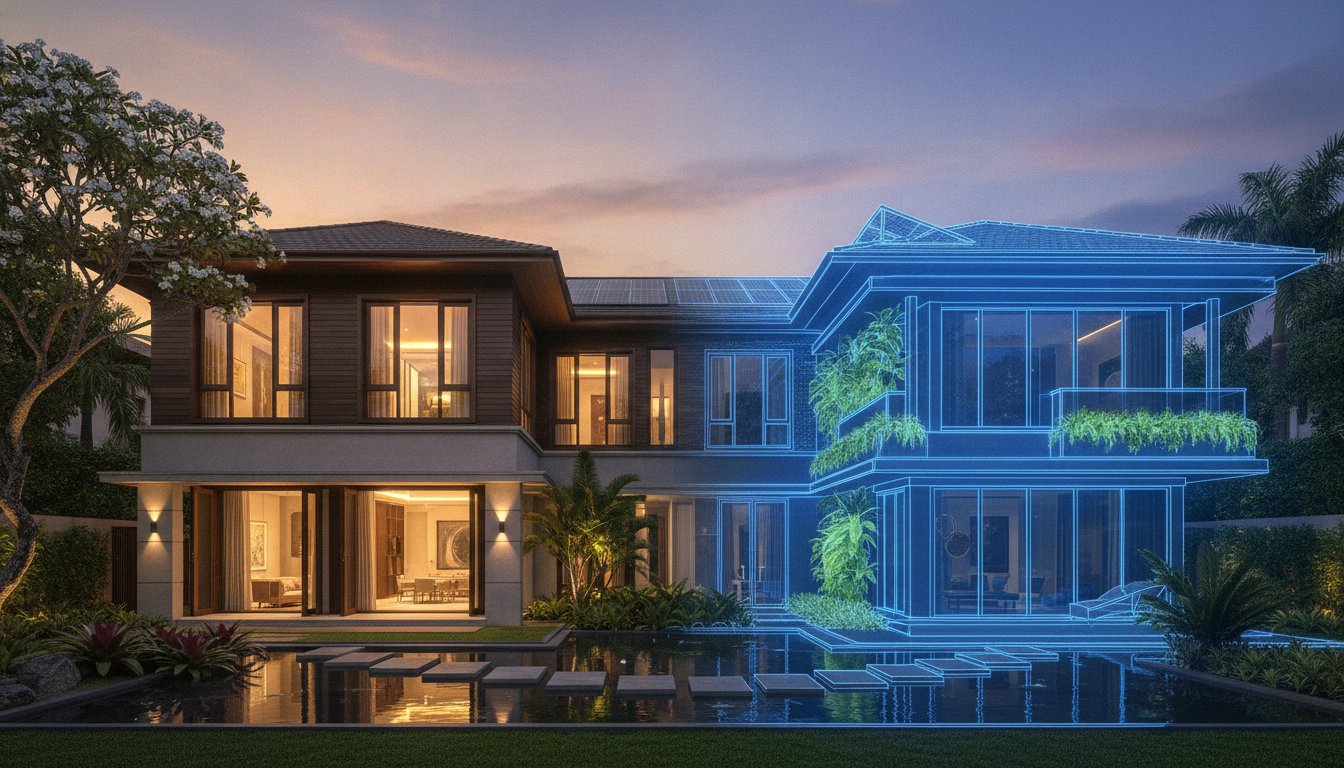
Sustainability is now a primary driver of resale value in the Singaporean luxury market. Detached houses that carry BCA Green Mark certifications act as a gold standard for quality and long-term viability. Building-integrated photovoltaics (BIPV) are particularly sought after, as they allow for renewable energy generation without compromising the architectural silhouette of the home. Passive cooling designs, such as thermal chimneys and strategic cross-ventilation corridors, significantly reduce the long-term cost of ownership. Using sustainable, high-performance materials acts as a powerful differentiator, appealing to a sophisticated demographic that values both environmental responsibility and operational excellence.
Functional Layouts for Modern Families
The internal architecture of a successful landed property must now accommodate the complexities of multi-generational living. Layouts that offer private suites for elderly parents and separate zones for adult children are essential for capturing the broadest possible buyer pool. We’ve seen a clear decline in the “formal dining room” in favour of integrated dry and wet kitchen concepts that serve as the home’s social heart. Post-pandemic requirements, such as dedicated home offices and private wellness suites, have become permanent fixtures in high-end briefs. While maximising Gross Floor Area (GFA) remains a priority for capital gains, it must be balanced with architectural voids that ensure natural light and ventilation penetrate the deepest parts of the home.
The Seller Checklist: Assessing Your Property Redevelopment Potential
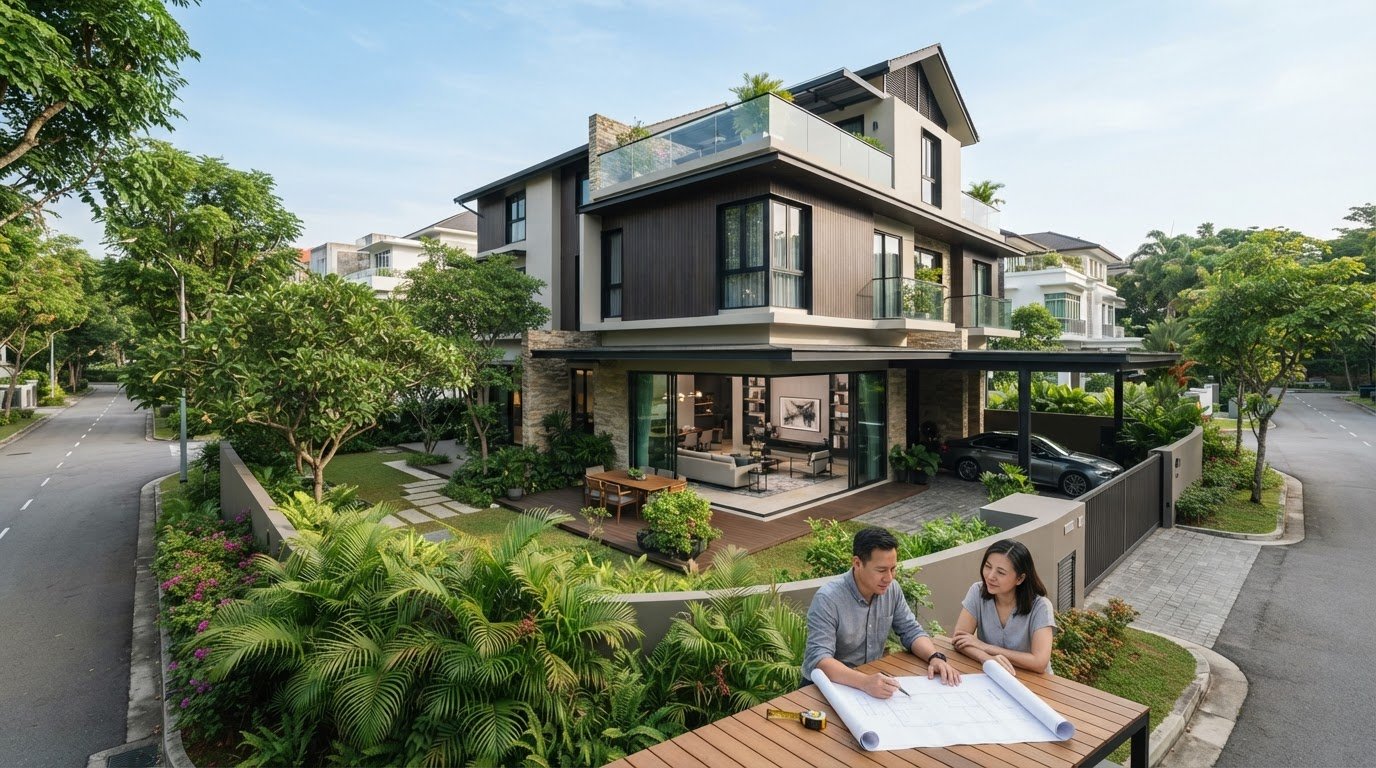
The true value of a landed asset often lies beneath the foundation rather than within the walls. Determining whether to renovate or sell landed property singapore requires a technical audit of the plot’s intrinsic characteristics. While a beautifully renovated interior appeals to owner-occupiers, developers and high-net-worth buyers prioritize the “raw canvas” potential. Regular, rectangular plots command a significant premium because they allow for efficient space planning and maximum GFA utilization. Conversely, irregular “pie-shaped” plots or those with narrow frontage can complicate setback requirements, potentially reducing the land’s residual value.
The 2026 URA Master Plan has introduced specific zoning updates that can overnight transform a property’s value. For instance, if your estate has been rezoned from a 2-storey to a 3-storey designated area, your “as-is” value may have spiked far beyond the cost of any renovation. For owners viewing their home as a pillar of long-term wealth, understanding asset progression to landed property singapore is vital for timing an exit that funds the next acquisition. Identifying these windows of opportunity is what separates a standard sale from a strategic divestment.
Technical Factors That Attract Developers
Technical encumbrances are the silent killers of land value. Before listing, you must verify the presence of drainage reserves or sewerage line encumbrances that might bisect your plot. These limitations can severely restrict where a new structure can be placed, often deterring professional builders. In prime districts, small landed clusters are increasingly being viewed for their “en-bloc” potential, where adjacent owners combine plots to create a larger, more lucrative development site. Calculating your “residual land value” involves subtracting estimated construction costs and developer profit margins from the projected end-sale price. If this figure exceeds your current market valuation, selling for redevelopment is your most logical path.
Legal and Regulatory Compliance
Navigating the 2026 ABSD landscape is essential for managing your transaction timeline. With Singapore Citizens facing a 20% ABSD on their second residential property and Permanent Residents at 5% for their first, the pool of buyers is highly discerning. They will not tolerate legal ambiguities. Ensure all previous A&A works have documented BCA clearances. Unapproved structures can stall a sale for months or lead to heavy price renegotiations. Engaging a Qualified Person (QP) to conduct a pre-sale audit is a hallmark of the elite strategist approach. This professional verification provides buyers with the peace of mind that the plot’s redevelopment potential is exactly as claimed. If you need an expert valuation of your plot’s highest and best use, a strategic consultation can reveal the hidden equity in your land.
The Vincent Lim Approach: Navigating High-Stakes Landed Transactions
Deciding whether to renovate or sell landed property singapore owners hold is a multi-million dollar calculation that leaves no room for error. A generalist agent might manage a standard transaction, but they often lack the technical acumen required to value a Good Class Bungalow or a complex luxury detached house. These assets require an understanding of “highest and best use” that transcends simple price-per-square-foot comparisons. My “Elite Strategist” method replaces guesswork with data-driven valuation, ensuring that every architectural nuance and redevelopment possibility is factored into your exit price.
As an Executive Associate Director at OrangeTee & Tie with over 20 years of experience, I provide a level of seasoned authority that safeguards your interests. We don’t just list a property; we position it. By leveraging the extensive OrangeTee & Tie network, your home gains direct exposure to a curated pool of ultra-high-net-worth individuals and seasoned developers. This strategic reach is essential in the 2026 market, where buyer profiles have become increasingly specific and discerning. If you’re ready to explore a tailored strategy, see how to sell my landed property singapore to ensure you maximize your capital gains.
Bespoke Marketing for Unique Assets
Luxury assets require a narrative that resonates with the right “persona.” We use professional cinematography and sophisticated home staging to tell a story of legacy and architectural excellence. Whether your buyer is a developer seeking a regular plot for reconstruction or an owner-occupier looking for a ready-to-move-in sanctuary, our marketing is surgical. For GCB and high-value detached sales, we maintain the highest standards of discretion. We understand that privacy is a priority for our clients, and we manage every viewing with a level of “white-glove” professionalism that reflects the quality of the asset itself.
Securing the Best Price in a 2026 Market
Negotiating a landed deal in 2026 involves more than just the final number. It requires a partner who can navigate complex redevelopment clauses and coordinate the intricate timeline between your sale and your next acquisition. We manage the friction of high-stakes transactions by providing calm, calculated competence at every stage of the journey. This includes verifying that your property’s potential aligns with the latest URA height controls and BCA safety standards before we even go to market. To ensure your next move is backed by two decades of expertise, Consult with Vincent Lim for a bespoke landed property strategy and secure your financial legacy.
Maximizing Your Landed Asset Value in 2026
Navigating the decision to renovate or sell landed property singapore owners possess requires a blend of technical foresight and market intuition. You’ve seen how rising material costs and strict URA guidelines can quickly turn a passionate renovation into a financial burden if the plot’s redevelopment potential is ignored. Strategic success in this landscape depends on identifying the highest and best use for your land before committing significant capital. Success isn’t just about the structure you build; it’s about the equity you protect.
Whether you choose to refine your home for the next generation or exit the market to capitalize on land scarcity, you deserve a partner who operates with calculated competence. As an Executive Associate Director at OrangeTee & Tie with over 20 years of expertise, I specialize in the nuances of Good Class Bungalows and luxury detached homes. I offer the seasoned authority needed to guide high-stakes transactions toward the best possible outcome for your portfolio.
Partner with Vincent Lim for a Strategic Landed Property Exit to ensure your next move is backed by elite market strategy and a gold standard of service. Your legacy is built on the precision of the decisions you make today.
Frequently Asked Questions
Is it better to renovate or sell an old landed property in Singapore in 2026?
The decision depends on your property’s “highest and best use” and your personal investment horizon. If your land is under-utilized according to current URA plot ratios, selling as-is to a developer often yields a higher return than a costly renovation. In 2026, the high cost of construction acts as a price floor for existing land, making as-is sales particularly attractive for owners of older homes on regular plots.
How much does a full reconstruction of a semi-detached house cost in 2026?
Rebuilding a semi-detached home typically requires a budget starting from S$700,000 to over S$1.5 million. Verified 2026 industry data indicates that construction costs currently range between S$600 and S$800 per square foot for the structure alone. These estimates don’t include professional fees for architects or the bespoke luxury finishes often expected in the Singaporean landed market.
What is the difference between A&A and reconstruction under URA rules?
The distinction is defined by the 50% threshold of the existing structure. To qualify as Additions & Alterations (A&A), your proposed works must not exceed 50% of the property’s gross floor area, external walls, or structural elements. If you exceed this limit, the project is legally classified as a full reconstruction, which triggers mandatory compliance with modern Envelope Control guidelines and current setback requirements.
Will a swimming pool or a lift increase my landed property resale value more?
A private lift generally provides a more reliable increase in resale value than a swimming pool in the 2026 market. Lifts have become a standard requirement for multi-generational families and elderly owners, making the home accessible to a wider buyer pool. While a swimming pool offers lifestyle appeal, some buyers view it as a maintenance burden, whereas a lift is considered a permanent, high-value functional upgrade.
Can I sell my landed property as-is if it has structural defects?
You can certainly sell your property as-is, provided all known defects are transparently disclosed during the transaction. In fact, many buyers specifically seek out “original condition” homes with defects because they intend to demolish the existing structure for redevelopment. Selling in this state allows you to avoid spending capital on repairs that a developer would simply tear down anyway.
How do I check the redevelopment potential of my terrace house?
You should begin by consulting the latest URA Master Plan to identify your zone’s height control and plot ratio. Determining the strategic path to renovate or sell landed property singapore owners must take involves checking if your terrace can be upgraded from a 2-storey to a 3-storey designation. It’s also vital to check for drainage reserves or sewerage encumbrances that might restrict your building footprint.
What are the 2026 ABSD rates for Singaporeans buying their second landed property?
Singapore Citizens are currently required to pay an Additional Buyer’s Stamp Duty (ABSD) of 20% on their second residential property. This rate has remained consistent since the last major revision in April 2023. If you’re purchasing a third or subsequent property, the ABSD rate increases to 30%, which is a critical factor to calculate when planning your asset progression strategy.