Broadcasting a trophy residence across mass-market property portals is often the fastest way to destroy its pricing power. When selling a luxury condo in Singapore, prolonged public exposure signals vulnerability rather than prestige, steadily eroding your price leverage as days on market accumulate. You likely already recognize that serious accredited investors don’t scour public classifieds. Instead, high-net-worth acquisitions move through private, established channels where discretion, exclusivity, and asset integrity are strictly preserved.
Achieving a benchmark transaction requires replacing speculative listing tactics with a disciplined, institutional divestment framework. This strategic guide provides the clear roadmap to position, price, and sell your luxury condominium for maximum capital extraction without unnecessary discounting or commercial compromise. Ahead, we examine how targeted private placement shields owner confidentiality, how to strategically structure timelines around modern stamp duty policies, and how to seamlessly transition your realized capital into landed residential holdings.
Key Takeaways
- Master qualitative valuation metrics that automated algorithms overlook to establish defensible benchmark pricing without sacrificing asset prestige.
- Execute a structured, five-step roadmap for selling a luxury condo in Singapore through private placement networks that shield owner privacy and sustain negotiating leverage.
- Assess collective sale feasibility against mounting maintenance liabilities to determine whether holding an older asset yields superior net returns over immediate private divestment.
- Structure divestment timelines precisely around holding thresholds and regulatory frameworks to ensure seamless capital extraction and tax efficiency.
- Formulate an intentional capital redeployment blueprint to transition your realized condominium proceeds into scarce landed residential assets for generational wealth preservation.
The Strategic Foundation: Assessing Market Timing and Luxury Condo Valuation
Precision valuation forms the cornerstone of any successful divestment strategy. In prime residential segments, generic algorithms and automated valuation tools fail because they evaluate real estate as uniform commodities. Successfully selling a luxury condo in Singapore demands an institutional approach that accounts for macro liquidity shifts, policy cycles, and the deeper context of Singapore private property market history. Rather than chasing moving targets, sellers must anchor negotiations with defensible, multi-layered pricing models.
Qualitative Versus Quantitative Luxury Property Valuation Factors
Median transaction data only reveals historical baselines. Prime residences command premiums through qualitative and architectural advantages that automated systems can’t quantify:
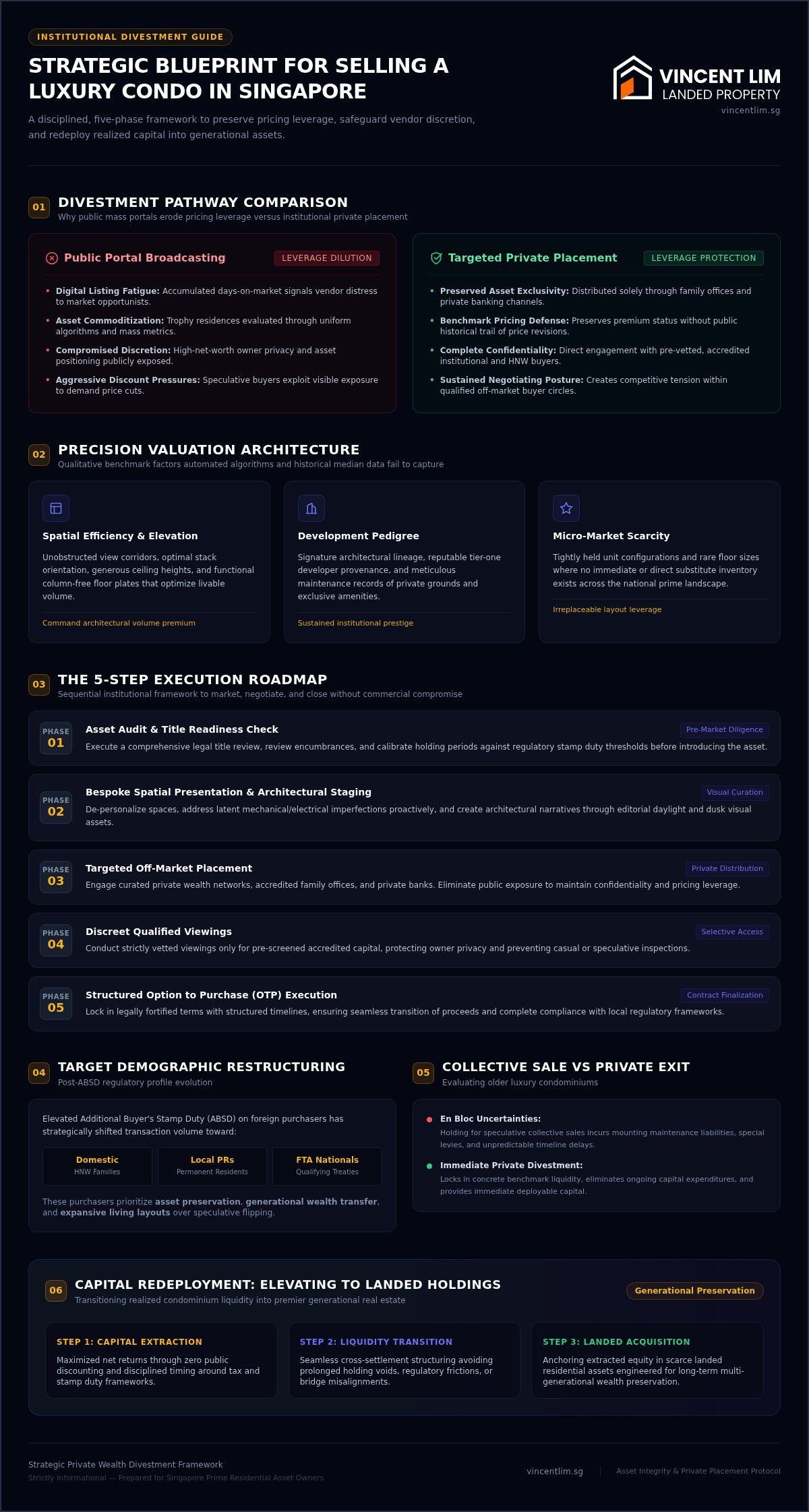
- Spatial Efficiency and Elevation: Unobstructed view corridors, optimal stack orientation, generous ceiling heights, and functional, column-free floor plates.
- Development Pedigree: Signature architectural design, reputable tier-one development provenance, and meticulous long-term maintenance of private grounds and exclusive amenities.
- Micro-Market Scarcity: Tightly held unit sizes and layouts where immediate substitute inventory simply doesn’t exist across the national landscape.
Synthesizing these tangible attributes creates an analytical narrative that justifies benchmark pricing during private buyer discussions.
Navigating Policy Impacts and Buyer Demographics
Regulatory frameworks have fundamentally restructured the prime residential buyer profile. Elevated Additional Buyer’s Stamp Duty rates on foreign purchasers have shifted transaction volume toward domestic high-net-worth families, local permanent residents, and qualifying Free Trade Agreement nationals. When selling a luxury condo in Singapore, positioning must appeal directly to this sophisticated domestic wealth base.
These buyers prioritize asset preservation, generational wealth transfer, and expansive living arrangements. Aligning your property’s spatial presentation with these wealth-structuring priorities eliminates friction during due diligence. It also protects your pricing leverage by showing accredited purchasers verifiable value rather than speculative marketing fluff.
The 5-Step Strategic Blueprint for Selling a Luxury Condo in Singapore
Divesting a prime residence requires an institutional process rather than casual listing tactics. Selling a luxury condo in Singapore succeeds when executed through five coordinated phases: conducting a rigorous asset audit and title readiness check, curating bespoke architectural staging, executing targeted off-market placement, conducting discreet qualified viewings, and securing structured Option to Purchase contracts. This structured methodology eliminates guesswork and protects capital value at every step.
Asset Curation and Bespoke Spatial Presentation
High-net-worth purchasers make buying decisions based on perceived volume, architectural integrity, and light. Staging must emphasize structural grandeur rather than surface-level decoration:
- De-personalization and Spatial Restoration: Remove idiosyncratic art and dense furniture layouts to restore intended sightlines and functional circulation.
- Architectural Narrative Asset Creation: Commission editorial daylight photography and curated dusk videography to present the property as an irreplaceable living gallery.
- Proactive Defect Rectification: Address latent mechanical, electrical, or finish imperfections before viewings, preventing aggressive price renegotiations during technical audits.
Private Placement Versus Public Portal Distribution
Public classifieds commoditize elite properties. Mass distribution causes digital listing fatigue, signaling vendor distress when a property accumulates unnecessary days on market. Conversely, private placement through accredited family offices and private banking channels preserves asset rarity.
Restricting distribution to verified high-net-worth channels builds competitive tension among serious buyers. Sellers also maintain complete confidentiality regarding personal financial matters. Engaging an experienced strategist with private distribution channels through bespoke advisory representation ensures your residence is introduced exclusively to qualified principals without public exposure.
Screening Qualified Purchasers and Closing Negotiations
Unvetted foot traffic compromises security and wastes time. Prior to granting private access, an advisory partner must confirm buyer purchasing capacity and assess their acquisition timeline. This step includes verifying compliance with statutory holding rules such as the prevailing Seller’s Stamp Duty (SSD) rules to ensure transaction dates protect both parties from unexpected tax liabilities.
During negotiations, counter-offers should remain rooted in qualitative architectural merits and verified transaction baselines rather than emotional back-and-forth. Once terms align, drafting the Option to Purchase requires specialized conveyancing coordination. Experienced legal counsel will secure the transaction deposit, outline explicit completion periods, and ensure flawless closing execution.
Immediate Divestment vs. Collective Sale Potential for Older Luxury Condos
Owners of mature properties frequently face an expensive dilemma. Should you retain an older asset in anticipation of an en bloc windfall, or does an individual market exit yield superior net returns? While industry lore paints collective sales as guaranteed liquidity events, institutional developers evaluate prospective acquisitions with strict risk matrices. When selling a luxury condo in Singapore, understanding this balance between redevelopment viability and capital stagnation is vital to protecting your overall portfolio.
Evaluating Realistic Collective Redevelopment Viability
A successful collective sale demands specific commercial attributes rather than mere asset age. Institutional developers scrutinize unexhausted gross floor area, baseline plot ratios, and road access before submitting competitive acquisition tenders. Consulting official URA private property data reveals how Land Betterment Charges can quickly compress developer margins, rendering seemingly prime residential sites financially unviable for high-density redevelopment. If a site lacks substantial unutilized plot ratio or requires extensive infrastructure works, statutory consensus alone won’t attract institutional capital.
The True Cost of Waiting: Depreciation Versus Capital Agility
Waiting years for a speculative collective sale carries severe operational friction and opportunity cost. As buildings age, asset deterioration accelerates across several measurable fronts:
- Escalating Maintenance Demands: Mechanical infrastructure, facade restorations, and waterproofing failures place recurring calls on sinking funds, quietly eroding net holding yields.
- Protracted Timeline Uncertainty: Organizing sales committees and securing statutory owner consent often requires years of effort, with zero guarantee of completion.
- Opportunity Cost of Capital: Stagnant equity locked inside an aging structure cannot capture superior compounding returns in more resilient residential asset classes.
Choosing to execute an individual sale eliminates these structural liabilities. Selling a luxury condo in Singapore through an immediate private transaction unlocks tangible liquidity today, bypasses years of procedural limbo, and frees your capital for active redeployment into generational landed holdings.
Critical Legal, Tax, and Financial Considerations for Luxury Sellers
Executing an elite real estate transaction demands absolute fiscal precision. Beyond finding the right buyer, selling a luxury condo in Singapore requires a structured legal and financial plan that prevents capital leakage. Managing holding thresholds, banking covenants, and statutory refunds directly dictates how much net liquidity you extract at the completion table.
Managing Mortgage Redemption and Legal Formalities
Financial liabilities must be cleared systematically well before completion day arrives. Overlooking bank facility covenants creates friction and triggers avoidable costs:
- Mortgage Redemption Notices: Most financial institutions require a formal three-month redemption notice. Serving this late incurs penalty interest in lieu of notice, unnecessarily eroding your net gains.
- Central Provident Fund Reconciliation: If CPF funds serviced the initial acquisition or monthly service payments, the principal amount plus accrued interest must return to your ordinary account upon completion before redeployment.
- Conveyancing Counsel Selection: Engage dedicated real estate solicitors familiar with private wealth transactions, power of attorney mandates, and complex property trust structures.
Mastering Completion Windows and Transaction Timelines
Strategic scheduling prevents expensive financing gaps. When selling a luxury condo in Singapore while preparing a subsequent property acquisition, standard eight-to-twelve-week completion timelines often prove too rigid. Extending completion windows allows sellers to align their sale proceeds with subsequent acquisition down payments, eliminating the need for costly short-term bridging loans.
Sellers also frequently negotiate formal temporary extension of stay agreements within the Option to Purchase. This contractual clause grants two to three months of occupancy post-completion, giving you ample time to transition into your next residence without rushed moves or intermediate leasing arrangements.
Orchestrating these moving components requires disciplined transactional oversight. For strategic advisory and precision management throughout your divestment journey, partner with Vincent Lim for high-end residential sales.
Capital Redeployment: Elevating Luxury Condo Proceeds into Landed Property
Divesting a prime condominium shouldn’t mark the conclusion of your wealth strategy. Instead, it creates the financial foundation for deliberate generational capital allocation. For established family offices and domestic property owners, selling a luxury condo in Singapore releases substantial liquid reserves that can be channeled into scarce landed properties. This pivot transitions private capital from shared strata developments into enduring freehold or 999-year landownership.
The Multi-Generational Wealth Advantage of Landed Real Estate
Singapore’s strictly finite land boundaries ensure that landed homes remain the nation’s most supply-constrained residential asset class. Unlike condominiums, which face periodic supply expansion through collective redevelopment and urban intensification, landed plots cannot be replicated. This structural scarcity drives a consistent long-term divergence in capital appreciation between strata titles and landed homes.
Beyond capital preservation, landed holdings grant absolute physical autonomy. Strata owners remain subject to management corporation bylaws, shared facility maintenance levies, and collective redevelopment uncertainties. Landed ownership restores total control over architectural design, floor-plate reconfiguration, and physical expansion. Whether acquiring a detached residence or a terrace home, this land title independence provides the ultimate framework for multi-generational wealth succession.
Executing the Transition with Veteran Advisory Leadership
Migrating capital from vertical developments into landed estates demands specialized market intelligence. Landed acquisitions require detailed structural assessments, boundary setback verification, and an understanding of redevelopment potential before capital commitment.
Drawing on over two decades of transactional leadership since 2004 as an Executive Associate Director at OrangeTee & Tie, Vincent Lim orchestrates seamless portfolio transitions for high-net-worth clients. By pairing discrete off-market sourcing with verified private investor networks, clients gain immediate access to exclusive opportunities that never surface on public portals.
Whether you’re examining the mechanics of selling your landed property or formulating a coordinated acquisition timeline, seasoned guidance safeguards your capital at every stage. Explore our comprehensive blueprint for asset progression to landed property to deploy your condominium proceeds into Singapore’s most coveted residential asset class.
Securing Benchmark Value for Your Prime Residential Asset
Successfully selling a luxury condo in Singapore requires moving beyond mass-market tactics to embrace disciplined valuation, discrete private placement, and precise timeline coordination. Protecting your confidentiality while engaging verified accredited capital ensures you extract maximum equity without sacrificing negotiating leverage. That realized liquidity serves as a powerful catalyst for your broader financial goals, establishing the foundation for strategic capital redeployment into enduring landed estates.
Navigating this high-stakes process demands seasoned strategic leadership. Backed by over two decades of residential market leadership since 2004 and the extensive client networks of OrangeTee & Tie, Vincent Lim provides tailored, end-to-end representation from luxury strata divestment through to prestigious landed acquisition. Take the decisive step toward optimizing your residential balance sheet. Schedule a confidential advisory session with Vincent Lim to structure your divestment strategy with absolute clarity and peace of mind.
Frequently Asked Questions
How long does it typically take to sell a luxury condominium in Singapore?
Selling a luxury condo in Singapore typically takes between three to six months when priced accurately and positioned through targeted private channels. The prime residential tier naturally possesses a smaller qualified buyer pool compared to mass-market developments. Transaction velocity depends heavily on stack positioning, unique layout appeal, and the strategic alignment of the asking price against recent benchmark data. An off-market approach with prescreened accredited purchasers often shortens this timeline substantially.
Should I renovate my luxury condo before placing it on the market?
Full-scale interior renovations rarely yield a positive return because high-net-worth buyers prefer customizing spaces to their personal aesthetics. Instead, focus on minor architectural remediation and professional spatial staging. Rectify latent mechanical or plumbing defects, refresh wall surfaces with neutral gallery finishes, and optimize lighting to accentuate spatial volume. These targeted touch-ups eliminate negotiating friction without sinking capital into design choices a new owner might promptly demolish.
Can I sell my luxury condo privately without public portal advertising?
Yes, private off-market sales represent an effective divestment path that completely protects owner confidentiality and prevents listing commoditization. A private placement strategy relies on direct representation through established family office networks, accredited private wealth databases, and discreet broker-to-broker syndicates. This methodology screens out casual spectators, protects sensitive asset details from public portals, and sustains pricing leverage by maintaining an aura of exclusivity around your property.
What happens to my CPF funds and accrued interest after the sale completes?
Any Central Provident Fund capital withdrawn for the initial purchase, monthly mortgage repayments, or stamp duties must be refunded to your CPF Ordinary Account upon completion. This repayment includes mandatory accrued interest compounded at the prevailing rate. If the net sales cash proceeds are insufficient to cover the full principal and accrued interest, sellers don’t have to top up the cash shortfall, provided the transaction took place at fair market valuation.
Is holding out for a collective sale better than selling my older condo now?
Holding for a speculative collective sale often underperforms an immediate individual exit due to compounding holding costs and prolonged execution risk. En bloc attempts frequently require years of committee meetings and statutory consent drives, during which your capital remains locked. Meanwhile, aging infrastructure drives up maintenance sinking fund levies. An immediate private sale unlocks liquidity today, eliminating uncertainty and allowing you to reallocate equity into appreciating landed assets.
What are the key tax obligations when disposing of a luxury condo in Singapore?
Singapore does not levy a capital gains tax on private residential property sales, provided you aren’t classified as a commercial property trader. The primary tax consideration is the Seller’s Stamp Duty, which applies if you dispose of the property within the statutory holding period. Additionally, while the residential property transaction itself is exempt from Goods and Services Tax, standard GST applies to real estate brokerage commissions billed by GST-registered agencies.
How do I transition my condo sale proceeds seamlessly into a landed property?
Seamless capital redeployment requires carefully synchronized completion timelines and tailored Option to Purchase terms to bridge transaction liquidity. When selling a luxury condo in Singapore to fund a landed acquisition, negotiate an extended completion period or a formal temporary extension of stay. This coordination ensures CPF funds and sales proceeds clear into your bank accounts before landed completion balances fall due, bypassing the need for stressful bridging loans.