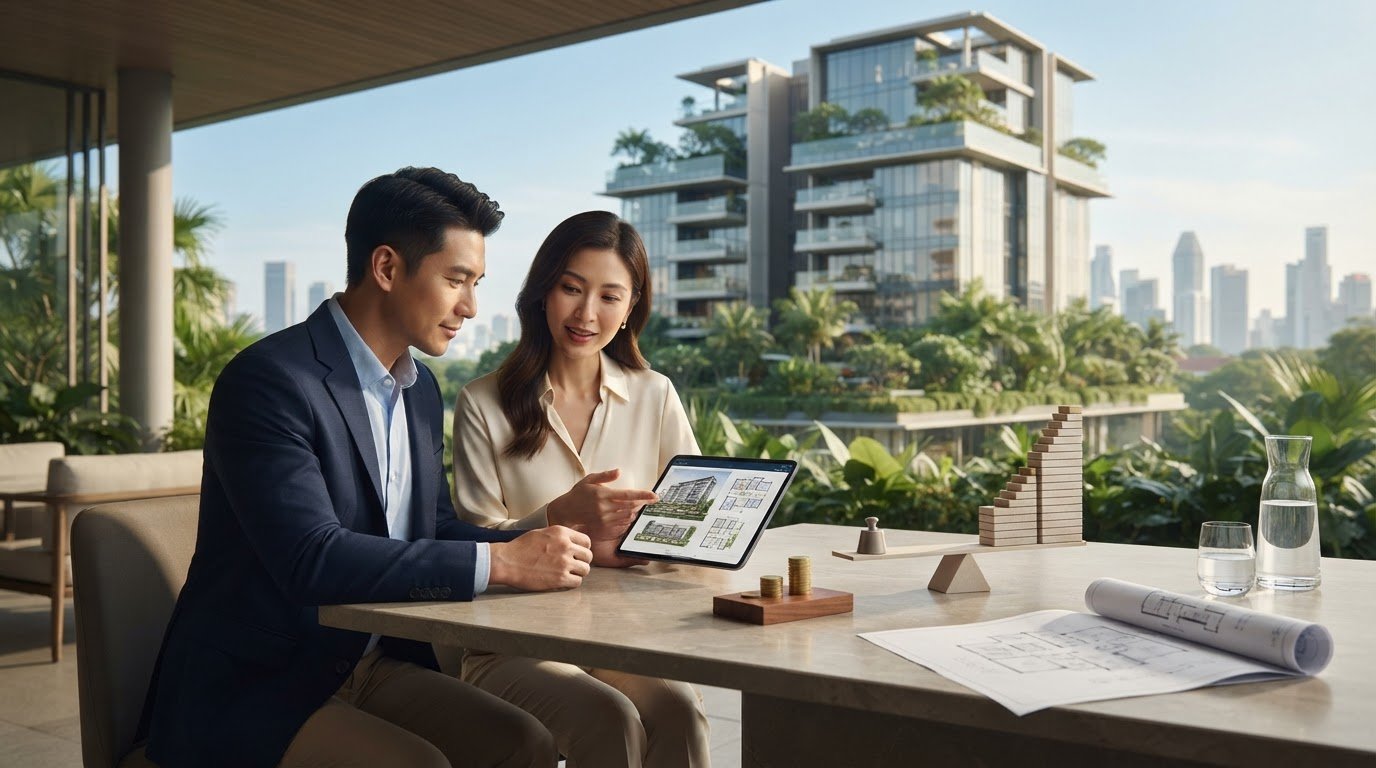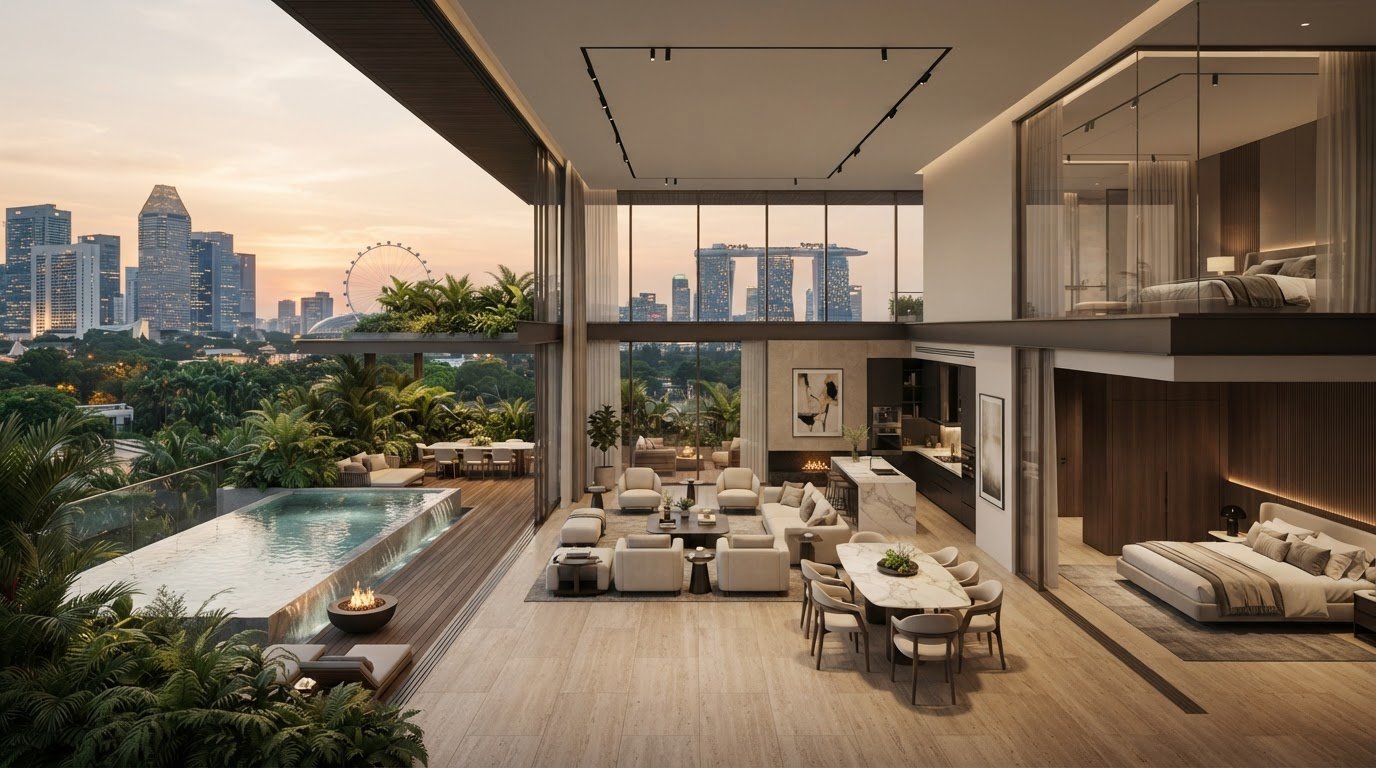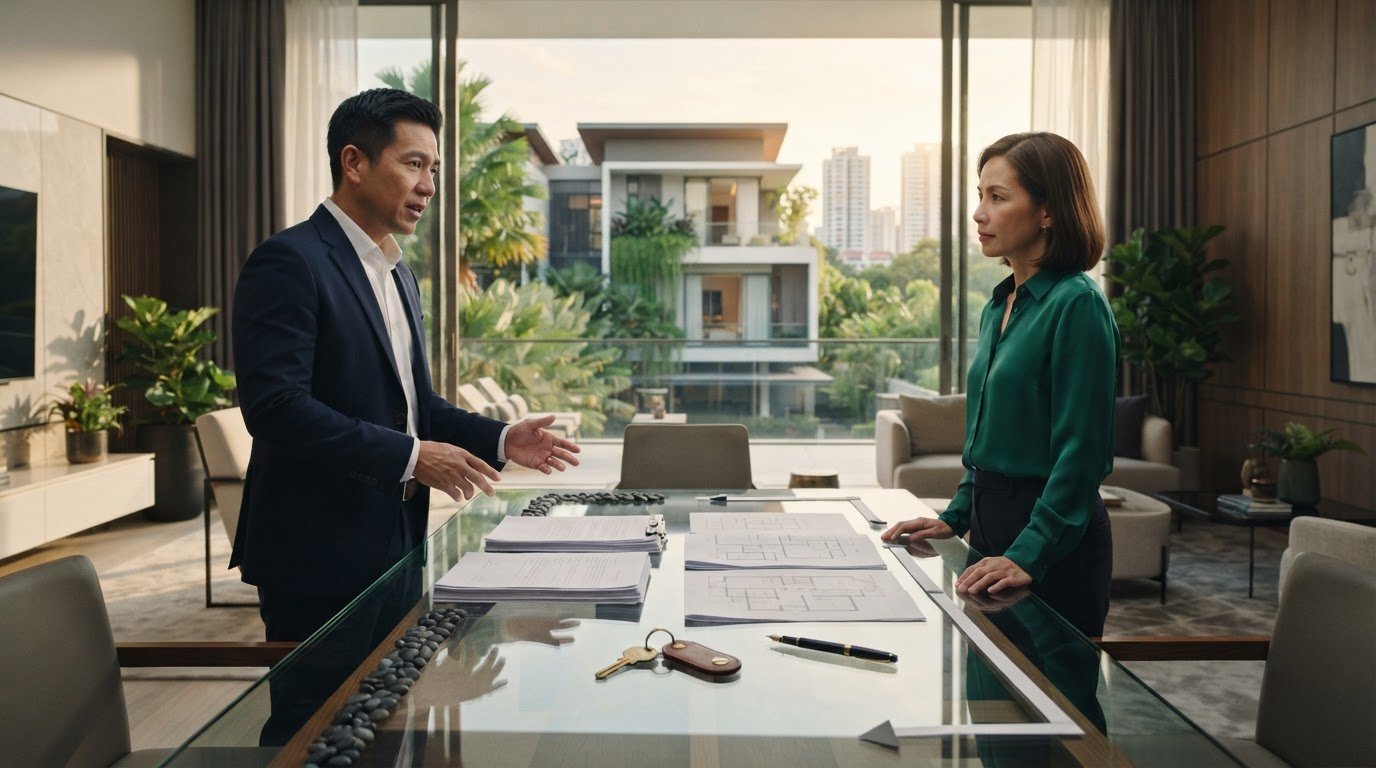
Did you know that less than five percent of Singapore’s population resides in landed property? This extreme scarcity defines the market, making every acquisition a high-stakes decision for your family’s legacy. You likely recognize that owning a terrace, semi-detached, or detached house is the pinnacle of local real estate, yet the barriers have never been higher. With Singapore Citizen ABSD rates for second properties at 20% and a 60% rate for foreigners, the margin for error in your investment strategy is virtually non-existent.
This guide offers a strategic framework to master the complexities of the 2026 market. Partnering with a luxury landed property agent singapore ensures you move beyond simple listings to identify off-market opportunities and assess true redevelopment value. We’ll examine the latest 2026 Buyer’s Stamp Duty schedules, analyze the impact of the 2025 Seller’s Stamp Duty regime, and provide a methodical approach to securing high-value residential assets. You’ll gain the clarity needed to handle regulatory hurdles seamlessly while ensuring your acquisition serves as a robust wealth-preservation vehicle for generations to come.
Key Takeaways
- Distinguish between technical asset classes, from terrace houses to Good Class Bungalows, to ensure your acquisition aligns with specific URA guidelines and long-term prestige.
- Analyze the critical relationship between land tenure and redevelopment potential by evaluating how plot ratios and site selection impact your building’s maximum floor area.
- Navigate the 2026 regulatory environment with a clear understanding of the Land Dealings Approval Unit (LDAU) requirements and total debt servicing ratio (TDSR) limits.
- Partnering with a luxury landed property agent singapore provides exclusive access to off-market opportunities that are often transacted privately before reaching public portals.
- Adopt a bespoke brokerage strategy to move beyond standard listings, focusing on identifying finite residential assets that offer the highest potential for capital appreciation and legacy preservation.
Navigating the Scarcity of Landed Property in Singapore (2026)
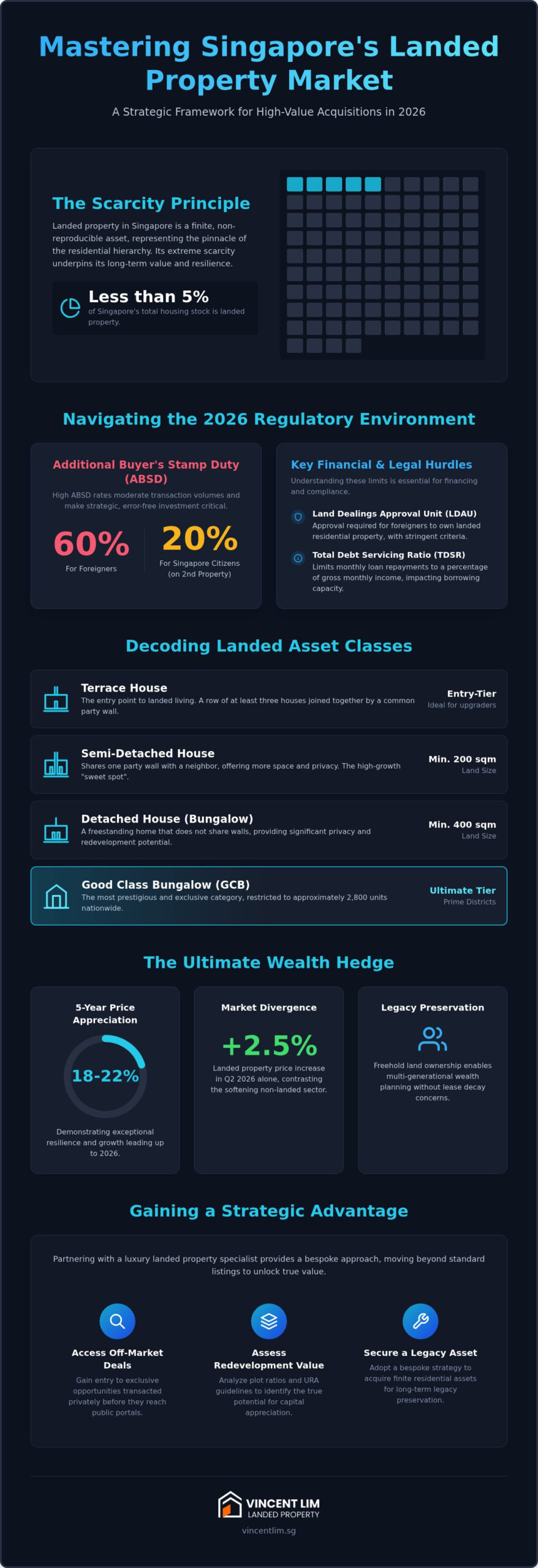
Landed property in Singapore is a finite, non-reproducible asset that remains the most coveted segment of the residential market. Unlike high-rise apartments where value is often tied to communal amenities and strata area, a landed home provides the owner with direct ownership of the land itself. This distinction is critical in a nation where land is the most precious resource. Currently, landed housing comprises less than 5% of the total housing stock, creating a structural supply constraint that underpins its long-term value. Landed property represents the pinnacle of the residential hierarchy in 2026, offering an unparalleled level of privacy and control over the physical land plot.
The regulatory framework managed by the Singapore Land Authority (SLA) ensures that land use is optimized, which naturally limits the number of new landed plots released to the market. In 2026, market sentiment remains remarkably resilient. While cooling measures like the 60% ABSD for foreigners and 20% for Singaporeans purchasing their second property have moderated transaction volumes, prices continue to reach new record highs. In the second quarter of 2026 alone, landed property prices increased by 2.5%, diverging from the softening non-landed sector. This trend highlights a fundamental reality: demand from high-net-worth citizens continues to outstrip the stagnant supply.
The Hierarchy of Landed Homes
Understanding the progression within this asset class is essential for any strategic acquisition. A terrace house for sale singapore often serves as the entry point for families transitioning from luxury condominiums to landed living. As one moves up the hierarchy to semi-detached and detached houses, the land requirements increase, with bungalows outside GCB areas requiring a minimum of 400 sqm. The ultimate tier is the Good Class Bungalow (GCB), a category restricted to approximately 2,800 units nationwide. Moving up this ladder isn’t just a financial decision; it’s a psychological shift toward total autonomy and the acquisition of a unique architectural footprint that cannot be replicated in a standard development.
Why Landed Assets Remain the Ultimate Wealth Hedge
Landed residences have demonstrated exceptional price resilience, appreciating by approximately 18-22% over the five years leading up to 2026. This growth is driven by the fact that land value tends to appreciate even as the building structure ages. For many investors, working with a luxury landed property agent singapore is about more than finding a home; it’s about executing a 30-year wealth preservation strategy. Freehold land ownership allows for multi-generational legacy planning, ensuring that the asset remains within the family without the ticking clock of a leasehold decay. In an era of global economic volatility, the permanence of a freehold land title in a stable jurisdiction like Singapore remains the definitive hedge against inflation and market uncertainty.
Decoding Landed Asset Classes: From Terrace Houses to Good Class Bungalows
To navigate the landed market effectively, you must first master the technical classifications established by the Urban Redevelopment Authority (URA). These categories aren’t just labels; they dictate land area, setback requirements, and the potential for future expansion. A Terrace house is defined as a row of at least three houses joined together. Intermediate terraces share walls on both sides, while corner terraces offer more land and only a single shared wall. In the resale market, corner units often command a significant premium because they provide better ventilation, more natural light, and a lifestyle that feels closer to a semi-detached home. Semi-detached houses share one party wall with a neighbor and require a minimum land size of 200 sqm. Detached houses, or bungalows, stand entirely independent with a minimum land plot of 400 sqm.
Terrace and Semi-Detached: The High-Growth Mid-Tier
The average price of semi-detached house in singapore in 2026 reflects its status as the ideal “sweet spot” for upgrading families. These properties provide a substantial increase in privacy over terrace houses while remaining more accessible than detached options. For investors, older terrace plots present unique redevelopment opportunities. Under the URA design flexibility guidelines, many of these plots can be transformed into modern, multi-storey residences that maximize internal floor area. Partnering with a luxury landed property agent singapore helps you identify these high-growth assets where the land value significantly outweighs the existing structure’s worth.
Detached Houses and GCBs: The Sovereign Assets
A detached house for sale singapore represents a sovereign asset class where the owner enjoys complete separation from neighbors. However, the absolute pinnacle of this hierarchy is the Good Class Bungalow (GCB). These are restricted to 39 designated areas and require a massive minimum land size of 1,400 sqm. URA maintains strict low-density controls in these zones, limiting site coverage to 40% and building height to two storeys. This extreme scarcity, with only about 2,800 GCBs in existence, creates a prestige value that transcends simple per-square-foot pricing. For those seeking to secure a multi-generational legacy, you can consult with an elite strategist to explore off-market GCB opportunities that never reach public portals.
Strategic Evaluation: Tenure, Land Size, and Redevelopment Potential
Selecting the right landed asset requires a shift from aesthetic appreciation to rigorous technical evaluation. While a property’s facade may be impressive, its true value lies in the underlying land and the regulatory constraints governing its use. A luxury landed property agent singapore provides the analytical framework needed to decipher these complexities, ensuring your capital is deployed into an asset with genuine growth potential. Redevelopment Potential is the gap between the current built-up area and the maximum allowable GFA. Understanding this delta is vital, as it dictates the volume of space you can legally construct, which directly impacts the property’s future resale value and utility.
Beyond the total area, the land’s frontage or width is a critical factor for architectural flexibility. A wider frontage allows for a more imposing entrance and greater design freedom for internal layouts. For example, a plot with a narrow frontage might restrict you to a certain driveway configuration, whereas a wider plot permits a grander car porch and better natural light penetration. These physical attributes, combined with the plot ratio, determine whether a site is merely a home or a high-value redevelopment opportunity.
The Freehold Premium in 2026
Freehold landed property remains the gold standard for legacy builders in Singapore. In a market where land is scarce, the permanence of a freehold title offers peace of mind that leasehold assets cannot match. Historical data shows that landed residences appreciated by approximately 18-22% between 2021 and 2026, with freehold properties leading the charge. Conversely, older 99-year leasehold properties face a lease decay curve that accelerates as the remaining tenure dips below 60 years. This decay can lead to financing restrictions for future buyers, negatively impacting your exit strategy. However, a leasehold property might be a strategic buy if the entry price is significantly lower, allowing you to enjoy the landed lifestyle while allocating the saved capital into higher-yield investments.
Evaluating the Land Value Component
When assessing a property’s cost, you must distinguish between the price per square foot (PSF) on land area and the PSF on built-up area. With the average PSF for landed properties hovering around S$1,815.79 in 2026, understanding this distinction is vital for accurate valuation. Irregular land shapes, such as triangular or trapezoidal plots, often result in higher construction costs and lower land efficiency due to “dead space” that is difficult to utilise. In contrast, regular rectangular plots are highly sought after for their ease of redevelopment. You should also prioritise elevated land. Sites on higher ground don’t just offer better views and ventilation; they carry a psychological prestige and are often perceived as more secure assets in the long term. Partnering with a luxury landed property agent singapore ensures these nuances are factored into every negotiation.
The Acquisition Roadmap: Financing and Regulatory Compliance
The roadmap to acquiring a landed asset in 2026 requires meticulous planning across five critical stages. First, conduct a thorough financial assessment. You must prepare for a 25% downpayment, as the Loan-to-Value (LTV) limit remains at 75%. Be prepared to cover any valuation gap in cash, as bank valuations occasionally fall below the agreed purchase price. Simultaneously, ensure your total monthly debt obligations don’t exceed the 55% Total Debt Servicing Ratio (TDSR) threshold. Second, verify your eligibility. While Singapore Citizens have unrestricted access, Permanent Residents and foreigners must navigate the Land Dealings Approval Unit (LDAU). Third, filter assets by technical specs like plot ratio and orientation; North-South facing homes are highly prized for avoiding the intense afternoon sun. Fourth, perform due diligence by consulting the URA Master Plan to identify future zoning changes that could impact your property’s value. Finally, manage the legal execution. The Option to Purchase (OTP) period typically lasts 14 to 21 days, giving your luxury landed property agent singapore time to coordinate with legal counsel. You should also factor in the July 2025 Seller’s Stamp Duty (SSD) regime, which applies if you divest within four years, starting at 16% in the first year.
Decoding ABSD and Taxation for Landed Homes
In 2026, the Additional Buyer’s Stamp Duty (ABSD) remains a significant consideration for portfolio expansion. Singapore Citizens pay 20% on their second property and 30% on their third. For Permanent Residents, the first purchase incurs a 5% ABSD, which jumps to 30% for subsequent homes. It’s vital to understand that trust structures, while common for luxury condominiums, are far more restricted for landed assets. Most landed acquisitions require a direct name to satisfy LDAU requirements. Property tax also varies; owner-occupied rates are tiered and significantly lower than the non-owner-occupied rates applied to investment-grade assets.
LDAU Approval for Permanent Residents
Permanent Residents seeking to own a landed home must demonstrate a strong economic contribution to Singapore. The LDAU typically requires applicants to have held PR status for at least five years. Even with approval, GCBs are strictly reserved for Singapore Citizens, maintaining the exclusivity of these approximately 2,800 units. When applying, it’s beneficial to highlight your professional background and long-term commitment to the nation. If you’re unsure about your eligibility status or the current 2026 tax environment, contact an expert strategist to review your profile before initiating a search.
Securing Your Legacy: Why a Bespoke Approach to Landed Sales Matters
In the elite tier of Singapore real estate, the most exceptional properties rarely reach public portals. While a standard listing browser approach might suffice for mass-market condominiums, it fails to capture the nuances of high-stakes landed acquisitions. A luxury landed property agent singapore operates as an elite strategist who identifies off-market opportunities through a deep network of private owners and institutional contacts. These off-market deals are often the most desirable assets, transacted quietly to maintain privacy and ensure a seamless transfer of title. By moving beyond public data, you gain access to a curated selection of homes that align with your specific architectural and financial requirements.
The Advantage of Professional Representation
Securing an undervalued land plot requires more than just a site visit; it demands a technical analysis of URA data and zoning regulations. With a track record spanning over 20 years since 2004, Vincent Lim provides the seasoned authority needed to navigate these complexities. He coordinates a comprehensive ecosystem of professionals, from valuation experts to legal counsel and architectural consultants, ensuring every detail is scrutinized. This white-glove service level provides peace of mind during the landed property transaction process, eliminating the risk of costly errors. His negotiation leverage, built on decades of industry experience, ensures that you secure the asset at a price that reflects its true redevelopment potential rather than just its current market sentiment.
Planning for the Next Generation
For affluent families, a landed home isn’t just a residence; it’s a central pillar of Property Wealth Planning. Structuring an acquisition correctly is vital for the smooth transition of assets to heirs and for maximizing long-term capital gains. Understanding asset progression to landed property singapore allows you to build a robust portfolio that withstands market cycles. By selecting a freehold asset with significant land value, you establish a multi-generational legacy that preserves wealth for your children and grandchildren. This bespoke approach ensures that your purchase isn’t just a transaction, but a strategic move in a broader life plan. Consult with Vincent Lim to begin your strategic landed acquisition journey today and secure your place in Singapore’s most exclusive residential segment.
Mastering the 2026 Landed Market
Success in Singapore’s elite residential tier requires a transition from viewing property as a mere home to treating it as a strategic wealth-preservation vehicle. You’ve identified that long-term capital appreciation depends on more than just aesthetic appeal. It demands a rigorous evaluation of URA plot ratios, 2026 tax frameworks, and the enduring resilience of freehold tenure. By prioritizing assets with significant redevelopment potential, you ensure your family’s legacy remains secure within the nation’s most exclusive land plots.
Partnering with a luxury landed property agent singapore provides the tactical advantage needed to secure off-market opportunities that never reach public eyes. Vincent Lim, an Executive Associate Director at OrangeTee & Tie, has specialised in the GCB and luxury landed segment since 2004. His bespoke, data-driven acquisition strategies offer the seasoned authority required to handle these complex transactions with absolute precision. It’s time to move beyond standard listings and embrace a professional standard that matches your ambitions.
Secure Your Legacy Asset: Contact Vincent Lim for a Strategic Consultation
Your journey toward an elite landed acquisition starts with a single, calculated step toward professional excellence.
Frequently Asked Questions
Can foreigners or PRs buy landed property for sale in Singapore?
Foreigners are generally restricted from purchasing landed property on the mainland, while Permanent Residents may apply for approval from the Land Dealings Approval Unit (LDAU). Approval is typically contingent on the PR having held their status for at least five years and demonstrating a significant economic contribution to the nation. Foreigners are largely limited to strata-titled landed developments or specific zones. Navigating these eligibility hurdles requires the expertise of a luxury landed property agent singapore to ensure compliance.
What is the minimum land size for a Good Class Bungalow (GCB)?
A Good Class Bungalow must have a minimum land plot size of 1,400 square metres, which is approximately 15,070 square feet, to qualify for the designation. These elite assets must also be located within one of the 39 gazetted Good Class Bungalow Areas. URA maintains strict controls over these zones, enforcing a maximum site coverage of 40% and a building height limit of two storeys to preserve the low-density, greenery-rich character of these sovereign estates.
What are the current ABSD rates for landed property in 2026?
In 2026, Additional Buyer’s Stamp Duty (ABSD) rates remain a critical factor for acquisition planning. Singapore Citizens pay 0% for their first home, 20% for the second, and 30% for the third. Permanent Residents incur a 5% rate for their first property and 30% for any subsequent purchases. All foreign buyers are subject to a 60% ABSD rate. These figures represent a significant upfront capital commitment that must be factored into your financial roadmap for any high-value residential acquisition.
Is it better to buy a brand new landed home or an old one for redevelopment?
Choosing between a brand-new home and an older property for redevelopment depends on your timeline and legacy goals. A new build offers immediate move-in convenience but carries a premium price reflecting current construction costs. Conversely, an older property provides significant redevelopment potential, allowing you to customise the architectural footprint to your family’s exact needs. Many elite strategists prefer the latter, as it often unlocks higher capital appreciation by maximising the allowable gross floor area through modern design.
What is the difference between a corner terrace and an intermediate terrace?
A corner terrace is situated at the end of a row, offering more land area and only one shared party wall with a neighbour. This configuration provides better ventilation, more natural light, and increased privacy. An intermediate terrace is positioned between two other units, sharing walls on both sides. Due to the additional land and the lifestyle benefits of a larger garden space, corner terraces typically command a higher price premium in the resale market compared to intermediate units.
How much downpayment is required for a $10 million landed property?
For a S$10 million landed property, a minimum downpayment of 25%, or S$2.5 million, is required under current Loan-to-Value (LTV) limits of 75%. Within this downpayment, at least 5%, which is S$500,000, must be paid in cash, while the remaining 20% can typically be funded through CPF savings. It’s also essential to prepare additional cash reserves to cover the Buyer’s Stamp Duty (BSD) and any potential gap between the purchase price and the bank’s professional valuation.
Are there any restrictions on rebuilding a landed house in Singapore?
Rebuilding a landed house is strictly governed by URA’s technical parameters to maintain urban harmony. Key restrictions include building height limits, typically two or three storeys, and mandatory setbacks from the property boundary. For bungalows, site coverage is often capped to ensure adequate greenery and drainage. Engaging a luxury landed property agent singapore ensures you understand these plot ratios and envelope control guidelines before committing to a purchase for the purpose of extensive reconstruction or asset enhancement.
Why are GCBs considered the most prestigious residential asset class?
Good Class Bungalows represent the pinnacle of Singapore real estate due to their extreme scarcity and the vast land they occupy. With only about 2,800 units in existence, they are a finite resource reserved exclusively for Singapore Citizens. Their location within protected low-density enclaves ensures a level of privacy and prestige that cannot be replicated elsewhere. Ownership of a GCB is widely recognised as the ultimate symbol of success and a robust vehicle for multi-generational wealth preservation within a stable economy.