In the refined arena of Singapore real estate, a single missed milestone during the 2026 regulatory shift can cost a legacy estate hundreds of thousands in unnecessary levies. You understand that transacting a Good Class Bungalow or a luxury detached house isn’t just a sale; it’s a high-stakes financial maneuver that demands absolute precision. This guide provides the elite framework you need to master the timeline for selling a landed property in Singapore, ensuring you retain maximum value while navigating the latest four-year Seller’s Stamp Duty (SSD) tiers and complex LDAU requirements.
Managing a seamless transaction requires more than just finding a buyer. It involves a calculated coordination of legal and financial milestones, from the initial valuation to the critical 14-day Option to Purchase (OTP) period. We’ll detail every stage of this strategic journey, providing you with the clarity needed to execute an error-free sale. By the end of this article, you’ll have a professional roadmap to guide your next high-net-worth acquisition or legacy disposition with total confidence.
Key Takeaways
- Grasp the strategic importance of the Residential Property Act and how it defines the acquisition of finite landed assets in Singapore.
- Execute the Option to Purchase with precision by managing the foundational legal commitments and meticulous due diligence required for high-value sales.
- Navigate the typical 8-to-12 week completion journey and the specific timeline for selling a landed property in singapore to ensure a seamless transition of ownership.
- Understand the 2026 regulatory landscape, including the concurrent Seller’s Stamp Duty systems, to maximize your value retention and avoid costly financial errors.
- Learn how a veteran strategist manages the complexities of the Good Class Bungalow and luxury markets to protect your legacy and financial interests.
The Strategic Landscape of Singapore Landed Property Transactions
Transacting a landed property in Singapore is far from a standard administrative task. It represents the acquisition or disposal of a finite national resource. Unlike high-rise apartments, where units are more abundant, landed homes are strictly limited by Singapore’s land-use policies. This scarcity transforms every sale into a strategic wealth management event rather than a simple exchange of keys. Because you’re dealing with a tangible plot of land, the stakes for precision and due diligence are significantly higher.
The governing framework for these transactions is the Residential Property Act. This legislation ensures that landed land remains primarily in the hands of Singapore citizens, protecting the nation’s limited space from unchecked foreign ownership. Understanding the intricacies of Singapore’s legal system is vital for both buyers and sellers. Property laws here are deeply rooted in specific regulatory safeguards that prioritize national interest, and any deviation from these rules can lead to severe legal complications.
Landed deals demand a higher level of coordination than luxury condominiums. You aren’t just selling a “unit”; you’re transferring a plot of land with specific boundaries, easements, and structural histories. This complexity directly impacts the timeline for selling a landed property in singapore, as due diligence must cover everything from land surveys to encroachment checks. Every detail must be verified to ensure the title is clean and the transaction is legally sound.
Eligibility and Regulatory Constraints
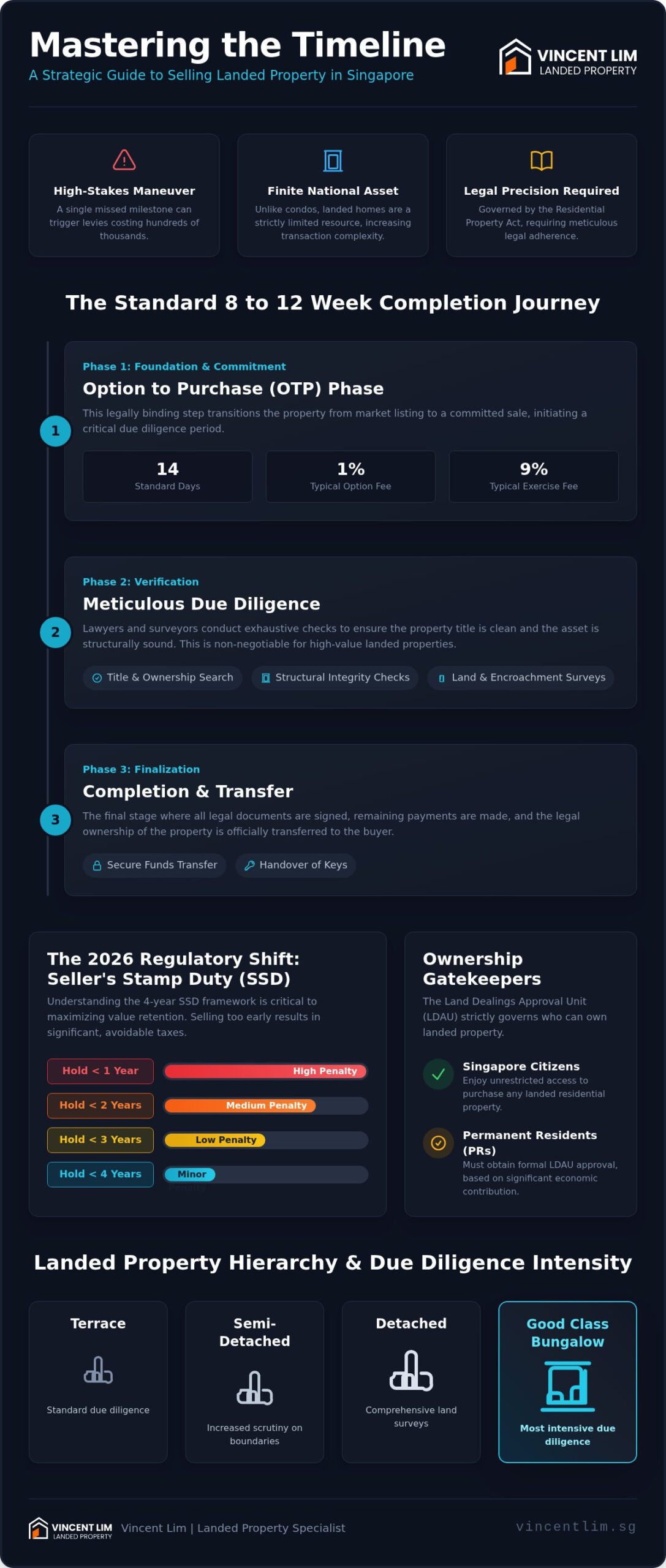
The Land Dealings Approval Unit (LDAU) acts as the primary gatekeeper for landed ownership. While Singapore citizens enjoy unrestricted access, Permanent Residents (PRs) must seek formal approval to acquire these assets. This process involves a rigorous assessment of the individual’s economic contribution to the country. It’s also vital to distinguish between properties generally subject to stringent foreign ownership restrictions and specific, designated areas where non-citizens may obtain approval more readily for landed acquisitions. Understanding these nuanced regulations is crucial for all prospective buyers.
Asset Classes and Transaction Nuances
The transaction journey varies significantly across different asset classes. Whether you’re dealing with Terrace houses, Semi-Detached homes, or sprawling Detached properties, each requires a bespoke marketing and legal strategy. Good Class Bungalows (GCBs) demand the most intensive due diligence due to their immense value and historical significance. A Good Class Bungalow represents the absolute pinnacle of the Singapore residential hierarchy. Managing these high-value assets requires a strategist who understands that the timeline for selling a landed property in singapore is often extended for GCBs to accommodate the meticulous verification of land titles and planning permissions. For expert guidance on such intricate transactions, consider consulting a seasoned professional like Vincent Lim (OrangeTee & Tie).
The Option to Purchase (OTP) Phase: Meticulous Due Diligence
The execution of the Option to Purchase (OTP) marks the transition from casual interest to a foundational legal commitment. In the Singapore market, this document isn’t just a placeholder; it’s a strategic tool that grants the buyer the exclusive right to purchase the property within a specific window. While the standard validity period is 14 calendar days, an elite strategist often negotiates this timeframe to accommodate the complex requirements of high-value assets. This period is a critical component of the timeline for selling a landed property in singapore, as it serves as the primary window for exhaustive investigation.
Strategic negotiation of the Option Fee, typically 1% of the agreed price, and the subsequent Exercise Fee is paramount. Coordination with conveyancing lawyers must begin the moment the OTP is signed. These legal professionals perform immediate title searches to verify ownership and ensure the property is free from undisclosed encumbrances. This process is strictly governed by the Conveyancing and Law of Property Act, which provides the essential legal framework for property transfers. Any oversight during this stage can lead to significant financial friction later in the transaction.
Technical and Structural Verification
Landed assets require a level of technical scrutiny that high-rise apartments simply don’t demand. We conduct structural due diligence to identify redevelopment potential or unauthorized alterations that could affect the property’s value. It’s vital to check for legal caveats, easements, or specific land-use restrictions that might limit your future plans. Verifying property boundaries is equally essential; identifying encroachment issues early prevents costly disputes with neighbors. For high-stakes transactions, having an expert landed property strategist by your side ensures that these technical nuances are managed with seasoned authority.
Securing the Financial Foundation
While technical checks are underway, the buyer must solidify their financial framework. This involves finalizing bank valuations and securing a formal Letter of Offer before the OTP window closes. Precision is required when managing the timeline for selling a landed property in singapore, especially regarding the Exercise Fee payment, which is usually a further 4% or 9% of the purchase price. Ensuring that all financial instruments are coordinated allows for a seamless exercise of the option, moving the transaction toward the final completion stage with total confidence.
- Confirm bank valuation matches the purchase price to avoid cash-over-valuation issues.
- Coordinate with CPF boards if funds are being utilized for the Exercise Fee.
- Ensure the lawyer has received the signed Exercise of Option and the deposit before the deadline.
Financial Frameworks and the 2026 Regulatory Environment
Financial precision is the hallmark of a successful landed transaction. In the current market, your tax obligations are heavily influenced by the specific date of acquisition. This factor significantly impacts the timeline for selling a landed property in singapore, as premature exits can trigger substantial levies that erode your capital gains. For a comprehensive look at how these financial variables fit into a broader wealth strategy, consult our Asset Progression to Landed Property: The Elite Strategist’s Guide to Singapore Real Estate in 2026.
High-value acquisitions also require a meticulous calculation of the Total Debt Servicing Ratio (TDSR). Because landed properties command higher price points, ensuring your debt obligations remain within regulatory limits is essential for a smooth bank approval. This technical rigor is a core part of any professional guide to selling landed property, as it directly affects the buyer pool’s ability to commit to a purchase. We manage these calculations early to ensure that only qualified interest reaches the negotiation table.
The 2026 SSD Regime: 3-Year vs. 4-Year Windows
The 2026 market operates under a two-tier Seller’s Stamp Duty (SSD) system. If you purchased your property between 11 March 2017 and 3 July 2025, you’re governed by a three-year holding period with rates of 12%, 8%, and 4%. However, assets acquired on or after 4 July 2025 are subject to an expanded four-year window. The specific date of your original purchase deed determines whether your asset falls under the legacy three-year Seller’s Stamp Duty regime or the expanded four-year holding period implemented in July 2025.
For properties purchased on or after 4 July 2025, the tiered rates are as follows:
- Year 1: 16% of the property value
- Year 2: 12% of the property value
- Year 3: 8% of the property value
- Year 4: 4% of the property value
ABSD and Legacy Planning Strategies
Additional Buyer’s Stamp Duty (ABSD) remains a primary consideration for legacy planning. With the rate for foreign buyers currently at 60%, the buyer profile for mainland landed assets is predominantly restricted to Singapore Citizens. Strategic use of trusts or multi-generational planning can help optimize tax exposure, ensuring that the timeline for selling a landed property in singapore aligns with your long-term wealth goals. Precision in these calculations preserves the maximum value of your estate during the transition, allowing for a seamless transfer of assets to the next generation.
Navigating the Completion Timeline: A Step-by-Step Roadmap
Once the Option to Purchase is exercised, the transaction enters a meticulously timed 8-to-12 week completion phase. This period represents the final sprint in the timeline for selling a landed property in singapore, requiring synchronized efforts between legal teams, financial institutions, and the parties involved. Protecting your interest begins immediately with your lawyer lodging a caveat with the Singapore Land Authority. This public notice serves as a formal declaration of your interest in the land, ensuring the title remains secure and preventing any secondary claims during the conveyancing process.
Managing this transition is particularly complex if you’re liquidating a current asset to fund the new acquisition. A veteran strategist coordinates these overlapping schedules to prevent financial gaps or the need for expensive bridge loans. We ensure the legal Completion Account is drafted with absolute precision, detailing the final payment disbursements, pro-rated property taxes, and any relevant MCST fees for strata-titled landed homes. This calculated approach ensures that every dollar is accounted for before the final handover.
The Role of the Conveyancing Lawyer
Your lawyer acts as the primary coordinator with the Singapore Land Authority (SLA) to facilitate the formal transfer of the title deed. They perform the final legal checks to ensure the property is delivered with vacant possession, meaning it’s free of any occupants or unauthorized tenancies. They also verify that all outstanding property taxes are settled up to the date of completion. To ensure your interests are protected at every milestone, it’s essential to engage an expert landed property strategist who can oversee these legal nuances alongside your conveyancing team.
Handover and Final Inspection
The strategic final walkthrough occurs just days before the official completion date. This is your opportunity to verify that the property’s condition aligns with the agreed-upon terms and that all fixtures included in the sale remain intact. We pay close attention to structural integrity and ensure the seller has removed all personal effects as stipulated in the contract.
Once the inspection is satisfied, the formal completion takes place. The remaining purchase price, typically 90% to 95%, is released to the seller’s solicitors in exchange for the keys and the title deed. This final exchange marks the successful conclusion of the timeline for selling a landed property in singapore, providing you with the peace of mind that the transaction was executed with elite-level precision.
- Verify that all air-conditioning units and major appliances are in working order.
- Confirm the removal of all debris and unwanted furniture from the land.
- Ensure all sets of keys, gate remotes, and architectural plans are ready for transfer.
Securing Excellence: The Role of a Landed Property Specialist
A multi-million dollar transaction involving a Good Class Bungalow or a luxury detached house is far too complex for a generalist approach. While a standard agent might focus on a simple listing, a veteran strategist views the sale as a sophisticated coordination of legal, financial, and technical variables. The timeline for selling a landed property in singapore is fraught with potential pitfalls, from misaligned bank valuations to overlooked easements. The elite strategist approach provided by Vincent Lim (OrangeTee & Tie) ensures that every professional in the chain, from conveyancing lawyers to specialized surveyors, operates with a singular focus on your success. This active management has been refined through decades of experience since 2004, providing a level of precision that high-value assets demand.
Professional representation does more than just facilitate a meeting; it actively preserves and enhances your equity. By leveraging a Strategic Guide to Selling Your Landed Property in Singapore: Maximising Value in 2026, you ensure that your asset is positioned correctly within the current two-tier SSD regime and shifting ABSD landscape. This level of oversight is what separates an average sale from a record-breaking legacy transaction. We coordinate with bankers to secure high-precision valuations and work closely with legal teams to ensure the title is pristine before the first viewing even occurs.
Refining the Sales Strategy
Reaching the right buyer pool for a Terrace or Semi-Detached house requires bespoke marketing that transcends common property portals. We utilize a curated approach to engage high-net-worth individuals who value privacy and exclusivity. Negotiation in the luxury sector is as much about psychology as it is about data. We manage these high-stress interactions with a grounded perspective, ensuring that tactical decisions are made based on market reality rather than emotional pressure. This steady hand is vital when navigating the multi-month timeline for selling a landed property in singapore, where maintaining momentum is key to securing a premium price.
A Commitment to Transparency and Integrity
Integrity is the foundation of the white-glove service standard at Vincent Lim (OrangeTee & Tie). Every regulatory requirement, including LDAU approvals and Residential Property Act compliance, is met with meticulous precision. Acting as your dedicated advocate, we prioritize your long-term wealth goals over a quick commission. This commitment provides the peace of mind that your legacy is in the hands of a professional who values transparency above all else. You receive a seamless experience from the initial strategic planning to the final handover of keys, knowing that your interests are protected at every milestone.
- Access a bespoke network of qualified high-net-worth buyers and investors.
- Benefit from a rigorous due diligence process that pre-empts legal and technical hurdles.
- Experience a dignified, results-oriented approach to luxury real estate negotiations.
Secure Your Legacy with Strategic Precision
Mastering the transaction of a high-value landed asset requires more than just administrative diligence; it demands a proactive, strategic approach. You’ve seen how critical the 14-day OTP window is for structural verification and how the 2026 SSD tiers dictate your exit strategy. Successfully navigating the timeline for selling a landed property in singapore ensures that you retain maximum capital value while avoiding the regulatory pitfalls that often catch generalist agents off guard. Precision at every stage is the only way to guarantee a seamless transition of ownership.
Every Good Class Bungalow or luxury detached house represents a significant chapter in your wealth journey. Vincent Lim (OrangeTee & Tie) has specialized in these high-net-worth portfolios since 2004, providing the meticulous coordination required to manage complex legal and financial milestones with absolute transparency. As an elite strategist, he ensures that your interests are protected through every phase of the transaction, from the initial valuation to the final release of keys. To ensure your next move is executed with the gold standard of professional excellence, consult with Vincent Lim (OrangeTee & Tie) for a bespoke landed property strategy today. Your legacy deserves the precision of a seasoned expert who understands the nuances of the Singapore market.
Frequently Asked Questions
How long does the entire landed property transaction process usually take in Singapore?
The entire process typically spans between 4 to 8 months from the initial listing to the final handover. This duration includes a marketing period of 1 to 6 months, followed by a 14-day Option to Purchase phase. Once the option is exercised, the legal completion journey takes another 8 to 12 weeks. Managing this timeline for selling a landed property in singapore requires careful coordination of these distinct milestones to ensure a seamless transition of ownership.
What is the typical Option Fee for a landed property in Singapore?
The standard Option Fee is 1% of the agreed purchase price, paid by the buyer to secure the exclusive right to purchase the asset. This fee is non-refundable if the buyer fails to exercise the Option to Purchase within the stipulated period. It serves as a foundational legal commitment, allowing the buyer time to perform necessary due diligence and finalize financial arrangements before committing to the full exercise deposit.
Can a Singapore Permanent Resident (PR) buy a landed house without LDAU approval?
Singapore Permanent Residents must obtain formal approval from the Land Dealings Approval Unit (LDAU) before acquiring landed property on the mainland. The only exception is Sentosa Cove, where non-citizens can purchase landed assets with fewer restrictions. This regulatory requirement ensures that mainland landed land remains primarily in the hands of citizens, reflecting the strategic value of Singapore’s limited residential space and finite national assets.
What happens if the buyer decides not to exercise the Option to Purchase?
If a buyer chooses not to exercise the Option to Purchase, the 1% Option Fee is forfeited to the seller. The legal relationship between both parties is then dissolved, and the seller is free to market the property to other potential buyers immediately. This forfeiture compensates the seller for the time the property was held off the market during the validity period, ensuring the transaction process remains disciplined and serious for all parties involved.
Are there different stamp duty rules for freehold vs. leasehold landed properties?
Stamp duty obligations, including Buyer’s Stamp Duty and Additional Buyer’s Stamp Duty, are based on the property’s market value or purchase price rather than its tenure. Whether the land is freehold or leasehold doesn’t change the tax rates or the 2026 Seller’s Stamp Duty windows. The financial framework remains consistent across all landed asset classes, focusing instead on the residency status of the buyer and the specific holding period of the seller.
What are the legal fees involved in a landed property transaction?
Legal fees for a landed transaction generally range between S$3,000 and S$6,000, depending on the complexity of the title and the law firm engaged. These costs cover the drafting of legal documents, conducting title searches, and coordinating with the Singapore Land Authority. Because landed properties require more intensive due diligence than high-rise apartments, engaging a lawyer with specific expertise in landed conveyancing is essential for protecting your interests and ensuring structural compliance.
How is the Seller’s Stamp Duty (SSD) calculated if I sell my landed home in 2026?
In 2026, SSD calculation depends entirely on your original purchase date. If you acquired the property on or after 4 July 2025, you’re subject to a four-year window with tiered rates of 16%, 12%, 8%, and 4%. Properties bought between 11 March 2017 and 3 July 2025 follow the legacy three-year regime. Understanding these tiers is a critical part of managing the timeline for selling a landed property in singapore to avoid significant tax liabilities during a sale.
Can I use my CPF funds to pay for the downpayment of a landed property?
You can use your CPF Ordinary Account funds to pay for the exercise deposit and the subsequent purchase price, provided the property is for residential use. However, the initial 1% Option Fee must typically be paid in cash. It’s also important to remember that any CPF funds used, including accrued interest at 2.5% per annum, must be returned to your account upon the eventual sale of the property to ensure your retirement foundations remain secure.