A single overlooked boundary discrepancy or an outdated understanding of the 2026 Seller’s Stamp Duty (SSD) rates can instantly erode hundreds of thousands of dollars from your landed property exit. Mastering the legal process of selling a landed home in singapore is not just about paperwork; it’s about safeguarding your wealth through meticulous preparation. Selling a high-value asset like a detached house or a terrace home is a sophisticated undertaking. It’s natural to feel a sense of trepidation when faced with the intricate requirements of the Residential Property Act or the fear of a deal collapsing due to unforeseen title defects.
This guide provides the strategic clarity you need to navigate the conveyancing framework with total confidence. We’ll ensure you secure maximum net proceeds while protecting yourself against potential buyer disputes regarding land boundaries. We’ll examine the specific 2026 tax updates, the critical role of legal representation in managing title due diligence, and the precise timeline required for a seamless, white-glove transaction that honors your investment. By the end of this article, you’ll have a clear roadmap to a smooth and legally sound exit.
Key Takeaways
- Understand how the 2026 dual-track Seller’s Stamp Duty system impacts your net proceeds based on whether your property was acquired before or after the July 2025 threshold.
- Learn the strategic nuances of drafting a binding Option to Purchase that protects your equity while strictly adhering to mandatory fee structures.
- Evaluate the eligibility of prospective buyers under the Residential Property Act to prevent deal collapses and manage the complexities of LDAU approval.
- Execute the legal process of selling a landed home in singapore with precision by resolving boundary encroachments and title defects through proactive SLA Title Searches.
- Master the final completion hurdles and legal requisitions required to transition your property smoothly within the standard 12-week handover window.
Navigating the 2026 Legal Framework: SSD and Pre-Sale Obligations
Selling a landed property in 2026 requires a firm grasp of a sophisticated regulatory environment. The legal process of selling a landed home in singapore has become increasingly nuanced, especially with the implementation of a dual-track tax system. Success begins with a clear understanding of your current obligations before the property even hits the market. Rushing to list without a comprehensive legal audit often leads to expensive delays or, worse, the collapse of a high-value transaction. By taking a proactive approach, you position yourself as a prepared seller, which is essential when dealing with high-net-worth buyers who prioritize speed and certainty.
The 2026 SSD Transition Rules
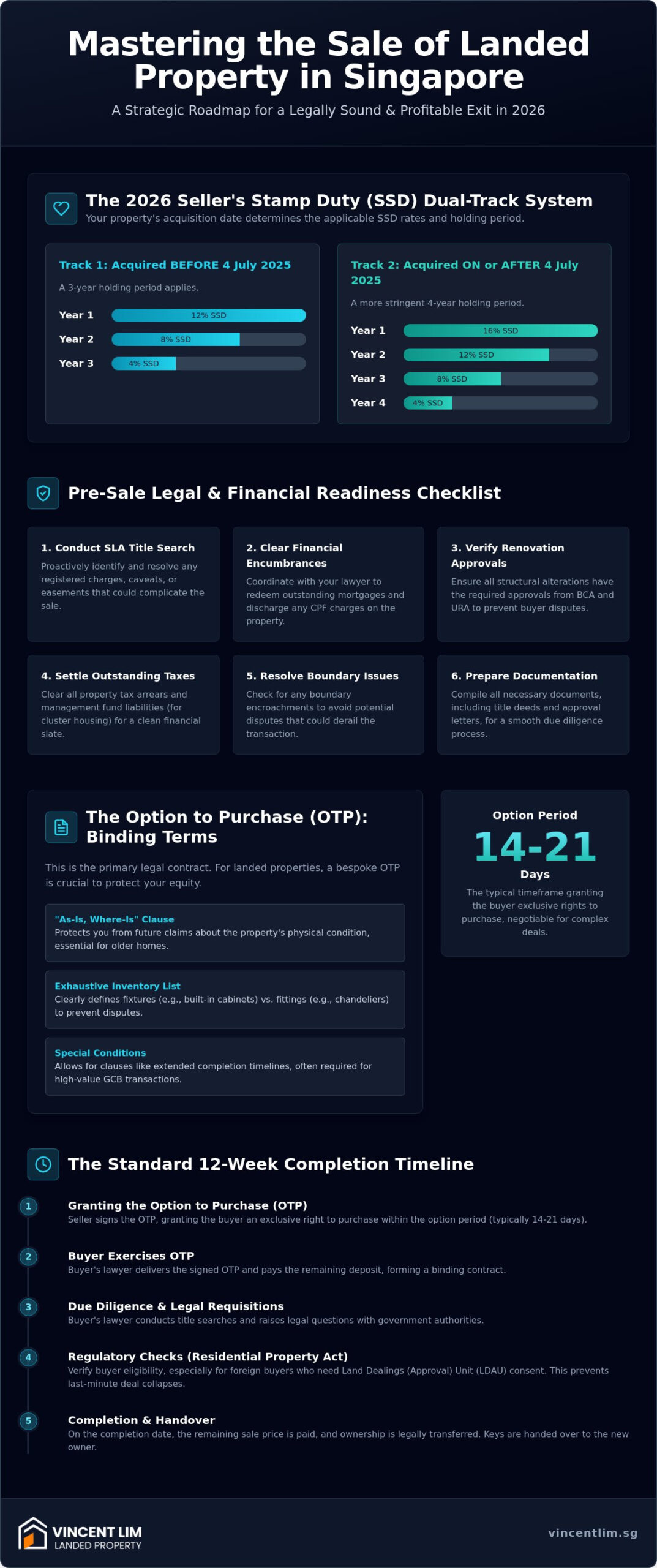
The 2026 tax landscape is defined by your original purchase date. If you acquired your home before 4 July 2025, you’re governed by a three-year holding period with rates of 12%, 8%, and 4% respectively. Properties purchased on or after that date face a more stringent four-year period, starting at 16% and tapering down to 4% by the fourth year. Your Seller’s Stamp Duty liability is determined strictly by the date you sign the sale contract. This distinction is critical for timing your exit to ensure you don’t inadvertently sacrifice a significant portion of your proceeds to the inland revenue.
Financial Clearance and Legal Readiness
Before inviting prospective buyers, you must resolve all financial encumbrances. A preliminary title search with the Singapore Land Authority (SLA) is an essential first step for any elite strategist. This search identifies registered charges, caveats, or easements that might complicate a transfer. Your conveyancing lawyer plays a pivotal role in this pre-marketing phase, coordinating the redemption of any outstanding mortgages and the discharge of CPF charges to ensure a clean title for the incoming party.
Landed homes often feature bespoke structural alterations that require careful documentation. It’s vital to verify that every renovation has the required approvals from the Building and Construction Authority (BCA) and the Urban Redevelopment Authority (URA). Prospective buyers of detached houses or GCBs will scrutinize these records during their due diligence. Having your certifications in order prevents the fear of title defects that can cause a buyer to walk away. You should also settle all outstanding property tax and any management fund liabilities for cluster housing. A clean financial slate is a cornerstone of the legal process of selling a landed home in singapore, projecting the professionalism and transparency that elite buyers expect.
The Option to Purchase (OTP): Binding Terms for Landed Assets
The Option to Purchase (OTP) serves as the primary legal instrument in the legal process of selling a landed home in singapore. It’s a binding contract that grants the buyer the exclusive right to purchase your property within a specific period, usually 14 days, though this is often negotiated to 21 days for complex landed transactions. Unlike high-rise apartments, landed properties require a bespoke OTP that addresses the physical and legal nuances of the land itself. A generic template rarely suffices when millions of dollars in equity are at stake. Precision at this stage prevents future disputes and ensures a high-value exit remains secure.
Essential Clauses for Landed Sellers
A strategic seller must include a robust “as-is, where-is” clause. This protects you from future claims regarding the property’s physical condition, which is vital for older terrace houses or detached homes where structural wear is expected. You should also define an exhaustive inventory list. In luxury residences, the distinction between fixtures, such as bespoke cabinetry, and fittings, like designer chandeliers, must be explicitly stated to avoid last-minute friction. For those selling a Good Class Bungalow (GCB), special conditions regarding extended completion timelines are often necessary to accommodate the buyer’s liquidations or the rigorous requirements of the Residential Property Act. Partnering with a seasoned real estate strategist ensures these clauses are drafted with your specific interests in mind.
The Execution Phase
The transition from a signed OTP to a confirmed sale follows a disciplined three-step sequence:
- Step 1: Granting the OTP. You issue the signed document in exchange for a 1% Option Fee. This fee is non-refundable if the buyer chooses not to proceed, acting as a commitment to the transaction.
- Step 2: Legal Requisitions. During the option period, the buyer’s solicitor conducts vital checks. They’ll scrutinize the title for encumbrances and verify that no government schemes affect the land.
- Step 3: Formal Exercise. To finalize the agreement, the buyer signs the “Acceptance” copy and pays the balance 4% exercise fee. This payment is usually held in a conveyancing account by your lawyer to ensure financial security.
If the buyer fails to exercise the option within the agreed window, the 1% fee is forfeited to you. While this provides some compensation for the time your property was off the market, the goal is always a successful exercise. Clear communication between solicitors during this window is essential to manage any extension requests, which should only be granted if they serve your broader strategic objectives. Once the option is exercised, the contract is legally binding, and the countdown to completion begins.
Regulatory Constraints: The Residential Property Act and LDAU
The legal process of selling a landed home in singapore is fundamentally shaped by the Residential Property Act (RPA). This legislation serves as a gatekeeper, ensuring that landed residential land remains primarily in the ownership of Singapore citizens. For a seller, this creates a restricted buyer pool that requires careful vetting. While luxury condominiums are accessible to global investors, mainland landed assets like terrace houses, semi-detached homes, and detached houses are generally off-limits to foreigners and Permanent Residents (PRs) without express government consent. If you don’t account for these restrictions, you risk entering a contract that is legally impossible to complete.
The only notable exception to these mainland restrictions exists in Sentosa Cove, where foreigners may obtain approval more readily for a single primary residence. On the mainland, however, the Land Dealings Approval Unit (LDAU) maintains a rigorous vetting process. PRs must typically demonstrate at least five years of residency and a significant economic contribution to the nation to be considered for approval. As a seller, failing to qualify your buyer before granting an Option to Purchase (OTP) can lead to months of wasted marketing time and legal friction if the regulatory authorities ultimately decline the application.
Qualifying the Buyer Pool
Before entering the process of buying or selling a private residential property, you must verify the citizenship status of every interested party. Corporate buyers face even steeper hurdles under the Qualifying Certificate (QC) regime, which prevents non-Singaporean companies from hoarding residential land. If you’re selling your landed property to a non-citizen, you’re essentially engaging in a transaction contingent on state approval. An elite strategist will often demand proof of eligibility or a preliminary assessment from the buyer’s counsel before committing to an exclusivity period.
Contingency Planning for Approvals
When a buyer requires LDAU consent, the OTP must be drafted with specific protective language. A “Subject to LDAU Approval” clause is non-negotiable. This clause dictates the precise outcome for the transaction and the deposit if the state rejects the buyer’s application. Typically, the approval window ranges from one to three months. You must factor this timeline into your subsequent moving plans or the purchase of your next residence. If the application is rejected, the legal process of selling a landed home in singapore usually requires the seller to refund the option fee, though some sellers negotiate a small administrative forfeit to cover legal costs. Managing these deposits in a conveyancing account ensures that you aren’t left with a legal dispute should the deal fail to clear regulatory hurdles.
Strategic Conveyancing: Resolving Title Defects and Encroachments
While a condominium sale is often a standardized exchange of titles, the legal process of selling a landed home in singapore involves a much more granular examination of the earth itself. The Singapore Land Authority (SLA) Title Search is the first line of defense for any elite strategist. This search reveals the precise footprint of your ownership. It identifies any easements, which are legal rights granted to third parties to use a portion of your land, or restrictive covenants that could limit future redevelopment. These burdens directly affect the land’s liquidity and value. If these are discovered late in the transaction, they can cause significant anxiety and jeopardize the deal’s completion.
One of the most frequent hurdles in landed transactions is the discovery of encroachments. This occurs when a physical structure, such as a perimeter wall, a roof eave, or even a driveway, crosses the legal boundary onto a neighbor’s lot. If left unaddressed, these issues can lead to a clouded title, giving the buyer a legal reason to rescind their offer or demand a significant price reduction. Resolving these defects before the completion date is essential to maintaining the integrity of your high-value exit and ensuring your proceeds remain intact.
Boundary and Encroachment Resolution
A registered surveyor plays a critical role in the legal selling process by providing a certified boundary plan. If a minor discrepancy is found, it can often be resolved through a formal encroachment agreement or a boundary adjustment. However, major discrepancies might require more complex legal remedies, such as purchasing the encroached sliver of land or physically relocating the structure. These factors are vital because property valuation for landed houses is heavily predicated on clear, unencumbered land area. A defect in the title doesn’t just complicate the law; it erodes your net proceeds and undermines buyer confidence.
Trusts and Inheritance Nuances
Selling a property held within a trust or an estate introduces additional layers of scrutiny. If the home is part of an inheritance, you must obtain a Grant of Probate or Letters of Administration before you can legally grant an Option to Purchase. All trustees or beneficiaries must be perfectly aligned in their intent to sell, as a single dissenting voice can freeze the entire transaction. In trust-held sales, your lawyer must verify that the trust deed explicitly empowers the trustees to sell the asset and that the proceeds are distributed according to the trust’s specific mandates. This ensures that the transfer of ownership is beyond legal reproach.
Navigating these complexities requires more than just a lawyer; it requires a partner who understands the high stakes of luxury assets. To ensure your title is pristine before you hit the market, consult with a specialist in landed property strategy who can preemptively identify and resolve these risks.
Completion and Handover: The Final Legal Hurdles
The final phase of the legal process of selling a landed home in singapore is a methodical transition that typically spans 8 to 12 weeks from the exercise of the Option to Purchase. This period is dedicated to the final legal requisitions. Your solicitor will verify that all outstanding property taxes, utility bills, and maintenance fees for cluster houses are settled. This ensures the buyer receives a clean slate. You must also decide between delivering “Vacant Possession” or selling with an existing tenancy. Delivering vacant possession means the property must be completely cleared of furniture and occupants by the completion date. This task requires early planning for large landed estates where moving logistics can be complex.
The role of the solicitor is paramount during the final exchange. They coordinate with the buyer’s counsel to ensure the cashier’s order is received and verified before the keys are surrendered. This high-level coordination prevents the financial risks associated with large-scale property transfers. It’s the culmination of weeks of disciplined planning, ensuring that the legal transfer of the land title matches the physical handover of the asset.
Preparing for Completion Day
The buyer is legally entitled to a final inspection, usually conducted a few days before completion. During this visit, they verify that the property remains in the agreed “as-is” condition and that all fixtures included in the inventory list are present. Your lawyer will prepare the Apportionment Account. This document meticulously balances prepaid items, such as property tax, ensuring you’re reimbursed for any costs covering the period after the handover. Whether you’re handing over a terrace home or a detached house for sale, meeting every handover condition is vital to avoid last-minute legal delays or escrow retentions.
Post-Completion Obligations
Once the keys are exchanged and the final funds are disbursed, several administrative tasks remain. Your legal representative will finalize the discharge of any existing mortgages and settle their professional fees. You must also ensure the sale is reported to the Inland Revenue Authority of Singapore (IRAS) to finalize your property tax obligations. This successful exit often serves as the foundation for your next move. Many clients utilize these proceeds to refine their portfolios through asset progression strategies, moving toward even more prestigious landed assets. The legal process of selling a landed home in singapore doesn’t just end with a signature; it concludes with the peace of mind that your wealth has been preserved and transitioned with absolute precision.
Securing Your High-Value Exit with Strategic Precision
Successfully navigating the 2026 property market requires more than just a listing; it demands a deep understanding of the evolving tax landscape and the rigorous requirements of the Residential Property Act. By synchronizing your exit timing with the dual-track Seller’s Stamp Duty rates and conducting proactive title due diligence, you eliminate the risks that often derail high-stakes transactions. Success in the legal process of selling a landed home in singapore is defined by the quality of your preparation and the precision of your conveyancing strategy. Ensuring your title is unencumbered and your buyer is fully qualified transforms a complex regulatory marathon into a seamless transfer of wealth.
As an Executive Associate Director at OrangeTee & Tie with over 20 years of landed property expertise, I specialize in the nuances of GCB and luxury residence transactions. My approach combines seasoned authority with a commitment to your specific financial goals. To ensure your property transition is managed with the white-glove service it deserves, consult Vincent Lim for a strategic, legally-sound landed exit. Your legacy and your proceeds are too valuable to leave to chance. Let’s execute your next move with the discipline and excellence required for a gold-standard result.
Frequently Asked Questions
How long does the legal process of selling a landed home take in Singapore?
The standard timeline for the legal process of selling a landed home in singapore is between 8 and 12 weeks. This period begins once the buyer exercises the Option to Purchase (OTP) and concludes on the completion date. This duration allows solicitors to conduct necessary legal requisitions, coordinate the discharge of existing mortgages, and ensure all financial apportionments are accurately calculated for a clean handover.
Can I sell my landed property if I haven’t hit the 4-year SSD window?
You can certainly sell your property before the four-year window, but you’ll be liable for Seller’s Stamp Duty (SSD). For properties purchased on or after 4 July 2025, the rate starts at 16% in the first year and reduces to 4% by the fourth. Timing your exit is a strategic decision that balances market gains against these tax obligations to ensure you maximize your net proceeds.
What happens if a buyer signs the OTP but fails to get LDAU approval?
If a buyer fails to secure LDAU approval, the transaction cannot legally proceed and the deal will collapse. A well-drafted OTP includes a “Subject to LDAU Approval” clause, which typically requires the seller to refund the option fee to the buyer. This highlights why verifying buyer eligibility early in the legal process of selling a landed home in singapore is essential for saving valuable marketing time.
Do I need a different lawyer for a Good Class Bungalow (GCB) sale?
While any qualified conveyancing lawyer can handle the sale, a GCB transaction demands a specialist with deep experience in high-value landed assets. These sales often involve complex title issues, trust structures, or specific boundary nuances that standard residential lawyers might overlook. Engaging a seasoned professional ensures that these elite assets are handled with the necessary precision, discretion, and strategic foresight.
What is a “Notice of Transfer” and who is responsible for it?
A Notice of Transfer is a formal document sent to the Inland Revenue Authority of Singapore (IRAS) to update the property’s ownership records for tax purposes. Your solicitor is responsible for filing this notice electronically upon the successful completion of the sale. This action ensures that property tax liabilities are correctly transitioned from your account to the new owner’s account without any administrative lag.
Are there legal restrictions on selling my landed home to a foreigner?
Yes, the Residential Property Act imposes strict restrictions on selling mainland landed homes to non-Singaporeans. Foreigners and Permanent Residents must obtain approval from the Land Dealings Approval Unit (LDAU) before they can legally purchase such property. Selling to an ineligible party without this approval will lead to an inevitable deal collapse during the legal requisitions phase, potentially causing significant delays to your exit plan.
Who pays the legal fees in a landed property transaction?
Each party is responsible for their own legal fees in a landed property transaction. As the seller, you’ll engage a solicitor to manage the mortgage redemption, CPF charge discharges, and the formal transfer of the title to the buyer. These professional fees, along with various disbursements for title searches and legal requisitions, are typically deducted from your sale proceeds at the point of final completion.
What is the difference between a “Freehold” and “99-year Leasehold” legal process?
The core legal framework is identical, but leasehold transactions require a closer examination of the remaining tenure and potential state consent. For leasehold properties, solicitors must verify that the remaining lease meets the buyer’s financing requirements and check for any specific covenants from the head lessor. Freehold properties offer a more straightforward title search but often involve more complex boundary and encroachment checks due to their age.