The traditional belief that purchasing a “fixer-upper” yields the best returns is being challenged by the sharp realities of the 2026 property market. Discerning investors now realize that the benefits of buying a renovated terrace house extend far beyond modern finishes; they represent a sophisticated form of financial arbitrage in a climate of rising costs.
You’ve likely observed the increasing complexity of URA and BCA approvals, coupled with construction material costs that have surged by up to 15% this year. This guide explains how a move-in-ready property provides a fixed capital outlay and eliminates the stress of managing an 18-month rebuild. We’ll detail how securing an upgraded asset today ensures immediate lifestyle continuity and positions your portfolio for superior appreciation in Singapore’s supply-constrained landed market.
Key Takeaways
- Bypass the typical 12 to 24-month construction cycle to achieve immediate lifestyle continuity within a turnkey luxury asset.
- Understand the benefits of buying a renovated terrace house as a strategic hedge against 2026 construction inflation and rising material costs.
- Leverage existing URA-approved Gross Floor Area (GFA) and “Envelope Control” height limits to secure maximum living space without regulatory delays.
- Identify high-quality craftsmanship versus cosmetic cover-ups by evaluating critical infrastructure such as M&E services and waterproofing.
- Gain a competitive advantage by accessing specialized insights to identify undervalued renovated properties and exclusive off-market opportunities.
The Value Proposition of Immediate Occupation and Lifestyle Continuity
Acquiring a renovated terrace house in the 2026 market is more than a real estate transaction; it’s a strategic move to secure a turnkey luxury asset. For most high-net-worth families, the primary benefits of buying a renovated terrace house center on the immediate elimination of the “construction gap.” In a landscape where the history of terraced houses in Singapore has evolved from simple row housing to complex, multi-storey architectural feats, the effort required to build from scratch has intensified significantly.
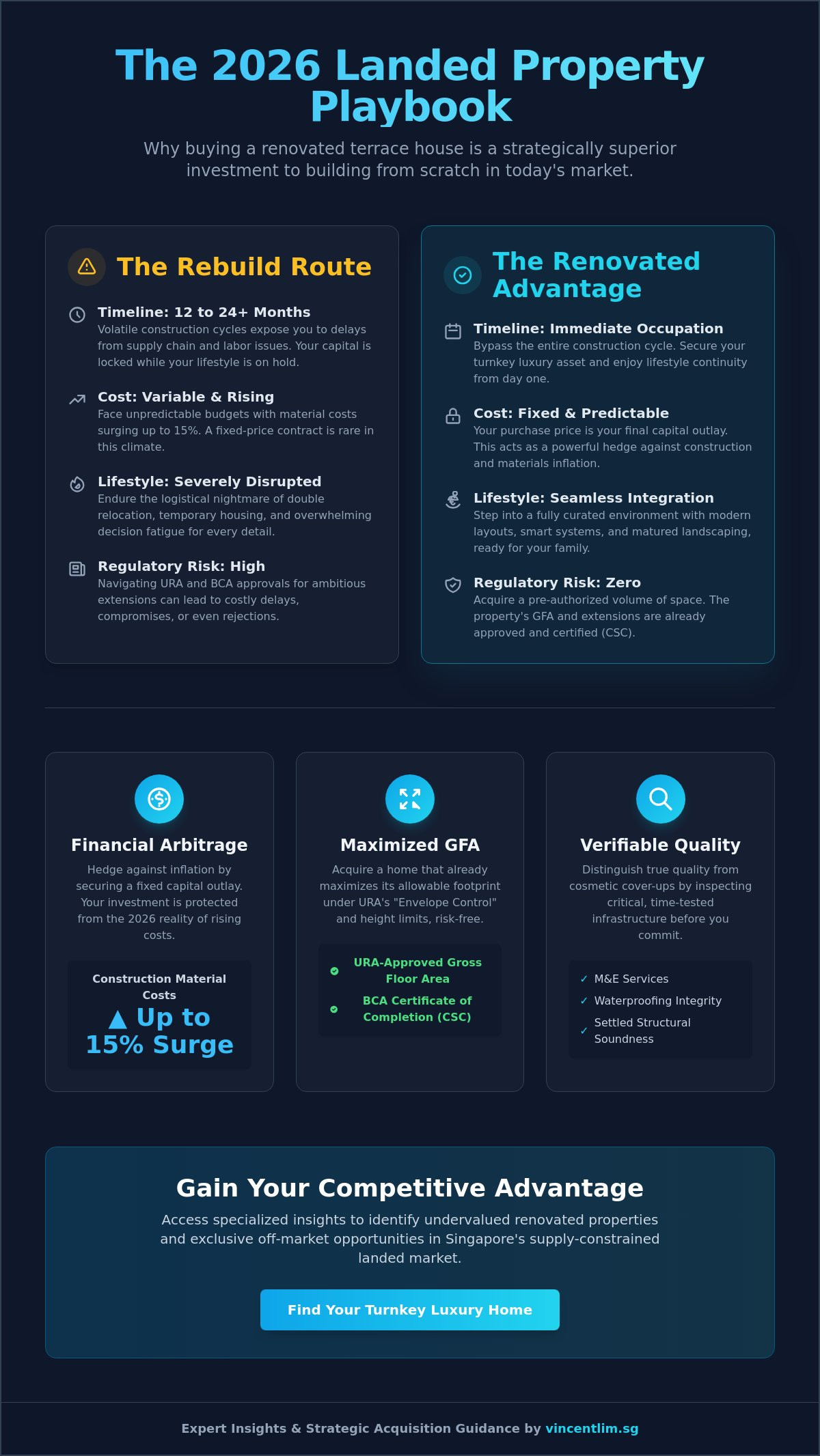
Choosing a pre-renovated property allows you to bypass the standard 12 to 24-month construction cycle. This isn’t just a matter of convenience. It’s a calculated decision to avoid the logistical nightmare of double relocation. Moving a family twice, first into temporary rental housing and then into the finished home, carries significant hidden costs and emotional strain. By selecting a house that’s already reached its final form, you secure lifestyle continuity from the day of completion.
Bypassing the Construction Space-Time Trap
2026 presents unique challenges for those considering a total rebuild. Construction timelines are increasingly volatile due to global supply chain shifts and localized labor constraints. A project estimated at 14 months can easily stretch to 20. This uncertainty creates a “space-time trap” where your capital is locked, but your lifestyle is on hold. Buying renovated eliminates this risk. You avoid the decision fatigue that comes with selecting every tile, fixture, and structural detail. Instead, you step into a curated environment where the quality is visible and verifiable before you commit your capital.
Lifestyle Integration for the Modern Family
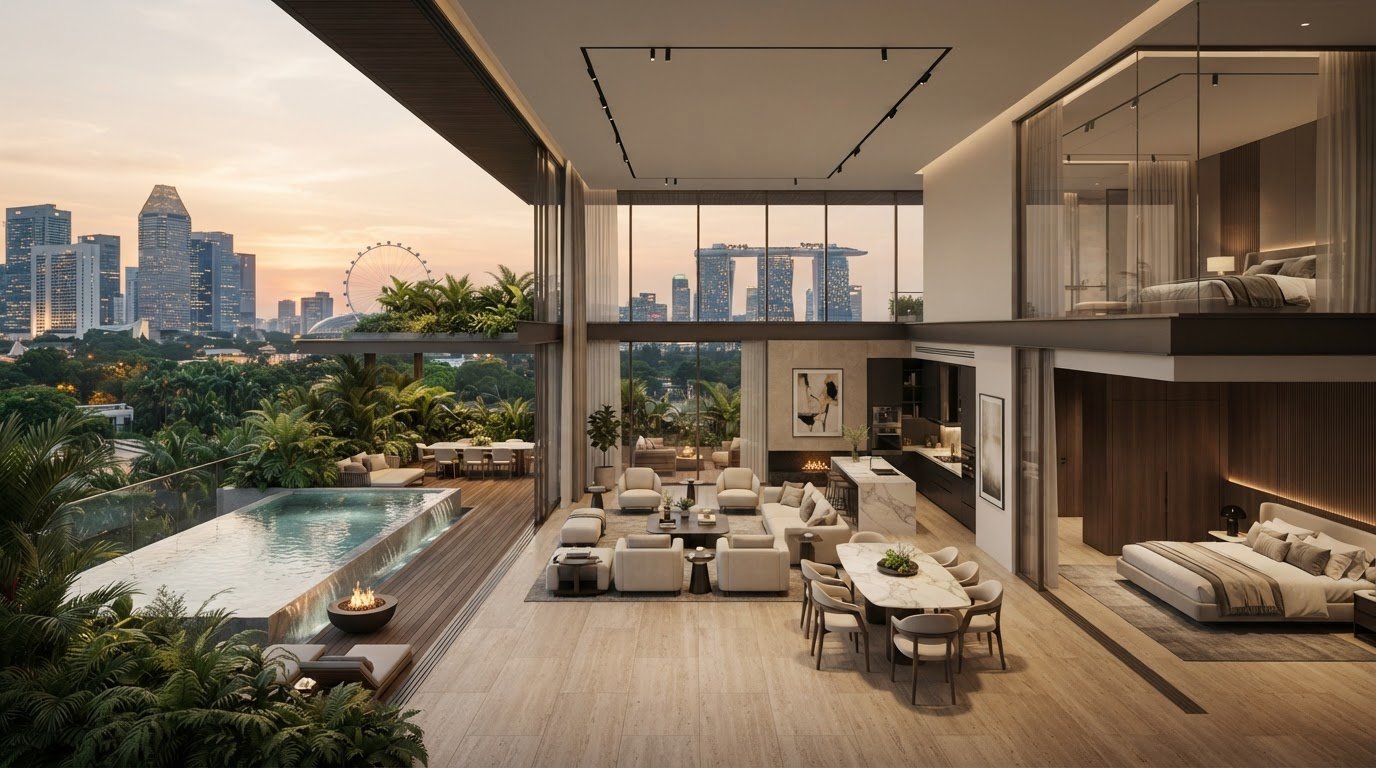
Modern 2026 living demands specific architectural features that older, unrenovated homes lack. Renovated terrace houses typically feature open-plan layouts, integrated smart home systems, and dedicated spaces for multi-generational living. These homes are designed for the wellness-centric requirements of today. You gain immediate access to matured garden spaces and established landscaping that would otherwise take years to flourish. There’s no waiting for the vision to materialize. The home is ready to perform its role as a sanctuary and a functional family hub from day one.
Maximized Gross Floor Area (GFA) and URA Compliance
Securing a landed property that already maximizes its allowable footprint is a masterstroke in risk management. In the 2026 market, where land is scarce and building regulations are precise, one of the primary benefits of buying a renovated terrace house is the immediate acquisition of fully compliant Gross Floor Area (GFA). You aren’t just purchasing a home; you’re acquiring a pre-authorized volume of space that has already navigated the complexities of URA’s Development Control Guidelines.
This predictability is invaluable. Many buyers underestimate the difficulty of obtaining approval for ambitious terrace house extension ideas. By choosing a property where these works are finished, you eliminate the possibility of a rejection. You also often benefit from grandfathered features. Some older renovations include structural elements or setbacks that are difficult to replicate under today’s stricter codes, providing a unique spatial advantage that cannot be built from scratch today.
Understanding the Envelope Control Advantage
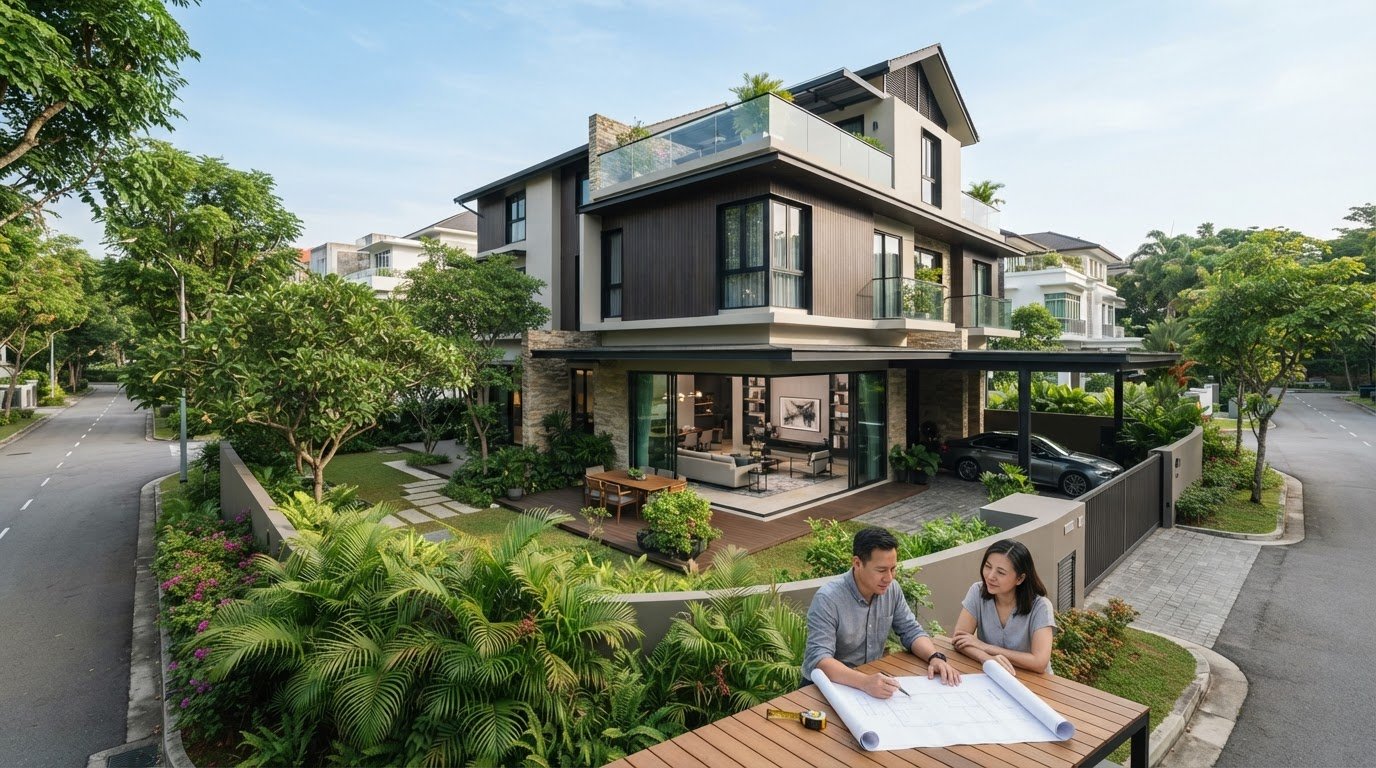
Modern landed properties are governed by “Envelope Control” guidelines. These define the maximum building volume based on height limits, typically 12 meters for two-storey homes. A renovated house often already utilizes this to the fullest, incorporating attic levels and high-ceiling void areas that create a sense of grandeur. You don’t have to wait for a builder to interpret these rules; the result is visible. If you’re looking for a property that meets these high standards, consulting a specialist in terrace house sales ensures you find a home that maximizes every square foot legally.
Technical Due Diligence of Existing Extensions
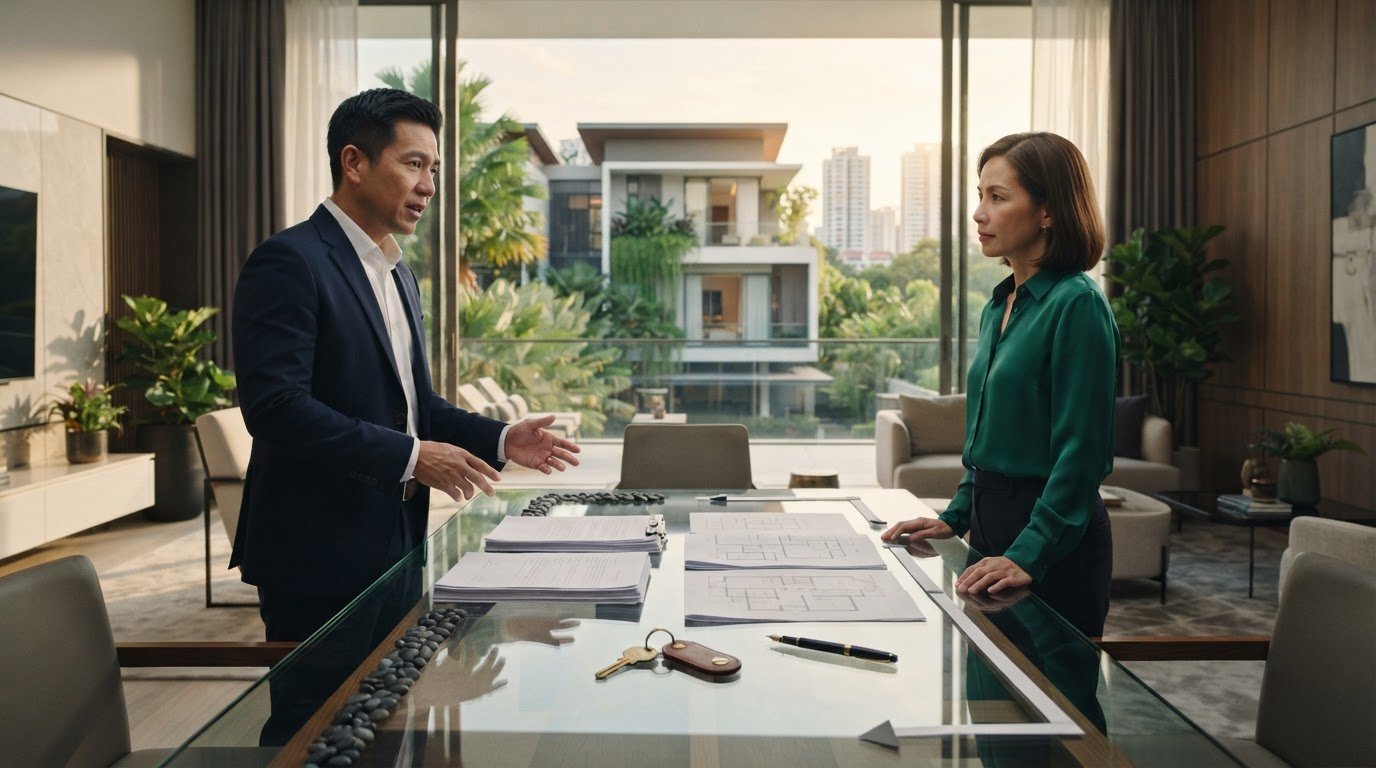
A critical part of the acquisition process involves verifying the legitimacy of all past works. Every extension should be backed by a Certificate of Statutory Completion (CSC) from the BCA. This document confirms that the renovations meet safety and structural standards. Buying a finished product also offers a physical advantage: the structure has already settled. Unlike new builds where hairline cracks might appear in the first year, a renovated home has already stood the test of time. This proves the integrity of its foundations and waterproofing before you commit your capital.
Financial Arbitrage: Hedging Against Construction Inflation
In the 2026 fiscal environment, the most compelling benefits of buying a renovated terrace house are found within the balance sheet. Construction costs are projected to rise by another 2% to 5% this year, with specific material prices already surging between 5% and 15%. By acquiring a property that’s already undergone a comprehensive overhaul, you effectively lock in historical construction rates. You avoid the direct exposure to upward price volatility that plagues those who choose the rebuild route.
Financially, the “turnkey” model offers a level of predictability that a fixer-upper cannot match. When you purchase a modernized asset, bank valuations are based on the tangible, finished product. This often results in a smoother financing process compared to an original-condition property where the bank may not fully account for your future renovation vision. It eliminates the “budget creep” common in 18-month projects, where unforeseen structural reinforcements can necessitate a 10% to 15% contingency fund. For a detailed breakdown of current market rates, reviewing a terrace house renovation budget reveals the significant capital and time required to execute a high-end transformation independently.
The “Move-In Ready” Premium vs. Construction Risk
Calculating the “effective cost” of a property is a discipline every elite strategist must master. An original condition house might appear cheaper on paper, but once you factor in mid-range construction costs of S$450 to S$600 per square foot and the cost of alternative housing during the build, the gap narrows. Buying a renovated home removes the risk of contractor insolvency or regulatory delays. You pay a premium for certainty, which in the current market is often the more conservative and profitable path. Buyers who are also evaluating end-unit options should consider that a corner terrace for sale in Singapore typically commands a 10% to 20% premium over intermediate units, making the valuation framework for renovated assets even more critical to master.
Long-Term Capital Appreciation of Refined Assets
Landed property in Singapore remains a structurally inelastic asset class. As median prices for inter-terraces trend toward the S$6 million mark by 2029, liquidity becomes a primary concern. Refined, modern assets consistently command higher demand and faster transaction times. Your exit strategy is strengthened because future buyers will place a high value on convenience and immediate utility. This scarcity of “ready-to-enjoy” homes ensures your investment retains a competitive edge in the secondary market.
Selection Criteria: Distinguishing Quality from Cosmetic Cover-ups
To fully realize the benefits of buying a renovated terrace house, you must look beyond the immediate visual appeal. A fresh coat of paint or trendy cabinetry can easily mask underlying structural deficiencies. An elite strategist prioritizes the “bones” of the property, focusing on Mechanical and Electrical (M&E) services and waterproofing. These are the high-cost items that, if neglected, can turn a turnkey dream into a financial burden. You’re not just buying a look; you’re acquiring a functional, modernized machine designed for long-term performance.
The floor plan remains the most critical element of your selection criteria. While finishes can be updated, a fundamental flaw in the spatial flow is difficult and expensive to rectify. Prioritize homes that offer a logical progression between communal and private zones. A well-designed 2026 renovation should emphasize multi-functional spaces that support both professional productivity and family life. For inspiration on how elite design can effectively double your perceived square footage, exploring strategic terrace house layout ideas reveals how the right spatial planning can add between 10% and 20% to a property’s resale value. If the layout doesn’t serve your lifestyle today, the highest grade of marble won’t compensate for the daily friction of a poorly planned home.
The Structural Integrity Checklist
Due diligence begins with the party walls and the roof. In the context of a terrace house singapore, shared walls are common points for moisture ingress. Inspect these areas for any signs of historical seepage or efflorescence. You should also verify the capacity of the electrical switchboard. With the 2026 shift toward electric vehicles and high-consumption smart appliances, an undersized electrical system is a significant hidden cost. Ensure the window systems are modern, double-glazed units that provide both thermal insulation and acoustic privacy from the street. For buyers specifically evaluating end-unit plots, understanding the unique setback and privacy advantages of a corner terrace for sale in Singapore is essential before committing to any structural assessment.
Modern Design Esthetics for 2026
The hallmark of a superior 2026 renovation is “Green Mark” compliance and sustainability. Look for homes that utilize passive cooling techniques, such as cross-ventilation and solar shading, to reduce reliance on air conditioning. The transition between indoor living areas and outdoor patio extensions should be seamless, reflecting a sophisticated understanding of tropical architecture. Finally, check the smart home infrastructure. A truly future-proofed home features hardwired Cat 6A or Cat 7 cabling throughout, ensuring it can handle the next generation of AI-integrated home management systems without lag.
If you’re seeking a property that has been vetted for both aesthetic excellence and technical precision, view my curated selection of terrace house sales to find your next strategic acquisition.
Strategic Acquisition: The Vincent Lim Advantage
Navigating the high-stakes landed property market requires more than just access to listings. It demands a partnership with a professional who understands the nuanced benefits of buying a renovated terrace house from a strategic, data-driven perspective. Identifying undervalued properties in this segment isn’t about finding the lowest price. It’s about uncovering assets where the quality of the renovation and the legality of the Gross Floor Area (GFA) provide a superior long-term ROI. By leveraging deep market analysis, I help clients distinguish between properties priced on emotion and those backed by tangible, verifiable value.
Many of the most desirable renovated assets never reach public portals. I provide my clients with access to exclusive off-market opportunities, ensuring they have the first-mover advantage in a competitive 2026 landscape. Whether you’re focused on terrace homes or exploring the detached house for sale Singapore market, having a specialist who can model the financial implications of each acquisition is essential for wealth preservation. We look at bespoke financial modelling to ensure your entry price aligns with projected appreciation and your overall portfolio goals.
The Elite Strategist Approach to Landed Property
We move beyond surface-level observations to analyze historical price trends and real-time transaction data. Negotiating the “convenience premium” is a delicate balance. You should pay for the time saved by avoiding a 24-month rebuild, but you shouldn’t overpay for the seller’s personal aesthetic choices. I coordinate the entire transition, managing the bridge between your current asset and your new landed home. This ensures a seamless financial and logistical move, allowing you to step into your new lifestyle without the friction of a double relocation or misaligned timelines.
Securing Your Legacy in 2026
Landed property in Singapore, particularly freehold assets, serves as a cornerstone for generational wealth. These properties are structurally scarce. A well-maintained, renovated home ensures that your legacy is preserved in an asset that remains relevant and desirable for decades. My approach integrates wealth planning with strategic property selection. This ensures your acquisition serves both your immediate lifestyle needs and your long-term estate goals. Contact Vincent Lim for a confidential consultation to begin your refined property journey and secure your place in Singapore’s most exclusive asset class.
Securing Your Position in Singapore’s Landed Market
Acquiring a move-in-ready property in 2026 is a sophisticated strategy to bypass the volatility of construction inflation and the friction of regulatory delays. By focusing on assets that already maximize their legal spatial volume, you secure both immediate lifestyle continuity and long-term capital protection. Understanding the benefits of buying a renovated terrace house empowers you to act with confidence, knowing your capital is parked in a refined, compliant, and highly liquid asset class.
As an Executive Associate Director at OrangeTee & Tie with over 20 years of expertise in luxury landed property, I specialize in strategic asset progression and GCB sales. I provide the technical due diligence and market data required to distinguish genuine quality from cosmetic updates. Partnering with a seasoned professional ensures your acquisition is both a sound financial decision and a lasting family legacy. Consult with Vincent Lim to find your next high-potential renovated terrace house and begin your journey toward a refined landed lifestyle today.
The path to a successful landed acquisition is defined by precision and foresight. I look forward to helping you secure an asset that reflects your standards and supports your future goals.
Frequently Asked Questions
Is it better to buy a renovated terrace house or renovate an old one myself in 2026?
Buying a renovated property is often the more strategic choice due to extreme timeline volatility and rising material costs. In 2026, building from scratch exposes you to a 12 to 24-month delay and material price surges of up to 15%. Purchasing a turnkey asset allows you to lock in historical construction costs and enjoy immediate lifestyle continuity without the stress of managing a complex site.
How much premium should I expect to pay for a move-in ready terrace house?
The premium typically reflects the current replacement cost of the renovation plus a convenience factor. With mid-range construction costs in 2026 hovering between S$450 and S$600 per square foot, a fully modernized home will carry a price tag that accounts for these expenses. You should also factor in the “effective saving” of not paying for alternative rental housing during a lengthy rebuild.
Do renovated terrace houses hold their value better than original condition ones?
Modernized assets generally command higher liquidity and maintain stronger price benchmarks in the secondary market. One of the primary benefits of buying a renovated terrace house is its broad appeal to buyers who prioritize immediate utility. This scarcity of “ready-to-enjoy” landed homes ensures that well-maintained, contemporary properties often lead the way in capital appreciation trends.
What are the most important things to check when buying a pre-renovated house?
Prioritize the technical “bones” of the property over aesthetic finishes. You must verify the Certificate of Statutory Completion (CSC) for all extensions and inspect the integrity of the waterproofing and M&E services. Check the capacity of the electrical switchboard and the quality of the window systems; these infrastructure items are expensive to replace if the previous owner used builder-grade materials.
Will a recent renovation affect my property tax or annual value?
Yes, a comprehensive renovation that increases the floor area or significantly improves the property’s quality can trigger a revision of its Annual Value (AV) by IRAS. Since property tax is a percentage of the AV, your tax liability may increase. However, owner-occupiers in 2026 still benefit from progressive tax rates and a 10% rebate, capped at S$500, to help manage these costs.
Can I still extend a terrace house that has already been renovated?
Further extension is possible only if the property hasn’t already maximized its allowable Gross Floor Area (GFA) under URA’s Envelope Control guidelines. You’ll need to verify the existing built-up area against the maximum permissible volume for your specific plot. Any new works must comply with 2026 setback requirements and height limits, which typically cap at 12 meters for two-storey zones.
How do I verify if the previous owner’s extensions were URA-approved?
You should request the approved building plans and the BCA Certificate of Statutory Completion (CSC) from the vendor during the due diligence phase. These documents confirm that all structural alterations were legally sanctioned. You can also conduct an official search through the URA or BCA portals to ensure the property’s current footprint matches the last authorized development application.
What is the average lifespan of a modern terrace house renovation?
A high-quality renovation typically remains functional and aesthetically relevant for 15 to 20 years. While cosmetic trends may shift, the underlying M&E systems and structural extensions are designed for much longer durations. Investing in a home with timeless architectural features and durable materials like natural stone or high-performance composites ensures the property’s value remains intact well into the next decade.