In the high-stakes arena of Singapore’s luxury real estate, the distance between a generational legacy and a costly liability is measured entirely by the depth of your preliminary research. For the discerning investor, a comprehensive due diligence checklist for buying property in singapore is no longer a simple administrative step; it’s a critical strategic audit that differentiates a basic acquisition from a sophisticated wealth-protection move. You likely recognize that securing a Good Class Bungalow or a prime terrace house requires far more than just significant capital. It’s natural to feel concerned about hidden structural defects in older landed homes or how the latest URA zoning shifts might impact your future redevelopment potential.
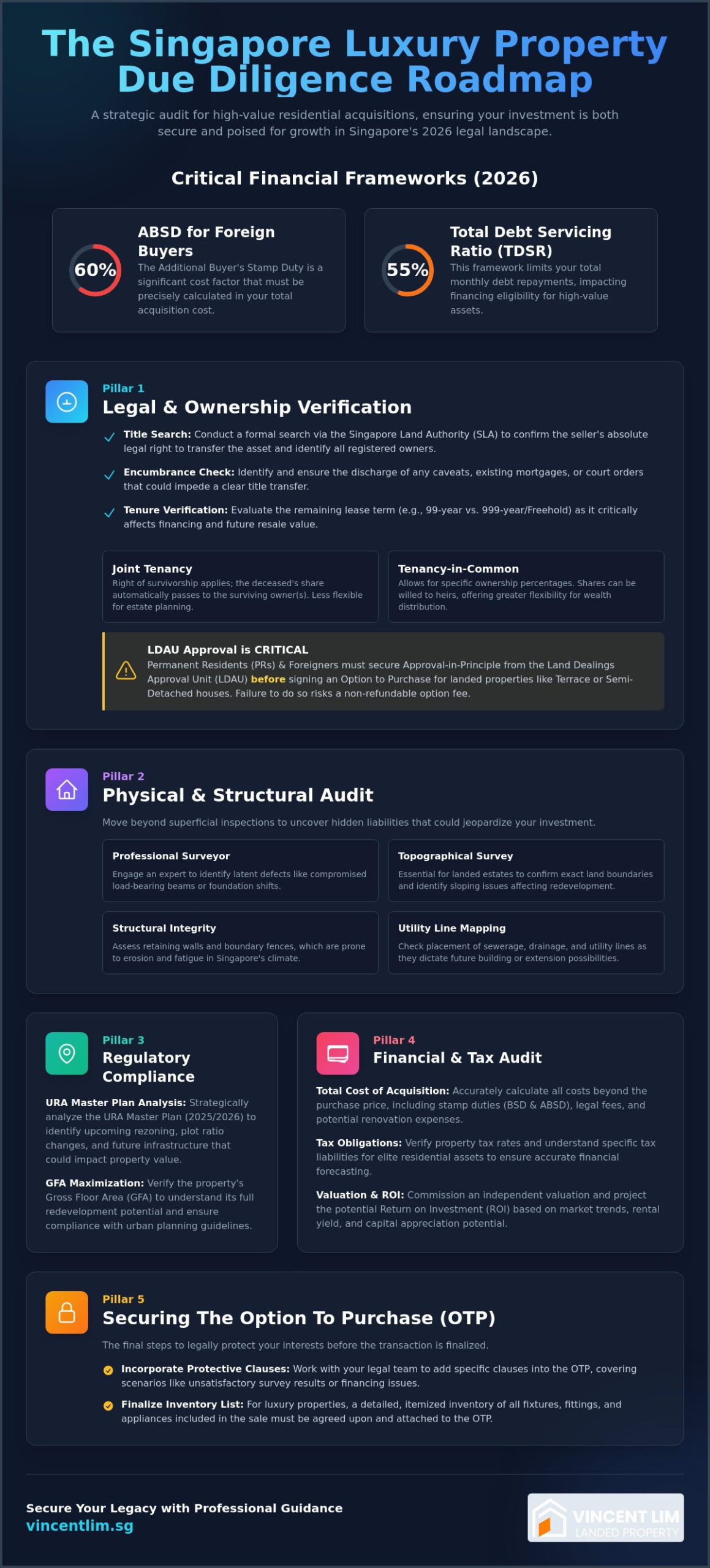
This guide provides a foolproof roadmap to ensure your next acquisition is both safe and strategically sound. We’ll guide you through the meticulous verification process required to navigate the 2026 legal landscape, including the 60% ABSD for foreign buyers and the 55% TDSR framework. By the end of this article, you’ll possess the professional framework needed to audit physical structures, verify LDAU eligibility, and ensure full compliance with current tax regulations. We’ll start by examining the essential financial and legal benchmarks that define a successful high-value transaction.
Key Takeaways
- Establish a foundation of security by verifying legal ownership and eligibility, ensuring every party has the absolute right to execute a high-value transaction.
- Move beyond superficial visual inspections by utilizing a comprehensive due diligence checklist for buying property in singapore that incorporates professional structural audits and topographical surveys for landed estates.
- Strategically analyze the URA Master Plan 2025/2026 to identify upcoming rezoning opportunities and maximize the redevelopment potential of your property’s Gross Floor Area.
- Protect your wealth by accurately calculating the total cost of acquisition, factoring in the latest 2026 ABSD rates and specific tax obligations for elite residential assets.
- Secure your interests during the final exchange by incorporating protective legal clauses into the Option to Purchase and finalizing a detailed inventory list for luxury fixtures.
Legal Due Diligence: Eligibility and Ownership Structures
Successful property acquisition begins with an uncompromising verification of legal standing. Due diligence in the Singapore context is a multi-layered audit that ensures you are purchasing a clear, marketable title. It’s the first pillar of any robust due diligence checklist for buying property in singapore. You must confirm that the seller possesses the absolute legal right to transfer the asset. This involves more than a cursory glance at a name; it requires a formal title search through the Singapore Land Authority to identify every registered owner and any legal impediments.
Identifying encumbrances is equally vital. Caveats, existing mortgages, or court orders can complicate a transfer. Your legal team must ensure that any existing debt is discharged before the transaction concludes. Additionally, the Manner of Holding requires strategic thought. Choosing between Joint Tenancy and Tenancy-in-Common impacts your inheritance strategy and potential tax liabilities. For legacy properties like Good Class Bungalows, these decisions carry weight for generations. Tenancy-in-Common allows for specific percentage ownership, which often facilitates more flexible estate planning and wealth distribution.
LDAU Approval for PRs and Foreigners
Permanent Residents and foreigners face specific restrictions when eyeing landed assets. The Land Dealings Approval Unit (LDAU) manages these applications with strict criteria. They generally look for individuals who have been PRs for at least five years and have made significant economic contributions to Singapore. It’s a common mistake to overlook this hurdle. Never sign an Option to Purchase for a Terrace House or Semi-Detached home without first securing an Approval-in-Principle. This proactive step protects your capital and ensures you don’t find yourself in a legal deadlock with a non-refundable option fee if the application is denied.
Title Search and Tenure Verification
Understanding the nuances of land tenure is central to evaluating a property’s future ROI. Whether you are considering a 99-year leasehold or a 999-year title, the remaining lease term affects both financing and resale value. You must also check for easements or rights of way. These legal provisions can grant neighbors or utility providers access to parts of your land, which might hinder your plans for redevelopment or expansion. For those purchasing large plots for GCB Sales, verifying the Master Title is essential to confirm the land hasn’t been subdivided in a way that limits its intended use.
Physical and Structural Audit: Beyond the Surface
Luxury properties demand a level of scrutiny that goes far beyond a standard weekend viewing. While a home might appear pristine during a walkthrough, the structural reality often tells a far more complex story. Engaging a professional building surveyor is a non-negotiable component of your due diligence checklist for buying property in singapore. These experts identify issues that escape the untrained eye, such as compromised load-bearing beams or subtle foundation shifts that could lead to catastrophic costs. For those investing in large plots or Good Class Bungalows, a topographical survey is equally essential. It confirms the exact boundaries of your land and identifies sloping issues that could complicate future redevelopment or landscaping plans.
You must also assess the integrity of retaining walls and boundary fences. In Singapore’s tropical climate, these structures are prone to erosion and structural fatigue over time. Neglecting this check can lead to massive rectification expenses shortly after moving in. Similarly, checking the placement of sewerage, drainage, and utility lines is a strategic move. These “invisible” elements often dictate where you can build or extend on the plot. Consulting the URA Master Plan ensures that your physical site layout aligns with broader urban planning guidelines and future drainage reserve requirements.
Identifying Latent and Patent Defects
Distinguishing between obvious patent defects and hidden latent ones is vital for your negotiation strategy. While a cracked tile is easily spotted, moisture ingress or termite infestations in older terrace houses can remain hidden behind fresh paint. A thorough audit uncovers these deep-seated failures before you commit capital. If you discover significant issues, use the estimated repair costs to refine your offer. If you’re unsure how to interpret a surveyor’s report, consulting a specialist in luxury residential sales can provide the market perspective needed to decide if the investment remains viable.
Soil Testing and Foundation Integrity
Foundation integrity is the bedrock of property value. Soil testing becomes mandatory if you plan to rebuild a detached house or add substantial weight to an existing structure. This is particularly relevant in coastal areas or hilly districts where land subsidence is a documented risk. You should also evaluate the impact of neighbouring construction projects. Large-scale excavations nearby can cause vibrations that compromise your property’s foundation. Ensuring the soil is stable and the foundation is sound provides the peace of mind necessary for a high-value acquisition.
Regulatory Compliance: URA Master Plan and GFA
Securing a high-value asset requires looking beyond the current structure to the future blueprint of the neighborhood. A sophisticated due diligence checklist for buying property in singapore must include a rigorous analysis of the URA Master Plan 2025/2026. This document serves as the definitive roadmap for Singapore’s urban evolution, identifying upcoming transport hubs and potential rezoning that can significantly shift property valuations. You don’t just buy a house; you buy a position within a larger urban strategy. For those tracking how these changes influence upcoming residential sites, New Launch provides a detailed overview of emerging projects across the island. Verifying the property’s approved zoning against its current usage prevents unexpected legal friction during future redevelopment or sale.
Understanding Gross Floor Area (GFA) and “Envelope Control” guidelines is essential for anyone considering a rebuild or major extension. These regulations define the permissible volume of your home, effectively setting the ceiling on your property’s redevelopment value. While older landed homes might have been built under more relaxed rules, modern reconstructions must adhere to strict volumetric limits. This ensures neighborhood character remains consistent while maximizing the efficiency of land use. Ignoring these constraints can lead to costly design revisions or the rejection of planning permissions from the authorities.
Setback Requirements and Road Line Plans
The Road Line Plan (RLP) is a critical document that many buyers overlook. It reveals if the government intends to widen roads adjacent to your property, which could force a surrender of land. This effectively shrinks your buildable area and impacts the overall value of the plot. You must also calculate mandatory setbacks from the boundary lines. These requirements, alongside potential buffer zones for properties near parks or industrial sites, dictate the actual footprint available for construction. It’s a calculation that determines the true utility of the land you’re purchasing.
Height Restrictions and Conservation Status
Height restrictions vary significantly across Singapore’s residential districts. You must verify if your plot is designated for a 2-storey or 3-storey development. This limitation directly affects the total GFA you can achieve. For those interested in heritage assets, checking the conservation status is vital. Conservation houses come with strict guidelines on what can be altered, often requiring the preservation of the original facade. If you’re targeting a Good Class Bungalow, you’ll face even more stringent rules regarding site coverage and minimum plot sizes. These GCB-specific regulations ensure the exclusivity and prestige of the asset class are maintained over time.
Financial Due Diligence: Tax, Valuation, and ROI
In the luxury market, your entry price is merely the starting point of a complex fiscal equation. True wealth preservation requires a comprehensive due diligence checklist for buying property in singapore that accounts for every peripheral cost. Calculating the total cost of acquisition involves more than just the negotiated price. You must factor in Buyer’s Stamp Duty (BSD), which reaches 6% for any amount exceeding S$3,000,000 as of 2026. Legal fees and professional survey costs also add up, though they’re minor compared to the potential impact of a valuation under-shoot. A desktop valuation offers a quick estimate, but a full formal valuation is the only way to confirm the bank’s lending limit for high-end assets like Good Class Bungalows.
Strategic exit planning is just as critical as the purchase itself. If you anticipate a short-term relocation or portfolio shift, you must understand the Seller’s Stamp Duty (SSD) framework. Properties purchased on or after July 4, 2025, are subject to a four-year holding period. Selling within the first year triggers a 16% tax, which gradually tapers down to 4% in the fourth year. This makes the timing of your exit a vital component of your overall ROI strategy. Aligning your financial roadmap with these regulatory timelines ensures you don’t erode your capital gains through avoidable tax liabilities.
ABSD and Tax Structure Optimization
The 2026 tax landscape demands sophisticated planning. For Singapore Citizens, the Additional Buyer’s Stamp Duty (ABSD) for a second residential property stands at 20%, rising to 30% for a third. Permanent Residents face a 5% ABSD on their first purchase and 30% on subsequent ones. You might consider legal optimization strategies, such as purchasing through a trust or under a child’s name, to manage these costs effectively. It’s also important to verify the latest ABSD for landed property before committing. With owner-occupied property tax rates reaching up to 32% in 2026, every percentage point saved contributes significantly to your long-term net worth.
Financing and Loan-to-Value (LTV) Limits
Securing capital for elite real estate requires navigating strict lending frameworks. The Loan-to-Value (LTV) limit for your first housing loan is typically 75%, but this drops significantly for subsequent loans. You must also satisfy the Total Debt Servicing Ratio (TDSR), which caps your monthly debt repayments at 55% of your gross income. A valuation under-shoot can be particularly painful; if the bank values the home lower than your purchase price, you’ll need to cover the difference in cash. Obtaining an In-Principle Approval (IPA) before you start your search is a hallmark of a prepared buyer. If you’re ready to optimize your financing strategy for a luxury acquisition, consult with a strategic property advisor today.
The Final Checklist: Securing the Option to Purchase
The Option to Purchase (OTP) is the legal manifestation of your strategic intent. It serves as the final stage of your due diligence checklist for buying property in singapore, where every finding from your previous legal, physical, and financial audits is codified into a binding agreement. In the luxury sector, a standard OTP is often insufficient to protect a high-value investment. You must ensure the document contains specific protective clauses that address the unique risks of the asset, such as the rectification of latent defects discovered during the surveyor’s audit or the explicit requirement for vacant possession upon completion.
An often overlooked but critical component is the Inventory List. For high-end luxury condos and landed sales, bespoke fittings, designer chandeliers, and integrated smart home systems represent significant value. Without a detailed, signed inventory attached to the OTP, these assets can become points of contention during the final handover. Negotiating a longer Option Period is also a tactical advantage. While 14 days is the market standard, requesting 21 days or more allows your technical team to complete deep-dive inspections and soil tests without the pressure of a looming deadline. Coordinating these complex moving parts requires the expertise of a landed property specialist who understands how to align legal timelines with technical realities.
The 1% and 4% Timeline
Precision in timing is non-negotiable in Singapore’s real estate framework. The process typically begins with a 1% Option Fee to secure the property and prevent other offers. You then have a strict window, usually 14 to 21 days, to exercise the option by paying the remaining 4% Exercise Fee. Missing these deadlines results in the forfeiture of your initial fee. Once you exercise the option, you’ve entered a legally binding contract. Backing out after this point can lead to significant legal consequences, including claims for damages or specific performance from the seller.
Post-OTP Access and Final Walkthrough
Your access rights shouldn’t end once the option is signed. It’s wise to negotiate for post-OTP access to allow architects or contractors to begin planning renovations before the official completion date. This proactive approach minimizes downtime and allows for a smoother transition. Finally, a joint inspection before the legal completion is essential. This walkthrough ensures the property’s condition hasn’t deteriorated since your initial audit and that all items on the inventory list remain in place. It’s the final verification that your capital is securing exactly what was promised during the negotiation phase.
Securing Your Legacy in Singapore’s Elite Market
Navigating the complexities of high-value real estate requires a shift from viewing property as a simple residence to auditing it as a strategic asset. You’ve now mastered the essential pillars of a robust due diligence checklist for buying property in singapore, from verifying legal titles and LDAU eligibility to analyzing the URA Master Plan’s long-term impact on Gross Floor Area. These meticulous steps ensure that your capital doesn’t just purchase a structure; it secures a legacy protected from hidden defects and shifting regulatory frameworks.
Precision in execution is what separates a standard acquisition from an elite investment. As an Executive Associate Director at OrangeTee & Tie specializing in GCB and luxury landed sales since 2004, I provide the seasoned authority needed to coordinate these complex moving parts. My approach focuses on strategic asset progression and legacy planning, ensuring every transaction meets a gold standard of excellence. If you’re ready to move forward with calculated confidence, Consult with Vincent Lim for a Bespoke Property Acquisition Strategy. Your journey toward a safe and high-value acquisition begins with a single, professional step.
Frequently Asked Questions
Can a Singapore Permanent Resident (PR) buy a landed property?
Yes, Singapore Permanent Residents can purchase landed property, provided they obtain prior approval from the Land Dealings Approval Unit (LDAU). The authorities typically assess the applicant’s length of residency and their economic contributions to the nation. It’s vital to secure this approval before committing to an Option to Purchase to avoid the risk of forfeiting your deposit.
What is the most common hidden defect in Singapore landed homes?
Moisture ingress and water leakage remain the most prevalent hidden defects in Singapore’s older landed estates. These issues often manifest as subtle wall dampness or ceiling stains that fresh paint might temporarily obscure. A professional building surveyor can identify these latent failures using moisture meters and thermal imaging, preventing expensive rectification works after you take possession.
How long does the due diligence process typically take?
A thorough due diligence process typically spans two to four weeks, often running concurrently with the Option to Purchase period. This timeline allows sufficient room for legal title searches, professional building inspections, and the verification of URA zoning requirements. Rushing this sequence can lead to oversight, so it’s best to negotiate an extended option period if the property’s complexity warrants deeper investigation.
What happens if the bank valuation is lower than the purchase price?
If the bank valuation is lower than the purchase price, the buyer must cover the shortfall in cash. Banks calculate the Loan-to-Value (LTV) limit based on the lower of the purchase price or the formal valuation. This “valuation under-shoot” effectively increases your initial cash outlay, making it essential to obtain a desktop valuation before finalizing your offer.
Is the URA Master Plan legally binding for future redevelopment?
The URA Master Plan is the statutory land use plan that guides Singapore’s development over a 10 to 15-year horizon. While the authorities review and update it periodically, the gazetted version remains the legal basis for all planning permissions. Following a due diligence checklist for buying property in singapore involves checking these plans to ensure your redevelopment goals align with the designated plot ratio and permissible use.
Do I need a separate lawyer and property agent for due diligence?
You do need both a qualified conveyancing lawyer and a strategic property agent to manage different facets of the acquisition. Your lawyer focuses on the legal transfer of title and the discharge of encumbrances. Meanwhile, your agent coordinates the broader due diligence checklist for buying property in singapore, managing technical surveyors and negotiating terms that protect your financial interests.
What is the difference between a title search and a property survey?
A title search is a legal investigation into ownership history and registered encumbrances, whereas a property survey is a physical assessment of the land. The title search confirms you’re buying from the rightful owner without hidden legal claims. In contrast, a property survey verifies boundary markers and identifies any encroachments that might restrict your use of the plot.
How much should I budget for professional due diligence inspections?
Budgeting for inspections depends on the property’s size and the depth of the audit required. You should generally set aside funds for a professional building surveyor, a licensed land surveyor, and potentially a structural engineer for older detached houses. While these costs vary based on the scope of work, they represent a small fraction of the property’s value and provide essential protection against future liabilities.