Landed properties represent less than 5% of Singapore’s total housing stock, yet they command the most sophisticated tax considerations in the residential market. You likely recognize that owning a terrace house, semi-detached home, or Good Class Bungalow involves more than just maintenance; it requires precise fiscal management. The recent upward revisions in Annual Value (AV) and the 2026 progressive tax rates, which now reach 36% for non-owner-occupied luxury assets, have created understandable anxiety for even the most seasoned investors. Using a reliable property tax for landed property singapore calculator is no longer just a convenience; it’s a strategic necessity for wealth preservation.
We’ll provide a definitive 2026 calculation framework to help you master these complexities and secure your investment yield. You’ll learn how to apply the current 10% property tax rebate for owner-occupied private homes and forecast your liabilities with professional accuracy. This guide offers the strategic insights required to manage a high-value real estate portfolio with the calm competence of an elite strategist. We’ll examine the specific tax brackets affecting your holdings and provide the clarity you need to move forward with confidence.
Key Takeaways
- Master the nuances between owner-occupied and non-owner-occupied tax treatments under the refined 2026 progressive rate framework.
- Gain insight into the land-heavy valuation process where plot size significantly outweighs built-up area in determining the Annual Value for detached houses and GCBs.
- Utilize a professional property tax for landed property singapore calculator to accurately forecast your 2026 liabilities and protect your long-term investment yields.
- Implement a methodical approach to monitoring your property’s valuation and refining your wealth preservation strategy with elite professional guidance.
Understanding Property Tax for Landed Property in Singapore (2026)
Property ownership in Singapore carries a significant fiscal responsibility, particularly within the elite segment of landed homes. Unlike a fixed service fee, property tax functions as a progressive wealth tax. The Inland Revenue Authority of Singapore (IRAS) determines this amount by applying progressive tax rates to the Annual Value (AV) of your residence. For owners of terrace houses, semi-detached houses, or Good Class Bungalows (GCBs), these calculations often involve higher stakes than for strata-titled units. Landed assets typically carry higher AVs due to their substantial land footprints, making the use of a property tax for landed property singapore calculator essential for accurate financial forecasting.
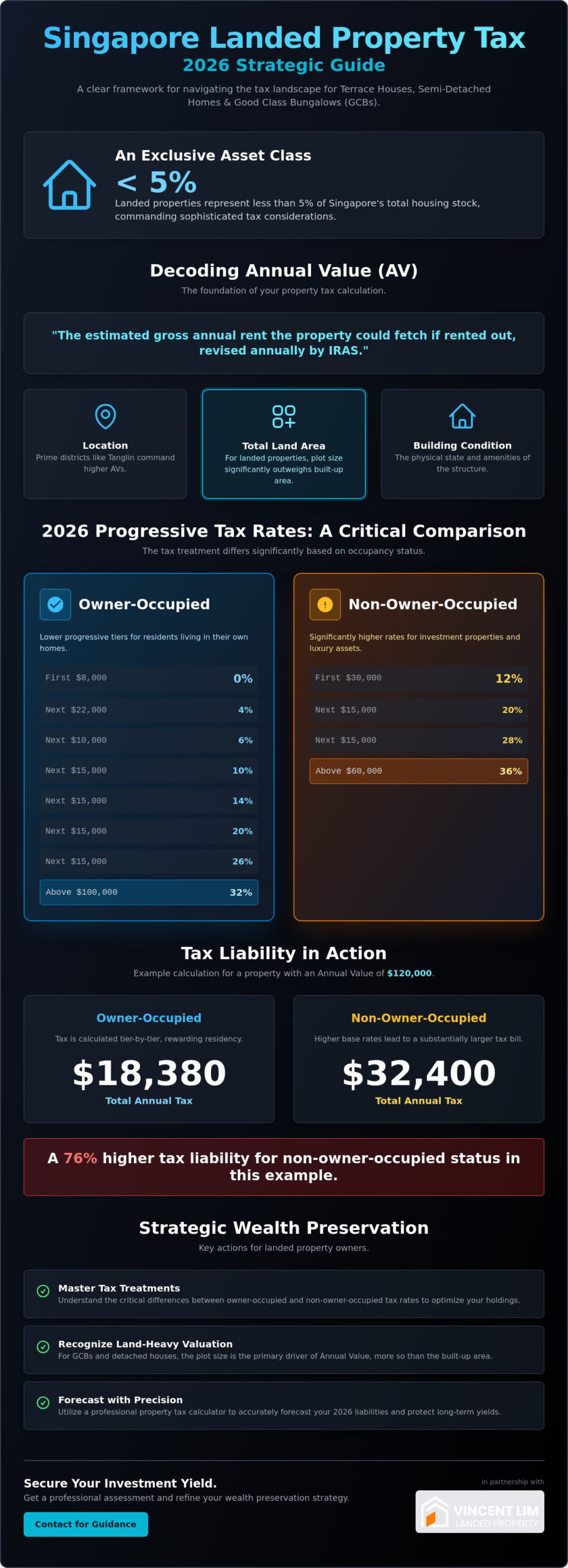
The 2026 tax framework maintains a strict distinction between owner-occupied and non-owner-occupied properties. Residents living in their own homes benefit from lower progressive tiers. Conversely, those holding luxury landed assets as investments face the highest tax brackets in the country. This distinction ensures that the tax system remains equitable while targeting high-value wealth accumulation. Because landed properties represent less than 5% of the total housing stock, the tax treatments applied to them are often more sensitive to market shifts than those of the broader residential market.
Defining Annual Value (AV) for Landed Estates
The AV serves as the foundational metric for all property tax assessments. For a landed estate, this value is influenced by the property’s location, the total land area, and the current state of the building. A GCB in a prime district like Tanglin will naturally command a higher AV than a terrace house in a suburban estate. Annual Value is the estimated gross annual rent the property could fetch if it were rented out, regardless of whether the owner actually leases the premises. This estimate is revised annually by the authorities to reflect current market rental trends and neighborhood developments.
The 2026 Tax Landscape for High-Value Homes
Effective January 2026, the progressive tax structure has reached a point of stabilization following several years of incremental adjustments. Landed property owners must account for the fact that as market rents rise, so does the AV. This creates a compounding effect on tax liability. High-value homes are particularly susceptible to these escalations. Consider the following benchmarks:
- Owner-Occupier Rates: These range from 0% to 32%, with the first $8,000 of AV remaining tax-free.
- Non-Owner-Occupier Rates: These are significantly higher, ranging from 12% to 36% for properties with high Annual Values.
Strategic planning is vital this year. Market data from 2025 showed a 15.38% increase in landed transaction values, which often signals an upcoming revision in tax assessments. Utilizing a property tax for landed property singapore calculator allows you to input these revised figures and prepare for potential tax adjustments before the January 31 payment deadline. Professional management of these liabilities is a hallmark of disciplined asset progression.
Calculating Your 2026 Tax Liability: Progressive Rates for Landed Homes
Determining your exact tax obligation requires a methodical approach to the current progressive structure. The 2026 tax year introduces a specific set of tiers that penalize high-value assets more heavily than in previous decades. For many owners, a property tax for landed property singapore calculator is the only way to navigate these steep curves without error. Understanding the math behind the numbers allows you to forecast cash flow with precision, ensuring your portfolio remains a source of strength rather than a liability.
Owner-Occupied Progressive Tax Rates 2026
The tax formula for residents is designed to be accessible at the entry level but scales quickly as the property’s value increases. You can review the Official IRAS Property Tax Rates to see how the first $8,000 of your Annual Value (AV) remains tax-free. Beyond this point, rates climb from 4% up to a significant 32% for the portion of AV exceeding $100,000. When considering a terrace house for sale singapore, investors often find the tax burden manageable. However, as you progress to semi-detached homes and detached houses, the leap into higher percentage tiers becomes a critical factor in your annual holding costs.
The standard calculation follows a logical progression: (AV x Applicable Tier Rate) minus any applicable rebates. In 2026, owner-occupiers of private properties receive a 10% rebate, though this is capped at $500. This cap means that for high-value landed estates, the rebate offers only a nominal reduction in the total bill.
Case Study: The Good Class Bungalow (GCB) Threshold
Most basic calculators fail to address the strategic implications for ultra-high-net-worth assets. Consider a Good Class Bungalow with an AV of $150,000. Under the 2026 owner-occupier rates, the tax is not a flat percentage of the total. Instead, the first $100,000 is taxed at various lower tiers, totaling approximately $11,980. The remaining $50,000 falls into the top 32% bracket, adding another $16,000 to the bill. This results in a total liability of roughly $27,980 before the $500 rebate. This steep escalation demonstrates why elite owners must treat property tax as a primary variable in their asset progression strategy.
Non-Owner-Occupied (Investment) Tax Rates
If you hold a landed property for investment purposes, the tax landscape shifts dramatically. Non-owner-occupied rates in 2026 range from 12% to 36%. There’s no tax-free threshold for these assets. Every dollar of AV is taxed, starting at 12% for the first $30,000 and reaching 36% for any amount over $60,000. For a detached house with a high rental yield, this can significantly compress your net ROI. If you’re managing a complex portfolio, consulting with an experienced landed property consultant can help you refine your holding structure to mitigate these costs effectively. Balancing multiple landed assets requires a disciplined look at whether the capital appreciation outweighs these structurally higher carrying costs.
The Landed Property Factor: How AV is Determined for Detached Houses and GCBs
Landed property valuation for tax purposes follows a distinct logic compared to the strata-titled market. While a luxury condominium’s Annual Value (AV) is largely driven by its internal square footage and floor level, landed homes are subject to “land-heavy” assessments. This means the size of your plot often carries more weight than the built-up area of the house itself. If you’re using a property tax for landed property singapore calculator, understanding this distinction is vital for accurate financial forecasting. A prime District 10 detached house sitting on 10,000 square feet of land will almost always command a higher AV than a terrace house in a fringe district, even if the terrace house has been built up to a larger total floor area.
The authorities benchmark these values against actual rental transactions in the immediate vicinity. For the most prestigious assets, GCB AVs are often benchmarked against the most exclusive rental transactions in Singapore, reflecting a scarcity premium that standard residences don’t possess. Specialized features also play a role in this calculation. The inclusion of a private swimming pool, a multi-car basement garage, or extensive professional landscaping can lead to a higher estimated rental value, subsequently raising your annual tax bill.
Land Size vs. Built-up Area
It’s common to see two houses with identical floor areas have vastly different AVs. This discrepancy usually stems from the land size and plot configuration. A wide, regular-shaped plot offers greater redevelopment potential and privacy, which increases its market rental appeal. When assessing what is a good class bungalow, the minimum land requirement of 1,400 square meters ensures these properties sit in the highest tax brackets due to their massive land footprints. Plot width and land shape aren’t just aesthetic choices; they’re fiscal variables that a property tax for landed property singapore calculator must account for when you’re estimating future liabilities.
Renovations and AV Revisions
Owners often wonder if an Additions & Alterations (A&A) project triggers an immediate tax hike. While minor cosmetic changes might not move the needle, significant structural improvements usually do. IRAS monitors property enhancements through building plan submissions to the Building and Construction Authority (BCA). Once your project reaches a stage of completion or a Temporary Occupation Permit (TOP) is issued, a reassessment is likely. Strategic timing for these upgrades is essential, especially when transitioning between owner-occupied and investment status. By planning your renovations with a clear understanding of the tax implications, you can manage the transition to a higher AV without unexpected financial strain.
Actionable Steps to Use a Property Tax Calculator Effectively
Before you can utilize a property tax for landed property singapore calculator, you must secure the most current assessment of your property’s value. The Inland Revenue Authority of Singapore (IRAS) provides this through the myTax Portal or your annual Valuation Notice. This figure is the foundation of your calculation; without a precise Annual Value (AV), any forecast will be fundamentally flawed. Accessing your account via Singpass allows you to view the historical trend of your property’s AV, which is essential for identifying whether your current assessment aligns with the broader market.
For the 2026 tax year, you must ensure your calculator is updated with the latest progressive rates and rebates. The government has confirmed a one-off property tax rebate of 10% for private residential properties, capped at $500. While this cap is easily reached by most landed homes, it’s a necessary deduction in your final tally. If your calculated liability seems disproportionately high compared to actual market rentals in your neighborhood, you have the right to lodge an objection. This process must be initiated within 30 days of the date on your Valuation Notice, requiring a methodical presentation of comparable rental data to be successful.
Step-by-Step Calculation Process
A disciplined approach to calculation prevents cash flow surprises at the start of the year. Start by confirming your occupancy status; the difference between owner-occupied and investment rates is the single largest variable in your bill. Once you have your AV, apply the 2026 tax tiers in sequence. Don’t simply apply the top rate to the entire amount. Instead, calculate the tax for each bracket, sum them up, and then subtract the $500 rebate. Finally, divide this annual total by 12 to determine the monthly set-aside required for your sinking fund. This ensures that the January 31 deadline is met with calm competence rather than financial strain.
Strategic Planning for Future Tax Hikes
Planning your next move requires more than just a glance at a calculator. When upgrading from condo to landed, the shift in tax liability can be substantial as you move from a strata-titled AV to a land-heavy assessment. Savvy investors use this tax data during the negotiation phase of a purchase. A high AV can sometimes be used as leverage to justify a lower purchase price, especially if the current tax burden impacts the property’s net yield. Consulting a landed property specialist for a comprehensive portfolio audit ensures you aren’t overpaying on assessments and that your asset progression remains on a sustainable trajectory.
Optimizing Your Luxury Portfolio with Professional Guidance
Mastering the data from a property tax for landed property singapore calculator is only the first step in sophisticated asset management. While the raw numbers provide a baseline for your annual liabilities, an elite strategist transforms this data into a comprehensive wealth preservation plan. Managing a high-value portfolio requires more than just reactive payments; it demands a proactive approach to holding structures and timing. In an era where progressive tax rates can reach 36% for investment assets, the difference between a standard brokerage service and a dedicated partnership is measured in your net portfolio yield.
Legacy planning and multi-generational wealth are deeply impacted by the fiscal carrying costs of landed estates. When you consider the long-term trajectory of your holdings, property tax acts as a constant variable that can either erode or enhance your family’s financial legacy. Strategic disposal of high-tax, low-yield assets is often necessary to optimize your overall return on investment. By identifying properties where the Annual Value (AV) revisions have outpaced rental growth or capital appreciation, you can reallocate capital into more efficient vehicles, ensuring your real estate remains a pillar of strength.
The Vincent Lim Advantage in Landed Sales
Navigating the nuances of the detached house for sale singapore market requires a level of expertise that only comes from years of high-stakes transactions. Vincent Lim provides a white-glove service that extends beyond simple property matching. We utilize bespoke marketing strategies that highlight the intrinsic value of your asset, often focusing on properties with favorable tax-to-value ratios. With a proven track record in Good Class Bungalow (GCB) and luxury condominium brokerage, our team understands the unique pressures facing ultra-high-net-worth individuals. We ensure that every transaction is handled with the calm, calculated competence your portfolio deserves.
Next Steps for Landed Property Owners
If your recent assessment has caused concern, the most effective response is a methodical review of your current position. We invite you to request a comprehensive portfolio audit to assess the full impact of the 2026 tax framework on your holdings. If you are considering a transition, our strategic guide to selling offers a roadmap for maximizing value in the current market. You don’t have to navigate these complexities alone. Contact Vincent Lim today for a confidential consultation to refine your property wealth plan and secure your financial future with precision.
Securing Your Real Estate Legacy in 2026
Managing a landed estate in Singapore requires a disciplined approach to fiscal obligations. You’ve seen how the 2026 tax framework emphasizes the land-heavy nature of valuations, especially for Good Class Bungalows where scarcity premiums apply. By utilizing a property tax for landed property singapore calculator, you can transform complex IRAS progressive rates into actionable financial data. This clarity is the foundation of effective wealth preservation and long-term asset progression.
True optimization involves moving beyond basic calculations to elite strategy. Vincent Lim, Executive Associate Director at OrangeTee & Tie, brings over 20 years of Singapore real estate expertise to your portfolio. As a specialist in Good Class Bungalows, he provides the white-glove guidance necessary to navigate high-stakes market shifts and optimize your ROI. Consult Vincent Lim for a Strategic Portfolio Review to ensure your luxury holdings remain efficient and secure. Your journey toward refined real estate management begins with a single, calculated step.
Frequently Asked Questions
How is the Annual Value (AV) of a landed property determined in 2026?
The Annual Value is determined by the estimated gross annual rent your property could command if it were leased. In 2026, the authorities benchmark this against actual rental transactions of comparable landed homes in your immediate vicinity. Factors such as land area, building condition, and specific location play a critical role. Using a property tax for landed property singapore calculator helps you stay ahead of these revisions by allowing you to input estimated rental trends for your specific district.
What are the property tax rates for owner-occupied landed houses in Singapore?
Owner-occupied landed houses are subject to progressive tax rates ranging from 0% to 32%. The first $8,000 of your property’s Annual Value is currently tax-exempt. As the AV increases, the tax rate climbs through various tiers, with the highest 32% rate applied to any AV amount exceeding $100,000. These tiers ensure that the tax burden remains equitable while reflecting the significant wealth represented by high-value landed assets.
Can I appeal against the IRAS assessment of my property’s Annual Value?
You can certainly appeal an assessment by lodging a formal objection with the authorities. This must be done within 30 days from the date of your Valuation Notice. To be successful, you’ll need to provide evidence that the assigned AV is higher than the actual market rental values of similar properties. A methodical presentation of comparable rental data is essential to prove that your current valuation is inflated or inconsistent with neighborhood trends.
Does the land area of my GCB affect my property tax directly?
Land area is a primary driver of property tax for Good Class Bungalows because assessments are land-heavy. Since GCBs require a minimum plot size of 1,400 square meters, they naturally command higher potential rental income. This scarcity and scale directly increase the Annual Value. When you use a property tax for landed property singapore calculator, you’ll see how these massive land footprints push GCBs into the highest progressive tax brackets.
When is the deadline for paying property tax in Singapore?
The deadline for property tax payment in Singapore is 31 January every year. You’ll typically receive your valuation notice and tax bill in the preceding December. It’s vital to ensure payment is made on time to avoid late payment penalties. Many owners opt for GIRO arrangements to manage their cash flow more effectively, sometimes benefiting from interest-free monthly installments if they meet specific eligibility criteria.
Are there any property tax rebates available for landed property owners in 2026?
For the 2026 tax year, owner-occupiers of private residential properties are eligible for a one-off property tax rebate. This rebate is set at 10% of the tax payable and is capped at $500. While this cap means the benefit is nominal for high-value detached houses or GCBs, it’s still a factor you should include when forecasting your net liability. This rebate is automatically applied to your bill by the authorities.
How does property tax differ between a terrace house and a semi-detached house?
The difference usually lies in the Annual Value assigned to each property type. Semi-detached houses generally occupy larger land plots and offer more privacy than terrace houses, which typically leads to a higher estimated rental value. Because the tax system is progressive, the higher AV of a semi-detached home often pushes it into a steeper tax tier. This results in a higher total tax bill compared to most terrace houses.
What happens to my property tax if I convert my home into a home-based business?
If you operate a small-scale home-based business, your property tax usually remains at the residential rate. The primary use of the property must remain residential, and the business must comply with specific guidelines regarding noise and traffic. However, if a significant portion of the property is converted for commercial use, the authorities might reclassify that section. This could result in a flat 10% tax rate applied to the non-residential portion’s AV.