Selling your landed home just twelve months too early could now cost you an additional 16% of your property’s total market value. In the current 2026 market, understanding the nuances of seller’s stamp duty for landed property singapore is no longer just a financial detail. It’s the critical difference between a successful exit and a significant erosion of your wealth. You’ve likely spent years maintaining and improving your asset, and the thought of losing hundreds of thousands of dollars to poor timing is understandably stressful.
The July 2025 tax hikes have fundamentally shifted the environment for luxury sellers, extending the mandatory holding period to a full four years. This guide provides the clarity you need to master the new 16%, 12%, 8%, and 4% tiers while protecting your hard-earned capital gains. We will explore a strategic roadmap for your transaction, identify legitimate tax exemptions, and ensure you have a precise 48-month exit plan to secure your financial legacy with confidence.
Key Takeaways
- Understand the fundamental shift from a three-year to a four-year holding period following the 2025 regulatory updates to ensure your exit timeline remains tax-efficient.
- Master the tiered tax structure, ranging from a 16% punitive rate for early disposals down to 4% in the final year, to accurately calculate liability on high-value assets.
- Develop a precise 48-month strategic roadmap for seller’s stamp duty for landed property singapore to protect your capital gains from being eroded by poor timing.
- Identify legitimate legal remissions and exemptions, such as those involving government land acquisition or specific bankruptcy scenarios, that may waive your duty obligations.
- Leverage professional valuation and expert guidance to coordinate a bespoke marketing approach that offsets tax liabilities and maximizes your net proceeds.
Understanding Seller’s Stamp Duty (SSD) for Singapore Landed Property in 2026
The Inland Revenue Authority of Singapore (IRAS) utilizes the Seller’s Stamp Duty (SSD) as a primary cooling measure to discourage short-term speculation and maintain a sustainable residential market. Essentially, it’s a tax levied on owners who dispose of their property within a mandated holding period. While the general framework of Stamp Duty in Singapore is a standard part of the real estate landscape, the specific application of seller’s stamp duty for landed property singapore requires a more rigorous level of strategic planning due to the immense capital involved.
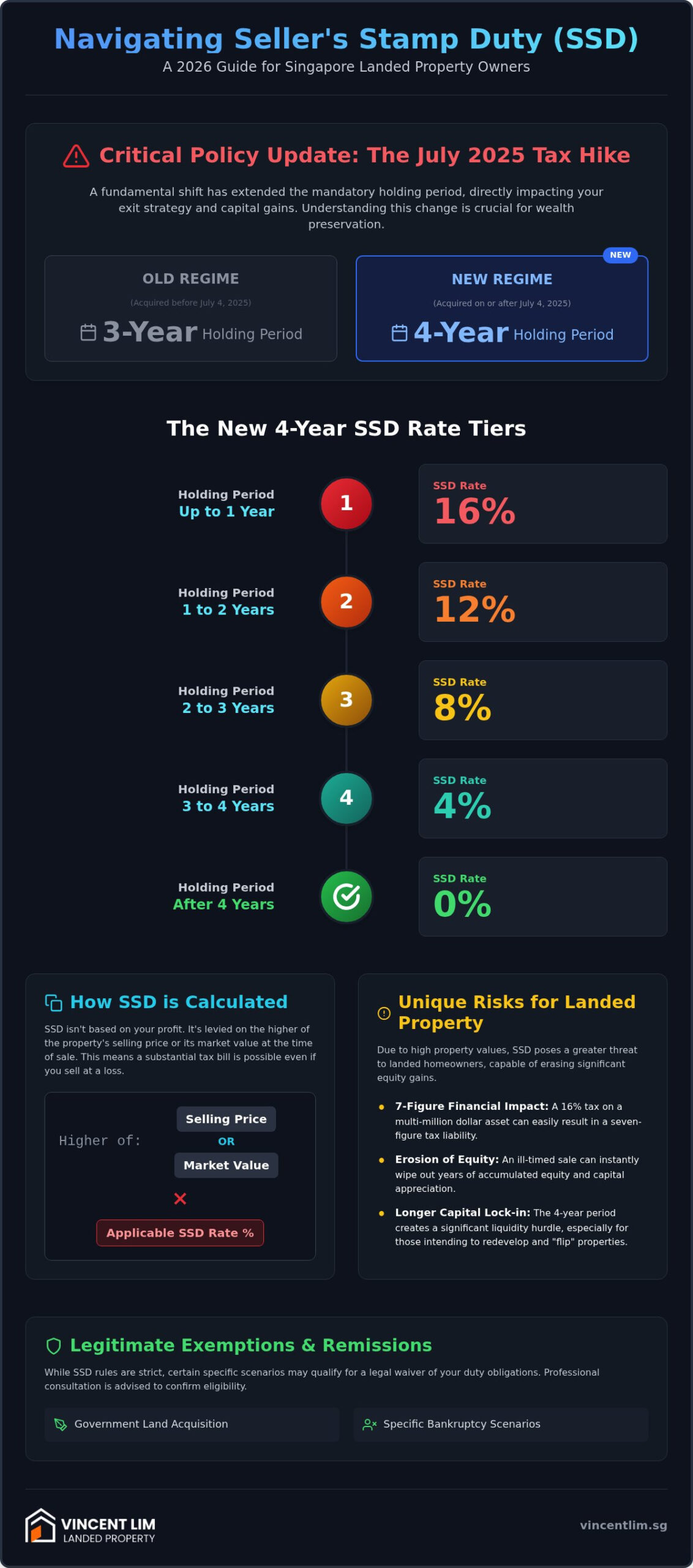
On July 4, 2025, the government implemented a significant policy pivot, extending the holding period from three years to four. This adjustment was designed to encourage long-term ownership and prevent volatile price swings driven by rapid turnover. The tax applies to all residential landed housing types, including Terrace Houses, Semi-Detached Houses, and Detached houses. It’s vital to recognize that the tax isn’t just calculated on your capital gains; it’s levied on the higher of the actual selling price or the current market value at the time of disposal. This means even a sale at a loss could still trigger a substantial tax bill.
Why Landed Property Owners Face Unique SSD Risks
Landed assets frequently command multi-million dollar price tags, ranging from several million for terrace homes to tens of millions for bungalows. This scale means a 16% tax liability isn’t merely a transaction cost; it’s a seven-figure expense that can instantly erode years of equity growth. For investors who acquire older landed houses with the intent of “flipping” them for redevelopment potential, the extended four-year window creates a significant liquidity hurdle. High-net-worth individuals must now account for longer capital lock-in periods, making the timing of an exit strategy more critical than ever. The strategic management of seller’s stamp duty for landed property singapore is therefore essential for preserving the wealth generated by these premium assets.
The July 2025 Cooling Measures: A 2026 Perspective
From our current vantage point in 2026, the impact of the July 4, 2025, measures has redefined the luxury market. Any property acquired on or after that date is subject to the new four-year regime, which includes rates that were increased by four percentage points across all tiers. If you purchased your home between March 11, 2017, and July 3, 2025, your asset remains under the “Old” three-year regime. To accurately determine your liability, you must identify your exact acquisition date. The SSD holding period officially begins on the date you granted the Option to Purchase (OTP) to the buyer or the date the Sale and Purchase Agreement was signed.
The 4-Year Holding Period: New SSD Rates and Calculations
The strategic management of your property portfolio requires a precise understanding of the current tax tiers. For any residential asset acquired on or after July 4, 2025, the holding period has been extended to four years, with rates increased by four percentage points across the board. This tiered structure is designed to penalize short-term disposals heavily while providing a clear path to tax-free exits for long-term owners. You can find the exhaustive technical details in the Official IRAS SSD Guidelines, which remain the definitive source for compliance.
These rates are applied to the higher of the actual selling price or the market value at the time of sale. This ensures that the tax remains significant even in transactions where the selling price might be intentionally lowered. The following table outlines the current liability framework for seller’s stamp duty for landed property singapore in 2026.
| Holding Period | SSD Rate (%) |
|---|---|
| Up to 1 year | 16% |
| More than 1 year and up to 2 years | 12% |
| More than 2 years and up to 3 years | 8% |
| More than 3 years and up to 4 years | 4% |
| More than 4 years | No SSD Payable |
Example Calculation: The Cost of Timing
Consider the disposal of a $15M Detached house. If you sell this property within the second year of ownership, the 12% SSD rate applies. This results in a tax liability of $1.8 million. If you wait until the fifth year, your SSD liability is zero. The difference of $1.8 million is a direct preservation of your capital gains. Understanding these numbers is vital before entering any negotiation. Professional strategic wealth planning can help you determine the optimal moment to list your asset to avoid these punitive costs.
Determining Your Holding Period Start and End Dates
Precision is paramount when calculating your 4-year anniversary. The holding period typically commences on the date the Option to Purchase (OTP) is granted by the seller to the buyer, provided it is subsequently exercised. It does not begin on the date of legal completion. Similarly, the disposal date is the date the buyer exercises the OTP you’ve granted them. Miscalculating this by even a single day can result in falling into a higher tax tier. The Commissioner of Stamp Duties defines ‘disposal’ strictly, so ensure your legal documentation reflects the correct dates to protect your financial interests.
Strategic Timing: Impact of SSD on High-Value Landed Assets
The decision to sell a high-value asset involves more than just finding a buyer. It requires a meticulous analysis of the opportunity cost associated with waiting out the mandatory holding period. In the current 2026 market, price volatility can sometimes outpace the potential savings from a lower tax tier. However, for most owners, the seller’s stamp duty for landed property singapore remains a primary barrier to an early exit. A calculated approach involves weighing the risk of a market softening against the guaranteed tax liability of a premature sale. Consulting a Legal Guide to SSD can provide the necessary framework for these high-stakes decisions.
Managing these liabilities is a cornerstone of successful asset progression to landed property singapore. Professional valuation plays a decisive role here. By establishing a robust market value, you can justify a premium sale price that might offset a portion of the SSD, ensuring your net proceeds align with your wealth preservation goals. This level of precision is what separates a standard transaction from a masterfully executed exit.
The GCB Strategy: Protecting 8-Figure Valuations
When dealing with the upper echelons of the market, the numbers become staggering. A 16% SSD on a $40 million Good Class Bungalow equates to a $6.4 million tax bill. This isn’t just a transaction fee; it’s a significant capital loss that can derail an entire family office portfolio. For those who understand What is a Good Class Bungalow?, these assets are often viewed as legacy holdings. In such cases, a disciplined 48-month holding strategy is essential. Selling too early doesn’t just attract tax; it signals a lack of strategic patience that can affect future negotiations.
Redevelopment vs. SSD: The Developer’s Dilemma
Developers and owners of older detached houses face a unique challenge. You must determine if the projected profit from a redevelopment justifies paying the 4% or 8% SSD tiers. In 2026, the trend has shifted toward ‘as-is’ sales where the buyer assumes the redevelopment risk. This allows the seller to wait out the holding period while the land value appreciates. If you’re unsure how to model these net proceeds, engaging a landed property specialist is a prudent step. They can provide the data-driven insights needed to decide whether to hold for the full four years or exit early to capitalize on a specific redevelopment surge. Every decision must be backed by precise numbers to protect your equity in the complex world of seller’s stamp duty for landed property singapore.
Exemptions and Remissions: Navigating Legal SSD Waivers
Navigating the legal landscape of seller’s stamp duty for landed property singapore requires a sophisticated understanding of the available waivers. While the 2025 regulatory shifts established a rigorous four-year holding barrier, the Stamp Duties Act recognizes that certain disposals aren’t voluntary or driven by market speculation. These exceptions provide vital relief for owners facing specific life events or legal mandates, ensuring that tax isn’t unfairly applied to involuntary transactions.
Involuntary disposals represent a primary category of exemptions. If your landed home is subject to compulsory land acquisition by the government under the Land Acquisitions Act, you won’t be liable for SSD. This protection also extends to disposals forced by financial distress, such as those conducted by the Official Assignee during bankruptcy or by liquidators during the involuntary winding up of a company. Furthermore, inheriting a landed asset through a will or the Intestate Succession Act grants you a unique tax status. When you dispose of a property acquired via inheritance, you’re generally exempt from SSD, which is a critical consideration for those managing multi-generational family estates.
Matrimonial Remissions and Asset Splitting
Domestic transitions often necessitate the transfer of property shares between spouses. Transfers made pursuant to a maintenance order or a court order for divorce are eligible for SSD remission. For high-net-worth individuals, these transitions require meticulous coordination to avoid accidental tax triggers. You must provide precise documentation to IRAS, including the Decree Nisi and the specific Order of Court, to qualify for these waivers. Strategic planning during these periods ensures that matrimonial assets are split according to legal mandates without eroding the value of the family’s landed holdings.
Exemptions for Foreigners and PRs
It’s a common misconception that citizenship status alters your SSD obligations. While the Residential Property Act (RPA) strictly governs the acquisition of landed homes by non-citizens, the rules for seller’s stamp duty for landed property singapore remain identical for Singaporeans, Permanent Residents, and foreigners alike. However, non-citizens must still account for ABSD for landed property as a secondary financial consideration during the initial purchase phase. SSD exemptions are applied based on the nature of the disposal rather than the passport held by the seller.
If you’re managing a complex disposal that may qualify for these legal remissions, seek expert guidance for your wealth planning to ensure every regulatory requirement is met with precision.
Optimizing Your Exit Strategy: Why Professional Guidance Matters
Executing a successful exit from a premium asset requires more than just market awareness; it demands the precision of an Elite Strategist. Managing seller’s stamp duty for landed property singapore is a multi-dimensional task that involves the seamless coordination of professional valuation, legal counsel, and tax planning. High-stakes transactions leave no room for error, especially when a single day’s discrepancy in timing the Option to Purchase (OTP) can determine whether you fall into the 4% Tier 4 liability or achieve a tax-free disposal. A seasoned professional ensures that every document is aligned to protect your equity.
Effective marketing also plays a pivotal role in offsetting potential SSD costs. By positioning a property to emphasize its unique ‘Legacy’ value and architectural significance, it’s often possible to secure a premium that absorbs the impact of the tax. This is particularly relevant for off-market sales within the Good Class Bungalow (GCB) and luxury landed segments. Access to a private network of high-net-worth individuals allows for a more discreet and strategically timed sale, moving beyond the limitations of public listings to find buyers who value the asset’s long-term potential over immediate market fluctuations.
Modeling Net Proceeds in a High-Tax Environment
Generic online calculators are fundamentally insufficient for transactions exceeding $5 million. A sophisticated financial model must factor in more than just the SSD; it must account for agent commissions, legal fees, and the Buyer’s Stamp Duty (BSD) for your subsequent acquisition. Without a comprehensive view of these variables, your actual liquidity after the sale might be significantly lower than anticipated. Creating a bespoke 5-year asset roadmap allows you to visualize the impact of different exit timelines on your total wealth. This methodical approach ensures that your next move, whether it’s a Terrace House, Semi-Detached, or Detached house sale, is part of a deliberate wealth-building journey rather than a reactive market exit.
The Vincent Lim Advantage for Landed Sellers
Since 2004, Vincent Lim has provided a white-glove service level for Singapore’s most discerning property owners. As an Executive Associate Director at OrangeTee & Tie, he specializes in the complex nuances of the GCB and luxury landed markets. His approach combines over 20 years of industry experience with a commitment to transparency and results-oriented planning. When you partner with a specialist, you gain access to a refined methodology that has successfully navigated multiple cycles of cooling measures and tax hikes. You don’t just get a service provider; you gain a high-level partner invested in the long-term success of your portfolio.
Contact Vincent Lim for a strategic review of your landed property portfolio to ensure your exit strategy is optimized for the 2026 tax landscape.
Master Your Property Exit with Strategic Precision
The 2025 regulatory shifts have transformed the luxury market into a landscape where patience is a literal financial asset. Successfully managing seller’s stamp duty for landed property singapore now requires a disciplined four-year outlook and a refusal to leave transaction timing to chance. By precisely aligning your OTP dates and leveraging professional valuations, you protect your capital gains from being eroded by unnecessary tax liabilities. You’ve worked hard to build your property portfolio; don’t let poor timing compromise your results.
As an Executive Associate Director at OrangeTee & Tie with over 20 years of expertise in luxury landed property, Vincent Lim acts as your elite strategist. He specializes in GCB and detached house transactions, providing the calm, calculated competence required for multi-million dollar sales. Secure Your Exit Strategy with Vincent Lim’s Expert Guidance and move forward with the confidence that your wealth is being managed by a top-tier professional. Your path to a tax-efficient exit starts with a single, calculated step toward expert planning.
Frequently Asked Questions
Is Seller’s Stamp Duty calculated on the profit I make from the sale?
No, SSD is calculated on the higher of the actual selling price or the market value of the property at the time of sale. It’s not a tax on your capital gains or profit. This means you could still face a substantial tax bill even if the property is sold at a loss or at the same price you originally paid.
What happens if I sell my landed house exactly 4 years after buying it?
If you sell your property exactly four years or more after the date of acquisition, no SSD is payable. For assets acquired on or after July 4, 2025, the holding period must exceed 48 months to reach the tax-free threshold. You must be extremely precise with your dates; selling even one day before the four-year anniversary will trigger a 4% tax liability.
Does SSD apply if I inherited the landed property?
SSD generally doesn’t apply to the disposal of residential property acquired through inheritance. Whether the asset was passed via a will or the Intestate Succession Act, IRAS typically grants an exemption for these specific transfers. This allows beneficiaries to manage family estates without the immediate burden of seller’s stamp duty for landed property singapore.
Are the 2025 SSD rate increases retroactive for properties bought in 2023?
The July 2025 rate increases aren’t retroactive. Properties acquired between March 11, 2017, and July 3, 2025, remain subject to the previous three-year holding period and lower tax rates. Only assets purchased on or after July 4, 2025, fall under the new four-year regime and the higher 16% peak rate.
Can I use my CPF to pay for Seller’s Stamp Duty?
You cannot use your CPF savings to settle Seller’s Stamp Duty. CPF funds are only applicable for property acquisitions and related costs like Buyer’s Stamp Duty. Since SSD is a liability incurred during the disposal of an asset, it must be settled using cash or the proceeds from your sale.
What is the difference between SSD for residential and industrial property in Singapore?
The primary differences lie in the duration of the holding period and the specific tax percentages. Residential properties now require a four-year hold to avoid tax, while industrial properties use a three-year cycle with rates of 15%, 10%, and 5%. The strategic planning for seller’s stamp duty for landed property singapore is often more critical due to the significantly higher transaction values involved.
Do I need to pay SSD if the government acquires my land for redevelopment?
You aren’t required to pay SSD if your land is subject to compulsory acquisition by the government under the Land Acquisitions Act. This is classified as an involuntary disposal. The Stamp Duties Act provides this exemption to ensure that owners aren’t financially penalized for transfers that are initiated by public authorities rather than the owner’s choice.
How do I pay my SSD to IRAS after the sale is completed?
SSD must be paid to IRAS within 14 days of the date of the executed transfer document, which is typically the date the buyer exercises the Option to Purchase. Your legal representative usually coordinates this payment through the IRAS e-Stamping portal. It’s vital to ensure prompt payment to avoid late interest charges and potential penalties from the tax authority.