Did you know that only 1.1% of land parcels across the island saw zoning or plot ratio changes in the recently gazetted URA Master Plan 2025? While that figure sounds marginal, for the owners of those 1,243 specific plots, it represents a monumental shift in their financial trajectory. You’ve likely felt the weight of uncertainty when assessing your own home’s future, perhaps wondering if your land is currently underutilized or if new regulations might limit your redevelopment potential. Understanding how ura zoning impacts landed property value singapore is no longer just for developers; it’s essential knowledge for any serious homeowner looking to preserve and grow their wealth in 2026.
It’s easy to get lost in the technicalities of Gross Plot Ratio and Envelope Control, but these codes are actually the secret blueprint to your property’s highest and best use. This strategic analysis provides you with a clear framework to decode the latest URA regulations and identify high-growth potential plots before the market fully reacts. We’ll explore the direct links between 2026 market trends and specific zoning mandates, giving you the confidence to make high-stakes decisions whether you’re looking to sell a Terrace house or acquire a Good Class Bungalow. By the end of this guide, you’ll have the expert clarity needed to transform regulatory complexity into a distinct competitive advantage.
Key Takeaways
- Understand the critical implications of the URA Master Plan 2025 gazetting and how it serves as the definitive statutory blueprint for land use over the next decade.
- Learn exactly how ura zoning impacts landed property value singapore by dictating the highest and best use and redevelopment potential for specific land parcels.
- Master the technical relationship between Gross Plot Ratio (GPR) and Envelope Control to accurately calculate a property’s maximum buildable floor area and market worth.
- Gain a structured framework for identifying value gaps by comparing current built-up areas against allowable URA limits to pinpoint high-growth investment opportunities.
- Discover how a strategic analysis of URA data can refine your asset progression plan for luxury landed assets, from Terrace houses to Good Class Bungalows.
Understanding URA Zoning and the Gazetted Master Plan 2025
The URA Master Plan serves as the statutory blueprint for Singapore’s land use, guiding development over a 10 to 15-year horizon. On December 1, 2025, the latest iteration was officially gazetted, marking a pivotal moment for the real estate market. This document is not merely a map; it’s a financial engine. Understanding how ura zoning impacts landed property value singapore is critical because it dictates exactly what can be built on a plot. In this latest update, 1.1% of land parcels, representing 1,243 specific sites, experienced a change in land use zoning or plot ratio. While this percentage seems small, it creates localized ripple effects that redefine valuations overnight.
Zoning is the primary driver of scarcity in our land-scarce nation. When the URA restricts the supply of landed land, prices naturally trend upward. This is especially true for Good Class Bungalow areas, where the zoning is the most restrictive. Strategic buyers look for these safeguarded signals as a mark of long-term stability and wealth preservation.
The Five-Year Review Cycle: Why 2026 is a Critical Year
The transition from a Draft Master Plan to a Gazetted Master Plan represents the move from proposal to law. The Gazetted Master Plan is the legally binding authority for land use in Singapore. For investors and homeowners, 2026 is a year of execution. When a single parcel in a neighborhood is rezoned for higher density, it re-anchors the price expectations for every surrounding property. This scarcity of “up-zoned” land ensures that those with higher development potential command a significant premium. It’s a period where savvy owners re-evaluate their portfolios to ensure their assets align with the new statutory reality.
Decoding Landed Housing Area (LHA) Designations
Not all landed properties are created equal. Properties located within designated Landed Housing Areas (LHAs) are governed by strict guidelines to preserve their low-rise character. These areas are often safeguarded. This means the URA intends for them to remain as landed estates indefinitely. This protection against high-rise encroachment is a primary reason why GCBs and detached houses in these zones maintain such high valuations. The history of Urban planning in Singapore shows that this deliberate segregation of use is what creates the exclusivity buyers crave. By analyzing these designations, we can see how ura zoning impacts landed property value singapore by separating mass-market assets from truly elite, safeguarded estates. Properties outside these LHAs may offer higher redevelopment potential but often lack the prestige and quietude of a dedicated landed enclave.
The Impact of Land Use Codes on Landed Property Categories
The hierarchy of landed assets in Singapore is strictly defined by the URA Master Plan, which categorizes residential land into specific housing types. These designations aren’t merely labels; they’re rigid legal frameworks that dictate the minimum plot size, frontage, and building setbacks allowed for a property. When considering how ura zoning impacts landed property value singapore, you must recognize that the ability to transition a plot from a lower-tier category to a higher one is where significant equity is often unlocked. Conversely, zoning also acts as a protective shield for the most elite assets, ensuring that high-density developments don’t encroach upon the privacy of landed enclaves.
Zoning also plays a decisive role in determining the “en-bloc” or collective sale potential of landed clusters. In areas where the URA has increased the permissible building height from two storeys to three, or where land has been rezoned for “Residential with a higher plot ratio,” the underlying land value often decouples from the physical state of the house. For those managing a high-value portfolio, consulting with a landed property specialist can reveal whether your current land holds untapped redevelopment potential based on these specific land use codes.
Terrace House vs. Semi-Detached Zoning Nuances
Terrace houses often represent the primary entry point into landed ownership, yet their value is highly sensitive to specific plot dimensions. An intermediate terrace typically requires a minimum land area of 150 square meters with a frontage of 6 meters. However, if a corner terrace or a large intermediate plot exceeds 200 square meters and meets the required 8-meter frontage, it may be eligible for conversion into a Semi-Detached dwelling. This technical shift significantly elevates the property’s market appeal and valuation. You can explore more about these strategic nuances in the guide on Terrace House acquisitions.
The Good Class Bungalow (GCB) Safeguards
The pinnacle of the Singapore residential market is the Good Class Bungalow. With only 39 designated GCB areas across the island, the URA maintains a fortress-like level of protection over these enclaves. By mandating a minimum plot size of 1,400 square meters and strictly prohibiting the sub-division of these plots, the authorities ensure that the scarcity of GCBs remains absolute. This regulatory moat is the primary reason how ura zoning impacts landed property value singapore at the ultra-luxury level; it prevents the dilution of the asset class. To understand the full scope of these elite requirements, refer to the definition of Good Class Bungalows for a detailed breakdown of the 2026 standards.
Gross Plot Ratio (GPR) and Envelope Control: The Math of Value
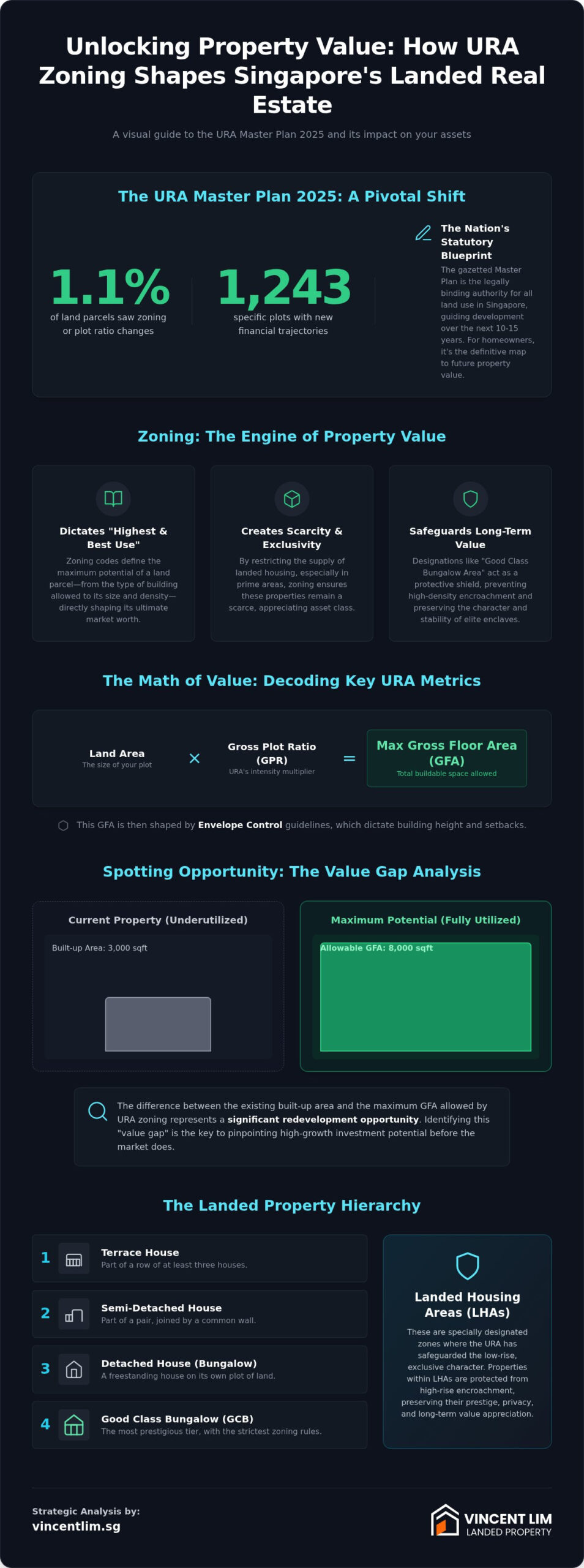
The true valuation of a landed asset often lies beneath the surface, hidden within the mathematical formulas of the URA development control guidelines. Gross Plot Ratio (GPR) serves as the definitive multiplier for buildable space, directly dictating the maximum Gross Floor Area (GFA) permitted on a site. For investors, a higher GPR isn’t just a technicality; it’s a direct inflation of land value because it increases the yield of any redevelopment project. Understanding how ura zoning impacts landed property value singapore requires a shift from viewing land as a flat surface to viewing it as a three-dimensional volume of potential. When a plot possesses “unutilized plot ratio,” it means the current house is smaller than what the law allows, creating a hidden goldmine for sellers who can market that untapped capacity to developers.
A GPR of 2.8 allows a 10,000 sq ft site to yield 28,000 sq ft of space. While such high ratios are typically reserved for high-density residential zones, the principle of buildable volume remains the core driver of price in the landed market. The shift from rigid storey-height limits to the Envelope Control Guidelines has further refined this calculation. Instead of just counting floors, the URA now defines a volumetric “envelope” that a building must fit within, allowing for much greater architectural flexibility and internal volume.
Maximizing Gross Floor Area (GFA) Under New Guidelines
Envelope control has revolutionized the design of modern landed homes by allowing for higher ceilings, mezzanines, and attics that don’t count strictly against storey limits. In a 3-storey housing zone, the maximum building height is 15.5 meters, whereas a 2-storey zone is capped at 12 meters. This 3.5-meter difference is significant; it often determines whether a property can capture unblocked views or house a prestigious double-volume living area. These design features aren’t just aesthetic choices; they’re strategic moves to maximize GFA within the permissible envelope, directly enhancing the property’s resale premium in 2026.
Road Line Reservations and Conservation Status
Precision in due diligence is mandatory when assessing landed land. Road line reservations can significantly reduce your “effective land area” by earmarking portions of the plot for future public infrastructure. If a 400-square-meter plot has a 50-square-meter road reserve, your redevelopment potential is only calculated based on the remaining 350 square meters. Similarly, properties with conservation status or those located in historic districts face strict limitations on alterations. While these heritage assets command a “rarity premium,” their value is governed by a completely different set of URA rules. Checking uraspace.com.sg is only the first step in due diligence; a professional audit is required to ensure these technical constraints don’t erode your investment’s foundations.
Identifying Redevelopment Potential and Value Gaps
Identifying the true worth of a landed home requires looking beyond the existing facade. The most significant wealth-building opportunities arise when you identify a “value gap” between the current built-up area and the maximum allowable floor area under the latest Master Plan. By analyzing how ura zoning impacts landed property value singapore, we can determine if a plot is underutilized. Professional investors don’t just look at the total price; they calculate the land rate, often expressed as the price per square foot per plot ratio ($psf ppr) for redevelopment sites. If a property’s land rate is significantly below the neighborhood average despite having the same zoning, you’ve found an undervalued asset with high growth potential.
Another layer of potential lies in subdivision. If a large detached plot meets the URA’s minimum width and size requirements, it can often be carved into two semi-detached units or even multiple terrace houses. This transformation can exponentially increase the total exit value of the land. Before making a purchase, it’s wise to request a strategic valuation analysis to verify the feasibility of such a high-stakes move.
The Strategy of “Additions & Alterations” (A&A) vs. Rebuild
Unlocking value doesn’t always require a total demolition. In some cases, URA zoning allows for an A&A where you can increase the GFA by up to 50% without the immense cost of a full reconstruction. This is particularly effective in 2026, as construction costs remain a significant factor in any investment. However, if the gap between the current house and the permissible building envelope is vast, a total rebuild is the only way to capture the full market premium. For a deeper look at these options, review these strategies for selling landed property.
Infrastructure Impact: MRT Lines and Growth Zones
The URA’s focus on decentralization in the 2025 Master Plan has shifted the spotlight toward suburban growth zones. Proximity to new MRT lines, such as the Cross Island Line, often acts as a catalyst for future rezoning. When a new station is announced, the URA may increase the plot ratio of nearby land to support higher density. This proactive analysis allows you to buy into areas before they are officially “up-zoned.” Landed assets in these regions benefit from both improved accessibility and the potential for a sudden jump in statutory value. It’s a calculated move that pays dividends.
Navigating Zoning Shifts with an Elite Real Estate Strategist
Entering the landed market in 2026 requires more than just capital; it demands a sophisticated understanding of statutory frameworks. High-stakes transactions for Detached houses or Good Class Bungalows often involve millions in potential equity that can be gained or lost based on a single zoning interpretation. This is where the expertise of a seasoned strategist becomes indispensable. By leveraging over 20 years of industry experience, Vincent Lim (OrangeTee & Tie) deciphers the granular details of how ura zoning impacts landed property value singapore to protect his clients’ interests. He moves beyond the raw data found on public portals, providing a layer of analysis that identifies hidden risks and untapped opportunities within the 2025 Master Plan.
Meticulous due diligence is the cornerstone of reducing transaction friction. Whether it’s verifying road line reservations or assessing the impact of a neighboring rezoning, every detail is scrutinized to ensure a seamless acquisition or sale. In the luxury segment, “off-market” knowledge is often the deciding factor. Many of the most significant GCB transactions occur within private networks, away from the public eye. Access to these exclusive opportunities, combined with a disciplined approach to planning, allows clients to operate with a level of confidence that few others can match.
Bespoke Property Wealth Planning
Moving from a luxury condominium to a landed asset is a significant milestone that requires a calculated approach to asset progression. It isn’t just about the upgrade; it’s about selecting a plot where the zoning aligns with your long-term financial goals. Vincent Lim (OrangeTee & Tie) utilizes URA data to craft tailored roadmaps for wealth preservation, ensuring that your next move is a strategic step forward. For those ready to elevate their portfolio, this asset progression guide offers a deep dive into the elite strategist’s methodology. Beyond immediate gains, this planning incorporates legacy considerations, ensuring your landed holdings remain a robust pillar of family wealth for generations to come.
Securing Your Legacy with Authority
In the ultra-luxury market, integrity and transparency are the non-negotiable standards. Owners of Detached houses and GCBs expect a “white-glove” level of service that respects the gravitas of their assets. This bespoke approach ensures that every interaction is handled with the professionalism and precision that a high-value portfolio deserves. You don’t have to navigate the complexities of the 2025 Master Plan alone. If you’re looking to understand the full potential of your land, reach out to Vincent Lim (OrangeTee & Tie) for a strategic URA zoning audit of your property. This audit provides the clarity needed to make informed, high-stakes decisions in an evolving regulatory environment.
Securing Your Position in Singapore’s Evolving Landed Market
The gazetting of the Master Plan 2025 has established a new baseline for landed property valuations across the island. Success in 2026 depends on your ability to look past the physical structure and decode the underlying land use potential. We’ve explored how technical factors like Gross Plot Ratio and the building envelope define a property’s financial ceiling. Understanding how ura zoning impacts landed property value singapore allows you to navigate these shifts with precision, turning regulatory changes into significant equity gains. Whether you’re managing a Terrace house or a Good Class Bungalow, the math of value remains the ultimate guide.
As you evaluate your next move, ensure your decision is backed by the highest level of industry insight. Vincent Lim, Executive Associate Director at OrangeTee & Tie, brings over 20 years of expertise and a specialized focus on Good Class Bungalow (GCB) transactions to your portfolio. Consult with Vincent Lim for a Strategic Valuation of Your Landed Asset today to unlock the hidden potential of your property. Your legacy deserves the precision of an elite strategist who understands the nuances of the Singapore market. Take the next step with confidence.
Frequently Asked Questions
How do I check the URA zoning for my specific landed property?
You can verify your property’s current designation by accessing the URA SPACE map on the official Urban Redevelopment Authority website. By entering your address or lot number, you’ll see the land use zoning and any specific height controls applicable to your plot. It’s essential to refer to the Master Plan 2025 layer for the most current data. While the map provides raw data, interpreting how ura zoning impacts landed property value singapore for your specific site often requires a professional audit.
What is the difference between a 2-storey and 3-storey landed housing zone?
The primary difference lies in the maximum building height permitted under the latest Envelope Control guidelines. A 2-storey zone is capped at a building height of 12 meters, while a 3-storey zone allows for a height of up to 15.5 meters. This extra 3.5 meters often enables the inclusion of a mezzanine or a more spacious attic. Properties in 3-storey zones typically command higher premiums because they offer greater internal volume and the potential for superior views.
Can URA zoning change after I have purchased a property?
Yes, URA zoning is subject to change during the five-year Master Plan review cycle or via specific amendments. These statutory shifts can either enhance your property value through up-zoning for higher density or restrict future development to preserve neighborhood character. Staying informed about neighborhood-wide planning changes is vital for long-term wealth preservation. Identifying a potential shift in land use early can help you determine the optimal time to either sell your asset or commence reconstruction.
How does Gross Plot Ratio (GPR) affect the en-bloc potential of landed houses?
Gross Plot Ratio acts as a multiplier for buildable floor area, directly influencing developer interest. A higher GPR allows for more intensive development, such as converting a cluster of landed homes into a high-density residential project. When the URA increases the GPR for a specific area, it creates significant en-bloc potential because developers can justify higher purchase prices based on the increased unit yield. This technical shift is often the primary catalyst for substantial appreciation in landed clusters.
What is Envelope Control and how does it differ from the old height guidelines?
Envelope Control is a volumetric approach to building height that replaced the rigid storey-based limits. Instead of just counting floors, it defines a three-dimensional space that a building must fit within. This offers homeowners more design flexibility, allowing for features like double-volume ceilings or mezzanines that don’t count strictly against storey limits. It shifts the focus from the number of levels to the total buildable volume, directly influencing how ura zoning impacts landed property value singapore.
Does a conservation status increase or decrease my property value?
Conservation status has a dual impact on valuation depending on the buyer profile. While it imposes strict limitations on alterations and prevents total reconstruction, it also creates an exclusivity premium. Heritage landed properties are finite assets that appeal to collectors and high-net-worth individuals. The value often stems from historical significance and architectural rarity rather than redevelopment potential. Consequently, these properties are priced based on prestige and their role as a unique pillar for capital preservation.
How much land is required to sub-divide a detached house into two semi-detached units?
To sub-divide a detached plot into two semi-detached units, the original land must be large enough to yield two plots of at least 200 square meters each. Additionally, each new plot must meet the minimum frontage requirement of 8 meters. If your current detached house sits on a plot exceeding 400 square meters with sufficient width, you may have a significant value gap. Unlocking this equity through sub-division is a common strategy for maximizing the exit value of large landed plots.
Will the new MRT lines in the Master Plan 2025 impact my landed property value?
New MRT lines, such as the Cross Island Line, typically boost landed property values by significantly improving regional connectivity. Beyond convenience, proximity to a new station often signals a neighborhood’s transition into a high-growth zone. The URA may eventually rezone nearby land for higher density to support the massive infrastructure investment. Owners who identify these infrastructure-led shifts early can position their assets to benefit from both improved lifestyle appeal and future increases in the official land rate.