
Could a property with an attractive rental yield still deliver a weaker return than expected? Yes, if the calculation leaves out purchase costs, financing, tax, maintenance or the time you hold the property. That’s why calculating return on investment for property should produce a transparent scenario, not just a headline percentage.
It’s easy to feel uncertain about which figures to include. Gross rental yield, net rental yield and total ROI measure different things. Comparing properties or investment periods without consistent assumptions can therefore lead to misleading conclusions.
This guide shows you how to build a property ROI estimate using your own figures, separate income from costs and compare scenarios on a like-for-like basis. It also explains how Singapore-specific rules, including stamp duties and property taxes, can affect the result and why you should verify them against current authoritative guidance. For landed-property decisions, Market Analysis and Property Valuation can help you assess the assumptions behind a purchase or sale. The aim is a more defensible estimate and a clearer view of what could change it.
Key Takeaways
- Build a transparent ROI estimate by defining the holding period, investment base, expected returns and relevant expenses.
- When calculating return on investment for property, distinguish gross yield, net yield, total ROI and annualised return so each comparison answers the right question.
- Document your assumptions, create a base case, then test how changing one factor at a time affects the result.
- Review Singapore-specific taxes, duties and transaction rules using current authoritative guidance before relying on an estimate.
- For landed-property decisions, Market Analysis and Property Valuation can help inform your assumptions, while Marketing Strategy and Expert Negotiation can support a sale decision.
What Does Property ROI Measure in Singapore?
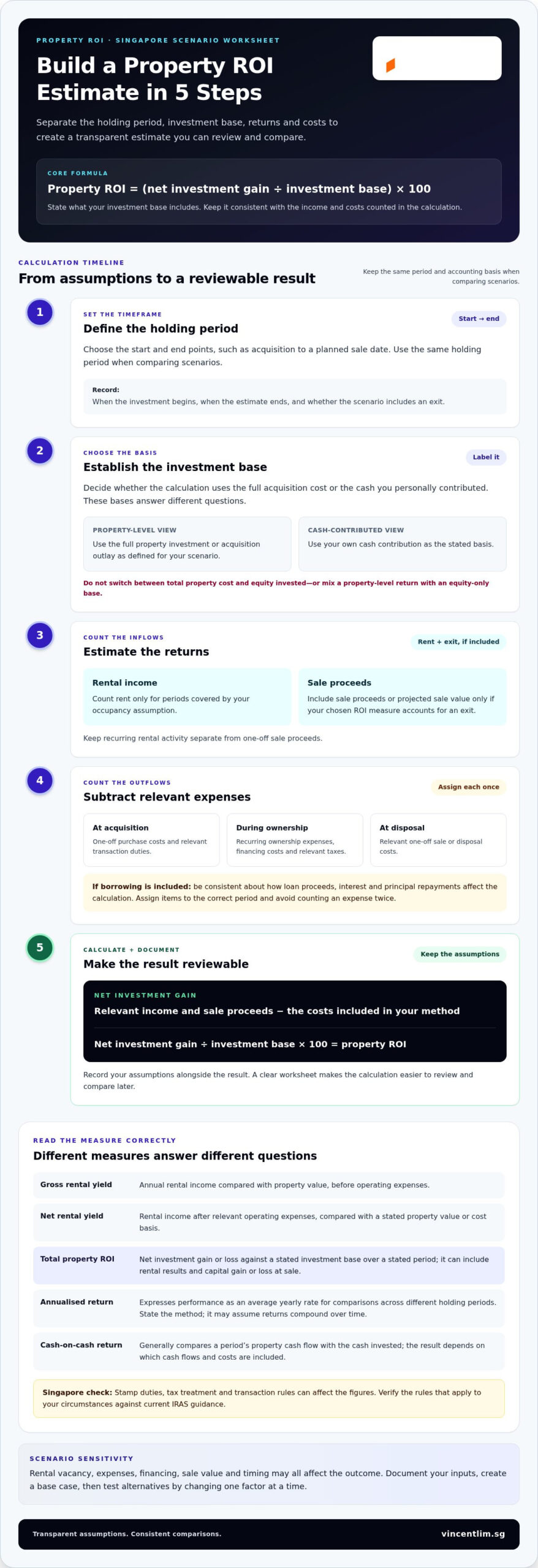
Property ROI is the net gain or loss from a property investment, expressed as a percentage of a defined investment base over a stated period.
Basic formula: ROI = (net gain or loss ÷ investment base) × 100
The result is an estimate, not a fixed characteristic of the property. It depends on the figures included, when income and costs occur, and the calculation method.
Before calculating return on investment for property, define the “investment base” for your analysis. It could mean the full acquisition cost or the cash you personally contributed. Those bases answer different questions, so label your choice and apply it consistently when comparing properties. A Singapore scenario may include purchase-related costs, financing, rental income, ongoing expenses and eventual sale proceeds, depending on the measure you choose.
This overview of Return on Investment (ROI) explains the general concept. For a property decision, state the period and inputs alongside the percentage. Without that context, a headline ROI can hide important differences between scenarios.
What is the difference between property ROI and rental yield?
Gross yield compares annual rental income with the property’s value before operating expenses. Net yield compares rental income after relevant operating expenses with a stated property value or cost basis. Both focus on rental performance, and neither necessarily captures the full investment outcome.
Quotable distinction: Gross yield measures rent against property value before expenses; ROI measures net investment gain or loss against a stated investment base over time.
Total ROI can include rental results and capital gain or loss when the property is sold. It can also include investment costs, depending on the method you use. Be explicit about what you count. An estimate that excludes purchase or selling costs will differ from one that includes them. Avoid counting the same expense twice.
Why the holding period changes the result
Total return alone does not show how long your capital was invested. The same gain achieved over a shorter period represents a different pace of return from that gain spread over a longer period. Annualised return expresses performance as an average yearly rate, which helps when comparing scenarios with different holding periods. It may assume returns compound over time, so state the method rather than treating it as interchangeable with a simple average.
Another useful measure is cash-on-cash return, which generally compares a period’s property cash flow with the cash invested. The result depends on which cash flows and costs you include, particularly when borrowing is involved. Keep the definition consistent with the question you want to answer.
Small changes to assumptions can alter a projection. Rental vacancy, expenses, financing, sale value and timing may all affect the outcome. Treat each result as a scenario, document its inputs and test alternatives before relying on the percentage.
How to Calculate Property ROI Step by Step
A reliable calculation starts with a defined period and a consistent accounting basis. When calculating return on investment for property, separate recurring rental activity from one-off purchase and sale items. State whether your investment base represents the total property investment or your own cash contribution.
Quotable formula: Net investment gain ÷ total investment × 100 = property ROI.
For this formula, net investment gain is the relevant income and sale proceeds minus the costs included in your method. Keep the numerator and investment base aligned.
- Define the period. Set the start and end points, such as acquisition to a planned sale date. Use the same holding period when comparing scenarios.
- Establish the investment base. Record the property value or acquisition outlay, then decide whether your calculation includes financing and other cash contributions. Label the basis instead of switching between total cost and equity invested.
- Estimate returns. Include rental income only for periods covered by your occupancy assumption. Add sale proceeds or projected sale value only if your chosen ROI measure accounts for an exit.
- Subtract expenses. Deduct relevant recurring ownership costs and one-off acquisition or disposal items. Assign each item to the correct period and avoid counting it twice.
- Calculate and document. Divide net investment gain by the investment base, multiply by 100, and record your assumptions alongside the result. A clear worksheet makes the calculation easier to review and compare later.
Which figures belong in the investment calculation?
Depending on the scenario, consider acquisition costs, financing costs, ownership expenses and disposal costs. Separate recurring items, such as rent and ongoing expenses, from one-off amounts paid at purchase or sale. If you include borrowing, be consistent about how loan proceeds, interest and principal repayments affect the calculation. Mixing a property-level return with an equity-only investment base can distort the result.
For Singapore, transaction duties and tax treatment can affect your figures. Verify the rules that apply to your circumstances against current IRAS guidance before using them. Rental assumptions also need a stated occupancy period, rather than an unsupported full-year estimate. Market factors can influence an eventual sale value, as discussed in DBS Bank’s analysis of the Singapore property market.
How to calculate annualised return and cash-on-cash return
Annualised return expresses the overall investment outcome as a yearly rate adjusted for the holding period. For a single initial investment and a final value, a common compound annualised formula is (ending value ÷ starting value)1 ÷ years − 1. Make sure the values use the same investment basis and account for the cash flows included in your method.
Cash-on-cash return compares cash flow over a stated period with cash invested. It can help assess a leveraged scenario, but it is not interchangeable with total ROI. If cash flows occur on different dates, a method designed for multiple dated flows, such as an internal rate of return calculation, may better reflect their timing. For a landed-property purchase or sale, Market Analysis and Property Valuation can help inform assumptions about value.
How to Compare Property ROI Measures Without Misreading Them
Different return measures can describe the same property and produce very different-looking results. That is not a flaw: each metric answers a different question. Start by identifying the question, then use the same assumptions, expense definitions and time period for each scenario.
| Measure | What it answers | Typical calculation basis | What it leaves out or depends on |
|---|---|---|---|
| Gross yield | How rental income compares with property value before operating expenses | Annual rent ÷ property value | Operating costs, financing and any change in value |
| Net yield | How rental income compares with value after defined operating expenses | Annual rent less recurring operating expenses, divided by a stated value or cost basis | Capital gain or loss, disposal items and potentially financing, depending on the method |
| Total ROI | What net gain or loss the investment produced over the full period | Net investment gain ÷ defined investment base | The time-adjusted pace of return unless annualised |
| Annualised return | How the overall result translates into a yearly rate | Total investment outcome adjusted for the holding period | It relies on the method used and the timing of cash flows |
A higher gross yield does not necessarily mean a better investment. It may indicate stronger rent relative to value, but it does not account for expenses or show the effects of financing, capital changes or the eventual sale. An attractive projected appreciation rate is also an assumption, not a certainty. Past performance and forecasts do not guarantee future results.
When is rental yield useful, and when is it incomplete?
Gross yield is useful for an initial income comparison when the rental and property-value inputs use a consistent basis. Treat it as a screening measure, not a complete investment verdict. Net yield gives a more considered view when recurring expenses are available and defined consistently across the properties being compared.
Keep assumptions visible: expected occupancy, rent, expense categories and the value basis. Label estimates clearly and distinguish them from known figures. This helps prevent a projected yield from being mistaken for an achieved result.
How do financing and capital changes affect comparisons?
Borrowing can reduce the cash you contribute initially while increasing the effect of property performance on your equity. Leverage may magnify gains, but it can also magnify losses and financing costs. For clarity, track property price movement, rental cash flow and financing effects separately before combining them in an overall return measure.
Compare scenarios over matching holding periods and with consistent expense assumptions. If one estimate includes financing costs or sale expenses and another excludes them, the percentages are not directly comparable. When calculating return on investment for property, record each metric’s basis beside the result so the comparison remains transparent.
How to Build a Singapore Property ROI Scenario You Can Review
A useful scenario is an auditable working model, not a forecast presented as fact. Start with a base case that records expected income, operating expenses, financing assumptions and the intended holding period. For a Singapore property, keep acquisition and disposal items distinct from recurring cash flows. Note whether each input is verified, estimated or uncertain. This makes the result easier to update as information changes.
Keep an assumption log alongside the calculation. For each figure, record its source, the date checked and how you use it. Separate evidence from judgement: a documented rental reference is not the same as an assumed future rent, and a current financing quote does not establish the rate for the full holding period. This discipline brings greater clarity to calculating return on investment for property.
What evidence should support each assumption?
Use relevant rental and transaction evidence for the property you are assessing, and identify the period those records cover. For financing, record the loan terms and rate assumption used. For ownership costs, note the basis for each recurring or one-off amount. Avoid relying on an unsupported appreciation forecast. Comparable transactions and official market information provide context, but they cannot establish the future value of an individual property.
URA market information can help frame broader market conditions. Treat it as context for a scenario, not a promise that a specific property will perform in the same way. Before making a decision, verify applicable transaction duties and tax inputs against current IRAS guidance. Rules and personal circumstances can affect the relevant figures, so date your verification and revisit it if you update the scenario.
How to stress-test the result before making a decision
Once you have a base case, create cautious and stronger alternatives by changing one assumption at a time. This shows which input drives the result instead of obscuring the cause by changing several variables together. Test rental income, occupancy or vacancy, ownership expenses, financing costs and the eventual sale outcome. Keep the holding period and calculation method consistent across cases.
- Income: Consider how a different rent assumption or longer vacancy period changes the rental contribution.
- Costs and financing: Test higher expenses or financing costs to see how much the result depends on your current assumptions.
- Exit: Compare sale outcomes without treating projected appreciation as assured.
Review the change in both the final return and the cash required along the way. A scenario may look acceptable on a total-return basis but feel different if income is interrupted or costs rise. For landed homes, property-specific context matters. The landed property acquisition guide can help frame purchase considerations. Vincent Lim’s Market Analysis and Property Valuation can also inform decisions about landed residential property. Discuss your landed-property assumptions with Vincent Lim as part of a considered purchase or sale decision.
How Vincent Lim Supports Landed Property Decisions
A property ROI estimate is only as useful as the assumptions behind it. For landed residential property buyers and sellers in Singapore, market evidence and a carefully considered value can help frame those assumptions. Vincent Lim is an Executive Associate Director at OrangeTee & Tie. His approach centres on transparent communication and a customized, efficient process for property decisions.
How market analysis and valuation inform an ROI scenario
Market Analysis uses current transactions and asking prices to formulate a pricing strategy. Property Valuation provides the latest valuation to help optimise the selling price. These inputs can support an ROI scenario by giving the owner a more grounded reference for the acquisition or exit value, rather than relying only on a broad appreciation assumption. For further valuation context, see this landed property valuation guide.
For a sale decision, Marketing Strategy matches the property with keen buyers to work towards the owner’s preferred outcome. Expert Negotiation supports the handling of offers. These services can inform the sale process, but they cannot promise a particular sale price or investment return. Legal and Paperwork Assistance and After-Sales Service provide further support around the transaction. Keeping each role distinct helps owners understand what informs the scenario and what supports the sale process.
What experience and process does Vincent Lim bring?
Vincent has been actively engaged as a real-estate agent since 2000. 70 % of Vincent’s transactions are in landed property. He received the EdgeProp Excellence Awards, Top 6 Transactor – Landed, in 2022 and 2023. His CEA Registration Number is R026632B.
Experience is most useful when applied with clarity. A customized, efficient process can help buyers and sellers review the assumptions that matter to their decision, distinguish market evidence from estimates, and understand how a valuation or pricing strategy relates to their intended outcome. It does not remove uncertainty from property investment. It makes the reasoning behind a decision more transparent and easier to review.
- For buyers: Market Analysis and Property Valuation can inform the value assumptions used to assess an acquisition.
- For sellers: Property Valuation, Marketing Strategy and Expert Negotiation can support a considered sale approach.
- For the transaction: Legal and Paperwork Assistance and After-Sales Service provide support beyond the pricing discussion.
If you are weighing a landed-property purchase or sale, consider how market evidence and valuation assumptions fit your scenario. A clear view of the inputs can support a more informed decision without treating projected ROI as assured.
Turn Your ROI Estimate Into a Clearer Property Plan
A return estimate is most useful when it clarifies what you need from a property decision. Before acting, consider how the investment fits your intended holding period, appetite for uncertainty and broader objectives as a landed-property buyer or seller. Keep assumptions visible and revisit them when new market evidence, financing details or transaction information becomes available. This turns calculating return on investment for property into an ongoing decision tool, rather than a percentage to rely on in isolation.
A considered next step is to assess whether your assumptions about value, timing and sale objectives align. The right analysis will not remove uncertainty or guarantee a particular outcome, but it can help you approach the decision with greater discipline and a clearer understanding of the trade-offs.
Plan your landed property objectives with Vincent Lim and take the next step with a more informed perspective.
Frequently Asked Questions
Is property ROI guaranteed once I calculate it?
No. A calculated ROI is an estimate based on assumptions, not a guaranteed outcome. Actual results can differ if rent, occupancy, expenses, financing terms or sale proceeds change. For example, a projected sale value may not match the price achieved when you sell. Treat the calculation as a planning aid, record where each input came from and update it when reliable information changes.
Can property ROI be negative?
Yes. ROI can be negative if the investment’s costs exceed its income and sale proceeds over the period assessed. This could happen if rental income is lower than expected, ownership or financing expenses rise, or the eventual sale proceeds are not enough to offset investment costs. A negative result is a useful signal to review your assumptions and identify which factors contribute most to the shortfall.
How should I compare properties held for different lengths of time?
Use annualised returns to compare the pace of returns across different holding periods, and make sure each calculation uses the same method and investment basis. If contributions, income or costs occur at different times, account for their dates rather than relying only on a simple annual average. Keep the underlying total return visible too, since an annualised figure alone can hide the size and timing of cash flows.
Does a property ROI calculation include mortgage payments?
It can, but the treatment depends on the measure. Interest affects financing costs, while principal repayment reduces the outstanding loan and builds equity. For a cash-flow or cash-on-cash view, track the actual payments made. For a total-return calculation, avoid counting principal repayment as an expense and then counting the same increase in equity again through sale proceeds. State your method clearly.
What is a good return on investment for property in Singapore?
There is no single return that is “good” for every Singapore property decision. The relevant result depends on your objectives, holding period, financing, risk tolerance and assumptions. Compare a property’s expected return with alternatives that suit your circumstances, and assess whether the outcome remains acceptable under less favourable assumptions. A single benchmark can mislead if it excludes costs or reflects a different time period.
Which Singapore sources can help verify property investment assumptions?
Use IRAS guidance to verify applicable taxes and duties, and URA property-market information to review transaction and market data. MAS publishes housing-loan rules, while lenders can provide financing information relevant to your scenario. Check the publication or data date, confirm that it applies to your property type and circumstances, and keep the source with your calculation so you can update the inputs later.
Should I calculate ROI before or after deciding to sell a property?
Do both. Before deciding, estimate the outcome under a sale scenario and compare it with holding the property, using current information and clearly labelled assumptions. This can clarify trade-offs without deciding for you. After a sale, replace estimates with actual proceeds and costs to assess the realised result. Verify relevant transaction duties or tax treatment against current IRAS guidance before finalising either calculation.