If you realize a S$2 million profit on a luxury property sale, how do you ensure IRAS views it as a tax-free capital gain rather than taxable income? While Singapore famously lacks a formal capital gains tax, the line between a savvy investor and a “property trader” is increasingly scrutinized. Effectively calculating capital gains tax on property sale singapore requires more than just looking at the bottom line; it demands a deep understanding of the “Badges of Trade” and the latest 2026 regulatory frameworks.
You likely recognize that high-stakes transactions require meticulous planning to avoid the pitfalls of reclassification. This guide provides a definitive framework for mastering the specific criteria IRAS uses to determine investment intent and provides a clear, step-by-step calculation for your potential liabilities. From navigating the current Seller’s Stamp Duty window to refining your multi-generational wealth progression strategy, we’ll ensure your next move is both profitable and protected.
Key Takeaways
- Identify the specific “Badges of Trade” IRAS utilizes to distinguish between non-taxable capital gains and taxable income for high-value property transactions.
- Master the framework for calculating capital gains tax on property sale singapore by auditing your holding period against the latest 2026 Seller’s Stamp Duty rates.
- Discover the critical importance of contemporaneous documentation and long-term tenancy agreements in defending your strategic investment intent.
- Learn how professional representation and bespoke wealth planning can mitigate tax risks before your luxury asset or GCB enters the market.
The Fundamentals of Property Gains Taxability in Singapore
Singapore’s status as a premier wealth hub is partly built on its attractive tax framework. For the owners of high-value assets like Good Class Bungalows (GCB) or detached houses, the lack of a formal capital gains tax is a significant draw. Yet, this simplicity can be deceptive. The Inland Revenue Authority of Singapore (IRAS) doesn’t simply ignore property profits; it categorizes them as either non-taxable capital gains or taxable trading income based on the seller’s intent.
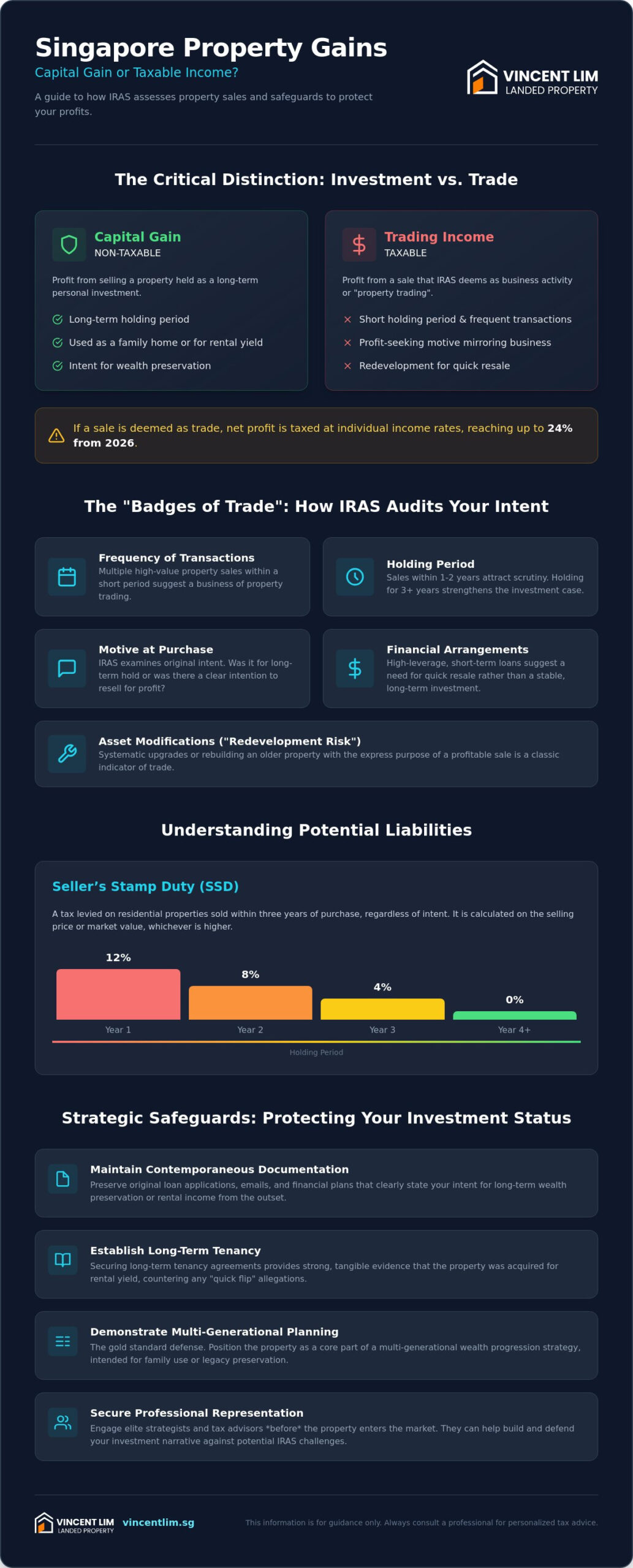
This distinction is critical for high-net-worth individuals managing legacy assets. While a family home held for a decade is typically safe, luxury landed properties attract higher levels of scrutiny than standard condominiums. The high financial stakes in these transactions mean that even a slight ambiguity in your investment narrative can lead to an audit. Under Singapore’s income tax system, if a sale is perceived as part of a “trade,” the net profit is taxed at individual income rates, which can reach 24% for the highest brackets as of 2026. It’s a high-stakes environment where precision matters.
Capital Gain vs. Trading Income: The Strategic Divide
A “Personal Investment” is defined by the intent to hold an asset for long-term appreciation or rental yield. In contrast, a profit-seeking motive that mirrors business activity triggers a tax liability. This is why calculating capital gains tax on property sale singapore starts with a rigorous audit of your own history. For companies, specific “Safe Harbour” rules provide some clarity for certain disposals, but for individuals selling landed property, no such automatic exemption exists. Every transaction is judged on its own merits. Professional representation is often the only way to effectively defend your investment intent against aggressive reclassification.
The 2026 Regulatory Landscape for Property Sellers
The 2026 market presents unique challenges. With the URA Master Plan driving rezoning and intensification in specific landed enclaves, the potential for rapid appreciation is high. IRAS monitors these areas closely. If you sell a Terrace House shortly after a Master Plan announcement, the authorities may question if your purchase was a strategic trade rather than a long-term investment. Market volatility in 2026 has led to shorter holding periods for some, but legacy planning remains the most robust defense. Demonstrating that a property was acquired for multi-generational wealth progression is the gold standard for maintaining tax-free status. It’s about proving your asset was a home, not a commodity.
The Badges of Trade: How IRAS Audits Your Property Sale
Determining your tax status isn’t a matter of simple self-declaration. IRAS employs a multi-faceted assessment framework known as the Badges of Trade to scrutinize the nature of your transaction. When calculating capital gains tax on property sale singapore, you must understand that the authorities look beyond the final profit figure. They examine the underlying behavior and intent of the seller through several key lenses.
The frequency of your transactions serves as a primary indicator. If you’ve sold multiple high-value assets within a short window, IRAS may conclude that you’re carrying on a business of property trading. While the 3-year Seller’s Stamp Duty (SSD) window is a known regulatory hurdle, it also serves as a critical psychological threshold for tax auditors. Holding a property for longer than three years generally supports a claim of long-term investment intent. Conversely, sales within 12 to 24 months often invite deeper investigation into your original motives.
Your financial arrangements are equally telling. Using high-leverage financing or short-term bridging loans to acquire a Semi-Detached House suggests a desire for quick liquidity rather than stable rental income. You should always maintain contemporaneous documentation, such as emails to bankers or original loan applications, that clearly state your intent for long-term wealth preservation. Ensuring your transaction is positioned correctly requires more than just accounting; it requires an elite strategist who understands how to defend your investment narrative from the outset.
The “Redevelopment Risk” for Landed Property Owners
Landed property owners face unique challenges, particularly when purchasing older assets for reconstruction. Buying a Terrace House with the intent to rebuild and sell shortly after completion is a classic indicator of trade. Substantial redevelopment involving the systematic upgrading of an asset for the express purpose of profit realization is frequently categorized by tax authorities as an organized business activity. Even “Additions & Alterations” (A&A) can shift your tax profile if the scale of work suggests you’re enhancing the property primarily for a rapid, high-margin exit.
Circumstances of Sale and Supplementary Work
The “reason” for your exit carries significant weight in any audit. Forced sales due to unforeseen health issues, genuine financial distress, or a sudden change in family size are typically viewed more leniently than a strategic exit timed to exploit a market peak. The way you market the asset also carries weight. While professional staging is standard for luxury sales, excessive commercial-style promotion may be interpreted as a trading motive. For a deeper look at preparing your asset for the current market, consult our Strategic Guide to Selling Your Landed Property.
Calculating Potential Liabilities: SSD vs. Income Tax
A common misconception among luxury property owners is that Seller’s Stamp Duty (SSD) represents the only financial obligation during a sale. While SSD is a transaction tax triggered by the holding period, income tax is a levy on profit triggered by intent. When calculating capital gains tax on property sale singapore, you must account for the possibility that IRAS may apply both. This “double taxation” scenario typically occurs when a property is sold within the three-year SSD window and the seller’s behavior triggers a “trading” reclassification.
The first step in your calculation involves determining your SSD liability. For properties acquired on or after 4 July 2025, the rates are significant: 16% if sold within one year, 12% between one and two years, and 8% between two and three years. Even if you purchased your asset before this date, the legacy rates of 12%, 8%, and 4% still apply within that same three-year window. These percentages are calculated based on the actual sale price or market value, whichever is higher, and must be paid regardless of whether you made a profit.
The second step is determining your Net Profit. This is the figure IRAS will examine if they deem your transaction to be a trade. You calculate this by taking the sale price and subtracting the original acquisition price along with all associated transaction costs. If your gains are reclassified as income, they’re added to your total personal income for the year. For high earners in 2026, this means your property profits could be taxed at the top marginal rate of 24%.
Deductible Expenses to Reduce Your Taxable Base
If your sale is classified as trading income, identifying every deductible expense becomes a priority to protect your margins. You can offset the following against your gross profit:
- Legal fees and brokerage commissions paid during both purchase and sale.
- Stamp duties, including Buyer’s Stamp Duty (BSD) and any Additional Buyer’s Stamp Duty (ABSD) paid at acquisition.
- Quantifiable renovation and improvement costs that enhanced the property’s value.
- Interest expenses on property loans, provided the property was producing income (such as rental) during the holding period.
The Calculation Framework for Landed Asset Progression
Strategic sellers must evaluate the “Price Gap” when transitioning between assets. This gap represents the difference between your net proceeds and the cost of your next acquisition. A 15% tax reclassification on a S$5 million profit can erode years of capital appreciation, significantly hampering your ability to upgrade within the GCB or luxury detached house segments. For a detailed look at navigating these transitions, consult our Asset Progression to Landed Property guide. Precision in your initial calculations ensures that your wealth remains within your legacy rather than being diverted to unexpected tax liabilities.
Strategic Safeguards: Protecting Your Property Wealth
Safeguarding your property wealth in Singapore’s complex regulatory environment requires a proactive rather than reactive approach. While the math behind calculating capital gains tax on property sale singapore is straightforward, defending your status as a long-term investor requires a meticulous paper trail. You shouldn’t wait for an IRAS inquiry to begin gathering evidence of your original investment intent. Instead, you should treat every high-value acquisition as a strategic entry that may eventually require a documented exit narrative.
A primary safeguard is the use of long-term tenancy agreements. Securing a two-year lease with a reputable tenant immediately establishes that your motive is recurring yield rather than a quick capital flip. This documentation, paired with your original Letter of Intent and contemporaneous correspondence with bankers, forms a robust defense. If you’re managing a diverse portfolio, you must also monitor your transaction frequency. Selling multiple assets in a short period can inadvertently flag you as a trader, even if each sale was motivated by genuine personal needs. Professional appraisals from accredited valuers further protect you by ensuring all transactions occur at fair market value, removing any suspicion of artificial price manipulation.
Documenting Your Investment Narrative
Your “reason for sale” is a pivotal component of your tax profile. Life changes such as an expanding family, a change in health status, or a significant shift in financial requirements are legitimate reasons for a strategic exit. You should keep records of these milestones with professional precision. A specialist agent does more than find a buyer; they help maintain a consistent market narrative that aligns with your long-term wealth goals. When handling IRAS inquiries, this consistency is your greatest asset. For bespoke guidance on aligning your portfolio with these tax-efficient strategies, consult with a veteran luxury asset strategist today.
Legacy Planning and GCB Scarcity
The unique nature of Good Class Bungalows (GCB) offers a natural defense against trading labels. Because there are only approximately 2,800 GCBs in Singapore, they’re inherently viewed as long-term legacy assets. Their extreme scarcity makes them ill-suited for the rapid “flipping” behavior that typically triggers trading income tax. By anchoring your multi-generational wealth strategy in these prestigious assets, you aren’t just buying land; you’re securing a tax-efficient vehicle for wealth preservation. The very prestige and holding costs associated with GCBs signal to authorities that the asset is a pillar of a legacy plan rather than a commodity in a trading book.
The Vincent Lim Advantage: Precision in High-Stakes Sales
When calculating capital gains tax on property sale singapore, the most significant financial risks are often identified months before the first viewing takes place. For owners of Good Class Bungalows or luxury detached homes, a standard listing approach is insufficient. Vincent Lim provides a level of foresight that stems from over 20 years of specialized experience in Singapore’s elite real estate sector. By auditing a seller’s profile against the “Badges of Trade” before the property enters the market, he identifies potential tax triggers that others might overlook.
This commitment to “White-Glove” service is rooted in the belief that high-stakes transactions require calm, calculated competence. Consider a recent complex landed sale where the seller faced potential reclassification due to a short holding period and recent A&A works. Through a methodical review of the investment intent and the cultivation of a consistent market narrative, the transaction was positioned to align with capital preservation goals. Integrity and transparency aren’t just values; they’re the cornerstones of a practice dedicated to protecting the wealth of Singapore’s property owners.
Bespoke Asset Progression Strategies
Asset progression for high-net-worth individuals isn’t just about the next purchase. It’s about aligning every move with long-term financial legacy goals. Vincent leverages deep market intuition to identify undervalued assets that offer “safe” redevelopment potential; properties where the value can be enhanced without inadvertently triggering a trading label. This strategic selection process ensures that your portfolio remains robust against market volatility while maintaining a tax-efficient profile. It’s a bespoke approach where every recommendation is backed by two decades of historical data and current market intelligence.
Secure Your Legacy with Expert Representation
Standard brokerage models often fail the HNWI because they prioritize the speed of the sale over the strategic health of the seller’s portfolio. In a complex tax environment where IRAS scrutiny is increasing, you need more than a salesperson; you need an elite strategist. This approach treats your property not as a standalone commodity, but as a pivotal component of your family’s multi-generational wealth. Protecting your gains requires professional representation that can articulate your investment intent with precision and authority. To ensure your next transaction is executed with the highest standard of excellence, Consult Vincent Lim for a Strategic Review of Your Property Portfolio.
Securing Your Financial Legacy in the 2026 Property Market
Navigating the intersection of investment intent and tax liability requires a level of precision that standard market analysis cannot provide. As discussed, the distinction between a tax-free capital gain and taxable trading income rests on the rigorous application of the “Badges of Trade” by IRAS. Mastering the nuances of calculating capital gains tax on property sale singapore is the first step in protecting your multi-generational wealth from unexpected reclassifications. By anchoring your strategy in long-term legacy planning and maintaining meticulous documentation, you ensure your asset progression remains both compliant and highly efficient.
Success in Singapore’s luxury market depends on having a partner who understands the high financial stakes involved. Vincent Lim, an Executive Associate Director at OrangeTee & Tie, has specialized in GCB and luxury residential sales since 2004. With a proven track record in bespoke wealth planning and asset progression, he provides the seasoned authority needed to defend your investment narrative with confidence. Don’t leave your portfolio’s tax efficiency to chance. Navigate Your Landed Property Sale with Vincent Lim and proceed with the peace of mind that your legacy is in expert hands.
Frequently Asked Questions
Does Singapore have a capital gains tax on property sales in 2026?
Singapore does not impose a formal capital gains tax on property sales. However, profits are taxable as income if the Inland Revenue Authority of Singapore (IRAS) deems the seller to be a property trader. This is why calculating capital gains tax on property sale singapore is essentially an assessment of whether your profit qualifies as a non-taxable capital gain or taxable trading income based on your intent.
How long must I hold a property to avoid being taxed as a trader?
There is no fixed statutory period that automatically exempts you from being classified as a property trader. While holding an asset for more than three or four years generally supports a claim of investment intent, IRAS evaluates the “Badges of Trade” holistically. A short holding period combined with high leverage or frequent transactions is more likely to trigger an audit into your original motives.
What are the current Seller’s Stamp Duty (SSD) rates for landed houses?
For landed properties purchased on or after 4 July 2025, the SSD rates are 16% for a holding period up to one year, 12% for one to two years, 8% for two to three years, and 4% for three to four years. If the property was purchased between 11 March 2017 and 3 July 2025, the rates are 12%, 8%, and 4% for the first three years respectively.
Can IRAS tax me if I only sell one property every five years?
It is unlikely but possible if other factors suggest a commercial motive. While a five-year holding period strongly indicates a long-term investment, IRAS may still scrutinize the sale if you undertook substantial redevelopment specifically to maximize profit. They evaluate your financial arrangements and the specific circumstances of the sale alongside the frequency of your transactions to determine the final tax status.
Are renovation costs deductible when calculating taxable property gains?
Renovation and improvement costs are deductible only if your gains are reclassified as taxable trading income. You can offset capital expenditures that enhanced the property value, such as structural additions or major A&A works, against your gross profit. This is a vital component when calculating capital gains tax on property sale singapore to ensure your taxable base is accurately reduced by all legitimate business expenses.
What happens if I sell my property at a loss; can I offset other income?
You can only offset a property loss against other income if you are officially categorized as a property trader by IRAS. For the majority of individual investors, a loss on a property sale is considered a capital loss. Capital losses are not deductible against personal income tax in Singapore, which underscores the importance of strategic timing and professional guidance in high-stakes luxury transactions.
How does IRAS define “profit-seeking motive” for landed property?
IRAS defines “profit-seeking motive” by examining if the property was acquired with the primary intention of reselling it for a gain rather than for long-term use. Indicators include the use of short-term bridging loans, a lack of rental history, or systematic upgrading of the asset for a quick exit. If your behavioral patterns mirror those of a commercial developer, the motive is deemed to be profit-seeking.
Does “Freehold” status affect how IRAS views my investment intent?
Freehold status often reinforces a narrative of long-term wealth preservation and legacy planning. Because freehold landed properties and Good Class Bungalows are finite, prestigious assets, they’re naturally suited for multi-generational holding. While not an absolute shield against trading labels, owning a freehold asset is generally more consistent with “investment intent” than a leasehold property acquired for a tactical market play.