The smartest move in the 2026 landed market isn’t necessarily acquiring the largest plot, but identifying the “strategic hybrid” that offers 80% of a semi-detached lifestyle at a significantly more efficient price point. When evaluating the inter-terrace vs corner terrace singapore debate, many astute buyers worry they’re overpaying for a land buffer that offers little functional utility. It’s a reasonable anxiety, particularly when complex URA setback regulations and road line plans can unexpectedly shrink your buildable footprint.
This guide empowers you to master the technical and financial nuances of corner terraces, ensuring you secure a landed asset that delivers prestige alongside superior capital growth. You’ll learn to identify properties that maximize natural light and privacy without sacrificing investment efficiency. We’ll analyze current 10% to 20% price premiums, audit critical land size requirements, and refine your strategy to ensure long-term resale liquidity in an increasingly scarce market where landed homes comprise less than 5% of Singapore’s total housing stock.
Key Takeaways
- Identify the unique structural advantages of terminal units that share only one party wall, providing the privacy and ventilation typically reserved for semi-detached residences.
- Evaluate the inter-terrace vs corner terrace singapore investment thesis to understand how a 10% to 20% price premium can translate into superior long-term capital growth.
- Perform technical due diligence on URA setback rules and road line interpretations to protect your land title from future widening projects or unusable buffers.
- Analyze the 200sqm land size requirements to determine if a corner terrace offers the most efficient strategic hybrid for your next asset progression move.
- Gain insights into navigating the tightly-held landed market through off-market opportunities and expert-led financial modeling for high-stakes acquisitions.
Defining the Corner Terrace: More Than Just an End-of-Row Unit
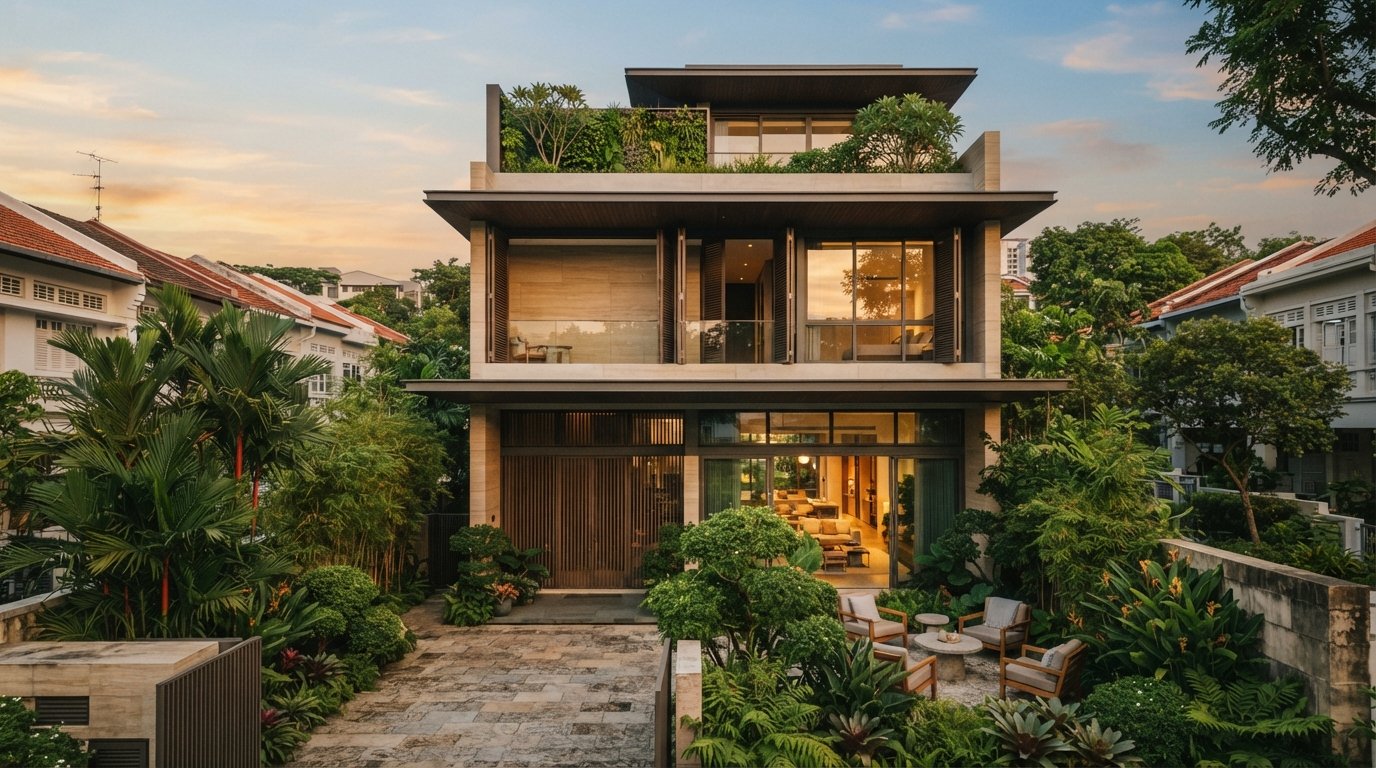
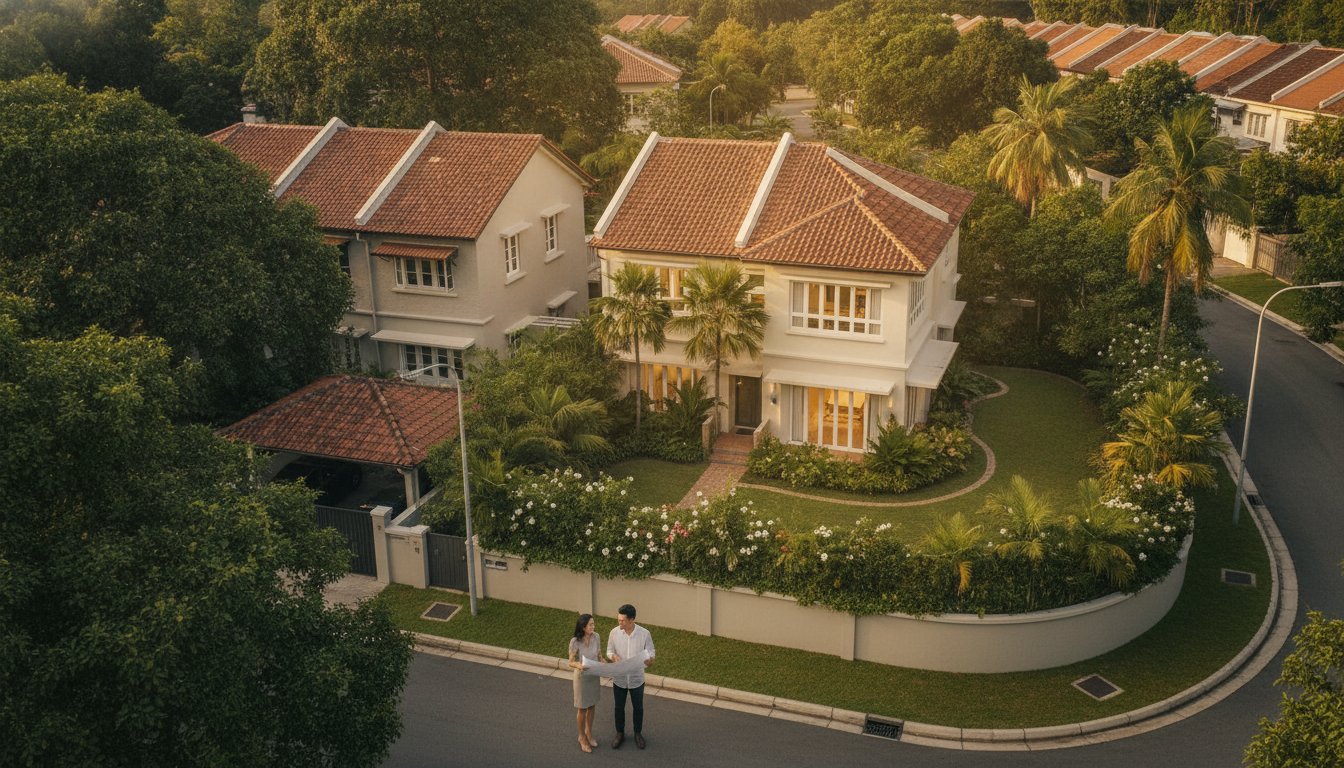
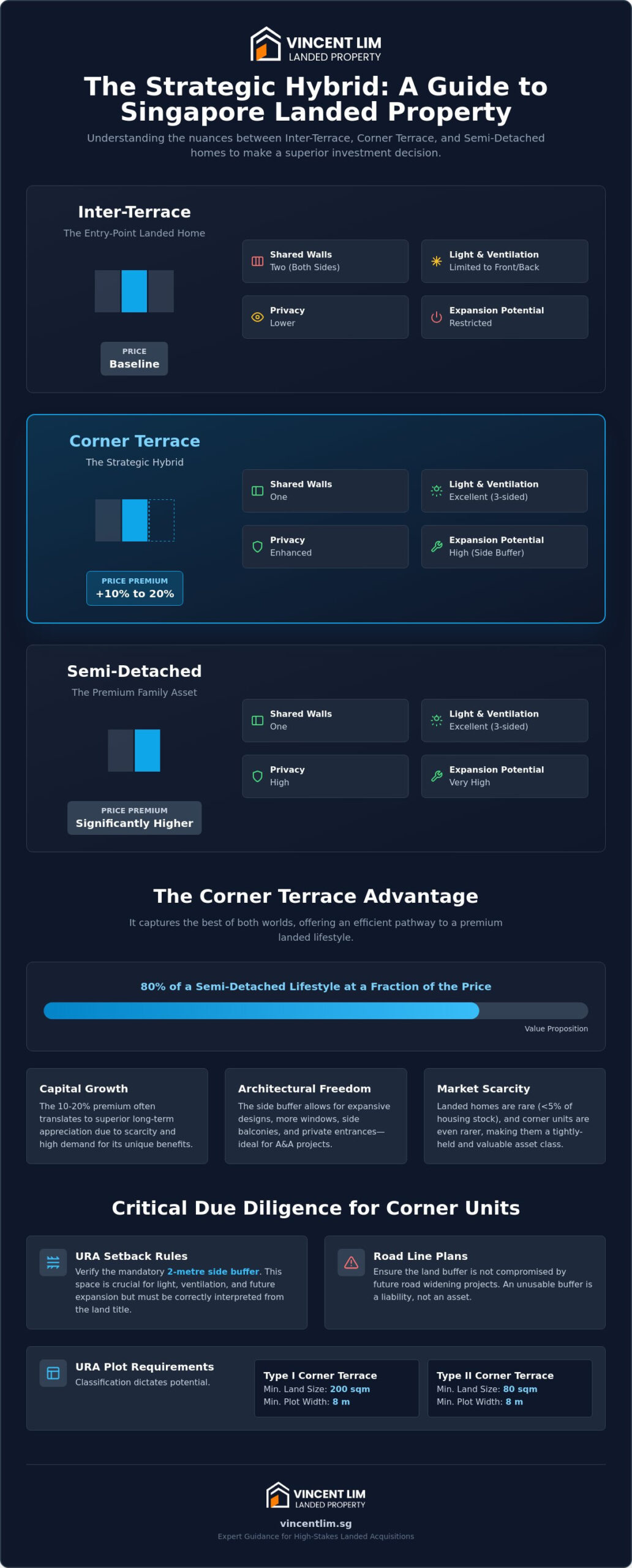
A corner terrace is a landed property occupying the end of a terrace row, providing a distinct land buffer on its open side. Within Singapore’s urban planning, this terminal unit must be part of a Terraced house development consisting of at least three units. While the central units are hemmed in by neighbors on both sides, the corner unit is distinguished by having only one shared party wall. This structural configuration is the foundation of the inter-terrace vs corner terrace singapore comparison, as it offers a level of autonomy that intermediate units simply cannot match. Corner plots typically feature significantly larger land areas, often commanding a 10% to 20% price premium due to their scarcity and potential for expansion.
Inter-Terrace vs. Corner Terrace: Structural Differences
The most immediate advantage of a corner plot is the side-setback requirement. URA guidelines generally mandate a 2-metre side buffer for corner units, which creates that characteristic garden space or private driveway. This open perimeter on three sides isn’t just an aesthetic luxury; it’s a functional upgrade. It facilitates superior natural lighting and cross-ventilation throughout the home, reducing the reliance on artificial cooling. Privacy is another critical factor. Having only one neighbor fundamentally changes the daily living experience, as it halves the potential for noise disturbance and creates a more secluded environment. For many elite buyers, this extra breathing room justifies the higher entry price, as it mimics the living experience of a semi-detached house.
Legal Classification: Type I and Type II Terrace Houses
Understanding the Urban Redevelopment Authority (URA) envelope control guidelines is essential for any serious investor. Corner terraces are classified into Type I and Type II categories, each with strict plot requirements. A Type I Corner Terrace requires a minimum land size of 200 square meters and a minimum plot width of 8 meters. Type II units are more compact, with a minimum land size of 80 square meters, though they must still maintain the 8-metre width. These technical details are vital because they dictate your future Additions & Alterations (A&A) or reconstruction potential.
The land title also plays a decisive role in valuation. While leasehold properties are common, freehold corner terraces are the gold standard for legacy planning. The “extra” land area on a freehold title appreciates more aggressively over time, providing a robust hedge against inflation. When you’re evaluating a potential acquisition, you must audit whether the land’s shape allows for efficient usage. An irregularly shaped plot might meet the 200-square-meter requirement but offer limited buildable area due to setback constraints. Expert technical due diligence ensures you don’t overpay for land that serves only as a maintenance burden rather than a functional asset.
The Investment Thesis: Why Corner Terraces Outperform as Strategic Assets
Acquiring a corner terrace represents a calculated move to capture the lifestyle benefits of a semi-detached house without the corresponding capital outlay. While an inter-terrace unit is often perceived as “boxed-in” by neighboring structures, the corner unit provides a three-sided open perimeter that fundamentally elevates the living experience. In the evolving landscape of inter-terrace vs corner terrace singapore, the latter is increasingly viewed as a “strategic hybrid.” It offers the prestige of a side garden and a single shared party wall, yet typically commands a price point significantly lower than its semi-detached counterparts. This creates a unique window for investment efficiency, where the buyer secures 80% of a semi-detached’s utility for a fraction of the cost.
The flexibility for future Additions & Alterations (A&A) or total reconstruction remains a primary driver for sophisticated investors. Unlike intermediate units, which are restricted by shared walls on both sides, corner plots allow for more expansive architectural designs. The 2-metre side setback provides the necessary clearance for additional windows, side balconies, or even a private side entrance. This structural freedom is essential for multi-generational living, allowing families to create distinct access points that preserve privacy within a single household. When you are evaluating a property’s redevelopment potential, these technical advantages translate directly into higher resale liquidity.
Privacy and Exclusivity as Wealth Indicators
For high-net-worth individuals, the side garden serves as both a psychological and physical buffer from the surrounding urban density. It is not merely about gardening space; it is about the exclusivity of unblocked views and the luxury of cross-ventilation. This sense of space is a tangible asset in Singapore’s land-scarce environment. Positioning a corner terrace within an elite asset progression to landed property singapore strategy allows owners to build equity in a segment that historically resists market volatility. The scarcity of these units, which form a small subset of the already limited 5% landed housing stock, ensures they remain highly sought after by discerning buyers.
Capital Appreciation and Land Scarcity
Historical data indicates that corner terraces demonstrate remarkable price resilience, even during periods of market cooling. Their superior land-to-built ratio makes them particularly attractive to developers and boutique builders who look for redevelopment opportunities. Because the land area of a corner plot is often 20% to 50% larger than an intermediate unit, the en-bloc or collective sale potential is inherently higher. This extra land area acts as a “land bank” for the owner, providing a more substantial exit value when the time comes to transition to a larger asset. In a market where landed prices rose by 7.6% in 2025, the defensive nature of a corner terrace makes it an indispensable component of a sophisticated property portfolio.
Corner Terrace vs. Semi-Detached: The Strategic Hybrid
In the technical hierarchy of Singapore’s landed property, the line between a corner terrace and a semi-detached house is often thinner than the market premium suggests. Both asset classes share a critical regulatory threshold: a minimum land size requirement of 200sqm for Type I classification. This parity in land area means that a corner terrace isn’t merely an “end unit” but a strategic hybrid capable of providing the same architectural volume and spatial luxury as a semi-detached home. When navigating the inter-terrace vs corner terrace singapore market, investors who prioritize land utility over nomenclature often find significant value in units that meet this 200sqm benchmark.
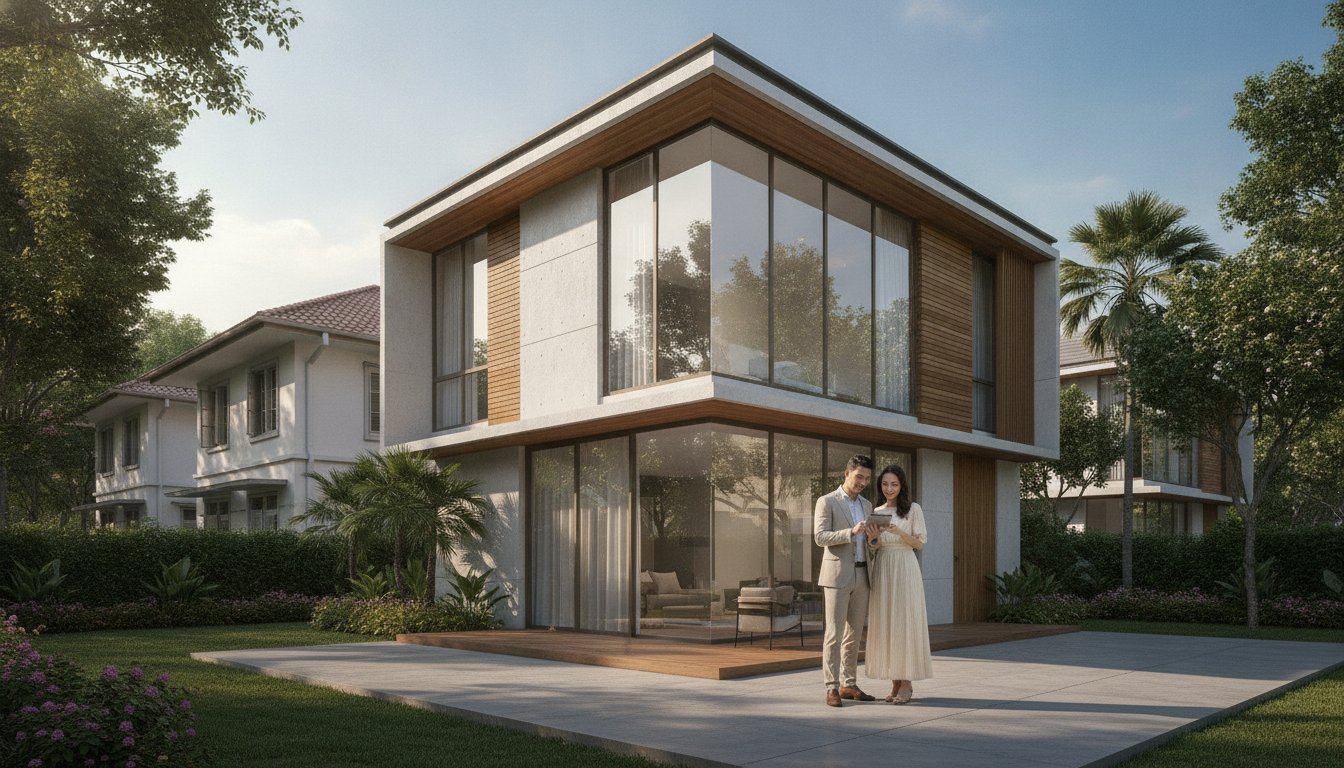
The shared “Party Wall” factor is the great equalizer in daily living. Just like a semi-detached house, a corner terrace shares only one wall with a neighbor, leaving three sides open to the elements. This structural reality provides identical benefits in terms of cross-ventilation, natural lighting, and perimeter privacy. Modern corner terraces are now architecturally indistinguishable from semi-detached homes, frequently featuring wide frontages and expansive side gardens that defy their “terrace” label. By acquiring these units, astute buyers effectively secure semi-detached frontage and lifestyle while operating on a terrace house budget.
The “Semi-D in Disguise” Phenomenon
Contemporary designs utilize the 2-metre side-setback to blur the lines between categories, often incorporating glass curtain walls or side-loading entrances that emphasize the open perimeter. The “Prestige Gap”, the psychological premium attached to the semi-detached label, is narrowing in 2026 as buyers become more data-driven. In many cases, a corner terrace with a 10-metre plot width offers a more imposing presence than a narrow semi-detached unit on a deep, restrictive plot. Choosing based on plot width and functional buildable area is a hallmark of the elite strategist who values performance over perception.
Financial Performance Analysis
From a rental perspective, corner units often command yields comparable to semi-detached properties in the same district, as tenants typically prioritize the living experience and garden space over the property’s legal classification. The ease of exit is another compelling factor; corner terraces attract a wider pool of buyers, including those looking to upgrade from inter-terraces and those who find semi-detached prices slightly out of reach. Before committing, it’s vital to reference the average price of semi-detached house in Singapore to quantify the exact discount you’re achieving. This data-driven approach ensures your acquisition isn’t just a home, but a high-efficiency asset in a tightly-held market.
Critical Considerations: Technical Due Diligence for Corner Units
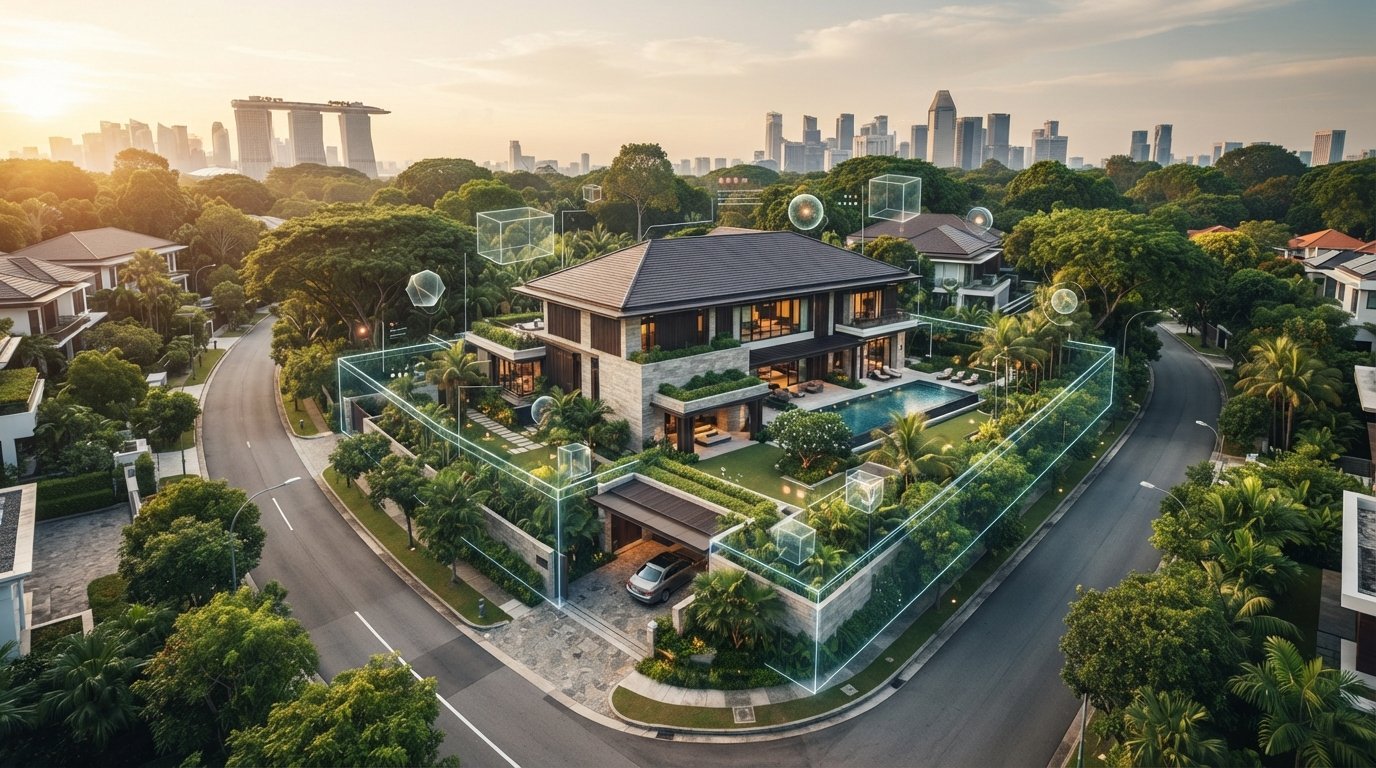
While the aesthetic appeal of a corner plot is undeniable, the technical encumbrances can significantly alter the property’s true valuation. Success in the inter-terrace vs corner terrace singapore market requires a meticulous audit of the Urban Redevelopment Authority (URA) setback requirements. For corner plots, a 2-metre side buffer is mandatory. This rule ensures a separation from the adjacent side road or neighbor, but it also restricts your buildable envelope. If you fail to account for this during the acquisition phase, you may find your actual living space smaller than the land size suggests.
Road Line Interpretation is another high-stakes factor. Corner units often face two distinct roads, increasing the likelihood of being affected by a Road Line Plan (RLP). If a portion of your land is earmarked for future road widening, that area is effectively “lost” for building purposes and may eventually be vested to the state. Meticulous due diligence involves verifying whether the land title reflects the net usable area or includes these potential encumbrances. I recommend securing a technical audit of your target property before finalizing any high-value transaction to ensure your investment remains protected.
Redevelopment and A&A Potential
The 2026 URA Master Plan dictates the allowable storey height, typically restricting terrace developments to 2-storey or 3-storey envelopes. For those planning a full reconstruction, the “Frontage Width” is a critical metric. A corner terrace must maintain a minimum width of 8 metres to qualify for its classification. This width is the canvas for your luxury facade; a wider frontage allows for a more imposing curb appeal and a more efficient internal layout. It is prudent to consult a terrace house for sale singapore specialist who can verify redevelopment feasibility against current zoning laws.
The Environmental Trade-off
Living on a corner plot introduces unique environmental variables. A long exposed side wall can lead to significant heat gain if it faces the afternoon sun. Strategic landscaping, such as planting dense hedges or installing vertical gardens, can mitigate this heat while providing a natural sound barrier against traffic noise from the side road. Maintenance requirements also scale with the perimeter length. Owners must budget for increased fencing upkeep and more frequent pest control treatments to manage the larger garden area. Security is a final consideration; longer perimeters require more sophisticated surveillance and lighting solutions compared to the “protected” nature of an intermediate unit.
Navigating the Landed Market with an Elite Specialist
The landed property segment in Singapore is notoriously opaque, often rewarding those with access to information not found on public portals. Success in this arena isn’t merely about browsing listings; it’s about securing off-market opportunities through a deeply entrenched professional network. Deciding on an inter-terrace vs corner terrace singapore requires more than a cursory look at a floor plan; it demands a rigorous audit of technical encumbrances and future exit strategies. In a market where landed homes constitute less than 5% of the total housing stock, the competition for high-efficiency plots is intense, making seasoned representation a prerequisite for success.
Coordinating the “sell-one-buy-one” transition is a high-stakes maneuver that requires surgical precision in financial modeling. For many property upgraders, the timing of these transactions determines whether they maintain liquidity or face unnecessary bridge loan costs. A veteran strategist provides bespoke modeling for asset swaps, ensuring that the transition from an intermediate unit to a premium corner plot is seamless. This level of oversight is particularly critical when your long-term goals include acquiring a detached house for sale singapore or other luxury assets that require complex legacy planning.
The Vincent Lim Advantage
Vincent Lim brings over two decades of experience to the table, having navigated Singapore’s luxury landed cycles since 2004. This longevity provides a grounded perspective that helps clients distinguish between short-term market noise and long-term value. His white-glove approach prioritizes discretion and strategic negotiation, ensuring that HNWIs receive the level of service their portfolios demand. Clients gain direct access to a trusted circle of architects, lawyers, and valuers who specialize in the intricacies of landed homes, from URA setback audits to complex land title transfers. It’s a partnership built on transparency and a commitment to maintaining a gold standard in every transaction.
Securing Your Multi-Generational Legacy
A corner terrace should be viewed as a multi-generational wealth vessel rather than just a residence. Because these units occupy a unique niche between terrace and semi-detached categories, they offer a resilient hedge against inflation and market volatility. Strategic entry and exit planning are essential to maximize capital gains, ensuring the property remains a valuable component of your family’s legacy. By identifying plots with superior redevelopment potential now, you’re securing an asset that will appreciate as Singapore’s land scarcity intensifies. Schedule a private consultation with Vincent Lim to identify your ideal corner terrace property.
Securing Your Position in Singapore’s Landed Legacy
The choice between an inter-terrace vs corner terrace singapore represents a pivotal moment in your asset progression journey. As we’ve analyzed, the corner terrace serves as a high-efficiency hybrid, providing the ventilation and privacy of a semi-detached home while maintaining a more accessible capital footprint. Success in this segment requires a dual focus on lifestyle prestige and technical precision. You must look beyond the facade to audit URA setbacks and road line encumbrances that dictate your property’s true redevelopment potential.
Navigating these complexities demands a partner who understands the nuances of the 2026 Master Plan. With over 20 years of experience in the luxury landed market, Vincent Lim, Executive Associate Director at OrangeTee & Tie, specializes in identifying off-market opportunities that align with multi-generational wealth preservation. Whether you’re upgrading your primary residence or refining a legacy portfolio, his veteran perspective ensures every acquisition is backed by rigorous financial modeling. Contact Vincent Lim for an exclusive list of off-market corner terraces and take the next step toward securing a premier landed asset. Your future legacy deserves a foundation built on strategic excellence and expert foresight.
Frequently Asked Questions
What is the primary difference between a corner terrace and a semi-detached house?
The primary difference lies in the property’s legal classification and its position within a row. A corner terrace is the terminal unit of a row consisting of at least three houses, whereas a semi-detached house is one of a pair. While both share only one party wall and often require a minimum land size of 200sqm for Type I units, the “semi-detached” label typically carries a higher prestige premium in the Singapore market despite having nearly identical structural benefits.
Is a corner terrace more expensive than an intermediate terrace unit?
Yes, corner terraces typically command a price premium of 10% to 20% over intermediate units in the same estate. This higher valuation reflects the larger land area, increased privacy, and superior natural light. In the context of the inter-terrace vs corner terrace singapore debate, savvy investors view this premium as a strategic cost for a “hybrid” asset that mimics a semi-detached lifestyle at a more efficient entry price.
Can I rebuild a corner terrace into a semi-detached house in Singapore?
You can rebuild a corner terrace into a semi-detached house only if the plot meets URA’s minimum requirements for land size and width. The site must generally have a minimum land area of 200sqm and a plot width of 8 metres. Furthermore, the conversion usually requires the adjacent unit to also be part of a semi-detached pair or for the entire row’s zoning to allow for such a change in classification through formal planning permission.
Are corner terraces harder to maintain than intermediate units?
Corner terraces require more intensive maintenance due to their larger land footprint and longer exposed perimeters. Unlike intermediate units, corner plots feature a side garden and additional fencing that demand regular landscaping and upkeep. You’ll also need to budget for more frequent pest control and exterior wall maintenance. While the workload is higher, many owners find the trade-off for better ventilation and exclusivity to be well worth the investment.
How much extra land does a corner terrace usually offer compared to an inter-terrace?
A corner terrace typically offers 25% to 50% more land than a standard intermediate unit. While a Type I inter-terrace requires a minimum of 150sqm, corner units often exceed 200sqm to accommodate the mandatory 2-metre side setback. This extra space provides the essential buffer for side gardens or private driveways, offering a level of functional utility that is physically impossible for boxed-in intermediate units.
What are the URA setback requirements for corner terraces in 2026?
The 2026 URA guidelines mandate a minimum 2-metre side setback for all corner terrace units. This buffer must remain clear of permanent structures to ensure proper fire safety and urban spacing. Additionally, the front setback is typically 7.5 metres from the road buffer, while the rear setback is 2 metres. These technical constraints are vital to understand because they directly impact your buildable envelope during a full reconstruction.
Do corner terraces have better resale value and liquidity?
Corner terraces generally enjoy superior resale liquidity and stronger capital appreciation because of their scarcity. Landed homes make up less than 5% of Singapore’s housing stock, and corner units are a small subset of that limited supply. Their status as a “strategic hybrid” attracts a wide pool of buyers, including those upgrading from inter-terraces who want semi-detached features without the corresponding price tag.
Can a foreigner buy a corner terrace for sale in Singapore?
Foreigners and Singapore Permanent Residents must obtain approval from the Land Dealings Approval Unit (LDAU) of the Singapore Land Authority (SLA) to purchase any landed property. The Residential Property Act restricts landed ownership to Singapore citizens. Approval is granted on a case-by-case basis and is usually reserved for those who have made significant economic contributions to the country. Without this clearance, foreigners are limited to Sentosa Cove or luxury condominiums.