In Singapore’s 2026 property market, waiting for your luxury condominium sale to finalize before committing to a landed home is no longer a safe strategy. It’s a risk that often leads to losing a generational asset to a faster buyer. With landed prices rising by 2.5 percent in the second quarter of 2026 alone, the window to secure a S$5 million entry-level property is narrower than ever. You likely feel the pressure of managing tight timelines while navigating the complexities of TDSR and LTV limits. This is why a bespoke bridge loan for upgrading to landed property singapore is a vital tactical tool rather than just a debt instrument.
It’s understandable to feel cautious about double mortgage exposure or the nuances of the 55 percent TDSR cap. However, you can achieve a seamless transition by aligning your financial strategy with the current market’s unique liquidity demands. This guide will show you how to master the mechanics of bridge loans to capture scarce land assets before prices climb further. We’ll explore optimized cash flow management and the strategic timing required to move from a high-end condo into a landed residence with absolute confidence and professional precision.
Key Takeaways
- Understand why land scarcity in 2026 makes transitioning from a luxury condominium to a landed asset a critical move for long-term capital preservation.
- Learn how to utilize a bridge loan for upgrading to landed property singapore to secure your ideal home without waiting for sales proceeds from your current residence.
- Discover the essential technical due diligence required when selecting landed assets, including the evaluation of road line plans and drainage reserves.
- Master the “Buy-First, Sell-Later” timeline to capture high-value terrace or semi-detached houses before market prices escalate further.
- Coordinate a seamless transition by integrating professional financial modeling with expert legal and banking support for a disciplined, white-glove upgrade experience.
The 2026 Transition: Why Condo Owners are Pivoting to Landed Assets
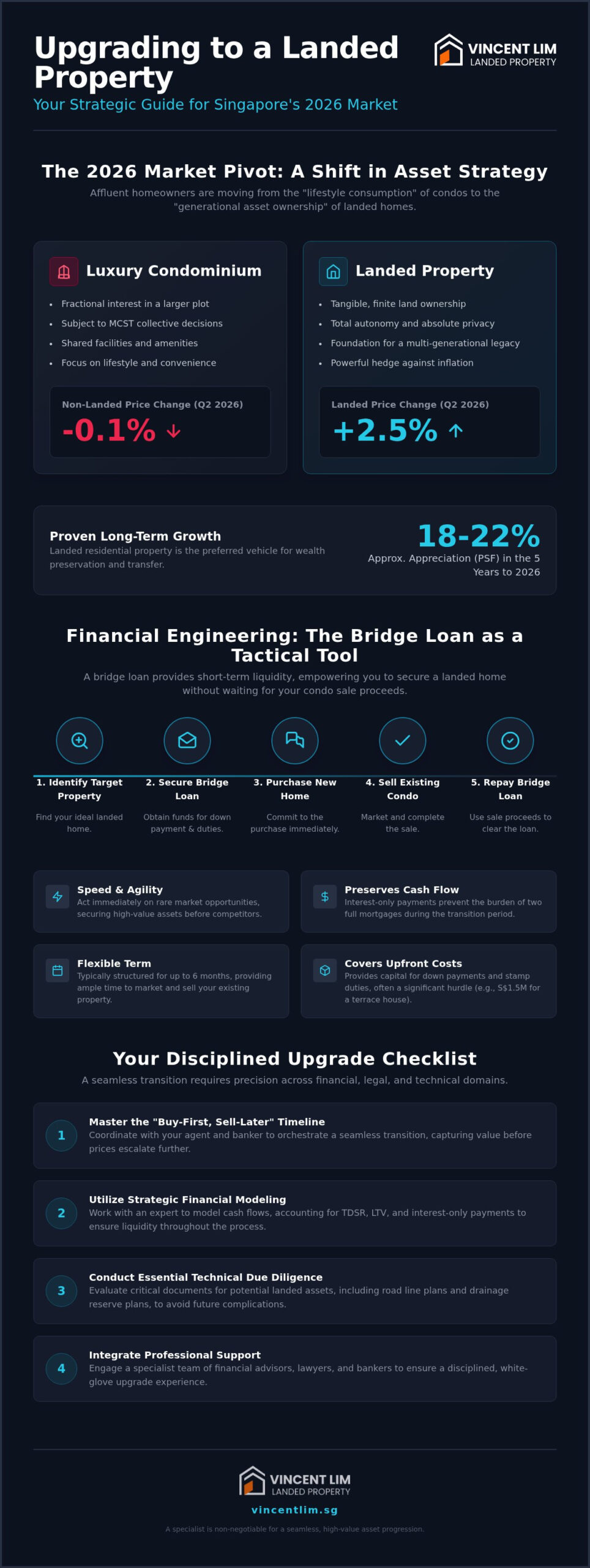
The year 2026 marks a decisive pivot in how Singapore’s affluent homeowners view their primary residence. We’re observing a clear shift from “lifestyle consumption” in luxury condominiums toward the “asset ownership” found in landed property. While high-end condos offer shared facilities and concierge services, they lack the one element that defines long-term wealth in a land-scarce city state: the land itself. For many, the realization has set in that a 1,500 square foot apartment, regardless of its finishing, remains a fractional interest in a larger plot. In contrast, a landed home represents a tangible, finite resource that serves as a powerful hedge against inflation.
The psychological advantage of ground-space ownership cannot be overstated. Beyond the prestige, it offers absolute privacy and a foundation for a multi-generational legacy. In the current economic landscape, the landed home has evolved into a safe-haven asset. Utilizing a bridge loan for upgrading to landed property singapore has become a standard tactical move for owners who recognize that waiting for a condo sale could mean missing a rare opportunity. When a prime terrace or semi-detached house enters the market, the ability to act with speed is often the difference between securing a legacy and settling for a compromise.
Condo Amenities vs. Landed Autonomy
Transitioning from a facility-managed lifestyle to bespoke home management is a significant step toward total autonomy. You’re no longer subject to the collective decisions of a Management Corporation Strata Title (MCST) or the frustrations of shared facility schedules. This exclusivity eliminates disputes over estate maintenance and allows for complete control over your living environment. A bridge loan facilitates this immediate transition, providing the liquidity needed to commit to a purchase while your existing condominium is still being marketed. It’s about trading a shared gym for the freedom to build your own private sanctuary, ensuring your capital is working toward your specific vision of home.
The 2026 Macro-Economic Argument for Landed Property
The data from the first half of 2026 confirms the resilience of the landed segment. While non-landed private home prices saw a slight decrease of 0.1 percent in Q2 2026, landed property prices increased by 2.5 percent in the same period. This divergence highlights the inherent value of scarcity. Land scarcity remains the primary factor for Singapore’s landed price floors, creating a natural barrier against market volatility. Over the five years leading up to 2026, landed residential property has appreciated by approximately 18 to 22 percent on a per-square-foot basis. This track record makes it the preferred vehicle for wealth transfer, as the “Legacy Factor” ensures that the asset you buy today remains a coveted prize for the next generation.
Financial Engineering: How Bridge Loans Facilitate the Landed Upgrade
At its core, a bridge loan is a short-term liquidity instrument designed to cover the financial “gap” between the purchase of your new landed home and the receipt of proceeds from your existing luxury condominium. In the high-stakes environment of 2026, where a terrace house often requires a S$1.5 million upfront commitment for down payments and stamp duties, timing is everything. This facility allows you to act immediately when a rare landed unit becomes available, rather than waiting for your condo sale to conclude. Under official MAS bridging loan regulations, these loans are structured to provide temporary capital, typically for a period of up to six months.
The primary benefit of this strategy is the interest-only payment structure. During the transition period, you aren’t burdened with full principal repayments on two properties. This preserves your monthly cash flow, allowing you to manage relocation or minor renovation costs without liquidity stress. You can also utilize your CPF Ordinary Account (OA) funds to service the interest or pay down the bridge loan once your condo sale completes, provided the necessary charge is in place. Modeling these cash flows with an expert in complex asset progression ensures that every dollar is accounted for before you commit to an Option to Purchase.
Bank vs. Private Bridge Loans: A Strategic Comparison
Choosing between a retail bank and a private lender depends on your specific timeline and the complexity of your current portfolio. While banks offer lower interest rates, private lenders provide the speed required for highly competitive auctions or distressed sales. In 2026, bank bridge loan rates generally hover between 4% and 5.5% per annum, often pegged to the 3-Month Compounded SORA or a bank’s Prime Rate.
| Feature | Bank Bridge Loan | Private Bridge Loan |
|---|---|---|
| Maximum Tenure | Up to 6 Months | Up to 12 Months (Flexible) |
| LTV Ratio | Up to 25% of Purchase Price | Bespoke / Asset-Backed |
| Approval Speed | 2 to 3 Weeks | 24 to 48 Hours |
| 2026 Rates | Approx. 4% – 5.5% p.a. | 1% – 4% per month |
TDSR and ABSD Considerations for Upgraders
A critical advantage of a bridge loan for upgrading to landed property singapore is its interaction with the Total Debt Servicing Ratio (TDSR). Bridge loans with a tenure of six months or less are typically exempt from the 55% TDSR cap, meaning they don’t impact your eligibility for the main mortgage on your new landed home. This is vital for high-net-worth individuals who may already have significant credit commitments.
Furthermore, you must manage the Additional Buyer’s Stamp Duty (ABSD) remission timeline with precision. For Singapore Citizens buying a second property, the 20% ABSD must be paid upfront. However, you can apply for a remission if you sell your first property within six months of purchasing the landed asset. This requires a disciplined “Buy-First, Sell-Later” schedule, where the bridge loan provides the necessary runway to execute the sale of your condominium at its peak valuation rather than rushing into a fire sale.
Asset Selection: Navigating the Spectrum from Terrace Houses to GCBs
Selecting the right landed asset isn’t just a matter of lifestyle preference; it’s a calculated move that must align with your financial runway. In 2026, the entry-level benchmark for landed property has stabilized at approximately S$5 million. Successfully securing a bridge loan for upgrading to landed property singapore allows you to compete in this fast-moving market where scarcity drives value. Your bridge loan capacity effectively determines which segment of the landed spectrum you can capture while your condominium sale is in progress. Whether you’re targeting an intermediate terrace or an expansive bungalow, the goal is to match your liquidity to the specific appreciation profile of the asset class.
For many high-net-worth individuals, consulting a practical guide to bridging loans provides the baseline understanding of how these instruments facilitate high-value acquisitions. However, the true strategy lies in identifying which property type offers the best “stepping stone” for your portfolio. While terrace houses offer a lower entry point, semi-detached and detached homes provide the significant land area required for substantial long-term capital gains and legacy planning.
Terrace Houses as a Strategic Entry Point
Evaluating the capital appreciation potential of terrace houses for sale in Singapore reveals why they are the preferred starting point for condo upgraders. Corner terraces, in particular, often serve as a “bridge” asset. They offer almost the same privacy and land size as a semi-detached home but at a more accessible price point. When assessing these units, we prioritize land frontage and depth. A wider frontage not only enhances curb appeal but also significantly impacts the future redevelopment potential and valuation of the property. In a market where landed prices rose by 2.5 percent in Q2 2026, these technical details are what preserve your equity.
The Detached and GCB Segment
Moving into the upper echelons of the market requires a more sophisticated approach. Acquisitions of detached houses for sale in Singapore require specialized financial modeling because the capital outlay and maintenance costs are substantially higher. At the pinnacle of this journey sits the Good Class Bungalow (GCB). You can explore the nuances of these elite estates in this definitive guide to Good Class Bungalows. In the GCB segment, bridge loans are often used to secure “off-market” opportunities. These are exclusive listings where the seller demands a quick, certain transaction. Having your bridge financing ready allows you to act as a cash-equivalent buyer, providing the leverage needed to secure Singapore’s most prestigious asset class before it ever reaches the public market.
The Buy-Sell Timeline: Orchestrating a Seamless Transition
Orchestrating a move from a high-value condominium to a landed estate requires a level of precision that goes beyond simple brokerage. The “Buy-First, Sell-Later” strategy is the preferred path for elite upgraders who refuse to let market timing dictate their lifestyle. By utilizing a bridge loan for upgrading to landed property singapore, you can secure your ideal terrace or semi-detached home the moment it hits the market, ensuring you don’t lose the unit while waiting for your condominium’s sales proceeds. This approach treats your transition as a controlled project rather than a series of reactive decisions.
The execution follows a disciplined four-step sequence. First, you must secure an In-Principle Approval (IPA) for both your bridge loan and your long-term mortgage to establish a firm acquisition ceiling. Second, once the right landed asset is identified, you execute the Option to Purchase (OTP). Third, your bridge loan is activated to cover the 25 percent downpayment gap that is normally tied up in your current property’s equity. Finally, you finalize the sale of your condominium within the stipulated window, using the net proceeds to redeem the bridge loan before the tenure expires. This methodical flow preserves your liquidity and provides the peace of mind necessary for high-stakes transitions.
Risk Mitigation and Exit Strategies
A primary concern for many upgraders is the possibility of a delayed condominium sale. To mitigate this, we prioritize a realistic, data-driven valuation of your current asset to ensure it moves within the six-month bridge loan window. If market conditions shift, exploring loan extensions or alternative private financing becomes necessary to avoid capital stress. The Redemption Clause in 2026 bridge loan contracts mandates that the loan be fully settled immediately upon the legal completion of your condominium sale or at the end of the six-month tenure, whichever occurs first. Understanding these contractual nuances is vital for a risk-averse exit.
Technical Due Diligence Before Commitment
In the landed segment, financial readiness must be paired with technical due diligence. Road line plans and drainage reserves are critical factors that can restrict your effective land area or future redevelopment potential. Before committing your bridge loan capital, it’s essential to factor in potential Addition & Alteration (A&A) costs into your initial request. We ensure the land has clear redevelopment potential to justify the premium price you are paying. To manage these complexities with professional oversight, you can secure a strategic consultation to align your timeline with Singapore’s unique regulatory requirements.
Strategic Wealth Planning: Why a Specialist is Non-Negotiable
Transitioning to a landed home is rarely just about the current transaction. It’s a strategic move within a broader 10-year asset progression to landed property plan. While many firms focus solely on the immediate funding, an elite strategist views the bridge loan for upgrading to landed property singapore as a single component in a complex wealth preservation engine. This level of planning ensures that your move from a luxury condominium into a terrace or semi-detached house isn’t just a change of address; it’s a calculated step toward a lasting legacy.
The Vincent Lim (OrangeTee & Tie) approach provides white-glove coordination across every stakeholder involved in your upgrade. This includes aligning private bankers, specialized real estate lawyers, and independent valuers to ensure every technical and financial detail is airtight. This level of oversight is particularly critical when accessing off-market inventory. Many of Singapore’s most coveted landed assets, especially in the GCB segment, never reach public portals. Securing these units requires a network built over decades, allowing you to capture value before the wider market even becomes aware of the opportunity.
Bespoke Brokerage for High-Stakes Upgrades
With over 20 years of industry experience since 2004, I’ve seen how “valuation gaps” can jeopardize even the most promising upgrades. If a bank’s valuation falls short of the purchase price, your bridge loan capacity may be compromised. Professional intervention at the negotiation stage prevents these pitfalls. Beyond the numbers, an advisor manages the psychological stress of high-value transitions, transforming a potentially volatile process into a steady, disciplined progression. This allows you to focus on the long-term goal of evolving your portfolio from a single condominium into a strategic landed estate.
Securing Your 2026 Landed Legacy
Executing this strategy effectively also means preparing your current luxury condo for a high-value sale. The 2026 market window favors those with ready liquidity, as the divergence between landed and non-landed segments continues to widen. By securing a bridge loan for upgrading to landed property singapore now, you position yourself to acquire a scarce land asset while the non-landed market supply remains high. If you’re ready to master the financial mechanics of this transition, I invite you to book a private strategic consultation to map out your bespoke path to landed ownership.
Mastering Your Move to Singapore’s Most Coveted Asset Class
The transition from a luxury condominium to a landed estate is a defining moment for your family’s wealth. We’ve explored how a bridge loan for upgrading to landed property singapore serves as a tactical liquidity tool, allowing you to capture scarce units before market prices escalate further. By prioritizing technical due diligence and a disciplined “Buy-First, Sell-Later” timeline, you eliminate the risk of missing generational opportunities while your capital remains tied to your current residence.
Navigating this high-stakes shift requires more than just financing; it demands a partnership with an expert who understands the nuances of the 2026 market. With over 20 years of experience since 2004, I specialize in Good Class Bungalows and high-value landed assets. My approach combines meticulous asset progression modeling with white-glove coordination to ensure your transition is seamless and secure. Secure your family’s legacy; consult with Vincent Lim for your strategic landed upgrade today. You’ve worked hard to reach this milestone, and it’s time to anchor your success in the permanence of Singapore’s limited land.
Frequently Asked Questions
Can I use a bridge loan for a Good Class Bungalow (GCB) acquisition?
Yes, bridge loans are frequently utilized for Good Class Bungalow acquisitions to provide the necessary speed for high-stakes transactions. In the GCB market, where properties can exceed S$65 million, these loans allow you to act as a cash-ready buyer. This is particularly effective for securing off-market opportunities where the seller demands a certain and swift completion timeline while your current luxury asset is still on the market.
What is the typical interest rate for a property bridge loan in Singapore in 2026?
In 2026, bank bridge loan interest rates generally range from 4% to 5.5% per annum. For example, the DBS Prime Rate is currently 4.25% as of July 23, 2026. While some loans are pegged to the 3-Month Compounded SORA, others follow a bank’s internal prime lending rate. This interest-only structure is a core component of a bridge loan for upgrading to landed property singapore, ensuring your monthly cash flow remains manageable.
Can Singapore Permanent Residents (PRs) use bridge loans for landed upgrades?
Singapore Permanent Residents can use bridge loans for landed property upgrades, provided they have already obtained the mandatory Land Dealings Approval Unit (LDAU) clearance. The financing mechanism functions identically for PRs, though you must account for the higher Additional Buyer’s Stamp Duty (ABSD) rates applicable to your residency status. It’s essential to coordinate the loan disbursement with your LDAU approval timeline to ensure a seamless acquisition process.
How long is the maximum tenure for a bank-issued bridge loan?
The maximum tenure for a standard bank-issued bridge loan in Singapore is six months. This duration is specifically designed to cover the period between exercising the Option to Purchase for your new landed home and the legal completion of your current condominium sale. If your transition requires a more extended timeline, private lenders can often provide bespoke solutions with flexible tenures, though these typically carry a different interest rate profile.
Is it possible to pay off a bridge loan early without penalties?
You can typically pay off a bridge loan early without any financial penalties. Since these are short-term facilities meant to bridge a specific liquidity gap, banks expect the loan to be redeemed as soon as your condominium sale proceeds are available. This flexibility is a significant advantage of a bridge loan for upgrading to landed property singapore, as it allows you to minimize interest costs the moment your capital is unlocked.
Can my CPF funds be used to repay the interest on a bridge loan?
Your CPF Ordinary Account funds can be used to repay both the principal and the interest of a bridge loan once your property sale is finalized. After the sale of your existing home, the refunded CPF proceeds can be channeled toward settling the bridge facility. This strategy is highly effective for preserving your cash reserves, though it requires precise coordination with your law firm to ensure the CPF charges are correctly managed.
What documents are required to apply for a bridge loan for a landed property?
To apply for a bridge loan, you must provide the exercised Option to Purchase for your new landed property and the signed Sale and Purchase agreement for your current home. Additionally, banks require your latest three months of payslips, CPF contribution history, and the most recent income tax assessment. These documents allow the lender to verify your financial standing and ensure the bridge loan complies with current MAS debt servicing guidelines.
Do I need to have a signed Sales & Purchase agreement for my condo before applying?
Most banks require you to have at least a signed and exercised Option to Purchase (OTP) for your existing condominium before they will approve a bridge loan. This document provides the lender with the necessary assurance that a sale is in progress and establishes a definitive repayment date. Having this agreement in place is a prerequisite for activating the bridge loan to cover the 25 percent downpayment on your new landed residence.