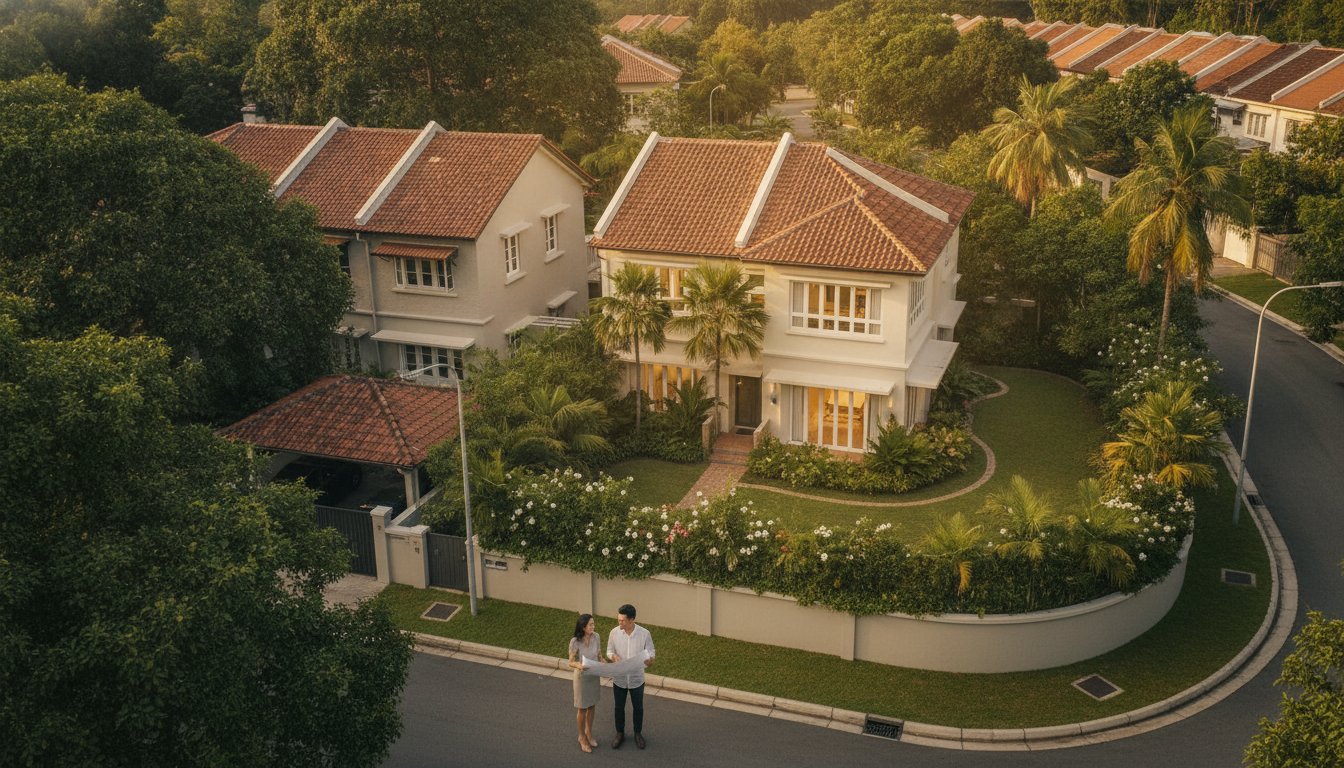
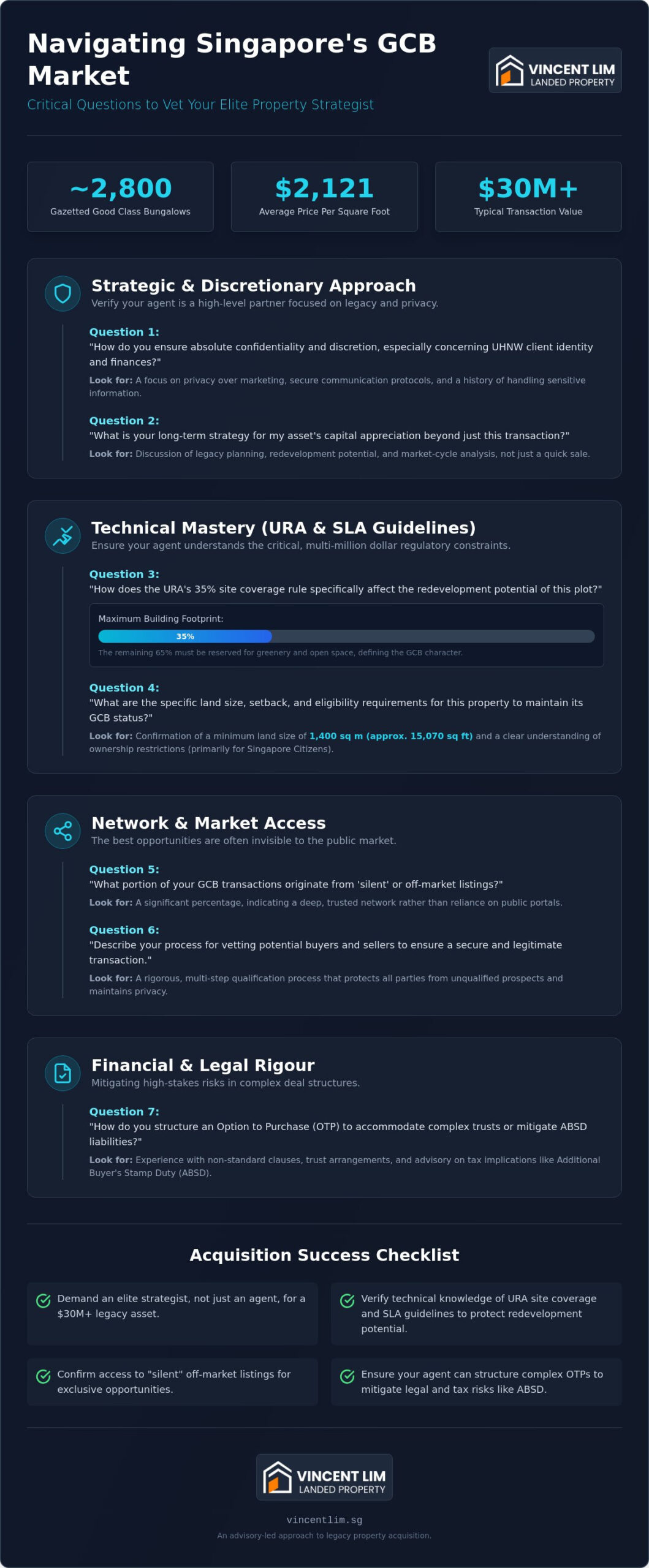
In the rarefied world of Singapore’s Good Class Bungalow market, a standard real estate transaction simply does not exist. You’re managing a legacy asset acquisition where a single oversight in URA site coverage or a misunderstanding of the 35% plot limit can cost millions. You likely recognize that securing one of the approximately 2,800 gazetted GCBs requires more than just capital. It demands a strategist who can navigate the 2026 market cooling and average prices of $2,121 per square foot with surgical precision. Identifying the right questions to ask a GCB agent is the only way to verify if your representative possesses the technical depth to handle SLA compliance and access “silent” off-market listings.
This guide provides the critical inquiries that separate elite GCB strategists from generalist agents. By asking these questions, you ensure your transaction remains discreet, fully compliant with strict planning parameters, and optimized for long-term capital appreciation. We’ll examine fifteen essential areas of inquiry, ranging from technical redevelopment constraints to sophisticated negotiation tactics tailored for the current price floor reset. You’ll gain the clarity needed to select a partner who protects your interests in a high-stakes environment where transparency is the ultimate currency.
Key Takeaways
- Recognize why a GCB acquisition demands an elite strategist who manages the professional accountability inherent in $30M+ transactions.
- Identify the technical questions to ask a GCB agent concerning URA site coverage and SLA guidelines to protect your property’s redevelopment potential.
- Evaluate an agent’s ability to source “silent” off-market listings and vet buyers to ensure a secure, discreet acquisition process.
- Learn to structure Options to Purchase that accommodate complex trust arrangements while mitigating high-stakes legal and ABSD risks.
- Understand how a bespoke, advisory-led approach refines the acquisition journey to prioritize your long-term legacy and capital appreciation.
Beyond the Transaction: Why a GCB Agent Must Be an Elite Strategist
High-stakes acquisitions require a fundamental shift in perspective. A GCB agent isn’t a mere facilitator; they are a high-level partner. With transaction values frequently exceeding $30 million, the level of professional accountability increases exponentially. A standard broker might focus on the immediate sale, but an elite strategist considers the asset’s performance over decades. This distinction is vital because the GCB market operates on a different plane of complexity. It’s about protecting wealth, not just finding a home.
Confidentiality is the cornerstone of the GCB sector. White-glove service means more than just luxury; it involves maintaining a fortress of privacy around the client’s identity and financial arrangements. Mass-market agents often prioritize visibility to drive more leads, but a veteran strategist understands that discretion is the highest priority for UHNW individuals. This advisory approach ensures that your move into the market is quiet, calculated, and secure. Identifying the right questions to ask a GCB agent will help you determine if they prioritize your privacy over their own marketing reach.
The Difference Between a Generalist and a GCB Specialist
General residential experience rarely translates to the technical nuances of the GCB segment. While a standard agent understands floor plans and basic zoning, a specialist masters the intricacies of URA planning parameters and SLA guidelines. It’s essential to understand what is a good class bungalow beyond the surface level. True Good Class Bungalows are defined by strict density controls and historical gazetting that a generalist might overlook. An elite strategist views these assets through the lens of legacy planning, ensuring that the property’s potential for capital appreciation remains intact for future generations.
Establishing Reassuring Professionalism from the First Meeting
Your first interaction sets the tone for the entire acquisition journey. Look for a communication rhythm that is methodical and intentional rather than rushed or overly sales-driven. A disciplined professional provides a clear, step-by-step roadmap for the transaction. Transparency isn’t just a buzzword; it’s the mechanism that builds trust for multi-generational asset management. You need a partner who presents data with seasoned authority and grounded confidence. This level of professionalism ensures you aren’t just making a purchase, but executing a well-planned strategic move. Knowing the specific questions to ask a GCB agent about their process will help you gauge their commitment to this gold standard of service.
Technical Mastery: Questions Regarding URA Guidelines and Eligibility
The transition from identifying a partner to verifying their technical depth is where many transactions fail. You aren’t just buying land; you’re acquiring a set of rights and restrictions governed by the Urban Redevelopment Authority (URA) and the Singapore Land Authority (SLA). These regulatory bodies maintain the low-density character of GCB areas through stringent planning parameters. Failing to probe these technicalities early can lead to acquiring a plot that doesn’t meet your architectural vision or investment goals. It’s why specific questions to ask a GCB agent must focus on the “buildable” reality of the land.
Navigating URA and SLA Constraints
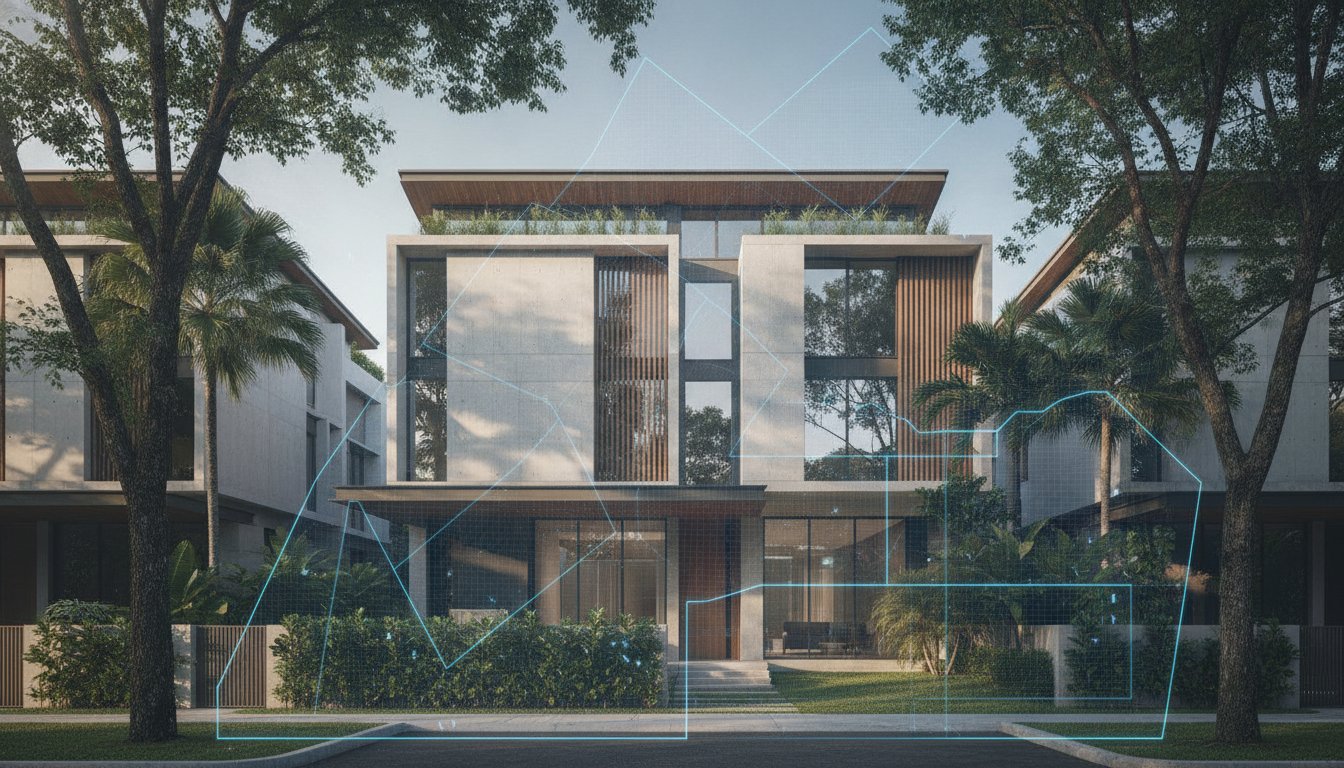
The URA site coverage rule strictly limits the building footprint to a maximum of 35% of the total land area for GCBs. This ensures the lush, green environment that defines the elite residential experience. When vetting a property, ask: ‘How do URA’s 35% site coverage rules specifically affect the redevelopment potential of this plot?’ This question reveals if the agent understands the setbacks and the actual footprint versus the total gcb land size, which must be at least 1,400 square meters for a gazetted GCB.
Eligibility is another complex layer. While current regulations generally restrict GCB ownership to Singapore Citizens, Permanent Residents (PRs) occasionally seek approval through the Land Dealings Approval Unit (LDAU). Ask: ‘What are the latest SLA guidelines regarding PR eligibility for this specific GCB area?’ A qualified strategist will provide a realistic assessment of the current landscape rather than a vague promise. For those looking to refine their portfolio, engaging an elite property consultant can clarify these legal hurdles before you commit capital.
Evaluating Redevelopment and Legacy Potential
Beyond the footprint, you must consider what’s hidden within the soil and the skyline. Ask: ‘Can you identify any conservation requirements or tree-planting zones on this land?’ Some GCBs are gazetted for conservation, or contain mature trees that cannot be removed, significantly impacting your rebuild plans. The land’s elevation is also critical. Ask: ‘How does the plot’s topography affect the buildable basement or attic space under current regulations?’ A sloping plot might offer unique opportunities for a walk-out basement that a flat plot cannot match.
These technical questions are essential for anyone viewing this acquisition as part of a broader asset progression to landed property singapore strategy. Understanding whether a property allows for a total rebuild or just “additions and alterations” (A&A) determines its long-term legacy value. Freehold assets naturally command a premium, but their value is only as strong as the development potential allowed by URA guidelines. Precision here prevents overpayment and ensures your acquisition remains a high-performing legacy asset.
Assessing the Network: Questions on Sourcing and Discreet Marketing
In the ultra-high-net-worth segment, the most coveted assets rarely appear on public portals. While mass-market properties rely on high-volume advertising, GCB transactions thrive on exclusivity and silence. An agent’s value is often measured by the strength of their private network rather than their public listings. This is where the strategic questions to ask a GCB agent shift from technical compliance to market access and relationship capital. You need to know if your representative can open doors that remain closed to the general public.
The Power of the ‘Silent’ Market
The best GCB deals often never hit the public market to protect the privacy of prominent families and high-profile sellers. Accessing these opportunities requires an agent who maintains deep connections with family offices, private banks, and other top luxury property agents. You should ask: ‘Do you have direct access to “pocket listings” that are not on PropertyGuru or 99.co?’ This determines if the agent is merely browsing public data or operating within the inner circles of the Singaporean elite.
Understanding the agent’s track record is equally revealing. Ask: ‘What percentage of your GCB transactions in the last 24 months were closed off-market?’ A high percentage suggests a professional who is trusted with sensitive information and can execute transactions without the noise of public bidding. This “silent” approach ensures that you aren’t competing with the general public for a limited pool of approximately 2,800 gazetted bungalows. It preserves the asset’s prestige and your own anonymity throughout the acquisition process.
Vetting and Qualification Strategies
Privacy is a two-way street. A landed property specialist must protect the seller’s sanctuary while ensuring the buyer’s intent is genuine. Ask: ‘How do you vet potential buyers to ensure they have the financial liquidity before a viewing?’ In a market where transactions often start at $30 million, proof of funds and wealth profile verification are non-negotiable steps before a front gate ever opens. This level of rigor prevents unqualified individuals from entering private estates and preserves the integrity of the process.
Finally, inquire about the communication strategy. Ask: ‘What is your strategy for maintaining the privacy of high-profile sellers during the marketing phase?’ An elite strategist coordinates with legal and tax advisors to ensure the narrative remains controlled. They prioritize quality over volume, targeting only the individuals who match the property’s unique legacy. These questions to ask a GCB agent will clarify whether your representative has the sophistication to manage a discreet acquisition or if they are still operating with a transactional, mass-market mindset.
Financial and Legal Rigour: Questions to Mitigate High-Stakes Risks
The financial architecture of a GCB acquisition is significantly more complex than a standard residential purchase. At the $30 million level and beyond, errors in tax calculation or contract structuring can lead to multi-million dollar liabilities. This stage of your due diligence requires a professional who moves beyond basic brokerage into the realm of financial risk management. Your representative must demonstrate an ability to coordinate with your family office, tax consultants, and legal counsel. Every dollar must be accounted for. Every risk must be mitigated.
Precision in these areas is the only way to achieve genuine peace of mind during a high-stakes transaction. Identifying the right questions to ask a GCB agent regarding their financial logic will quickly reveal if they possess the necessary rigour to protect your capital. A strategist who lacks this depth can inadvertently expose you to legal complications or inefficient tax structures that diminish the value of your legacy asset.
Mitigating ABSD and Ownership Risks
The regulatory environment in 2026 demands absolute precision regarding the Additional Buyer’s Stamp Duty (ABSD). With rates for Singapore Citizens purchasing their second property at 20% and third properties at 30%, the financial stakes are high. You should ask: ‘Can you provide a detailed breakdown of the ABSD implications for a PR vs. a Citizen in this transaction?’ This question tests the agent’s current knowledge of the progressive stamp duty rates that have defined the market since the 2023 cooling measures.
Many GCB buyers utilize trusts or corporate structures for legacy planning. You must ask: ‘How should we structure the Option to Purchase (OTP) to allow for complex financing or trust arrangements?’ An elite strategist understands how to draft nomination clauses and extension periods that accommodate the landed property transaction process without triggering unnecessary tax events. This level of foresight is the cornerstone of the white-glove experience. It ensures your wealth is protected through disciplined, methodical planning.
Valuation Accuracy in a Low-Volume Market
GCB markets are notoriously illiquid. Some districts see only a handful of transactions per year. Relying on simple “per square foot” averages is a red flag that indicates a generalist mindset. Instead, you need to ask: ‘What is the recent “caveat lodged” data for this specific GCB area, and how does it affect our valuation?’ This forces the agent to analyze actual transacted data from the URA database rather than speculative asking prices.
A critical challenge is the “valuation gap.” Bank appraisals may not always mirror the premium for a rare plot in 2026. Ask: ‘How do you handle the valuation gap if the bank’s indicative value is lower than the asking price?’ A veteran professional will have strategies for justifying a higher property valuation for landed house based on unique architectural merits, frontage, or historical scarcity. Identifying red flags in an agent’s valuation logic is critical. Watch for these signs of a generalist:
- Using broad district averages for a unique GCB plot without adjustment.
- Ignoring the impact of the 20% or 30% ABSD on your total cash outlay.
- Failing to account for how topography or frontage affects the per-square-foot premium.
If you require a partner who can navigate these complex financial waters with seasoned authority, engaging a dedicated GCB advisor ensures your acquisition remains a robust financial asset.
Partnering for Success: How Vincent Lim Refines the GCB Acquisition Process
Identifying the right questions to ask a GCB agent is the foundation of a secure transaction, but the execution requires a partner who has mastered the market’s nuances over decades. Vincent Lim, an Executive Associate Director at OrangeTee & Tie, brings over 20 years of seasoned experience to the table. His approach isn’t merely about facilitating a sale; it’s about acting as an elite strategist for individuals who view real estate as a multi-generational legacy. In a market where only 11 GCB deals were recorded in the first half of 2026, every transaction is a rare event that requires surgical precision and a high degree of professional accountability.
Vincent’s methodology eliminates the friction often associated with multi-party GCB deals by prioritizing meticulous planning and unwavering transparency. He coordinates the complex intersection of legal counsel, tax advisors, and architects, ensuring that every technical constraint discussed in previous sections is managed proactively. This advisory-led approach provides clients with the peace of mind that their acquisition is not only compliant with URA and SLA regulations but also optimized for long-term capital appreciation. It’s a “white-glove” service level where the client’s interests are protected with disciplined, calculated competence.
A Legacy of Excellence in Singapore Landed Property
Throughout his career, Vincent Lim has established a formidable track record in the sale of detached houses and Good Class Bungalows. He understands that the elite buyer profile is almost exclusively Singaporean in 2026, requiring a deep understanding of local wealth structures and family office requirements. By being industry-aware yet intensely client-focused, Vincent bridges the gap between technical requirements and client ease. He translates the complexity of the 2026 price floor reset, where deals below $25 million have become unusual, into actionable strategies for his clients. This ensures you aren’t just reacting to the market, but moving with controlled momentum toward a successful acquisition.
Your Next Step in GCB Acquisition
The journey toward acquiring a legacy asset shouldn’t be defined by stress or uncertainty. It requires a partner who manages the fine details of luxury residences while maintaining the highest standards of discretion. Whether you’re navigating the current market cooling or looking to capitalize on the rare negotiating power available in 2026, professional guidance is your most valuable asset. The most critical questions to ask a GCB agent often revolve around their ability to manage the “silent” market, and Vincent’s extensive network provides the direct access you need.
We invite you to schedule a confidential consultation to refine your property strategy and explore how an elite strategist can secure your next high-stakes transaction. You can Contact Vincent Lim for a bespoke GCB market analysis that aligns with your long-term legacy goals. Let a veteran professional guide you through the complexities of the Singaporean landed property market with the transparency and expertise your portfolio deserves.
Securing Your Legacy in the GCB Market
Acquiring a Good Class Bungalow is an exercise in precision where the margin for error is non-existent. You now possess the framework to distinguish between a standard broker and an elite strategist. By focusing on technical URA constraints, off-market network access, and financial rigour, you ensure your capital is protected. These questions to ask a GCB agent serve as your primary defense against the inefficiencies of a generalist approach. Transitioning into this exclusive market requires a partner who operates with the same level of discipline you apply to your own wealth management.
Vincent Lim, Executive Associate Director at OrangeTee & Tie, provides the seasoned authority necessary for these high-stakes transactions. With over 20 years of industry expertise and a specialization in high-value GCB and luxury landed property sales, he refines the acquisition process into a seamless, white-glove experience. You don’t have to navigate the complexities of the 2026 regulatory landscape alone. Refine your GCB acquisition strategy with Vincent Lim to secure a legacy asset that stands the test of time. Your path to a discreet and optimized transaction begins with a single, strategic conversation.
Frequently Asked Questions
Can a Singapore Permanent Resident (PR) buy a Good Class Bungalow?
Ownership is strictly reserved for Singapore Citizens. While Permanent Residents may apply for special approval through the Land Dealings Approval Unit (LDAU), such grants are exceptionally rare and subject to stringent criteria regarding economic contribution. Since 2023, the approval process has tightened significantly. Any approved non-citizen acquisition is also subject to a 60% Additional Buyer’s Stamp Duty (ABSD).
What is the minimum land size required for a property to be classified as a GCB?
A property must occupy a minimum plot area of 1,400 square meters, which is approximately 15,069 square feet, to be classified as a Good Class Bungalow. This requirement ensures the low-density, lush character of the 39 gazetted GCB areas. If a plot is smaller than this due to historical sub-division, it may still reside within a GCB area but must adhere to specific URA planning guidelines for that zone.
How long does the GCB transaction process typically take in Singapore?
A standard GCB transaction typically spans three to four months from the granting of the Option to Purchase (OTP) to legal completion. However, this timeline often extends if the deal involves complex trust structures or offshore financing. Meticulous planning during the initial stages is essential to ensure that all legal and financial milestones are met without friction or delay.
Do GCB agents charge a higher commission than standard property agents?
Commission rates for GCB transactions generally align with the industry standard of 2%, though the complexity of the service often justifies a bespoke advisory approach. Unlike mass-market sales, GCB deals involve extensive off-market sourcing and coordination with tax and legal professionals. When considering questions to ask a GCB agent, you should clarify their fee structure and the specific white-glove services included in their representation.
What are the restrictions on rebuilding or renovating a Good Class Bungalow?
The Urban Redevelopment Authority (URA) enforces strict limits, including a maximum site coverage of 35% and a building height of two storeys. While attics and basements are permitted, they must comply with specific setback and drainage requirements. Any renovation or rebuild must preserve the low-density character of the area, and conservation-gazetted bungalows face even more rigorous restrictions regarding original architectural features.
How do I verify the track record of a GCB agent before hiring them?
You can verify an agent’s credentials through the Council for Estate Agencies (CEA) Public Register to view their transacted properties. Beyond public records, request a detailed list of caveat lodged data for GCBs they’ve handled in the last 24 months. A veteran strategist should be able to discuss specific technical challenges they resolved during those transactions, demonstrating their competence in managing high-stakes acquisitions.
Why are some GCBs sold through an ‘Expression of Interest’ (EOI) instead of a direct sale?
Sellers use the Expression of Interest (EOI) process to gauge market sentiment and discover the asset’s true value without committing to a public asking price. This method is common for high-profile estates where privacy is paramount. It allows the representative to vet potential buyers’ liquidity and intent before entering formal negotiations, ensuring that only qualified parties participate in the process.
What happens if the URA changes the zoning or site coverage rules for a GCB area?
URA guidelines are designed to preserve the long-term character of these elite enclaves, and significant changes are rare. If a policy shift occurs, it typically applies to new redevelopment projects rather than existing structures. An elite strategist stays ahead of these regulatory trends, providing you with the foresight needed to protect your property’s legacy value against potential planning updates. These are essential questions to ask a GCB agent during your initial consultation.