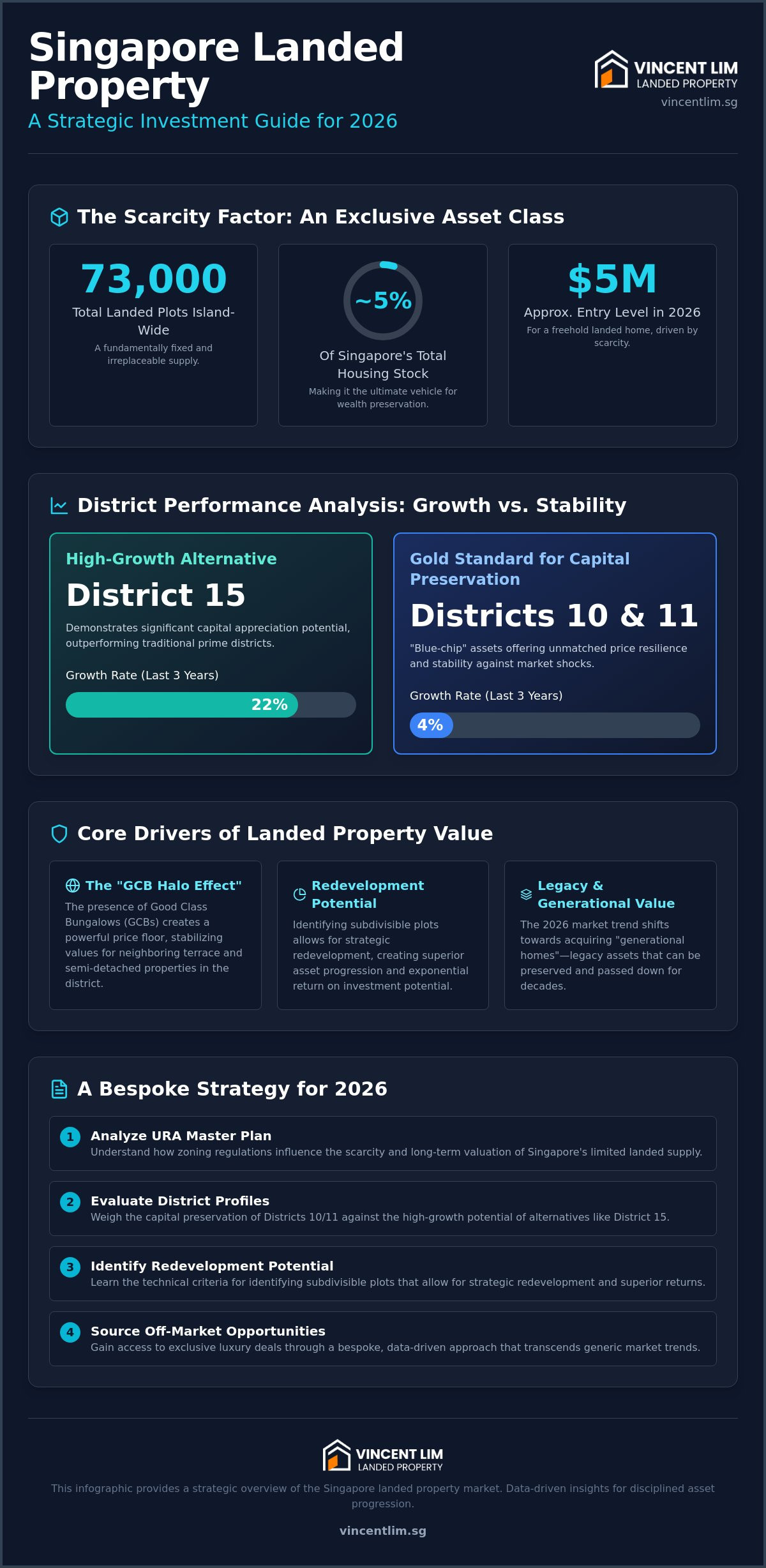
With only 73,000 landed plots across the island, the scarcity of Singapore’s most prestigious assets has pushed the entry level for a freehold home to approximately $5 million in 2026. While many investors reflexively target the traditional prime areas, recent data reveals that District 15 has outperformed these stalwarts with a 22% growth rate over the last three years. Identifying the best districts for landed property investment requires more than just following prestige; it demands a calculated look at URA zoning changes and specific redevelopment potential.
You likely recognize that landed property remains the ultimate vehicle for long-term wealth preservation, yet the fear of overpaying in a peak market or misinterpreting complex redevelopment rules is a valid concern. This strategic analysis will identify the high-performing districts that offer the most resilient capital appreciation and legacy value for your portfolio. We’ll examine the specific ROI drivers for terrace houses and detached bungalows, providing you with a clear roadmap for disciplined asset progression in this high-stakes environment.
Key Takeaways
- Analyze how the 2026 URA Master Plan influences the scarcity and long-term valuation of Singapore’s limited landed housing supply.
- Discover the best districts for landed property investment by evaluating the capital preservation of Districts 10 and 11 against the high-growth potential of District 15.
- Learn the technical criteria for identifying subdivisible plots that allow for strategic redevelopment and superior asset progression.
- Understand the “GCB Halo Effect” and its role in stabilizing price floors for neighboring terrace and semi-detached properties.
- Gain insights into sourcing off-market luxury deals through a bespoke, data-driven approach that transcends generic market trends.
The Strategic Importance of District Selection in 2026
Selecting a location for a landed home in Singapore is a decision that extends far beyond lifestyle preferences. It’s a strategic move to secure a portion of an extremely limited resource. As of 2026, the market has matured into a landscape where precision in district selection determines both capital resilience and future liquidity. Identifying the best districts for landed property investment requires a deep understanding of how specific neighborhoods respond to economic shifts and urban planning initiatives.
The value of a landed asset is anchored by three specific pillars: accessibility to core business hubs, the density of nearby premium amenities, and the social status associated with the address. While many buyers focus on the structure itself, the land’s underlying value is dictated by its position within Singapore’s 55 official planning areas. These designations, managed by the Urban Redevelopment Authority (URA), define the redevelopment potential and long-term desirability of every plot. Certain districts act as a “safe haven,” offering a hedge against inflation because their demand remains constant even when the broader economy fluctuates.
Understanding the Landed Scarcity Factor
Landed properties comprise only about 5% of Singapore’s total housing stock. With approximately 73,000 plots available island-wide, this supply is essentially fixed. Unlike the condominium market, where new high-rise developments can be launched regularly, the landed segment cannot be expanded. This structural scarcity makes it the ultimate asset for wealth preservation in a land-scarce city-state.
Owning the land title provides a level of control that stratified titled properties lack. Investors can decide when to rebuild, how to optimize the plot’s footprint, or whether to subdivide a larger parcel for exponential ROI. This autonomy is a primary driver for the best districts for landed property investment. It ensures that the owner, rather than a management corporation, dictates the asset’s future value. In 2026, this level of control is increasingly prized by high-net-worth individuals looking for tangible security.
2026 Market Dynamics: Why Timing Matters
The market in 2026 is defined by a shift toward “generational homes.” Modern investors aren’t looking for short-term flips. They’re seeking legacy assets that can be passed down through decades. This trend has increased the demand for larger plots in districts with stable price floors. While entry-level prices remain high, the easing interest rate environment in 2026 has made the financing of these substantial transactions more predictable.
Timing your entry depends on monitoring district-level transaction volumes. When volume increases in a specific area, it often precedes a price correction upward. We use these localized data points to help clients spot emerging trends before they become common knowledge. This methodical approach ensures you aren’t just buying a home; you’re acquiring an investment-grade asset at a strategic moment in the market cycle.
Prime Districts 10 and 11: The Gold Standard for Capital Preservation
Districts 10 and 11 have long been regarded as the pinnacle of Singapore’s residential landscape. While other regions may offer higher short-term growth spikes, these core central areas provide a level of price resilience that is unmatched elsewhere. For investors whose primary objective is wealth protection and legacy planning, these remain the best districts for landed property investment due to their historical performance and structural scarcity. The enduring appeal of Bukit Timah, Holland Road, and Tanglin is grounded in the URA Master Plan, which strictly regulates land use to maintain the low-density, high-value character of these neighborhoods.
Recent market data highlights this stability. While District 15 experienced a 22% growth rate over the last three years, Districts 10 and 11 saw a more measured 4% increase. This contrast is vital for the sophisticated investor to understand. Lower volatility in these prime districts represents a “blue-chip” asset profile. It’s a stable store of value that resists market shocks; making it the preferred choice for those looking to park significant capital with peace of mind.
The Good Class Bungalow (GCB) Influence
The presence of Good Class Bungalow areas in District 10 creates a powerful “halo effect” that stabilizes the entire local market. Because GCBs are the most prestigious and restricted asset class in the country, they act as a permanent price floor. When GCB prices rise or hold steady, they provide a psychological and financial cushion for the surrounding terrace and semi-detached houses. This proximity to the ultra-wealthy ensures that demand remains constant, even during broader economic cooling periods.
Understanding the nuances of this segment is essential for any serious acquisition. For a deeper analysis of these elite plots, you may refer to our Definitive Guide to Good Class Bungalows. The extreme scarcity of GCBs directly impacts the pricing and desirability of standard detached houses for sale in Singapore, as buyers who are priced out of the GCB market often look to these large detached plots as the next best alternative.
Education and Lifestyle Anchors
The permanent value floor in District 11 is largely driven by its concentration of elite educational institutions. Proximity to schools like Nanyang Primary, Hwa Chong Institution, and Anglo-Chinese School (Barker Road) ensures a perpetual cycle of demand from affluent families. This “school-driven” demand is a unique characteristic of the Singapore market that transcends typical economic cycles. Families will often pay a premium to secure a home within the critical one-kilometer radius, providing investors with high liquidity when it comes time to exit.
Beyond education, the lifestyle amenities in these districts are irreplaceable. The Singapore Botanic Gardens, exclusive social clubs, and high-end dining enclaves in Dempsey Hill create an “Old Money” prestige factor that cannot be replicated in newer districts. If you’re seeking a property that combines social status with unwavering capital preservation, these prime areas remain the benchmark. Exploring the current inventory of detached houses for sale in Singapore within these districts is a prudent first step toward securing your family’s financial future.
Districts 15 and 21: High-Growth Alternatives for Asset Progression
While Districts 10 and 11 represent the pinnacle of stability, investors seeking more aggressive capital appreciation often pivot toward the Rest of Central Region (RCR). Districts 15 and 21 have emerged as the best districts for landed property investment for those prioritizing growth over pure preservation. According to the URA Q1 2026 real estate statistics, landed prices in these high-growth enclaves have shown a resilient upward trajectory, fueled by significant infrastructure improvements and a shift in buyer demographics. These areas offer a compelling investment profile, combining lower entry costs with the potential for substantial re-rating as urban transformations conclude.
The East Coast Transformation (District 15)
District 15 has moved beyond its reputation as a lifestyle enclave to become a premier transport hub. The full operationalization of the Thomson-East Coast Line (TEL) has fundamentally altered land values in the area. It’s no longer just about the sea breeze; it’s about seamless connectivity to the Central Business District and Marina Bay. This makes terrace houses for sale in Singapore within this district particularly attractive to young, affluent families who value both space and efficiency.
The growth data is striking. While prime districts have maintained steady performance, District 15 has seen a 22% growth rate over the last three years. This outperformance is driven by the narrowing price gap between the East Coast and traditional prime regions. Investors who recognized this trend early have benefited from significant equity gains, proving that lifestyle landed living can be as much about ROI as it is about recreation.
The Beauty World Evolution (District 21)
Similarly, District 21 is witnessing a revitalization centered on the Beauty World integrated transport hub. This development is breathing new life into established landed enclaves like Toh Tuck and Hoover Park. The area offers a unique dual appeal: immediate access to the Bukit Timah Nature Reserve and the modern convenience of a mixed-use transport node. For investors, this represents a rare opportunity to acquire land in a region where the “amenity density” is rapidly increasing.
For many homeowners, this district is the primary target for asset progression to landed property. It serves as a strategic bridge between high-end condominium living and the ultimate goal of freehold land ownership. While the market here can experience slightly more volatility than the Core Central Region, the long-term fundamentals are bolstered by the government’s commitment to decentralized commercial hubs. Investing here in 2026 allows you to capture the upside of an evolving neighborhood while still enjoying the prestige of a Bukit Timah-adjacent address.
Key Investment Metrics Beyond Location: Tenure and Redevelopment Potential
Successful acquisition in the landed segment involves looking past the prestige of an address to evaluate the technical attributes of the land itself. While identifying the best districts for landed property investment provides the foundation, the specific metrics of tenure and redevelopment potential dictate the ultimate trajectory of your ROI. In the 2026 market, where the entry price for a landed home averages $5 million, a disciplined analysis of land size and built-up efficiency is mandatory. Understanding the average price of semi-detached houses relative to their land area allows you to spot undervalued plots that others might overlook due to the age of the existing structure.
Redevelopment potential is often the “hidden” value in landed real estate. We look for properties where the current built-up area is significantly lower than what the URA “envelope control” guidelines allow. These guidelines, which replaced traditional plot ratio controls for landed housing, focus on the allowable building volume within a defined “envelope.” This shift has empowered owners to maximize their floor area, often adding a mezzanine or an attic to significantly increase the property’s utility and resale value. When you buy for land value rather than the house’s current condition, you’re essentially purchasing a blank canvas for capital growth.
The Tenure Debate: Freehold vs. Leasehold
The “Freehold Premium” in the 2026 market reflects the significant price gap buyers are willing to pay for indefinite ownership and the complete absence of lease decay. For most of our clients, freehold or 999-year leasehold properties are the non-negotiable standard for multi-generational wealth preservation. These tenures ensure that the asset’s value remains resilient even as the building ages, providing a permanent anchor for a family’s portfolio.
However, 99-year leasehold landed properties can make strategic sense for investors with shorter horizons or those prioritizing high rental yields. Because the entry price is lower, the gross rental yield, which typically hovers around 1.9% to 2.0% for semi-detached homes, can be slightly higher on a leasehold basis. Nevertheless, for those focused on legacy planning, the security of a freehold title remains the gold standard in a land-scarce city-state.
Redevelopment and Subdivision Strategies
Identifying “subdivisible” plots is the secret to achieving exponential ROI in the landed market. This strategy involves sourcing a large plot, such as a detached house on 800 square meters, and confirming through URA zoning that it can be split into two smaller semi-detached plots. The combined value of two new semi-detached houses almost always exceeds the value of a single aging bungalow. This requires a precise understanding of minimum plot sizes and frontage requirements, which are 200 square meters and 8 meters respectively for semi-detached homes.
Executing this strategy requires more than just capital; it requires a specialized network of architects and planners. Once the redevelopment is complete, the final step is to sell your landed property at the new market peak for modern, move-in-ready homes. If you are looking to identify plots with high redevelopment potential, we can provide a bespoke analysis of current off-market opportunities. Connect with our team to refine your acquisition strategy and secure a plot designed for maximum built-up efficiency.
Navigating the 2026 Landed Market with a Bespoke Strategy
The 2026 landed market is characterized by structural scarcity and high capital requirements. While identifying the best districts for landed property investment is a necessary foundation, it’s only the first step in a complex acquisition journey. High-stakes transactions in this segment require more than just access to public listings; they demand a bespoke strategy that aligns with your specific legacy goals. Generic market data often fails to capture the nuances of individual plots, such as drainage reserves, specific URA setback requirements, or the true redevelopment potential of an irregular land shape.
Relying on a seasoned professional allows you to move with a level of confidence that stems from long-term industry experience. An “Elite Strategist” serves as your dedicated advocate, refining your search to only include investment-grade assets that meet a gold standard of quality. This disciplined approach ensures that every acquisition is a calculated move toward wealth preservation rather than a reactive purchase in a peak market. Meticulous due diligence is particularly critical in 2026, given the 60% Additional Buyer’s Stamp Duty (ABSD) for foreigners and the tiered Seller’s Stamp Duty (SSD) for those exiting within three years.
The Value of a Landed Specialist
Accessing the most desirable properties often requires looking beyond public portals. In the luxury and GCB segments, many of the most significant deals occur off-market through “pocket listings.” These are exclusive opportunities shared only within a trusted network of veteran professionals. Vincent Lim leverages over 20 years of experience to identify these rare assets, providing his clients with a first-mover advantage in highly competitive districts. Negotiation for landed property is fundamentally different from the condominium market; there are rarely direct comparables for a unique freehold plot with specific redevelopment potential. We employ a methodical, results-oriented approach to ensure you don’t overpay while securing terms that protect your long-term interests.
Next Steps for Your Investment Journey
Refining your property portfolio requires a partner who values integrity and transparency above all else. We offer personalized district analysis reports that go beyond surface-level statistics to examine the specific ROI drivers of your target area. Whether you’re planning an asset progression from a luxury condominium or seeking a multi-generational detached house, a structured plan is essential. We invite you to schedule a private consultation to discuss your strategic objectives and align your acquisition with 2026 market dynamics. Partner with Vincent Lim for your next landed property investment and secure an asset that serves as a cornerstone for your family’s future wealth.
Strategizing for Long-Term Appreciation and Preservation
In the 2026 market, success is defined by the ability to distinguish between prestige and performance. While Districts 10 and 11 remain the gold standard for capital preservation, the high-growth potential of Districts 15 and 21 offers a compelling alternative for asset progression. Identifying the best districts for landed property investment is only the start. You must also master the technical nuances of tenure and URA envelope control to maximize your ROI.
Navigating these high-stakes transactions requires a partner with a proven track record. Vincent Lim brings over 20 years of expertise in Singapore’s luxury real estate market to every consultation. As an Executive Associate Director at OrangeTee & Tie, he specializes in high-value landed assets with a documented history of GCB and luxury condominium sales. His methodical approach ensures that your acquisition is protected by meticulous due diligence and strategic foresight.
Secure your legacy with a strategic landed property investment, consult Vincent Lim today.
Take the next step with confidence, knowing your portfolio is in the hands of a seasoned professional dedicated to your long-term success.
Frequently Asked Questions
Which district in Singapore has the highest concentration of Good Class Bungalows?
District 10 holds the highest concentration of Good Class Bungalow (GCB) areas, including the prestigious enclaves of Nassim, Tanglin, and Chatsworth. These zones are strictly regulated by the URA to preserve their low-density character and elite status. The presence of these assets creates a permanent value floor for the entire district, making it a primary target for those seeking the absolute pinnacle of residential land ownership.
Is it better to invest in a freehold terrace house or a leasehold detached house?
A freehold terrace house is generally the superior choice for long-term wealth preservation and legacy planning. While a leasehold detached house may offer more land area for a similar price, the inevitable lease decay will eventually impact its resale liquidity and capital resilience. Freehold titles ensure that the land remains a permanent asset in your portfolio, allowing you to capture the full benefit of land scarcity in Singapore over decades.
How does the URA Master Plan affect landed property prices in District 15?
The URA Master Plan has transformed District 15 into one of the best districts for landed property investment by introducing the Thomson-East Coast Line and enhancing coastal lifestyle amenities. These infrastructure developments have fundamentally improved connectivity to the Central Business District, leading to a significant re-rating of land values. Investors have seen District 15 outperform traditional prime areas as the gap between lifestyle appeal and transport efficiency closes.
Can foreigners or PRs buy landed property in these investment districts?
Foreigners and Singapore Permanent Residents are generally restricted from purchasing landed homes and must obtain specific approval from the Land Dealings Approval Unit (LDAU). This approval is typically reserved for individuals who have made exceptional economic contributions to Singapore. Sentosa Cove remains the only exception where foreigners can acquire landed property without the same level of LDAU restriction, though these are leasehold titles.
What is the typical downpayment required for a landed property investment in 2026?
Investors should expect a minimum cash downpayment of 25% of the purchase price, provided they qualify for the maximum 75% Loan-to-Value ratio. In 2026, you must also budget for Buyer’s Stamp Duty and applicable Additional Buyer’s Stamp Duty (ABSD), which is 20% for a Singapore Citizen’s second residential property. For an entry-level $5 million landed home, the total initial capital outlay, including taxes, often exceeds $1.5 million.
Are there any “undervalued” districts for landed property in Singapore currently?
District 21 is currently considered an undervalued high-growth area due to the ongoing evolution of the Beauty World integrated transport hub. While prices have risen, they still offer a more accessible entry point compared to the neighboring District 10. This region represents one of the best districts for landed property investment for buyers looking to capitalize on government-led decentralization and infrastructure maturity before prices reach their projected peak.
How do I identify if a landed plot has redevelopment potential?
Redevelopment potential is identified by analyzing a plot’s dimensions against URA “envelope control” guidelines and minimum frontage requirements. You should look for “subdivisible” plots, such as a large detached house on a plot exceeding 400 square meters that can be legally split into two semi-detached homes. Confirming the absence of major drainage reserves or restrictive setbacks is essential before committing to a purchase for redevelopment purposes.
Why is District 10 considered the safest district for property investment?
District 10 is regarded as the safest investment because it combines irreplaceable prestige with proximity to Singapore’s most elite educational institutions. The “GCB Halo Effect” ensures that even during market downturns, the price floors for terrace and semi-detached houses in this district remain remarkably resilient. Its status as an “Old Money” enclave ensures a perpetual cycle of demand from affluent families, providing both capital security and high exit liquidity.