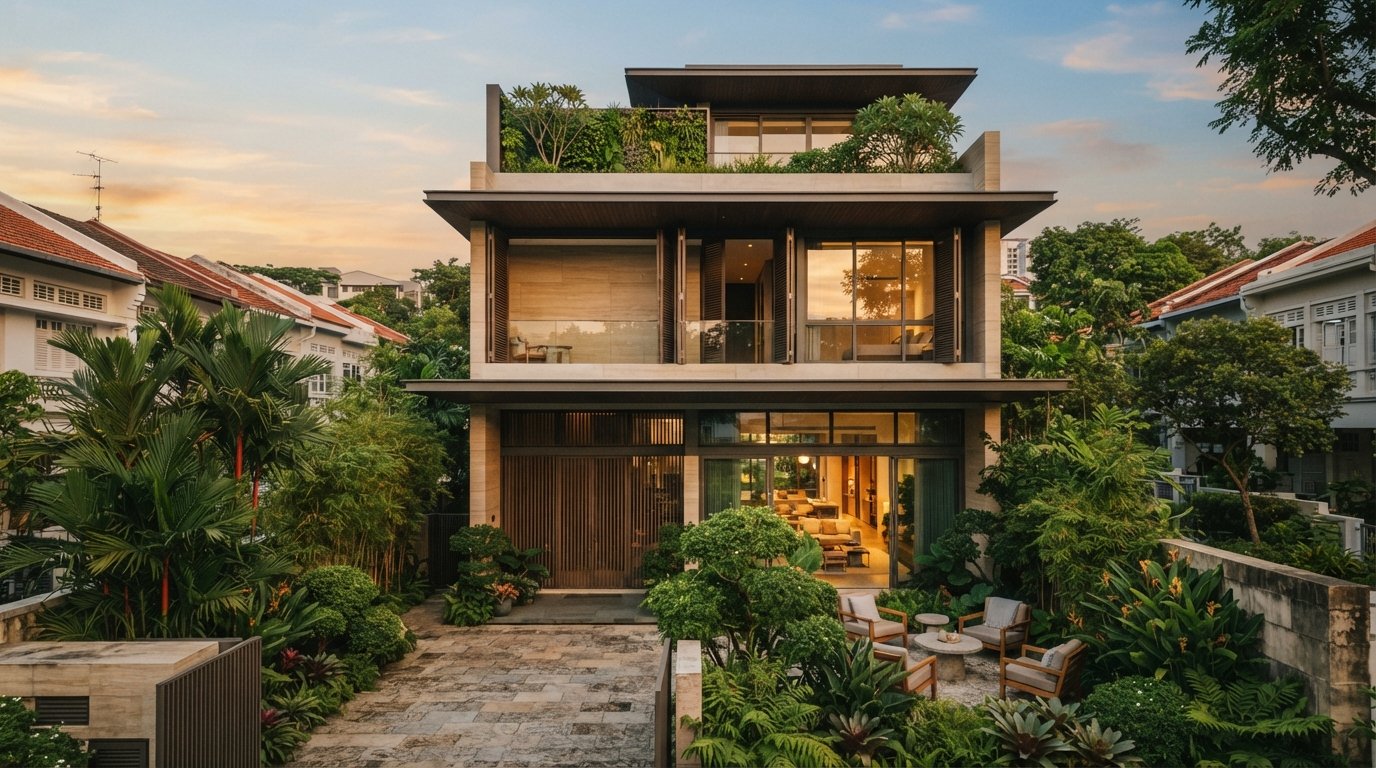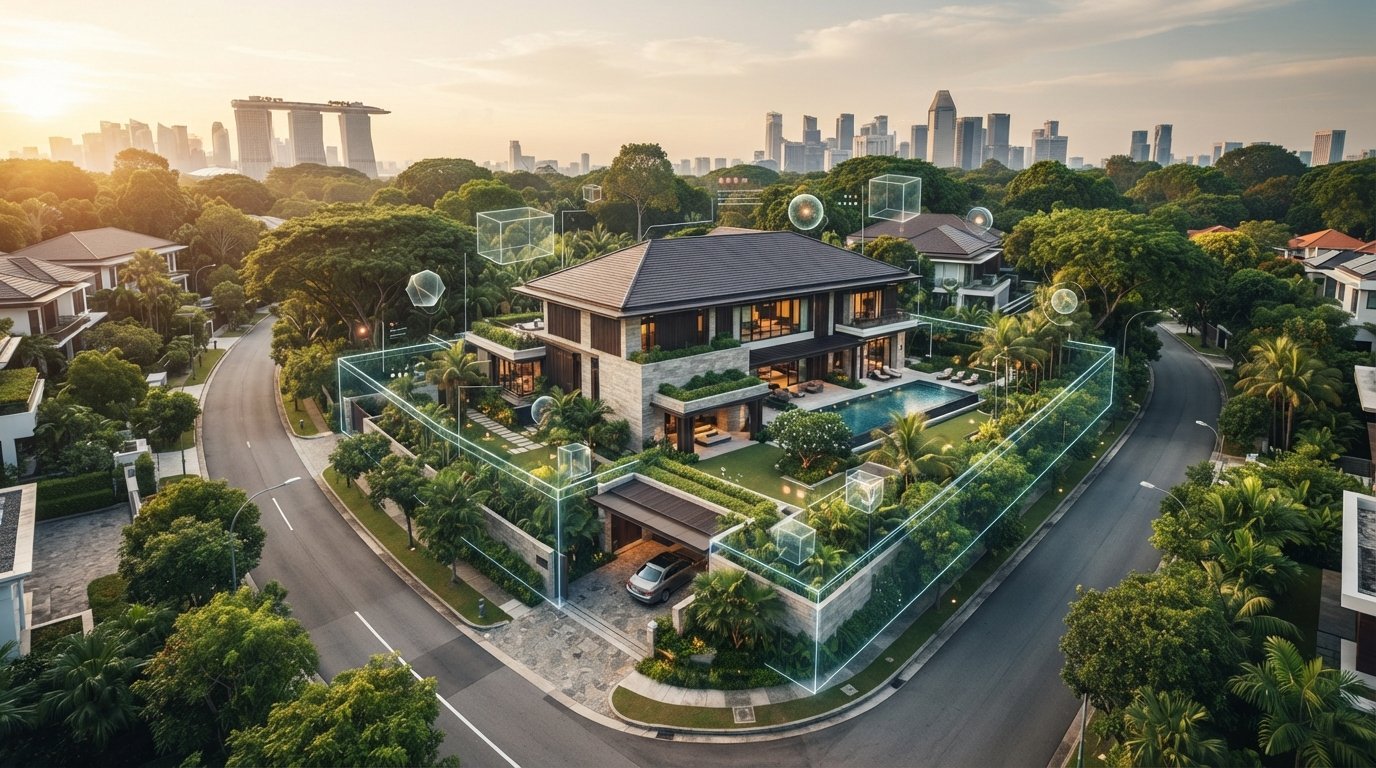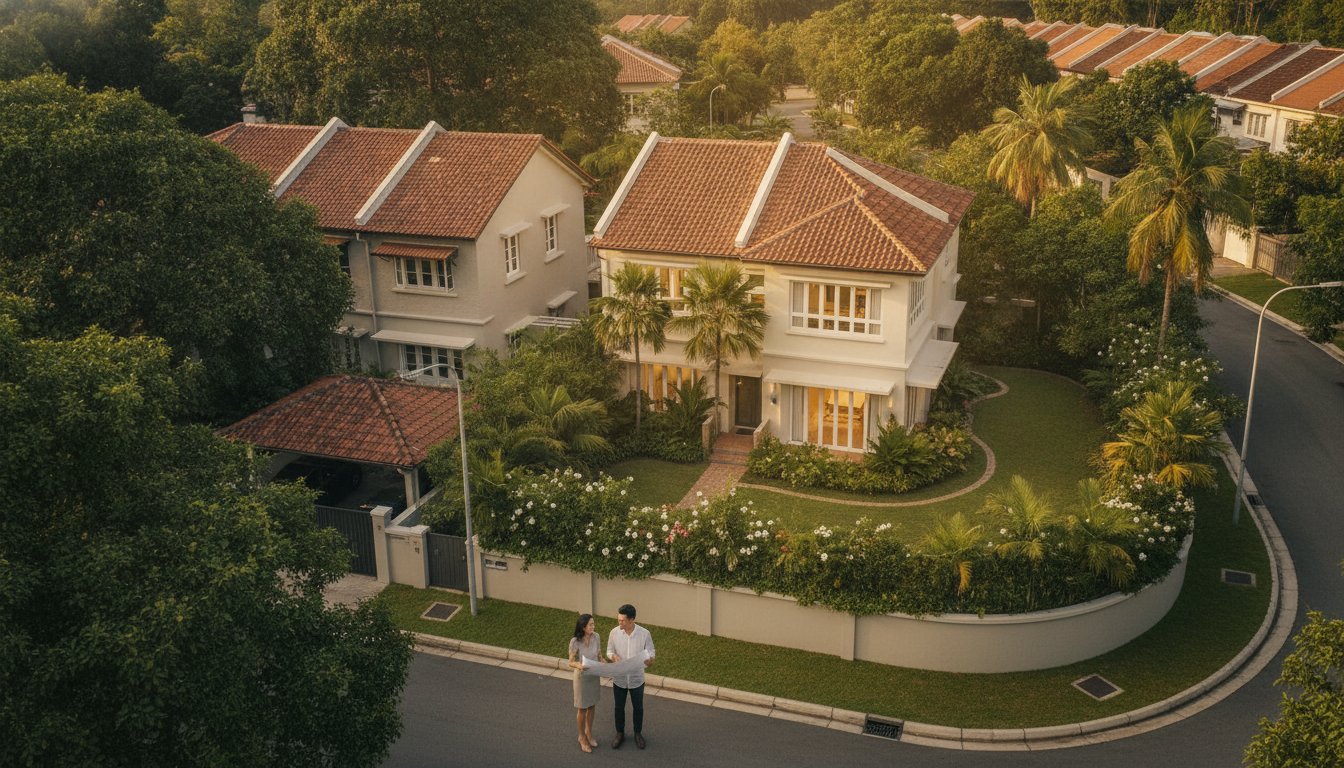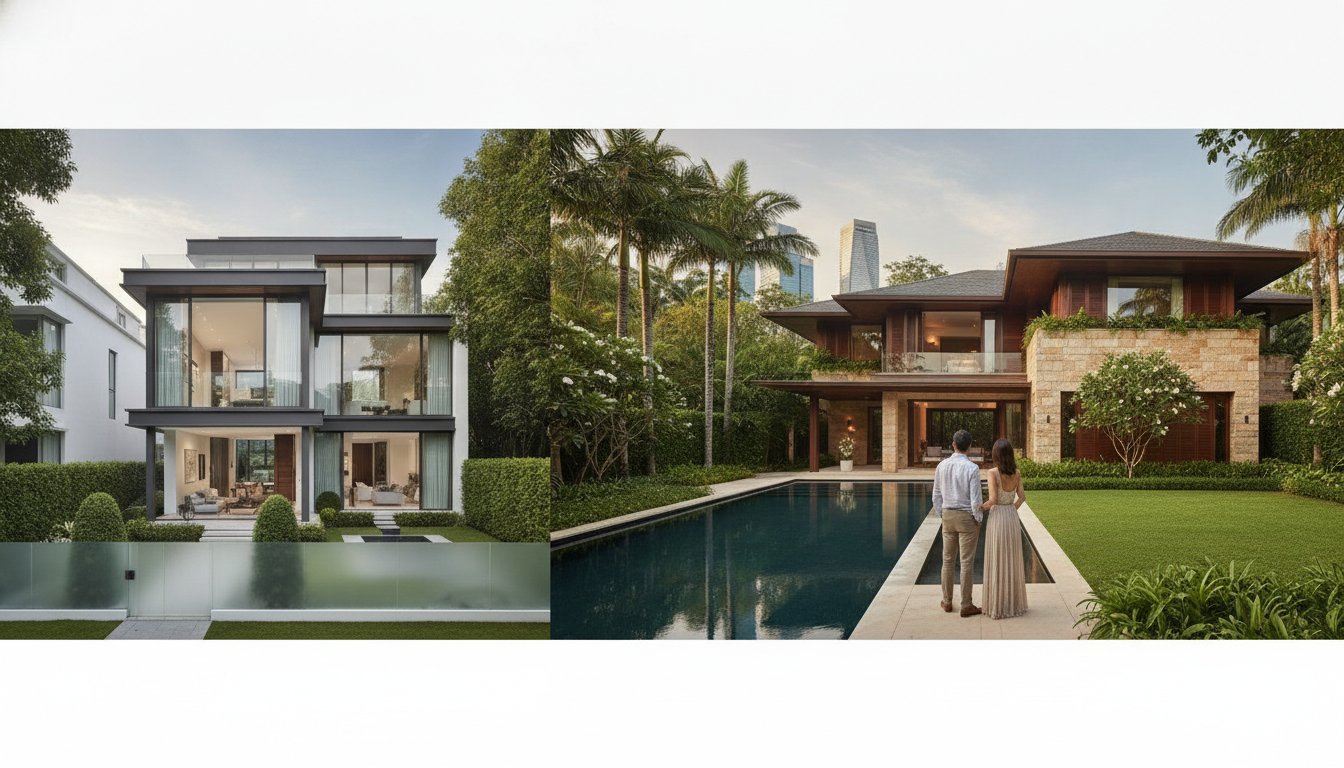
A 1,400 square meter plot of land in Singapore might appear to be a Good Class Bungalow, but without the specific gazetted status from the Urban Redevelopment Authority, it remains a standard detached house with a fundamentally different valuation trajectory. You likely understand that prestige and privacy are the pillars of elite real estate, yet the technical nuances of the detached house vs good class bungalow comparison often create confusion for families looking to anchor their wealth. Misinterpreting these boundaries can lead to acquiring a property with restricted redevelopment potential or missing out on the unique regulatory moat that protects GCB values.
This strategic guide clarifies the regulatory and financial distinctions to ensure your next acquisition secures a true multi-generational legacy. We’ll examine the 39 designated GCB areas, the 40% site coverage limits, and the specific ownership eligibility requirements that define these sovereign assets in 2026. By the end of this analysis, you’ll have a professional framework for evaluating these prestigious properties with the confidence of a seasoned market veteran.
Key Takeaways
- Identify the fundamental regulatory distinctions that separate the absolute pinnacle of Singapore’s property hierarchy from standard detached units.
- Navigate the critical URA planning constraints, including the 1,400 square meter minimum plot size and site coverage limits that protect GCB exclusivity.
- Evaluate the 2026 financial dynamics of a detached house vs good class bungalow to determine which asset better preserves capital for your family legacy.
- Understand the impact of extreme scarcity, with only approximately 2,800 GCBs existing, on long-term valuation and asset resilience.
- Discover the strategic advantage of partnering with an elite specialist to access off-market opportunities that never reach public listings.
Defining the Tiers: Standard Detached Houses vs. Good Class Bungalows
In Singapore’s land-scarce environment, the term “bungalow” is the official technical designation for a detached house. By definition, a detached house is a standalone residential unit that shares no common walls with neighboring properties, offering the highest level of privacy in the landed hierarchy. However, not all bungalows are created equal. While every GCB is technically a detached house, only a small fraction of detached houses can ever claim the GCB title. This distinction is the foundation of the detached house vs good class bungalow comparison that shapes the ultra-high-net-worth market.
We view the market through three “Elite Tiers” to help clients categorize their acquisitions. The Standard Bungalow serves as the entry point to detached living. The Luxury Detached category often features modern architectural marvels on larger-than-average plots. Finally, the Good Class Bungalows sit at the absolute pinnacle. These aren’t just homes; they’re “sovereign” assets protected by a regulatory framework that ensures they remain the most prestigious addresses in the country.
The Quantitative Threshold: Plot Size and Frontage
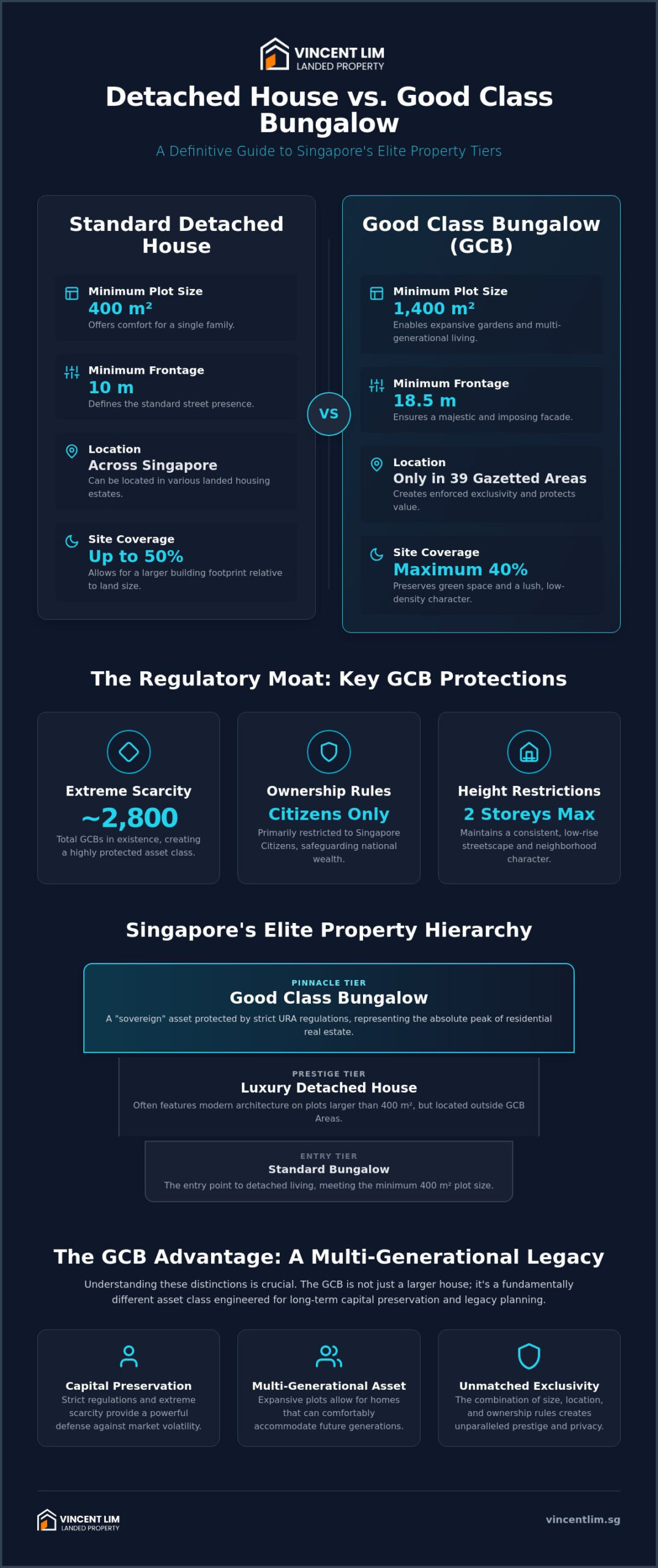
The URA maintains strict physical parameters that separate these asset classes. A standard detached house requires a minimum land area of 400 square meters. In contrast, a GCB must sit on a massive plot of at least 1,400 square meters, which is approximately 15,070 square feet. This jump in scale is significant for legacy planning. While a 400 square meter plot offers comfort, a 1,400 square meter plot allows for expansive gardens, private pools, and multi-generational wings that don’t compromise individual privacy.
Frontage requirements also dictate the “street presence” of the property. Standard bungalows require a 10-meter width at the building line. GCBs must possess a minimum frontage of 18.5 meters. This ensures that every GCB maintains an imposing, majestic facade. It prevents the “squeezed” look often seen in high-density areas and guarantees that the neighborhood maintains its lush, low-density character.
Locational Exclusivity: The 39 GCB Areas
Physical size is only half of the equation. To qualify as a GCB, the property must be situated within one of the 39 gazetted Good Class Bungalow Areas. This is a critical point for investors to understand. If you purchase a 2,000 square meter house in a neighborhood not designated as a GCBA, it remains “just” a detached house in the eyes of the URA. It won’t benefit from the same level of capital preservation or prestige associated with the GCB brand.
This locational boundary creates a form of “enforced exclusivity.” Because the URA rarely expands these zones, the supply is effectively capped at approximately 2,800 units. This scarcity protects the asset’s value against market volatility. It makes the detached house vs good class bungalow debate a question of both scale and geography. By restricting where these homes can exist, the government has created a protected asset class that serves as a reliable store of wealth for generations.
The Regulatory Moat: URA Constraints and Architectural Exclusivity
The URA serves as the ultimate guardian of Singapore’s landed estates. Its planning constraints act as a “regulatory moat,” ensuring that the most prestigious neighborhoods never lose their lush, low-density character. When evaluating a detached house vs good class bungalow, the differences in building constraints are as critical as the price tag. These rules don’t just limit what you can build; they protect the long-term value of the asset by preventing the overcrowding that often plagues other residential zones.
Height restrictions are a primary tool for maintaining this aesthetic. Most GCB areas are restricted to a maximum of two storeys, though an attic and basement are frequently permitted. This ensures that no single property dominates the skyline or overshadows its neighbors. It creates a uniform, dignified streetscape that is unique to these 39 designated areas. This consistency is a major factor in why GCBs are viewed as a “flight to safety” for wealthy investors.
Site Coverage and the ‘Garden City’ Aesthetic
The concept of site coverage is where the distinction between these tiers becomes most visible. For a standard detached house, the URA typically allows for a site coverage of up to 50%. This means half the land can be covered by the building footprint. In contrast, a GCB is restricted to a maximum site coverage of 40%. This mandatory 60% of open space ensures that every GCB remains a “bungalow in a garden.”
This rule effectively prevents “mansionization,” where a massive structure consumes the entire plot. By enforcing a higher ratio of greenery and open space, the URA guarantees that GCB estates retain their tranquil, park-like atmosphere. For buyers analyzing recent GCB market trends, this environmental preservation is a key driver of asset resilience. It ensures that the neighborhood’s character remains unchanged even as individual properties are redeveloped.
Setback Rules and Acoustic Privacy
Setback requirements are the invisible lines that define your privacy. While standard detached houses have specific setbacks from the road and side boundaries, GCBs are subject to even more stringent rules. These buffers create a natural acoustic shield. You aren’t just buying land; you’re buying a quiet zone that separates your living spaces from the sounds of the neighborhood. This level of seclusion is difficult to replicate in standard detached house vs good class bungalow comparisons where plot sizes are smaller.
Stringent setbacks also provide immense architectural freedom. With significant space on all four sides, architects can design for maximum natural light and cross-ventilation. This four-sided exposure is a luxury rarely found in standard landed properties. If you’re looking to refine your search for a property that offers this level of seclusion, it’s wise to consult a specialist in GCB sales who understands these technical nuances.
Financial Dynamics: Valuation, Scarcity, and Liquidity in 2026
The financial landscape of Singapore’s elite residential market is defined by a sharp divergence in valuation and liquidity. When analyzing the detached house vs good class bungalow market in 2026, the primary differentiator is the “scarcity premium” applied to GCBs. With only approximately 2,800 units in existence, GCBs represent a finite asset class that operates independently of broader residential trends. While standard detached houses provide excellent utility and status, GCBs function as a sovereign store of wealth, often holding their value even during periods of global economic volatility.
Liquidity profiles differ significantly between these tiers. Standard detached houses often have a faster transaction cycle because their lower price quantum appeals to a broader pool of high-net-worth buyers. In contrast, GCB transactions are methodical and deliberate. These sales often occur off-market through private networks, reflecting a “flight to safety” where owners are rarely under pressure to liquidate. This resilience makes the GCB a cornerstone for capital preservation in any sophisticated portfolio.
The Wealth Gap: Price Per Square Foot vs. Total Quantum
PSF trends highlight the growing gap between these asset classes. In the first half of 2026, average GCB land rates reached approximately S$2,121 per square foot, hovering near all-time highs. This remains true even though the first quarter of 2026 saw a temporary dip to S$1,803 per square foot. This volatility at the entry level doesn’t diminish the prestige of the asset class. Finding a detached house for sale singapore remains a more accessible goal for many, as the total quantum is significantly lower than the S$30 million to S$100 million plus range typical of GCBs.
To put this in perspective, monitoring the average price of semi-detached house in singapore serves as a baseline for the luxury ladder. However, once a property crosses the threshold into the GCB category, the valuation model shifts. It moves from being a calculation of built-up area to a valuation of land scarcity and gazetted exclusivity. This is why the detached house vs good class bungalow comparison is less about square footage and more about the “regulatory moat” discussed previously.
Investment Yield vs. Legacy Value
Ultra-high-net-worth individuals typically prioritize legacy value over immediate rental yield. While a standard detached house might offer a more predictable rental return, GCB owners focus on long-term capital appreciation. The strict citizenship requirement for GCB ownership ensures a stable buyer pool and prevents the market from being swayed by speculative foreign capital. This regulatory protection anchors the market, making it one of the most stable real estate segments globally.
Ownership of these assets is a marker of success that transcends simple investment metrics. The 6% top marginal rate for Buyer’s Stamp Duty on properties valued above S$3 million is a standard consideration, but for the GCB buyer, these costs are secondary to the goal of securing a multi-generational anchor. You’re investing in a piece of Singapore’s limited history that cannot be replicated, ensuring that your family’s wealth is tied to the most resilient land in the country.
Legacy and Lifestyle: Designing for Multi-Generational Wealth
Choosing between a detached house vs good class bungalow is often a decision about how your family will inhabit space for the next fifty years. While a standard detached house provides a private sanctuary, the sheer scale of a GCB enables a level of multi-generational living that is impossible to replicate on smaller plots. A GCB allows for the creation of distinct wings or separate pavilions, ensuring that grandparents, parents, and children enjoy total autonomy within a single estate. This architectural separation is the key to maintaining family harmony while preserving a shared legacy on a single piece of freehold land.
The transition through the landed hierarchy is a strategic journey for many Singaporean families. Moving from a terrace house for sale singapore to a detached property represents a significant milestone in wealth accumulation. It marks the shift from high-density living to a lifestyle defined by land ownership and personal expression. For those at the peak of their careers, the detached house serves as the final proving ground before entering the elite circle of GCB ownership.
Architectural Grandeur and Bespoke Features
GCB plots offer a canvas for “unlimited” luxury that standard detached houses cannot match. The massive land size allows for bespoke features such as private art galleries, 25-meter Olympic-length pools, and underground entertainment bunkers or car collectors’ vaults. In these ultra-high-end developments, the involvement of world-renowned architects often adds a significant “design premium” to the property’s valuation. These homes aren’t just residences; they’re functional pieces of art that reflect the owner’s status and taste.
For those acquiring older detached homes, Additions and Alterations (A&A) provide a path to unlocking immediate value. A&A refers to specific modification works that enhance an existing structure without requiring a full rebuild, allowing owners to modernize their assets while maintaining the property’s original charm. This strategy is particularly effective for older bungalows with “good bones” that can be transformed into smart, sustainable mansions with the right technical guidance.
Asset Progression: The Road to GCB Ownership
A detached house is a critical step in asset progression to landed property singapore. It allows families to build significant equity in a stable asset class while waiting for the right GCB opportunity to emerge. Savvy investors often look for “GCB-lite” plots; these are detached houses with land sizes exceeding 1,000 square meters that sit just outside the 39 gazetted areas. These properties offer much of the lifestyle benefit of a GCB without the same entry-level price quantum.
The social transition into the GCB community is as much about networking as it is about real estate. Owning a trophy home in a prestigious GCBA places you among the nation’s most influential figures, creating a unique social environment for your family to grow. To begin curating your family’s real estate legacy, contact Vincent Lim for a private consultation on the current off-market opportunities in the detached and GCB segments.
Strategic Acquisition: Navigating the High-End Market with Vincent Lim
Securing a legacy property in Singapore’s most exclusive enclaves requires more than just capital; it demands a deep understanding of the detached house vs good class bungalow regulatory environment. Navigating these transactions involves coordinating with multiple authorities and interpreting complex URA guidelines that can significantly impact the future value of your land. Partnering with an elite strategist ensures that you don’t just buy a house, but acquire a strategic asset that is technically sound and legally future-proofed for the 2026 market and beyond.
The acquisition process for high-value landed property is methodical and requires a high degree of discipline. Whether you’re evaluating a standard detached plot for its redevelopment potential or seeking the absolute pinnacle of luxury in a GCB area, every detail must be refined. This steady, intentional approach identifies risks early, such as hidden easements or restrictive covenants, allowing you to proceed with the calm confidence that comes from professional expertise.
The Off-Market Advantage
The most prestigious GCBs rarely appear on public property portals. High-profile sellers value their privacy and prefer discrete, off-market transactions that protect their anonymity and maintain the estate’s exclusivity. Vincent’s 20-year tenure as Executive Associate Director at OrangeTee & Tie provides clients with access to a refined network of off-market listings that are never seen by the general public. This professional coordination allows for nuanced negotiations where the buyer’s identity is protected, maintaining significant leverage throughout the acquisition journey.
Meticulous Due Diligence for High-Stakes Purchases
A white-glove acquisition process includes exhaustive technical due diligence to protect your investment. We coordinate essential checks, including:
- Soil Testing: Determining foundation requirements for potential redevelopment.
- Drainage Reserves: Verifying if government setbacks will impact your building envelope.
- Encroachment Checks: Ensuring boundary lines are clear and uncontested.
- Title Verification: Confirming the property is Freehold or 999-year leasehold to ensure it serves as a permanent legacy.
Understanding what is a good class bungalow in a technical and legal sense is the only way to guarantee the long-term resilience of your wealth. If you’re ready to refine your portfolio with a prestigious landed asset, consult with Vincent Lim to develop a bespoke acquisition strategy tailored to your family’s multi-generational goals.
Securing Your Multi-Generational Legacy in Singapore’s Elite Market
Navigating the technicalities of a detached house vs good class bungalow requires more than just a financial commitment; it requires a strategic vision for wealth preservation. We’ve explored how URA regulations and gazetted exclusivity create a sovereign asset class that remains resilient against global volatility. By prioritizing land scarcity and architectural integrity, you’re not just buying a residence. You’re anchoring your family’s future in Singapore’s most limited and protected resource.
Success in this high-stakes segment depends on meticulous due diligence and early access to off-market opportunities. As an Executive Associate Director at OrangeTee & Tie and a specialist in Good Class Bungalow (GCB) sales with over 20 years of results-oriented brokerage, I provide the white-glove service necessary to refine your acquisition strategy. My focus is on delivering a seamless experience that values integrity and transparency above all else.
Consult the Elite Strategist for your GCB or detached house acquisition to begin your journey with a trusted guide who understands the nuances of the luxury landed market. Your vision for a lasting legacy deserves the precision and discipline of a seasoned professional.
Frequently Asked Questions
What is the primary difference between a detached house and a GCB?
The primary difference lies in the mandated land size and gazetted location. A Good Class Bungalow requires a minimum land area of 1,400 square meters and must be located within one of the 39 designated GCB areas. A standard detached house only requires 400 square meters and can be located anywhere in Singapore zoned for landed residential use. This distinction creates a significant gap in prestige and valuation between a detached house vs good class bungalow.
Can a foreigner buy a detached house or a GCB in Singapore?
Foreigners are generally restricted from purchasing any landed property in Singapore, including detached houses and GCBs. Under the Residential Property Act, non-citizens must seek approval from the Land Dealings Approval Unit (LDAU). For Good Class Bungalows, the criteria are exceptionally stringent; ownership is almost exclusively reserved for Singapore Citizens to preserve the nation’s most elite land assets for its people.
Why are there only 39 Good Class Bungalow Areas?
The 39 Good Class Bungalow Areas were gazetted by the Urban Redevelopment Authority (URA) to preserve the low-density and lush character of these historic estates. These specific boundaries create a regulatory moat that prevents urban sprawl and ensures these neighborhoods remain the most exclusive in the country. By capping the number of areas, the government maintains the scarcity and long-term capital preservation of this sovereign asset class.
What is the minimum land size required for a GCB?
A Good Class Bungalow must have a minimum plot size of 1,400 square meters, which is approximately 15,070 square feet. This requirement ensures that the building footprint remains small relative to the land, allowing for expansive greenery and high levels of privacy. If a property is smaller than this threshold, it’s classified as a standard detached house, even if it sits within a gazetted GCB Area.
Can I sub-divide a GCB plot into two smaller detached houses?
Sub-division of a GCB plot is only permitted if each resulting plot maintains the minimum land area of 1,400 square meters. Because most GCB plots are between 1,400 and 2,000 square meters, sub-division is rarely feasible. This regulation prevents the densification of these elite estates and ensures that the detached house vs good class bungalow hierarchy remains intact by protecting the large-scale nature of the land.
Are all GCBs freehold properties?
While the vast majority of GCBs are freehold or 999-year leasehold properties, a small number exist on 99-year leases. Freehold status is highly coveted as it ensures the property serves as a permanent multi-generational legacy. Buyers should conduct thorough title searches to verify the tenure, as leasehold GCBs face different financing constraints and valuation trajectories compared to their freehold counterparts in the same area.
What does ‘site coverage’ mean for a bungalow owner?
Site coverage refers to the percentage of the land area that the building footprint occupies. For a Good Class Bungalow, the URA mandates a maximum site coverage of 40%, ensuring that 60% of the plot remains dedicated to open space and greenery. This is lower than the 50% site coverage typically allowed for standard detached houses, which helps maintain the “bungalow in a garden” aesthetic that defines Singapore’s most prestigious estates.
Is it a good investment to buy a detached house that is just under GCB size?
Buying a detached house that is just under the 1,400 square meter GCB threshold can be a savvy strategic move. These “GCB-lite” properties often offer similar lifestyle benefits and privacy but at a lower price quantum. While they don’t carry the official GCB title, their scarcity and size make them highly resilient assets that serve as an excellent stepping stone in a sophisticated asset progression plan.