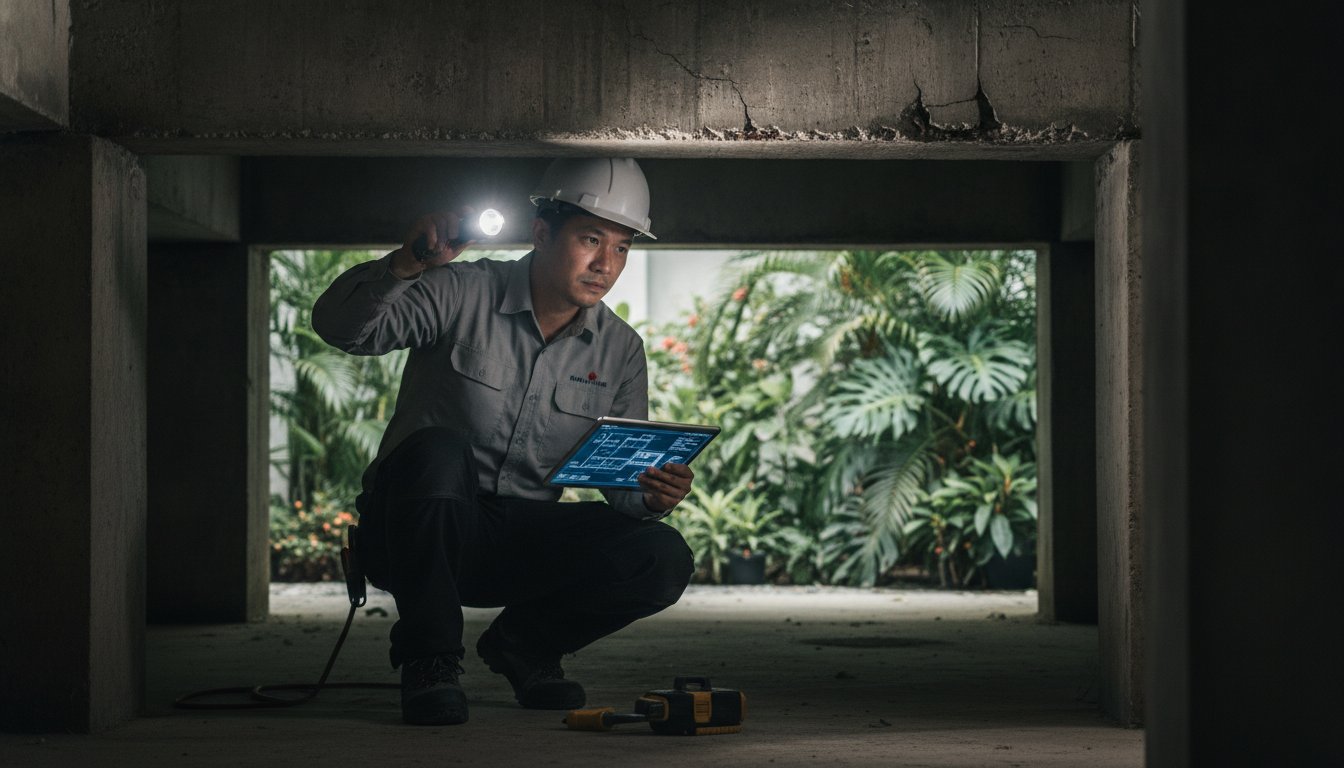
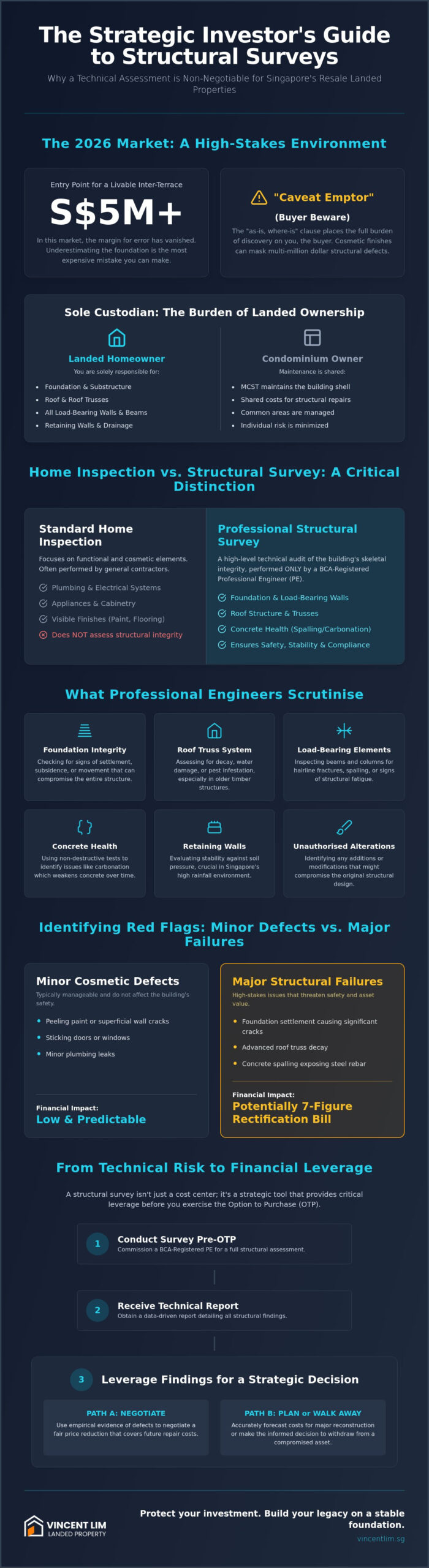
In the 2026 Singapore property market, the most expensive mistake isn’t overpaying for the land; it’s underestimating the foundation. With the entry point for a livable inter-terrace now reaching S$5 million, the margin for error has effectively vanished. Conducting a structural survey for resale landed property is no longer a cautious formality. It’s a strategic necessity for the disciplined investor.
You likely recognize that while a house may look impeccable during a viewing, cosmetic finishes often mask deep-seated issues like subsidence or structural fatigue. Inheriting a multi-million dollar repair bill is a risk no serious buyer should accept. This guide will show you how a professional structural assessment transforms hidden technical risks into powerful financial leverage, ensuring you never overpay for a compromised asset. We’ll examine why 2026’s regulatory shifts make due diligence more critical than ever and how you can use technical findings to secure total peace of mind before you exercise your Option to Purchase.
Key Takeaways
- Learn why the “caveat emptor” principle places the full burden of discovery on the buyer and why landed homes require more scrutiny than high-rise units.
- Understand the technical depth of a structural survey for resale landed property and why only a BCA-registered Professional Engineer can provide the necessary technical assurance.
- Distinguish between minor cosmetic defects and high-stakes structural failures like foundation settlement or roof truss decay before you commit your capital.
- Gain a clear framework for using technical survey findings as a negotiation bridge to adjust your offer price or accurately forecast future reconstruction costs.
- Discover how an elite property specialist streamlines the due diligence process to protect your investment and ensure a seamless acquisition experience.
Why a Structural Survey is Non-Negotiable for Resale Landed Homes
In Singapore’s elite real estate circles, the purchase of a landed home is often the pinnacle of a successful investment journey. However, the prestige of owning a terrace or detached house comes with a technical burden that many buyers overlook until it’s too late. Unlike high-rise condominiums where the Management Corporation (MCST) maintains the building’s shell and common areas, a landed homeowner is the sole custodian of the foundation, the roof, and every load-bearing element. This shift in responsibility makes a structural survey for resale landed property an essential tool for risk mitigation. Without it, you aren’t just buying a home; you’re potentially adopting a seven-figure rectification bill that could have been identified during due diligence.
The “Buyer Beware” Principle in Resale Transactions
The Singapore legal landscape for property transactions operates under the principle of caveat emptor, or “buyer beware.” Standard Option to Purchase (OTP) agreements typically include an “as-is, where-is” clause. This means that once you exercise the option, you’ve legally accepted the property in its current state, including any defects that weren’t immediately visible during a casual walk-through. High-end staging and fresh coats of paint are common tactics that can mask deep-seated issues like concrete carbonation or foundation movement. A comprehensive structural survey provides the technical clarity needed to see past the aesthetics. It’s vital to conduct this assessment before you commit your capital. Discovering a major structural failure after the sale is finalized is a scenario that can derail even the most robust financial plans.
The Specific Risks of Singapore’s Landed Market
Singapore’s unique environment presents specific challenges for older landed assets. Many 30-to-50-year-old properties were built using standards that didn’t always anticipate the intense tropical rainfall and heat cycles we experience today. These conditions accelerate the decay of roof trusses and can cause soil instability around retaining walls. If you are pursuing asset progression to landed property singapore, your primary goal is long-term wealth preservation. A house with compromised structural health isn’t just a repair headache; it’s a liability that can erode your asset’s market value over time. By commissioning a structural survey for resale landed property, you ensure that your legacy wealth is built on a stable foundation. This proactive approach allows you to identify whether a property is a sound investment or a potential “money pit” that requires total reconstruction rather than simple renovations. This technical foresight is what separates the casual buyer from the strategic investor.
Decoding the Structural Survey: What Professional Engineers Actually Scrutinise
A common misconception among buyers is that a standard home inspection and a structural survey are interchangeable. They are not. While a home inspector typically focuses on functional elements like electrical wiring, plumbing, and cabinetry, a structural survey for resale landed property is a high-level technical audit. This assessment is conducted exclusively by a Professional Engineer (PE) registered with the Building and Construction Authority (BCA). The PE isn’t looking at the quality of the marble flooring; they are scrutinising the skeletal integrity of the building to ensure it remains safe, stable, and compliant with national standards.
The distinction is critical because structural failures are rarely visible to the untrained eye. A fresh coat of paint can easily hide hairline fractures in load-bearing beams or signs of concrete spalling. By engaging a PE, you transition from a subjective visual assessment to a data-driven technical report. This process provides the empirical evidence needed to justify a multi-million dollar acquisition or, conversely, to walk away from a compromised asset.
The Role of the BCA-Registered Professional Engineer
A Professional Engineer brings a level of legal accountability and technical depth that a general contractor cannot provide. The scope of their work goes beyond a simple walk-through. A PE utilizes non-destructive testing methods, such as ultrasonic pulse velocity tests or rebound hammer tests, to assess the strength of the concrete without damaging the property. Their objective is to evaluate the main frame, the foundation’s stability, and the load-bearing capacity of the floors.
Crucially, a PE also acts as a technical detective. They identify “unauthorised additions” or alterations that may have been performed without the necessary BCA or URA approvals. In the context of Singapore’s strict building codes, inheriting an illegal structure can lead to mandatory demolition orders and heavy fines. If you are uncertain about the compliance of a specific property, consulting with seasoned landed property consultants can help you coordinate these essential technical evaluations before you commit to the purchase.
Reviewing Approved Architectural and Structural Drawings
A vital component of the survey involves reviewing the “as-built” drawings. These are the original structural plans filed with the BCA. The PE compares these blueprints against the actual physical state of the house. This comparison often reveals hidden risks, such as illegal mezzanine floors or extensions that exceed the permitted Gross Floor Area (GFA).
Understanding the original structural capacity is also a prerequisite for any future renovation plans. If you are already considering terrace house extension ideas, the PE report will tell you whether the existing foundation can support an additional floor or a roof terrace. Without these drawings, you are essentially guessing the building’s limits, which can lead to catastrophic structural failures or budget overruns during the construction phase. A strategic buyer ensures that the technical reality of the property aligns perfectly with their long-term vision.
Identifying Red Flags: Minor Defects vs. Major Structural Failures
Distinguishing between a superficial hairline crack and a systemic failure is the primary objective of a professional technical audit. For the untrained eye, it’s often difficult to separate cosmetic aging from high-stakes structural instability. A structural survey for resale landed property provides a clear framework for categorising these findings. We typically group defects into three tiers: cosmetic issues that impact aesthetics, functional defects that affect daily use, and structural failures that compromise the building’s safety and longevity. While cosmetic repairs are a standard part of any renovation budget, structural failures represent a significant financial risk that can escalate into seven-figure rectification costs.
The “Big Three” failures in the Singapore market are foundation settlement, roof truss decay, and retaining wall instability. These aren’t merely maintenance tasks; they are fundamental breaches of the building’s integrity. In our tropical climate, water ingress acts as the silent killer. When moisture penetrates the concrete shell, it leads to carbonation and the corrosion of steel reinforcement bars. This process, known as concrete spalling, can weaken load-bearing beams over time. If left unchecked, what looks like a simple damp patch can indicate a profound failure in the property’s protective envelope.
Foundation and Settlement Issues
Not every crack in a wall indicates a disaster. Hairline settlement cracks are common in older terrace and semi-detached houses as the ground naturally shifts over decades. However, a Professional Engineer looks for active structural cracks, which are typically wider than 3mm and often run diagonally or horizontally. These patterns suggest uneven settling, where one part of the house is sinking faster than the rest. This risk is particularly acute for Good Class Bungalows situated on sloped terrain or undulating land. For these prestigious assets, a topographical survey, which can cost anywhere from S$2,000 to S$12,000 depending on complexity, may be necessary to assess soil movement and earth stability before you commit to the acquisition.
Roof, Ceiling, and Retaining Wall Integrity
The roof truss remains one of the most vulnerable components in older landed homes. In properties built 40 years ago, timber trusses were the standard. Over time, these are susceptible to termite infestations and dry rot, which can lead to a sudden collapse. A structural survey for resale landed property involves a physical inspection of the attic space to ensure the primary supports remain sound. Similarly, for houses with varying ground levels, the retaining walls must be scrutinized for signs of tilting or “weeping” joints. A failing retaining wall is a massive liability; it’s responsible for holding back tonnes of earth. If the wall shows signs of hydrostatic pressure or lack of proper drainage, the cost of reinforcement can be staggering. Identifying these red flags early allows you to quantify the risk before it becomes your financial burden.
The Financial Impact: Using Survey Findings for Negotiation and Planning
A professional engineer’s report is more than a technical summary; it’s a strategic asset that quantifies the gap between a property’s asking price and its true market value. In a market where entry-level terrace houses now command S$5 million, the financial implications of a structural survey for resale landed property are immense. By translating technical defects into a detailed rectification cost estimate, you move from speculative bidding to data-driven negotiation. This process ensures you don’t overcapitalize on a property that requires significant structural reinforcement before it becomes livable.
The “Negotiation Bridge” is the most critical phase of the acquisition. It involves presenting the PE’s findings to the seller as objective, third-party evidence of the property’s condition. While many sellers rely on the “as-is, where-is” clause to deflect responsibility, a documented structural failure provides a legitimate basis for a price adjustment. If you’re preparing for a high-stakes purchase, you can consult with an elite real estate strategist to help interpret these technical findings and lead the negotiation process on your behalf.
Re-negotiating the Purchase Price
Timing is everything when using survey results to adjust an offer. You must present the findings before the Option to Purchase (OTP) expires to maintain your leverage. When a seller is confronted with evidence of foundation settlement or concrete spalling, they’re often more amenable to a price reduction than risking a collapsed deal and the stigma of a “failed” sale. We’ve seen cases where a S$5,000 investment in a structural survey identified issues that led to a S$200,000 reduction in the final purchase price. This isn’t just about saving money; it’s about ensuring the price reflects the actual risk you’re assuming.
Estimating Future Rectification and Renovation Costs
Strategic buyers don’t just look at the purchase price; they look at the total capital outlay. When you calculate your total capital requirements, including the landed property downpayment singapore needs, you must account for immediate structural rectifications. Integrating these findings into your terrace house renovation budget ensures that your financial planning remains grounded in technical reality.
Allocating a contingency fund of at least 15% to 20% for unforeseen structural reinforcements is a hallmark of a disciplined investor. Some “cheap” resale houses end up being the most expensive assets in a portfolio because the buyer failed to account for the cost of bringing the structure up to modern BCA standards. Identifying “deal-breakers”—such as major foundation failures that require deep piling or illegal GFA that cannot be regularized—is essential. In these instances, the most strategic move isn’t a lower price; it’s walking away to protect your capital for a sounder investment.
Navigating High-Stakes Acquisitions with a Landed Property Specialist
In the upper echelons of the Singapore property market, an acquisition is rarely a simple exchange of capital for titles. It’s a sophisticated operation that requires the coordination of technical experts, legal counsel, and financial planners. While the previous sections established the technical necessity of a structural survey for resale landed property, the execution of this due diligence is where many buyers falter. Without a central strategist to oversee the process, critical details can be missed, and timelines can slip. An elite specialist doesn’t just find you a home; they manage the entire risk mitigation framework to ensure your investment remains secure.
The strategist acts as the orchestrator of your professional team. They translate the technical jargon of a Professional Engineer’s report into actionable market insights. This high-level oversight is essential because a structural defect isn’t just a repair bill; it’s a factor that influences the long-term appreciation potential of the asset. By viewing the technical findings through a market-value lens, your specialist ensures that you are not only buying a safe structure but also a sound financial instrument.
Coordinating the Professional Team
The window between receiving an Option to Purchase and its expiry is often narrow. Within these few weeks, a buyer must align a Professional Engineer, a property valuer, and a conveyancing lawyer. A “white-glove” service level means your property specialist takes ownership of this coordination. They ensure the PE’s scope of work is tailored to the specific nuances of the asset, whether it’s a terrace house or a sprawling Good Class Bungalow. For high-value estates, this might include specialized topographical surveys or soil density tests that go beyond a standard visual inspection. By managing these moving parts, the strategist protects your interests while maintaining the momentum of the transaction.
The Strategic Advantage of Veteran Insights
Experience is the most reliable filter for identifying potential liabilities. A veteran professional with over 20 years in the industry often spots red flags, such as subtle wall dampness or suspicious floor level changes, during the very first viewing. This early detection allows you to commission a structural survey for resale landed property with specific instructions for the PE, saving time and focusing the investigation on high-risk areas. It’s this level of discipline and foresight that separates a standard transaction from an elite acquisition.
When you are considering a detached house for sale singapore, you are making a legacy-defining decision. Vincent Lim provides the seasoned authority needed to navigate these high-stakes acquisitions, leveraging a trusted network of engineers and contractors who understand the gold standard of Singaporean construction. This proactive partnership transforms a technical audit into a calculated business decision. To ensure your next landed acquisition is both structurally sound and financially strategic, consult with Vincent Lim today. Securing your family’s future starts with building on a foundation of professional excellence and unwavering transparency.
Securing Your Legacy Through Technical Precision
Acquiring a landed home in Singapore is a landmark achievement that requires more than just financial readiness. It demands a disciplined commitment to technical due diligence. By prioritizing a structural survey for resale landed property, you move beyond surface aesthetics to understand the skeletal health of your investment. This proactive approach doesn’t just prevent unforeseen repair costs; it empowers you with the technical leverage needed to negotiate from a position of absolute strength.
Success in the luxury market depends on the caliber of your professional team. As an Executive Associate Director at OrangeTee & Tie with a specialization in GCB and luxury landed sales since 2004, I’ve guided countless clients through complex asset progression journeys. My focus is to ensure every technical finding is interpreted through a strategic lens, protecting both your capital and your peace of mind. With a proven track record in high-value transactions, I provide the authoritative guidance your legacy deserves.
Secure your investment—contact Vincent Lim for expert landed property guidance. Your journey toward a secure and prestigious home deserves the highest standard of professional care and unwavering transparency.
Frequently Asked Questions
Is a structural survey mandatory for buying resale landed property in Singapore?
No, a structural survey isn’t a legal requirement for residential landed properties. Detached, semi-detached, and terraced houses are currently exempt from the Building and Construction Authority’s mandatory Periodic Structural Inspection regime. However, most strategic buyers commission a voluntary survey to mitigate the risks associated with the “as-is, where-is” nature of resale transactions. It’s the most reliable way to ensure you aren’t inheriting a compromised asset.
How much does a professional structural survey by a PE typically cost in 2026?
The investment for a voluntary pre-purchase assessment by a registered Professional Engineer generally ranges from S$1,800 to S$4,500. This fee depends on the property’s size and the complexity of the structure. While it’s an additional upfront cost, it’s a marginal expense compared to the S$5 million entry point for many landed homes. It provides the technical insurance needed for such a high-stakes acquisition.
What is the difference between a building survey and a structural survey?
A building survey is a general condition report that focuses on functional elements like plumbing, electrical systems, and cosmetic finishes. In contrast, a structural survey for resale landed property is a specialized technical audit conducted by a Professional Engineer. It scrutinizes the building’s skeletal integrity, including the foundation, load-bearing walls, and roof trusses, to ensure the property is fundamentally stable and safe.
How long does it take to get a structural survey report for a terrace or GCB?
The entire process typically requires seven to ten working days to complete. This timeline includes the initial site inspection and the subsequent data analysis required to produce a certified PE report. For larger estates or Good Class Bungalows, the duration might extend if non-destructive testing is required. It’s essential to factor this timeline into your due diligence period before the Option to Purchase expires.
Can I use a structural survey report to withdraw from an Option to Purchase?
Under a standard “as-is, where-is” contract, you cannot withdraw from the purchase without forfeiting your option fee unless a specific “subject to survey” clause was inserted. Most sellers are reluctant to include such clauses, which is why we recommend conducting the survey as early as possible. If major issues are found, the report serves as a powerful tool to negotiate a price reduction rather than a simple exit.
What are the most common structural issues found in resale semi-detached houses?
The most frequent red flags include foundation settlement cracks, concrete spalling caused by water ingress, and timber roof truss decay in older properties. In semi-detached houses, we often see issues related to the party wall or uneven settling between the two units. Identifying these structural survey for resale landed property findings early allows you to estimate rectification costs before they become an unmanageable financial burden.
Do I need a structural survey if I plan to rebuild the entire house?
If your intention is a total reconstruction, the integrity of the existing house is less critical. However, you’ll still need a topographical survey and a soil investigation to determine the land’s buildability and foundation requirements for the new structure. You should also evaluate the condition of any shared retaining walls or boundary structures, as these will remain your responsibility even after the main house is demolished.
Can a foreigner buy a resale landed property that requires major structural work?
A property’s structural condition doesn’t change the strict eligibility rules for foreign buyers. Foreigners are generally prohibited from purchasing mainland landed property regardless of its state. Only Singapore Citizens have the unrestricted right to buy these assets. Permanent Residents may apply for approval from the Land Dealings Approval Unit, though this is rarely granted. The only exception for most foreign investors remains the landed homes in Sentosa Cove.